
Home > Articles > The Artists > Missing Home
Missing Home
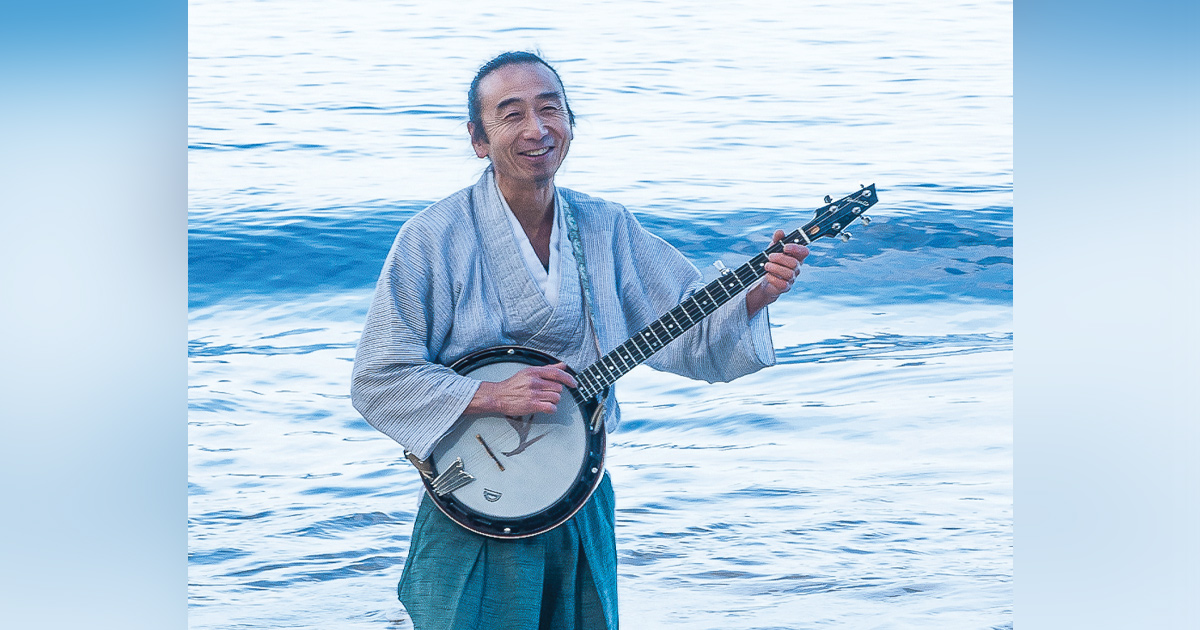
Photo by Melanie Lunden
Montz is a fascinating character. He lives off the grid, four miles up a mostly gravel road on Cradoc Hill, which is approximately 30 miles southwest of Hobart, Tasmania. His one-room house with a loft is solar powered, and he uses a rocket stove for heat when needed. Montz is a wizard at clamoring up and down a ladder to access his loft. And, plenty of hot tea is available for his visitors. As Montz says jokingly, it’s his “little cabin home on the hill.”
Montz was born in 1962 in the Shiga Prefecture in Japan. In the mid-1970s, he had the very good fortune to be living in a part of Japan where country and bluegrass music were readily accessible, whether on the radio or in a music store. Montz remembers a music store in Kyoto selling 20 banjos in a month! A radio show in Kyoto played a variety of music and that is where he first heard the banjo. The band was The Natasha Seven, which was a Japanese folk band playing bluegrass instruments and singing in Japanese.
To use a Ben Hogan expression, Montz dug his banjo skills out-of-the-dirt. He was just the right age to dive deeply into Pete Wernick’s Bluegrass Banjo and Tony Trischka’s Melodic Banjo and a Japanese language version of Tony’s Bill Keith Banjo Bluegrass Masters Series. And, of course, he learned from the famous Earl Scruggs and the 5-String Banjo. He also listened intently and learned from recordings by musicians and bands such as the Country Gentlemen, the Seldom Scene, Lester Flatt, and David Grisman.
As a member of his school’s broadcasting club, one of his assignments was to DJ (play music) while his fellow students cleaned classrooms. Montz was totally into bluegrass, and every school day he fed his classmates a healthy dose of bluegrass music over the school sound system. Within two years, Montz was playing with high school friends in a band called the Kentucky Ramblers. He ascribed to the view: let’s jam; let’s make music; let’s have fun playing music. To this day, he still ascribes to that view.
Montz studied fine art at Kyoto Seika University. Again, he was fortunate as the Earthie Music Shop was nearby. In a pattern that is familiar to many, i.e., the local music store being a center of musical activity, he taught banjo and jammed with friends there. He met Tony Trischka, who came to the store for a workshop. He was also able to continue enhancing his performance skills by playing in the store owner’s band.
Over the next fifteen years, Montz continued to hone his skills. Seminal events included visiting Vancouver, B.C. in 1989 and studying Carnatic music in Chennai. In Vancouver, he crossed paths again with Tony Trischka and spent a memorable time jamming with him. Tony was in town for the Vancouver Folk Festival where he gave a workshop and performed with Pete Seeger and Richie Stearns. Montz stayed in Vancouver for five months, and he particularly remembers enhancing his busking skills, or, more importantly, playing with joy in front of people (plus earning some income).
Later, Montz spent three memorable months in India studying Carnatic music, which is classical Indian music originating from southern India. He says he was able to learn two scales, one of which is familiar to bluegrass pickers as it is the major pentatonic scale. There was lots of oral practice singing the scales. He also studied Carnatic rhythm theory. Montz described and demonstrated how, in Carnatic music, one keeps rhythm patterns with hand gestures. A Youtube search of “Carnatic rhythm theory” brings up a video with a good explanation of one pattern called Adi Tala.
In 1996, Montz released his first album, which is entitled Forgotten Scent. It is an album of songs and tunes written by Montz. In 1997, Montz had a memorable tour of Okinawa Prefecture as a member of Peter Rowan’s band. Montz remembers Peter not wanting his band members to tap their feet, as he wanted the band members to follow his lead and his choices to speed up or slow down as the song warranted to his ear. Peter also said that he does not push his voice anymore. Peter said Carter Stanley never pushed his voice and the coolness of bluegrass singing is the “whispering.”
In 2001, Montz moved with his partner to her home country of Australia. He has remained in Australia ever since. A big part of Montz’s muscial scene in Australia has been as the banjo player for the band called The Pigs. Montz describes The Pigs as a hillbilly pop band. One memorable gig for The Pigs was participating in Australia’s Got Talent. The Pigs made it to the semi-finals, but the band was not destined to go any further. Montz is also playing gigs with the very talented Pete Denahy. Pete plays fiddle and guitar. Their gigs feature some wonderful fiddle/banjo duets. Pete is also a professional comedian, and this brings lots of good humor to their shows.
Songs and tunes on Missing Home that might be familiar to a bluegrass audience include “Midnight Moonlight,” “Elzic’s Farewell,” “Jerusalem Ridge,” “Texas Gales,” and a medley of “Cuckoo’s Nest” and “Big Sciota.” There are two cuts that are Irish tune medleys. And, there are five Montz originals. Accompanying Montz are an eclectic mix of wonderful musicians located in Australia. Paddy Montgomery plays guitar and bouzouki; Ross Sermons (originally from North Carolina) plays bass; Elisse Kleiner plays flute; Luke Plumb is on the mandolin; Ross Smithard is on fiddle; and Cloudy Davey sings harmony. The CD is available through Montz’s web site at montzbanjo.com.au. Missing Home is also available at montzmatsumoto.bandcamp.com/album/missing-home-2.”
