
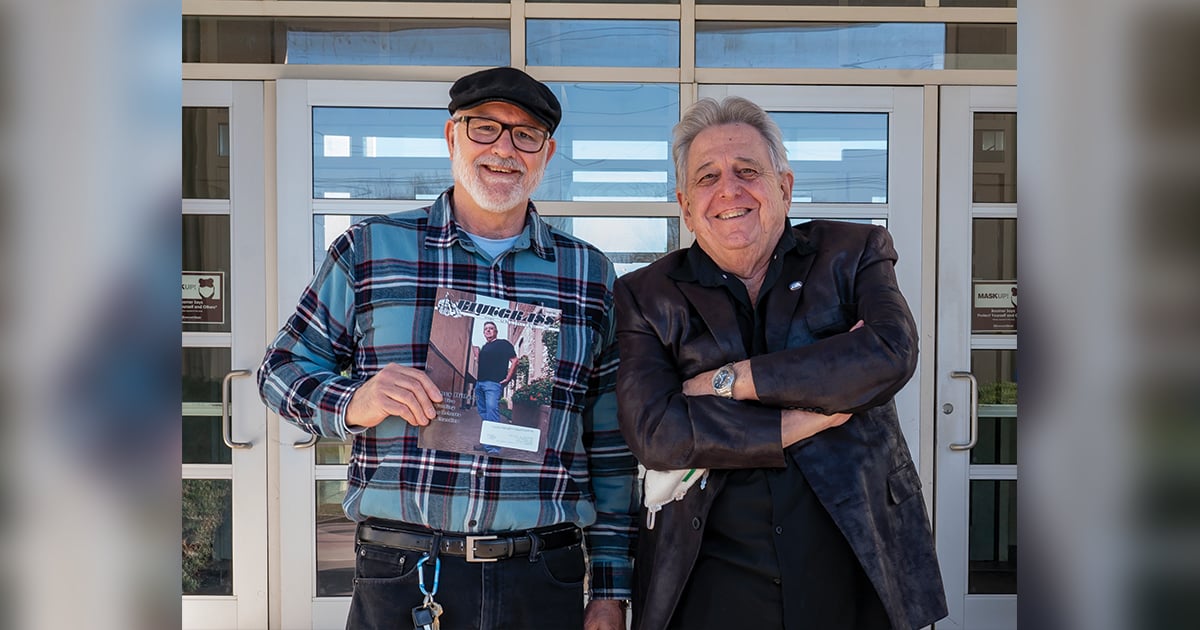
Mike Smith
A Music Seldom Heard
Written By Dale McCurry with Bambi Grinder
“Make it about the music,” Mike Smith implores. “Don’t make it about me. It’s about the music.”
Mike said this in preparation for a story I was to write about him a decade or so ago. I remember he followed me to the parking lot after a tour of the KSMU Studios—the NPR affiliate on the campus of Missouri State University, serving Springfield, Missouri, and much of the greater Ozarks Plateau region. He had been a gracious host. Opening doors to special rooms—studios and the offices of coworkers for whom his palpable respect runs apparent.
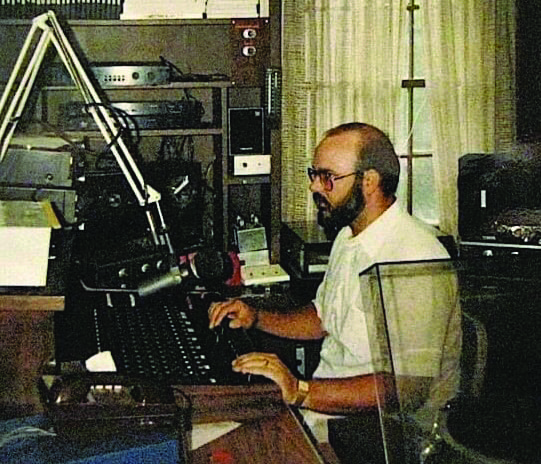
Smith created the Ozarks’ celebrated bluegrass series, Seldom Heard Music, in 1982 and has manned the microphone every Saturday night since. It is, he believes, the longest running bluegrass radio show in Missouri.
And, of course, it is true: It’s not just about Mike.
“To observe Mike at work is to watch a consummate professional in action. He’s already given that week’s show a lot of thought by the time he walks through the doors. He has a pulse on what listeners are going through, and what we need to hear that week——whether it’s songs centered around a particular holiday or theme, or honoring an individual musician. The respect with which Mike approaches the show, and the entire bluegrass genre and culture, is unlike anything I’ve ever seen. There’s a reverence there.”
— Jennifer Moore, KSMU News Director and Content Coordinator
The Beat Goes On
Following Smith’s discharge from the Navy in 1979, the submariner veteran came to Southwest Missouri State University—now Missouri State (MSU)—on the GI bill. He saw an ad for a student announcer at KSMU and landed a job.
“I was that kid sleeping with my radio,” says Mike, who had radio experience and an announcer’s license before enlisting in the Navy. “I was always fascinated by the idea of sending music out on the airwaves. It was a dream job for me.”
Director of Broadcast Services at MSU, Arlen Diamond—over both Ozark Public Television (OPT) and KSMU—spotted something in Smith’s drive and work ethic and quickly promoted him to chief announcer. The job description included supervising other students in the program and a mission to hire and train enough staff to keep KSMU live 24/7. “The station had a 24-hour license at that time,” Mike explains, “but neither the staff nor programming to stay on the air around the clock. We would go off at 10 p.m. It’s hard on those transmitters to turn them off and on.”
In 1982, though Diamond was “a little skeptical at first” that there was a suitable audience for bluegrass on the radio, Smith launched Seldom Heard Music. Today, he is a “reporting DJ”—documenting and sharing his playlists for Seldom Heard with Bluegrass Unlimited for its monthly National Bluegrass Survey of the top 30 tunes from bluegrass DJs around the country.
In January of this year, Mike completed his 2,000th weekly episode. As a wearer of many hats, however, Mike’s history with KSMU has reached well beyond the revered show from which he shares his love of the river of good vibrations ever flowing from the acoustic instruments he has come to love.
“Mike Smith is the voice of bluegrass at KSMU as Bill Monroe was to bluegrass music itself. Professional and informative, Mike takes pride in digging to the depths of seldom heard music to keep it alive for the generations to come.
— Steven Spencer, world traveler and gypsy photographer
Doing it My Way
“I looked at my job as turning those kids into broadcasters in the true sense of being broadcasters,” Mike says of his early days in the station. “Today, we’re not so much broadcasters as we are producers of digital audio. As broadcasters, we were watching the weather and other announcements of interest to the listeners—those things that really connect you to your community and your audience—today, not so much.
“I do try to include elements of that connection into my show, though,” he quickly adds. “I’ll tell them about a bluegrass festival nearby; talk about new releases; celebrate artist birthdays and so forth.
“The way I approach my show is I will play a minimum of two cuts from an album. I like to give folks a flavor … a sense of what this album might be about. Sometimes, when I’m featuring an artist, I might play two cuts from one album and one from another. I just want the listeners to get a real feel for who this artist is beyond one song we’ve all heard. You know … to maybe make the connection between the listener and the artist a little stronger.”
“Mike Smith is extremely well-respected by his KSMU colleagues, not only for his success as the long-time host and creator of Seldom Heard Music, but also as an award-winning journalist and storyteller with the KSMU news team. He brings an invigorating energy to the station and pours passion into every project he touches.”
— Melissa Rea, Ozarks Public Broadcasting Volunteer and Engagement Coordinator
Dapper Mike
“Oh, no; I don’t play,” Mike says of the bluegrass and traditional music he loves so well. “I don’t even play the trombone anymore.” The trombone is the instrument that paid his way through college. He played jazz then; somewhere along the way, he became smitten by flatpickin’ guitar licks.
“It’s funny you should mention that,” he says when asked about the surge in popularity for the music he plays that occurred following the release of the Coen Brothers’ box-office and critical hit, O Brother, Where Art Thou?
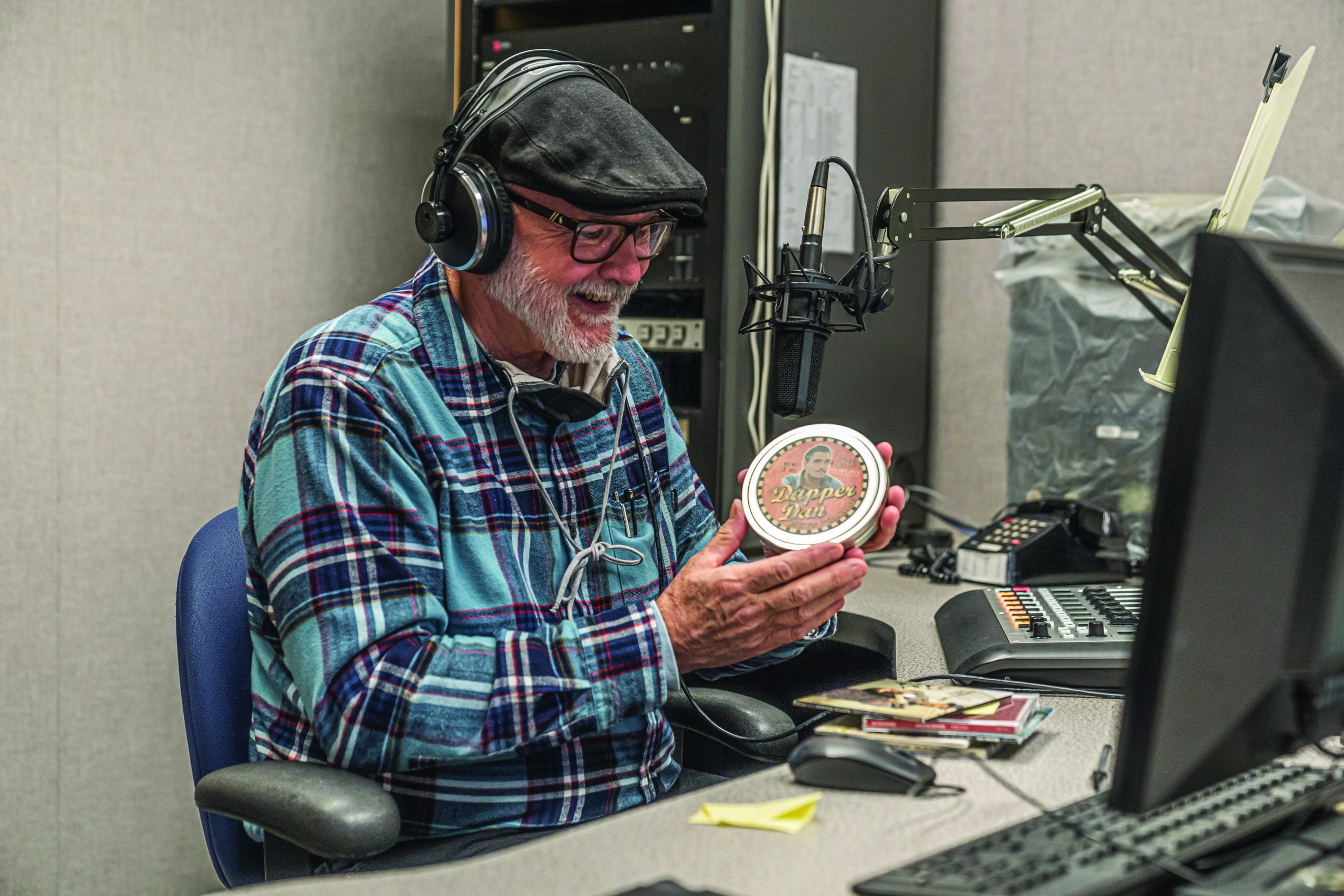
Smith beams as he describes how he came to be the first DJ in America to play the soundtrack on the air. Missy Shelton—who was later to replace Smith as news director when he “retired” from the position in 2006—was traveling Europe when the movie and soundtrack was pre-released in Paris. She adored the movie, bought the CD “with Euros,” and told Smith he was going to love what she had brought home. He did—and shared it with his listeners, months before O Brother’s American release.
Mercury Records sent Mike a special “Dapper Dan”-tin-packaged soundtrack CD aftering learning of his premiere in July, 2000. When the Down From the Mountain concert tour—featuring many of the original musicians recreating the soundtrack of O Brother—came to Kansas City, Smith was invited to sit in Ralph Stanley’s guest seats.
“I’m pretty proud of that,’’ he says modestly.
“Mike Smith equals bluegrass. You know it’s him when you hear his voice on the air. His passion for music and public radio shines through every project he undertakes. Recently, KSMU aired the 2,000th episode of Mike’s show. To celebrate, those of us at the station gathered outside to greet him with cheers and cowbells and make-shift percussion. Even in a pandemic, we wanted to make sure Mike got the recognition and fuss he deserves. I’m in awe of his accomplishments and am proud to call Mike a colleague and a friend.”
— Jessica Balisle, KSMU’s Studio Live co-host
Listen to the Music

Smith speaks of the “perk” of his long run at the station facilitating the opportunity to “interview everyone”—from a “very young” Allison Krauss at Telluride Colorado’s top-shelf bluegrass festival, to Bill Monroe and Rhonda Vincent, Mac Wiseman and Becky Buller, Earl Scruggs and Tim O’Brien and many others. He often will share snippets of those career experiences with such artists while wooing us with their songs.
Mike especially enjoys talking about shows he has emceed. He smiles broadly recalling introducing Hot Rize and the Red Knuckles gang at a concert in Lawrence, Kansas, and interviewing the band over lunch before the show along with Nancy Cardwell Webster who was gathering notes for a Bluegrass Unlimited Hot Rize cover story.
“I was the emcee for a show that had Peter Rowan, Alan Mundy, and Townes Van Zandt,” he says. “That was one of Townes’ last concerts in the United States before he died. My relationship with a microphone has given me that.”
“I’ve been impressed with Mike Smith’s work since I met him in the early 80s. He is, quite simply, the voice of bluegrass in the Ozarks. He is gifted with a natural baritone broadcasting voice that is extremely easy to listen to, and he’s been willing to share his broadcasting skills with students at Missouri State University in Springfield, for a number of years. He keeps listeners up to date with the latest national releases, and he also remembers to spotlight local and regional artists. Mike Smith keeps the bluegrass community in southwest Missouri and northern
Arkansas connected. And we love him for that.”
— Nancy Cardwell Webster, IBMA Foundation Executive Director
Gimme the News
KSMU has won three national and 17 regional Edward R. Murrow Awards, given by the Radio Television Digital News Association. Murrows are awarded to the station and never to individuals. Mike produced or co-produced three of the regional winners and was News Director during the time the station won “probably 15 or so.” The first one was in 1987, when KSMU received both the regional and national Murrows for Investigative News. “My buddy Ron Davis did those, while I was Chief Announcer,” Mike says with a grin.
“I still occasionally produce for the Sense of Community Series, for which I was one of the six producers of the 10 reports on The Intersection of Poverty and Education.” KSMU earned it’s latest regional Murrow for that series in 2020.
Mike received a Missouri Broadcasters Association first-place award in the Documentary Public Affairs category for a first-account mental health series produced for Making a Difference. The series aired from October 2018 until August of 2019.
Fittingly, in 2016, Mike was selected to MSU’s Wall of Fame. “The primary criteria for selection for the honor was the impact made on university students—and the community—but mostly the students’ overall education experience. I am humbled that they recognized me in that regard,” he says.
“Often, Michael Smith was called the voice of KSMU. He was the director of news and production coordinator at the station. Personally tied to many talented musicians, he brought the genre of bluegrass music to listeners. As a mentor to students, he demanded high standards of accuracy and professionalism, which prepared them for the deadline-driven environment of journalism.”
— Missouri State News on the occasion of Mike’s selection to MSU’s Wall of Fame in 2016
What about Harry?
“And make sure you tell them about Harry Moore,” Mike said at the car those many years ago.
For 17 years, Moore, who passed in August 2019, was the co-host of Seldom Heard Music. A long-time fan, Harry approached Mike in 2002. “He had been a listener,” Mike says. “He just had this intense interest and love of the genre and an impressive collection of music—perhaps a couple thousand recordings—and he wanted me to know he was available to share some of what he knew.”
Mike says he asked Moore to sit in one night and then asked him to stay. “I just thought his tastes were different enough than mine—along with a knowledge of the genre that ran so deep—that he would do nothing but add to the experience of our listeners,” he said.
“Harry was with me for 17 years. His last shows in the studio were in December 2018. In July and early August 2019, I took a recorder to his long-term facility bedside, to have him intro and close CD cuts. I did the editing in the studio, and he was on the air again for a few weeks before he died.”
“Mike is truly one in a million. He has not only kept the Ozarks region in tune to what is happening in the bluegrass world of old and new musical offerings over the airwaves, but he has had a tremendous role in shaping so many of our lives as we grew in our own musical journeys. Mike has always made time to see and hear who was in the area. He was always there for us with a smile and encouraging us on.”
-Ray Cardwell, Pinecastle Records bluegrass recording artist
Those Darling Boys
Of all the musicians Smith has met and worked with, he speaks with a special fondness for the Dillards, a bluegrass family band from Salem, Missouri, who are generally regarded as a major influence on the country rock movement of the early 70s and were also known as The Darlings on The Andy Griffith Show.
Mike was born in Grand Junction, Colorado, and lived in such places as Home on the Range, Wyoming, as the family moved around the country for jobs for his father—a mining operator and uranium expert. The family moved to Salem, Missouri when Mike was in junior high where his dad operated the local lead mill. There, he discovered that Salem was home to the Darling boys he had loved on TV and soon met the parents of Doug and Rodney Dillard.
Mike got involved with radio in high school and met Mitch Jayne in 1974 when he was at one of his pre-Navy radio gigs—KSMO in Salem. Mitch, bass player with The Dillards, had left the band and was an author and storyteller and worked at the station. “I met the brothers and Dean Webb in 1979. Became good friends with Mitch, Dean, and Rodney. Doug was an acquaintance,” Mike recalls.
“Last year Pinecastle Records and Rodney Dillard allowed me to premiere the latest Dillards album Old Road New Again featuring guest appearances from Ricky Skaggs, The Whites, and Tim Crouch as well as Don Henley and Bernie Leadon from The Eagles.”
“Mike is a talented man, and I have always considered him a friend——he’s a friend of the family; my dad was always trying to get him hooked up with some girl in Salem. I love the way he puts his show together and the way he presents himself on the air. He treats his listeners like the intelligent audience they are. Education through entertainment is the way I perceive what he does. And he’s done a lot for the music, which is why I wanted him to be the first one to air this new album. I thought he deserved it, and I was proud he did.”
— Rodney Dillard on the occasion of
Mike premiering the latest Dillards album
Old Road New Again.
Entertainment as Education Smith is also excited about his role in KSMU’s Youth in Bluegrass competition held annually during Silver Dollar City’s (SDC) Bluegrass & BBQ festival. “That contest is very important to me personally,” Smith says. “I was hosting a picking party at my home when [SDC Entertainment Director] D. A. Callaway approached me and said, “Hey, I have an idea; why don’t we host a bluegrass contest for kids? And that’s how it started.”
The first contest was held during SDC’s fall festival the following year before being moved to the theme park’s annual May bluegrass festival. “I don’t know how many kids have come through that program, but in the past 10 years or more, we’ve had 20-plus bands from all around the country entered. And a lot of those kids have gone on and become stars themselves.”
Last May would have been the 19th annual contest before COVID-19 left the world wanting for live music. At the time of this writing, SDC plans to continue both the bluegrass festival and the youth contest in May 2021.
“What I love is that these young people will be playing this music 50 and 60 years from now,” Mike says. “I have witnessed young musicians who are now virtuosos.”
“Mike Smith is a legendary broadcaster, reporter, and news director. His DJ work has spread the sounds of bluegrass music across these Ozark Mountains for decades. I’ve spent many happy Saturday evenings listening to Mike.”
— D. A. Callaway, Silver Dollar City Entertainment Manager and the Society for the Preservation of Bluegrass Music of America seven-time Bluegrass Promoter of the Year
The Wires and the Wood
Toward the end of the station tour—I recall—I jerked my thumb over my right shoulder toward Smith and told Tammy Wiley—then general manager of OPT and KSMU: “I’m here to do a story about this guy.”
“No,” he insisted. “Not about me. About the show … and the station.”
In the end, it is true, of course; it’s not about Mike Smith. It’s about a decades-long love affair with the “pure sound of the wires and the wood.”
It still is about the music.