
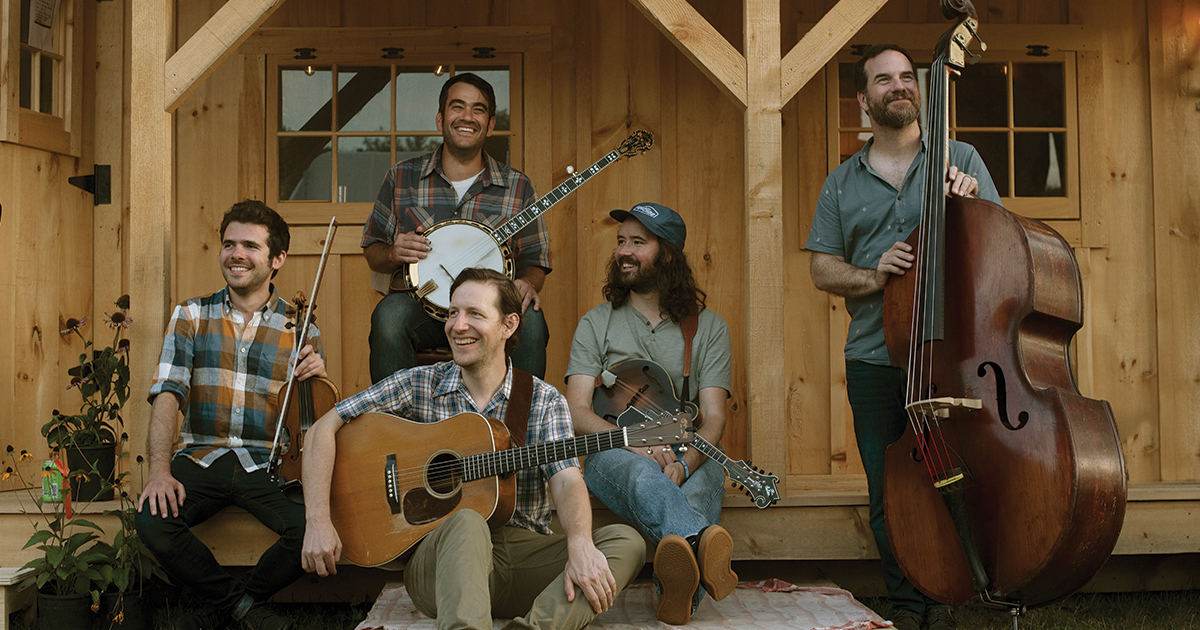
Mighty Poplar
“I was sitting with my bluegrass ensemble I teach at CU Denver and we were listening to the Bluegrass Album Band,” says bassist Greg Garrison. The Bluegrass Album Band was a 1980’s supergroup consisting of guitarist Tony Rice, banjo-picker J.D. Crowe, mandolinist Doyle Lawson, fiddler Bobby Hicks, and bassist Todd Philips. The group was founded by Rice and Crowe in 1980 with the intention to record a solo album for Rice. Recognizing the chemistry between the players and the unique spark emanating from the quintet’s playing, they instead decided to record a collaborative effort of bluegrass standards, resulting in the band’s 1981 debut, The Bluegrass Album. They would follow this up with five more albums. For Garrison, best known for his long tenure with jamgrass progenitors Leftover Salmon and his time as one of the original members of the Punch Brothers, they are simply one of the best groups from the eighties. He says, “We were working on a bunch of their music in class, and I realized I want to do this, I want to play this, why don’t I have a band that I can dig deep into bluegrass with.”
For Garrison the plan was pretty straightforward, “Going all the way back to my time with the Punch Brothers I have been interested in exploring a different element of progressive bluegrass.” Using the inspiration he found in The Bluegrass Album Band, which united some of that era’s best bluegrass musicians, Garrison wanted to craft an album with some of the best players in the progressive/jamgrass world that he has always been a part of. With this group he hoped to follow in the footsteps of The Bluegrass Album Band, and hoped thatwhile sharing the same combustible spark and spontaneity that inspired their album, would also be able to highlight the appreciation for the roots of bluegrass and old-time, and potentially inspire a new generation to explore the music’s rich history. In assembling a band to tackle this project, Garrison wanted to explore his options beyond his Leftover Salmon bandmates. “I love playing with my Salmon boys, but I think it is healthy and productive to play with other people who I don’t get to play with all the time,” says Garrison. “In my mind I started piecing together who I would want to play with. Noam [Pikelny] was my first thought, I have worked with him a lot with Salmon and the Punch Brothers. It had been a long time since we had done anything substantial and I wanted to get something going with him.”
With banjo-picker Pikelny on board, the two started brainstorming other potential recruits and first turned to fiddler Alex Hargreaves. Hargreaves, who recently joined Billy Strings band, previously worked with Garrison on a project that resulted in the album Bluegrass and the Abstract Truth. Garrison says, “He is an amazing improviser with a great pocket.” From there Garrison and Pikelny both agreed Watchhouse’s Andrew Marlin would be perfect. He seemed like a natural fit; he’s a storyteller, an amazing interpreter of other people’s lyrics, and both Pikelny and Garrison had previous connections to him. He and Pikelny had worked together before, while Garrison says he first played with Marlin after a Leftover Salmon show in North Carolina a few years back. “It was one of the rare times I actually went out to pick after a gig,” says Garrison. “I wasn’t even playing bass, I was playing guitar and doing a half-assed Tony Rice imitation. Andrew was playing mandolin. We had met a few times before that, but I remember saying to him that night I had no idea you were a picker like this and him saying the same to me.”
The last piece was Punch Brothers’ guitarist Chris Eldridge. “We needed someone with that driving bluegrass guitar to hold things together,” says Garrison. “Critter and I go back to the How to Grow a Band and early Punch Brothers days. We have an easy fit as far as pocket and time.”
Getting a band together was the first step, next the newly assembled group had to find time among all their busy schedules to get together to record the album and decide what material would compose that album. The ability to get together was made even more difficult by the emergence of the COVID-19 pandemic. The band, later christened Mighty Poplar (from a suggestion by Marlin that was equal parts ridiculous and interesting, and “perfect,” in Garrison’s estimation) scheduled a brief window of time in the fall of 2020 at the secluded location of The Tractor Shed studio, a converted tractor shed on the outskirts of Nashville, to record the album. The uncertain times of the pandemic made for unease heading into the recording session. “With everything leading up to it,” remembers Garrison, “we almost never believed the session was going to happen until it actually did, and we were in the same room. We were just always waiting for someone to miss a test or test positive or someone’s manager to say, ‘I don’t think this is a good idea,’ but we all made it there healthy.”
Despite the shared history among the five musicians—Eldridge, Garrison, and Pikelny had played together in the Punch Brothers, Garrison and Hargraves had done a lot of work together, and Hargreaves has subbed in with Punch Brothers—it was the first time they had all been in a room together and played as a quintet. Garrison says, “To put it all together with Andrew in a bluegrass band formation was just it. Everyone talks about that magic you get the first time you play a tune with a new group. It was there for us for sure. It was a group of musicians I had also wanted to be in a bluegrass band with.” The “magic” Garrison spoke of informed the recording and sound of the album, as it was recorded live, staying true to the idea of being in the moment and playing together as a band. Pikelny agrees with Garrison’s assessment, “The songs really came into their own in front of the mics. A lot of first or second exploratory ideas made it onto the record, as opposed to having an idea being thrown out and having weeks of refining and tweaking. I love catching that initial energy and spark. It means that things won’t always be squeaky clean, but I’ll take that lightning in a bottle over perfection.” And lighting in a bottle is exactly what was captured, as there is a palpable sense of excitement and energy permeating the album.
Just as daunting as finding time when all five musicians could get together was deciding what material to work up for the album. Marlin had brought in a couple of instrumental tunes he had been working on, but it was decided early on to stay true to the original concept of reinterpreting traditional and bluegrass songs for the album. The selection of material was a collaborative effort with everyone suggesting tunes to the group. Everything from New Grass Revival to Bill Monroe to the Seldom Scene to Hot Rize to traditional standards were considered. “We had a pile of maybe 30 or so tunes we traded back and forth,” says Garrison. “Obviously whoever was singing it had a little more weight in its selection and with Andrew being the main singer on the album the tunes he was bringing in you could hear the deep connection he had with them. Noam took on the role of organizing and producing the right material for the album.”
Garrison speaks with awe of the role his longtime friend Pikelny had in the creation of the album, “That is one of the reasons I love working with Noam, and this goes back to the How to Grow a Band and Punch Brothers days, he has such an analytical mind. I think it is a banjo player thing, he can process things and look at things in a number of different ways and he works through all the possibilities before getting to that perfect outcome.”
As the band waded through all the tracks they were considering for the self-titled album, they slowly found they were moving away from some of the familiar tunes by more recognizable faces such as the Stanley Brothers, Bill Monroe, and the like. Garrison explains, “In the initial stages all that stuff was considered, we were looking at all our influences. We had a pile of tunes that could have gone in another direction with more Bluegrass Album Band style tunes that people were more familiar with. We went a step beyond and picked songs that were probably not as well represented in the canon. I think we did a good job with uncovering songs people might not have heard before or be as familiar with.”
The resulting twelve tracks run the gamut and include a handful of traditional tunes, “Grey Eagle,” “Blackjack Davy,” and the instrumental pairing of “Kicking Up The Devil on a Holiday / Dr. Hecock’s Jig,” two Carter Family standards, “A Distant Land to Roam,” and “Little Joe,” a John Hartford song, ‘Let Him Go Mama,” a deep Bob Dylan cut, “North Country Blues,” the Uncle Dave Macon inspired, “Lovin’ Babe,” and the complete reinvention of Leonard Cohen’s, “Story of Isaac.”
Garrison says their take on Cohen’s song could almost qualify as an original as Marlin completely reimagined the melody and structure of it. “The lyrics are the same,” he says, “but it’s 50% Andrew Marlin.” “Cohen’s version was so heavy,” says Marlin. “The first time I ever heard him sing that tune I felt like I’d just survived falling down a hill. For our version, I tried to take this really serious heavy subject and put it to some not-quite-as-heavy music.” For Marlin, despite the song not being in the bluegrass canon, he jokes that’s the real spirit of bluegrass, “You take sad songs and make them sound a little happier, and you’ve got yourself a Stanley Brothers album all of a sudden.”
Similarly is “Lovin’ Babe,” a reworked version of the Uncle Dave Macon tune. Singer/ songwriter Kristin Andreassen (Eldridge’s wife), used the song’s initial verse as a starting point and then crafted five brand new different verses that tell a new story. Eldridge says, “It’s part cover, part new song that has never been recorded before. It and ‘Story of Isaac’ are kind of a pair in my mind that way.”
In addition to showcasing his songwriting and ability to arrange music, the “Story of Isaac,” also shines a light on Marlin’s understated singing. There is a comforting and familiar element in Marlin’s voice that reminds of the old home place. That comfort adds a whole new layer to their take on Dylan’s “North Country Blues,” delivering the song, not with Dylan’s razor-sharp sneer, but instead a down-home familial quality.
Even with the analytical mind of Pikelny and the passionate approach of Marlin providing guidance and inspiration for the project, the album was truly the work of five musicians working together, sharing ideas, and creating music as a band. For a band this talented the execution of the songs was often the easy part, the difficult part was the arrangements they were going to use and being able to put their own unique, modern stamp on each tune. Garrison cites the instrumental pairing of “Kicking Up the Devil on a Holiday / Dr. Hecock’s Jig,” as an example of how the band would experiment and revamp existing arrangements. “We were taking it from a very simple one or two instrument arrangement and putting it into a band formation and having to decide who plays what part and who solos,” explains Garrison. Even with the work that they had to put in new arrangements, the dominant approach of the recording session was loose and in the moment, simply allowing their collective talents to shine with minimal planning, allowing each song to grow organically as they played together live in the studio. “With good musicians sometimes if you don’t have an agenda that is when the best things happen,” says Garrison. “Just take the best things that happen in the moment.”
The finished album allowed the five musicians of Mighty Poplar to reconnect with the music of their roots, something not always possible within the progressive confines of their regular bands. There was a shared ease and freedom they found in the studio with being released from the bonds that normally tie them to their regular bands. Instead allowing them to reinterpret and reinvent music from their similar influences. “You eliminate the stress of having to ask, ‘Is this a great tune?’” says Garrison, “You know it’s a great tune because it already exists. Interpreting it and turning it into something unique and your own is the fun part for this ensemble.” Mighty Poplar the album is perfect as it is a clear shout to the future but also plainly echoes the past. “It’s an homage to where we came from, without it being a recreation of an earlier era,” says guitarist Eldridge.
Mighty Poplar is a masterclass in bluegrass. From the gentle sway of Martha Scanlan’s “Up on the Divide,” to the impassioned, inventive fiddle runs of Hargreaves on “Grey Eagle,” to the old-timey stomp of “Blackjack Davy,” Might Poplar creates a dreamy atmosphere that glides along on the winds of the past as it recites the gospel of bluegrass for the next generation. Much of that atmosphere is powered along by Garrison’s understated and efficient bass which propels each song along with a subtle prod, while at the same time creating a safe platform over which the rest of the band can work. “As a bass player and having the personality I do, I’m OK with sitting back and not stepping out front,” says Garrison. “This kind of band provides me that opportunity. I play less on this album because of the vocal nature of it. I am more in a supporting role. My comfort zone is playing with people who are doing things that are so exciting that they just need the support of a good bass player and I am just glad I get to be that guy on this album.”
The joy and excitement of playing and creating with Mighty Poplar has the five musicians already thinking about the next album. They have even started thinking about material they would like to tackle for another record and if they would consider any original material next time around. “We were sharing some messages and Andrew sent a playlist of some tunes he has been learning and they are all covers. We will see where it goes. That being said I don’t think if there were some great original tunes that we would say no if it’s the right thing for the record.” But before that, there is their debut album to enjoy and celebrate first. The band has a tour planned in May as well appearances at festivals throughout the summer, followed by another two-week run in the fall. “We are all really taking the opportunity to put our best foot forward and launch the band and make it a thing,” says Garrison.
Bluegrass is at its best when it is representing its long tradition, yet at the same time moving that tradition further down the road. Much like the Bluegrass Album Band did forty years ago when they released their first album, Mighty Poplar wanted to look at the music of not only their past, but bluegrass’ past and discover what it is that makes the heart of the music beat, and then unlock fresh ways to tell the story of bluegrass to a new generation. When asked if he thinks Mighty Poplar achieved his original goal when he first conceived the idea of the album Garrison answers, “If what we were trying to achieve was getting a great group of musicians together and playing some bluegrass and capturing it, while at the same time making it exciting for people to listen to, I think we have achieved that. As far as where this album can sit among our heroes and people we look up to, I would never even expect to even be considered in the same breath as the Bluegrass Album Band, but hopefully people will get the same feels listening to this that I get listening to that album.”