Mickey Abraha m
How to Win Friends, Influence People, and Play the Guitar
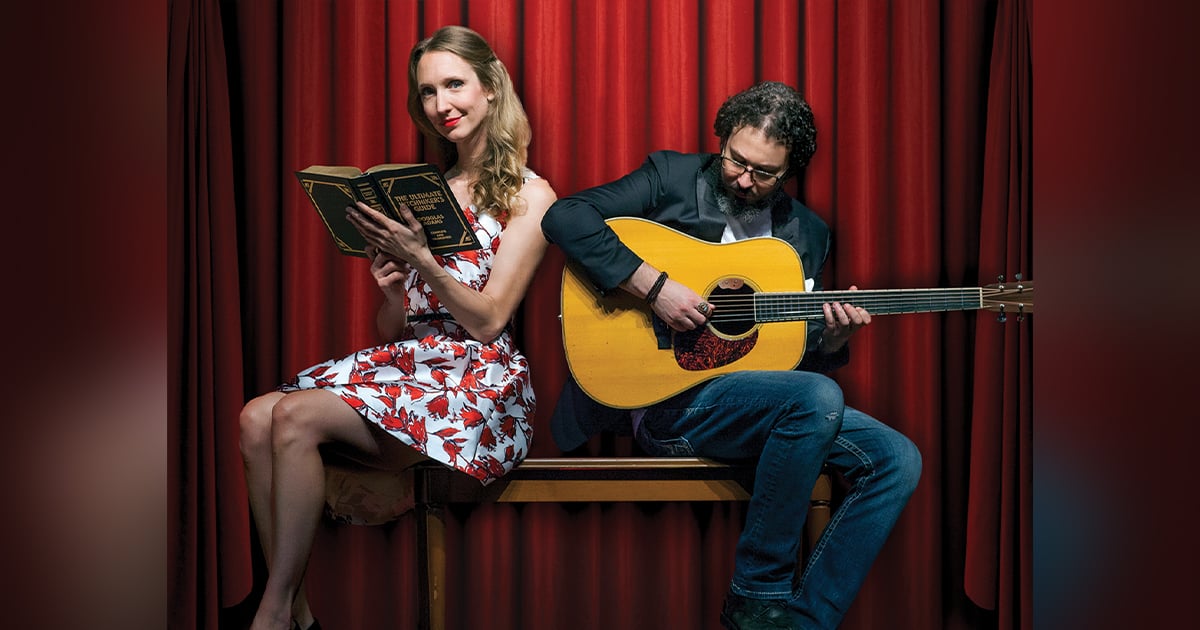
Meet Mickey Abraham: Teacher, musician, and all-around good fellow. Longtime subscribers to Flatpicking Guitar Magazine will already be well familiar with Mickey, as his excellent monthly instructional guitar column and tablatures have graced the pages of the flatpick.com website beginning around 2008 and continue on to this day. Recently I had the opportunity to meet with Mickey, and found him to be personable, very likeable, and filled with joyous enthusiasm for life, the music he loves, and the people he meets in his musically inspired life.
The quote at the top of the page can be attributed to Dale Carnegie, author of the famous book, How to Win Friends and Influence People, published in 1936. The book opens with that piece of advice, and Mickey’s dad, Marty Abraham came across it at some point and passed the advice on to Mickey when he was still a youngster. Mickey took the notion to heart and it became something of a guiding principle in his approach to music, to teaching, and indeed to living life as a whole.
Born and raised in South Florida, Mickey grew up in a musical family. He counts both his parents and one of his uncles as his first and primary influences in music. His mom was an accomplished Scruggs-style banjo picker, his dad played the guitar well enough to support his mom’s banjo habit, and his Uncle David Deckelbaum had a bluegrass band in Israel called the Jerusalem Taverners. Family gatherings included playing and singing folk and bluegrass tunes from as far back as Mickey can remember. He says those early years immersed in the family’s folk music “planted the seed” which flowered later in his adoption of acoustic and bluegrass music as his main interest.
While in college at Florida State University, Mickey made a leap from his interest in rock music to acoustic folk and bluegrass. He explains, “I came to Tallahassee to go to FSU, ended up getting into the folk music scene, and never looked back. When I graduated other people were getting jobs and moving on with their lives, and I had all these folk music friends and I was already teaching and playing and I kind of morphed that into a temporary gig, and the temporary gig ended up becoming a full-time life!”
By his senior year at FSU, Mickey was working and teaching at Gordon’s String Music. “Gordon Scott is a Florida bluegrass legend who played with J.D. Crowe. He and his wife Jane Scott owned a ma and pa music store with a Martin dealership here in Tallahassee. Gordon was my first big influence in folk music, and it was through him that I had the good fortune to meet many of the Florida folk legends like Lis and Lon Williamson, Sam Pacetti, Gabe Valla, and Chris Henry.”
One deeply significant event for Mickey’s life and career took place in 2005. Mickey tells the story: “I was able to meet the Rice family through my friend Lee Kotick, who had taken lessons with Wyatt Rice back in the 80s. I found myself at the time playing in a band with Larry Rice. Well, Larry came down with cancer. Lee Kotick and I, along with some other friends decided to put on a benefit concert to raise money for some of Larry’s medical bills. The benefit event was how I first met The Dawg [David Grisman]. I had an idea to raffle off some Tone Poems albums to be autographed by Tony Rice, who of course was scheduled to play at the benefit concert.
“I called up Acoustic Disc, the label Tone Poems is on, and I asked if they could donate some copies of the album. They said ‘Yes, of course we will do that!’ I said ‘thank you very much’, and about five minutes later I got a call back from Craig Miller, who is David Grisman’s producer, and he said ‘Hey Mickey, I’m going to send you those Tone Poems CDs, but I’m also going to send David to Florida. He wants to play. He knows Larry and the Rice family very well, and he would like to be there to show his support.’
“I ended up picking up Dawg at the airport, and I was his Tallahassee liaison for the weekend. It was an organic way of meeting, and we’ve had a friendship ever since. Tony Rice was there that weekend, Vassar Clements was there among others, and by the end of that weekend I had become acquainted with a lot of legends of bluegrass music. It was an amazing experience putting on the concert, and it felt natural working with some of my heroes. That kind of put me in that world, and I’ve stayed in that world ever since.”
In that world, having struck up a friendship, and having had the chance to play together on several occasions, David Grisman had this to say about his friend, “Mickey’s a talented picker and teacher whose passionate enthusiasm for acoustic music is infectious.”
In the years following the Larry Rice benefit, Mickey came into his own as an established performer, playing both guitar and mandolin (not at the same time, but there’s an idea Mickey might want to explore someday). His musical chops are well documented on his collaboration with dulcimer virtuoso Aaron O’Rourke. Their album, The Aaron O’Rourke Trio was released as a digital download on Grisman’s Acoustic Oasis website. He has performed with numerous Florida musicians, perhaps most notably with Kathryn Belle Long in their group Belle and The Band. In 2016, Mickey and Kathryn won a Suncoast Emmy Award™ for the theme song to the PBS TV show, Local Routes, and their work together continues to flourish.
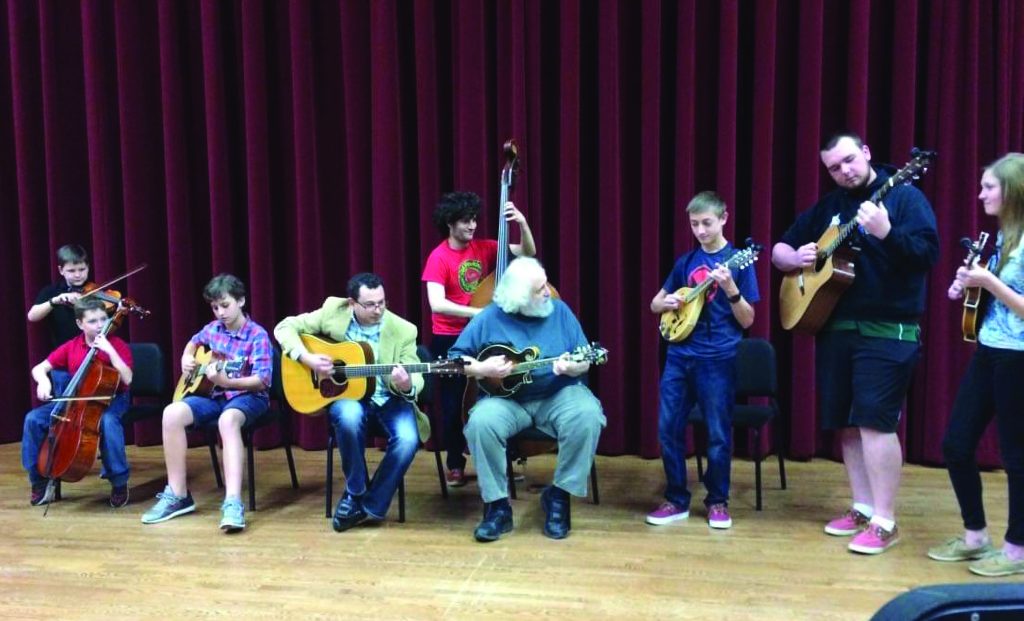
As much as Mickey loves performance and the creative process, he gives equal attention to his teaching career. Some musicians teach out of necessity, so as to support their performing career. Not so with Mickey. For him, teaching is an expression of his being, wherein he can bring all of his talents and skills developed over a lifetime in music to share directly with others. Along with his longtime gig teaching on the flatpick.com website, Mickey has taught many youth ensembles. “I spent fifteen years with the Tallahassee Youth Orchestra working with kids, taking them to music festivals, and introducing them to playing with my music festival friends like Joe Craven, and Rushad Eggleston, and even one time my students had the opportunity to play with David Grisman himself!” Two of Mickey’s alumni include Juiliard graduate Kayla Williams and Eastern Tennessee State Jazz Guitar Program graduate Noah Wise. Kayla and Noah have previously received instruction in their chosen genres, and they know a good teacher when they see one. Looking to expand their horizons into bluegrass, it was an easy choice to stay with Mickey for further insight into what bluegrass uniquely offers to the world of great music.
Currently, as we all continue to be affected by the ongoing pandemic, Mickey has utilized the online “virtual” world to advantage. He has teamed up with bluegrass YouTuber Marcel Ardans. Mickey can now be found on the YouTube site “Lessons with Marcel.” He says, “I’m now branching out into the world where if you live somewhere like South America or Japan you can take lessons with me, and it’s been really rewarding and a totally new experience working online with different people.”
After speaking at length with Mickey, I was intrigued with his teaching style and felt that I wanted to learn more, so I asked if he could give me a lesson. He gladly obliged and a few days later we met online for an introductory lesson. Because my personal background includes acoustic folk and bluegrass, singer/songwriter music, listening to and playing Grateful Dead music, and studying jazz guitar, we found a lot of common ground! In fact, when I mentioned my jazz guitar teacher was Bruce Saunders, Mickey replied, “Oh, I actually have a book by him!” After shooting the breeze together for a few more moments, Mickey began the lesson by asking me to play something. I played my version of “Long Black Veil,” the country tune written by Lefty Frizzell. After listening attentively Mickey said “Great job! You know, singer/songwriters are often the most challenging to teach because in that realm, basically all you really need are three chords and the Truth!”
As the lesson continued, we landed on the subject of cross-over genres, such as New Grass, Jam Grass, or the merging of Grateful Dead and Dawg Music with bluegrass we hear so often these days. Mickey said, “People might wonder, ‘Why are hippies into bluegrass?’ It seems like it’s very ‘suits and ties,’ for lack of a better term, very Southern conservative music. But why are hippies into it? It seems so logical now as you go to a festival and there are hippies all over the place. I think that Jerry and Grisman had a lot to do with that… It was the Folk Revival of the 60s (or as Garcia once referred to it, the ‘Folk Scare’) that gave people like Ralph Stanley their legendary status. All of a sudden you have Bluegrass Festivals, bluegrass magazines, all because of those hippies who really ‘got it’ back then in the 60s.”
I then asked Mickey about learning fiddle tunes, and he said, “I’m totally into fiddle tune standards. I remember wanting to be a better improviser. I had a blues/rock language coming from high school, but I knew I didn’t know the bluegrass language. I knew that I wanted to play something like this: (he plays a tasty fiddle tune lick). I realized if I learned like a thousand of those, then some of those beautiful lines would begin to creep into my own playing. I would learn how to play melodically.
“People like Tony, and Dawg, and Bela Fleck were making up their own music, but I could tell that what I was missing was that I didn’t play the standards that they played. I knew that David Grisman was writing some killer tunes and I loved the music, but I also knew I couldn’t understand it at all unless I learned to play tunes like ‘Soldiers Joy,’ and ‘Whiskey Before Breakfast.’”
Touching on the topic of music theory, Mickey acknowledged that there are many roads to Rome. He also said, “There’s definitely more than one way to do it. You don’t have to necessarily know a lot of scholastic theory to play really great. It’s not essential at all. And just because someone is super technical doesn’t necessarily mean they are a great musician. People sometimes study theory thinking it’s going to make them sound like something else…It won’t do that, but for certain people theory will allow you to place whatever your interest is in music into a greater context, and it feeds understanding of music overall.”
At the end of my lesson with Mickey, I asked him about what he is currently most excited about in his musical life. Up front and center is a new collaboration with his musical partner Kathryn Belle Long. Together they are recording a two-hour long concept album entitled Voices: A Folk Opera. The idea for a folk opera arose while recording the most recent Belle and The Band album, Till We Know Better. “We were working on adding sound effects to a couple of songs, and at that moment, Kathryn and I had the idea of doing an entire concept album with all kinds of sound effects all over it. I am very influenced by epic concept albums, and Kathryn has worked extensively in New York theater and for Disney. This project feels natural for us, and it’s right up our alley!”
The album, which will also include original art work by Avi Renick, consists of all new songs written, arranged and produced by Kathryn and Mickey. The project is a culmination of the many years Mickey and Kathryn have spent together making music. “Our goal is to deliver a concept album that combines our love of theater with our passion for songwriting and folk music. The Folk Opera is driven by character development, socially relevant subject matter, soaring melodic themes, and compelling visual art.” Details about the project can be found on Facebook, YouTube, Instagram, and the Belle and The Band website. Mickey graciously shared a few tunes-in-progress from the album with me, and I for one am very much looking forward to seeing and hearing the finished product.
Mickey has successfully applied the advice he received as a youngster from his dad in his career as a performing musician, as a teacher, and throughout his life. In music, the idea of “being interested” translates as “be a good listener.” When playing with others, by always listening and being attuned to what others are playing, one can play appropriately and harmoniously, and applying the principle, Mickey excels as an ensemble player.
In his teacher’s role, I can attest from my own experience that Mickey is unfailingly attentive to and interested in what his students bring to the table. He says, “I keep my brain open, that’s one of the reasons I’ve succeeded as a teacher. If someone comes to me with a song they are loving, be it funk, rap, Broadway, Disney or whatever, I’m genuinely interested in what they are hearing in it.” In relationships with others in today’s world, Mickey said this, “To disagree with someone without hating seems to be a lost art form. There are so many things that are lost in society these days. Musically, and in every other way, there is much to be gained from anyone, to recognize value for what it is, and to honor what others have to bring to us, whatever that may be.”
Mickey is a highly accomplished teacher and musician with talent, skill, and insight. If you bring your aspirations in music to Mickey Abraham, he will pay you back with interest.