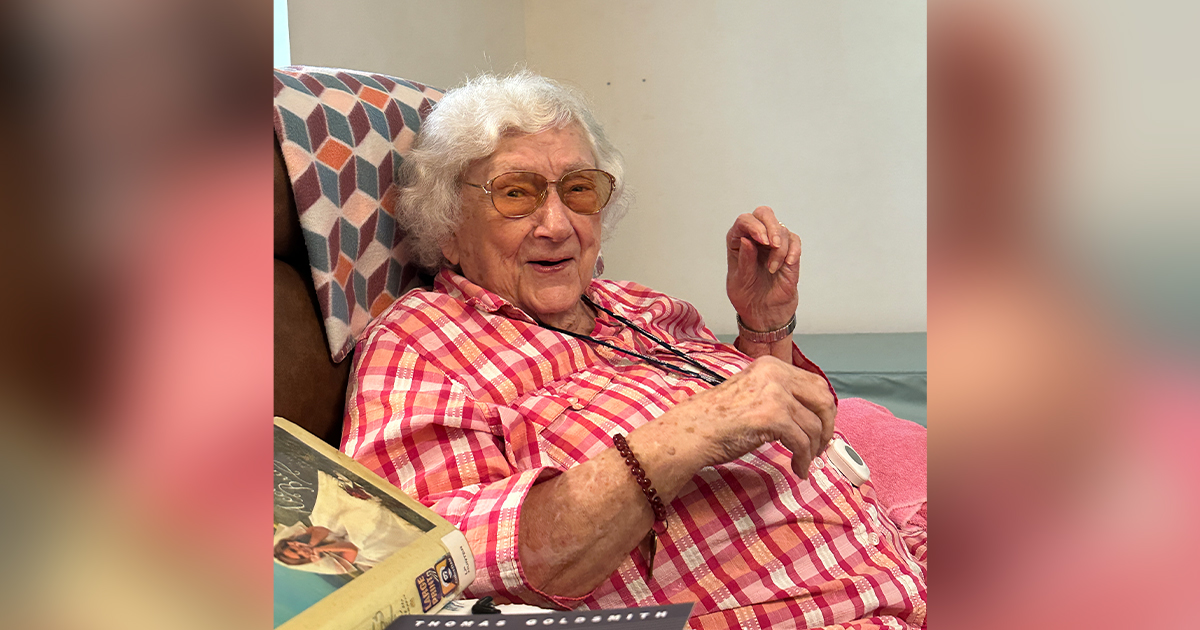
Maida Scruggs Tells Her Story at Age 99
The Widow of Earl’s Brother Horace, she was a Family Member for Many Decades
Photos by Thomas Goldsmith
Born April 15, 1925, Maida Greene arrived on this earth one year, three months, and nine days after her future brother-in-law Earl Eugene Scruggs, a notable champion of American music. Maida knew the Scruggs family from elementary school days on and married his slightly older brother Horace in 1941. “He was a good man, a good brother, a good father, and a good husband,”Maida Scruggs, 99, said of Earl during an afternoon visit at a long-term care center in Boiling Springs, North Carolina.
My visit with Maida (pronounced may-I-da) was made possible by her friends Harry and Sherwin Washburn, also of Boiling Springs. They are also my friends and my cousins; we are part of an extended family whose history in Scotland County, North Carolina, stretches back more than two centuries.
I’m grateful to the Washburns for introducing me to this spirited woman Maida, who agreed and seemed happy to talk about Horace, Earl, and her own life for this story. Sad to say,she died on Oct. 21, 2025, less than two months after the interview.
Early Days
Maida Greene Scruggs made her name as a valued citizen of Boiling Springs, as a wife, mother, teacher, artist, crafter, and pillar of her church, Boiling Springs Baptist. Of interest to people who love bluegrass music, she had much to relate not only about Earl Scruggs the famous musician, but also about the Earl who loved his family and hometown and frequently returned there throughout his life.
The world knows Earl Scruggs as a banjo virtuoso, but his sister-in-law also recalled him as a horn player. Earl and Maida were both signed up to play in the band of Boiling Springs Junior College before it became Gardner-Webb College. “Earl and I both played in the band we had; I guess they called it the community brass band, with [Boiling Springs Junior College],” Maida Scruggs said. “There wasn’t enough students that played instruments, and Earl played the big bass horn.”
This memory sheds an interesting light on Earl, known around the world as a folk musician. Many accounts of his life maintain that he could not read music. However, he must have been able to do so at that time, or at least was able to play alongside people who did read. American brass bands going back many decades included various instruments referred to as bass horns, as Maida Scruggs referred to Earl’s instrument. A band photo in the 1939 edition of the Boiling Springs Junior College’s Bubbles yearbook included Earl Scruggs associates such as his friend Bobby Jones, and Betty Jenkins, later the mother of my cousin Harry Washburn, who, as noted, introduced me to Maida in 2024. Small world. “He was really shy, real nice, clean-cut, a farm boy,” Betty Jenkins Washburn told me in 2015 for my book on Earl and Foggy Mountain Breakdown. “They lived down in the country toward the river on a farm.”
During the same talk, Betty Washburn mentioned that she kept up with Earl Scruggs’s career through her friendship with Horace and Maida Scruggs.
“He had talent, didn’t he?” Betty Washburn said then. “We didn’t know it then. Just knew that he and Horace and some of the boys got together and played.”
A Musician Around Town
Likely during the same years, or a little earlier than the brass band stint, Earl was also learning banjo, as his oldest sibling, Junius, or Junie, Scruggs recalled in a 1984 interview in the local publication The Foothills View.
By that time Junie was already an established musician in the community, and Earl, though quite young, was learning to note, or fret, the banjo, and to pick with the fingers of his right hand. “Earl used to sit on my knee and I’d note the banjo and he’d pick,” Junius Scruggs said of the years around 1928, when their father, George Elam Scruggs, died of cancer. “Then he’d note and I’d pick.”
Maida Scruggs remembered that Earl “all the time” played the banjo.
“He always played string music,” she said. “The whole family did; Horace played guitar, and Earl played the banjo, and they had the sister that played guitar.” (Both of Earl’s sisters, Eula and Ruby, played guitar and banjo.)
Earl, his brothers, and other friends played first at home, then informally at the homes of friends, including those of informal band members’ families.
As time went on, a crowd would gather regularly on Friday nights at a house they’d agreed on. Sometimes they’d play in town at the Snack Shop, where Earl’s sister Ruby worked for years, Maida Scruggs said.
It was during this period, according to an often-told story, that Earl and Horace came up with a way to make sure their tempos were perfectly aligned. The famous musician Billy Strings and a friend once stopped by the Scruggs homestead to pick, according to a 2017 Facebook post that referred to the brothers’ practice sessions. “…we spent a chunk of the early afternoon pickin’ there,” Strings wrote. “He and his brother Horace used to start a tune out front and then walk around the house in opposite directions to see if they could still be in time with each other when they got around back.”
Scruggs Family Matters
Going out with Horace, Maida got to know the family including Lula Ruppe Scruggs, who headed the family when George Elam Scruggs died. Horace and Maida married on July 7, 1941, in Gaffney, South Carolina, an over-the-line destination where young couples in North Carolina often wed. Earl and other family members gathered for a celebration after the bride and groom came back to Boiling Springs and initially lived with Lula. “Ma Scruggs was a sweet lady,” Maida Scruggs said. “She played the organ for Flint Hill Baptist Church for several years. She was an organist, but I didn’t know her then.” Junie, Eula Mae, and Ruby Scruggs had gotten married and moved off the farm. That left Lula Scruggs and the young brothers on their own at the house up the hill from the Broad River. “The boys did the farm,” Maida Scruggs said. “She got married and left those little boys to do the farming. And they did.”
Knowing Venie Mae
Earl Scruggs gained a half-sister, Maida Scruggs said, when Lula Scruggs remarried and had another child, Venie May. Times got hard at the farm and Grady Wilkie, a family friend and Earl’s picking partner, got him work at a thread mill in Shelby. Earl had left high school after 10th grade, Maida Scruggs remembered, and he went to work instead of joining military service. That choice was allowed so that he could support Lula and Venie May with his factory wages. Later the family benefited from the money Earl made playing banjo with Lost John Miller and the Allied Kentuckians in Knoxville and Nashville and with Bill Monroe on the Grand Ole Opry.
Maida lacked the same close relationship with Venie Mae that she had with Horace’s other siblings, and had not seen her in years at the time of my visit.
“She came here after I came here,” Maida said of a visit Venie Mae once paid to the well-maintained residential care center. “She came to visit a friend of hers, and I was in the craft work (area), and this little blonde-headed woman came in and said, ‘Hey, how are you?’
“I said, ‘All right. How are you?’
“She said, ‘You don’t know me, do you?’”
Earl, Horace, and the others had also lost touch with Venie Mae after Lula Scruggs died in 1955, not through a misunderstanding, Maida said. They just lost touch.
An Enduring Taste for Home
The union of Maida and Horace lasted for 66 years. They raised two sons and Maida trained for and spent years as a kindergarten teacher.
For decades before his death on July 19, 2007, Horace continued to play guitar locally and during picking sessions with Earl, who often praised him as a strong rhythm man. Horace and Maida would go to Nashville several times a year to spend time with Earl’s family.
Long after Earl had become a musician known around the world, he and his wife Louise came back to visit folks in Cleveland County. “They came to our house several times,” Maida said. “They had little boys and we had little boys, and they all got along.”
On one occasion Earl came to Shelby to take part in a function at the theater honoring another Cleveland County member of the Country Music Hall of Fame. “About a year before he died, he came to the theater, the Don Gibson Theatre and he couldn’t leave the theater because he was in charge of the thing,” Maida Scruggs said. “And he called and asked me if he ordered supper if I’d come to supper with him. I usually cooked supper for him. “He said, ‘I can’t leave the theater. Will you come eat supper with me?’ I went over there and we ate in the corner at the Gibson Theatre, and they fixed us a table with a little tablecloth.”
Earl sometimes returned to Cleveland County with a seeming urge to escape the attention that followed him everywhere, to enjoy the rolling hills around Flint Hill and Boiling Springs, not far from the Broad River he loved.
“A lot of times when he’d come down, he’d come to the house and he’d ask me if Horace had an old pair of overalls he could put on,” Maida said. “And he’d borrow his rifle and he’d go hunting out in our woods. He never did shoot anything. “He’d wear Horace’s overalls that he used to farm in, and a shirt, and he put them on to go walk around in the woods for hours, and he’d come back, put his own clothes on, and he’d say, ‘Thank you.’”