Lynn Dudenbostel
Overcoming the Pandemic Year
Photos by Matthew Dudenbostel
Next year will mark the 25th year since Lynn Dudenbostel starting building world-class mandolins and guitars full-time (it’s been 32 years since his first guitar build and 25 since his first mandolin). But even in this pandemic year, Lynn has been exploring new avenues for instrument production, music, and—as you might expect—providing world-class repair services. BU recently visited Lynn at his shop in rural Maryville, TN.
How has this pandemic year affected your business?
The amount of repair work over the last year has been unreal. Since no one could get out and play or go to workshops or festivals, I think most folks saw this as an opportunity to get repairs done. It could have swamped me, but fortunately, now I’ve got Matthew [Lynn’s son] here doing fretwork and setups under my supervision, which allows me more time to do actual building.
Currently I’m working on two 12-fret guitar builds, a 000 mahogany and a D with koa and abalone trim. And this summer—once I get through with the guitars I’m currently working on and finishing a A-style mandolin—I’m going to take some time off to develop a 2-point mandolin. Kimble and Ellis and Duff have put theirs out, and I just want to do that as well. I’ve been fielding requests for one for several years. I know I want it to be asymmetrical, so I have to work on that design. I also want it to be Art Deco style, using some of the elements of the uke I built for my older son. After building for as long as I have, I think my inner designer is starting to emerge, so there may come a time when I have a list of contracted builds, each paired with a “builder’s choice.” There might even be a ukulele or two in there; they are really fun to build.
So having Matthew as your apprentice doing minor repair work is just logical.
Exactly. He’s already built a couple of electric guitars from scratch, and now he’s just adding to that core building skill set. The first time Matthew fit a bridge to a mandolin, it was about 90% there, so I worked with him to refine it. He installed one last week and I couldn’t have done it better. He’s a quick study; I’m very proud of him. The bottom line is that his work ultimately has to meet my standards before it leaves here, but I enjoy sitting down with him and discussing what the best course of action would be for any work.
It has been an odd year with the pandemic. I’ve not allowed hardly anyone into the shop, but I did make an exception.
Yes; care to talk a bit about that?
Sure. Sam [Bush] was being very careful, and more so because our friend Harry Sparks [the legendary Cincinnati-based guitar repairman and architect] was going to be here as well. Harry’s just turned 80 and has decided to cut back on his repair work. Harry’s been taking care of Hoss [Sam’s 1937 F-5] for many years, and when Sam called about replacing Hoss’s fingerboard, Harry had to turn him down. “What am I going to do?” Sam asked, and Harry said “Well, we’re going to take it to Lynn.”
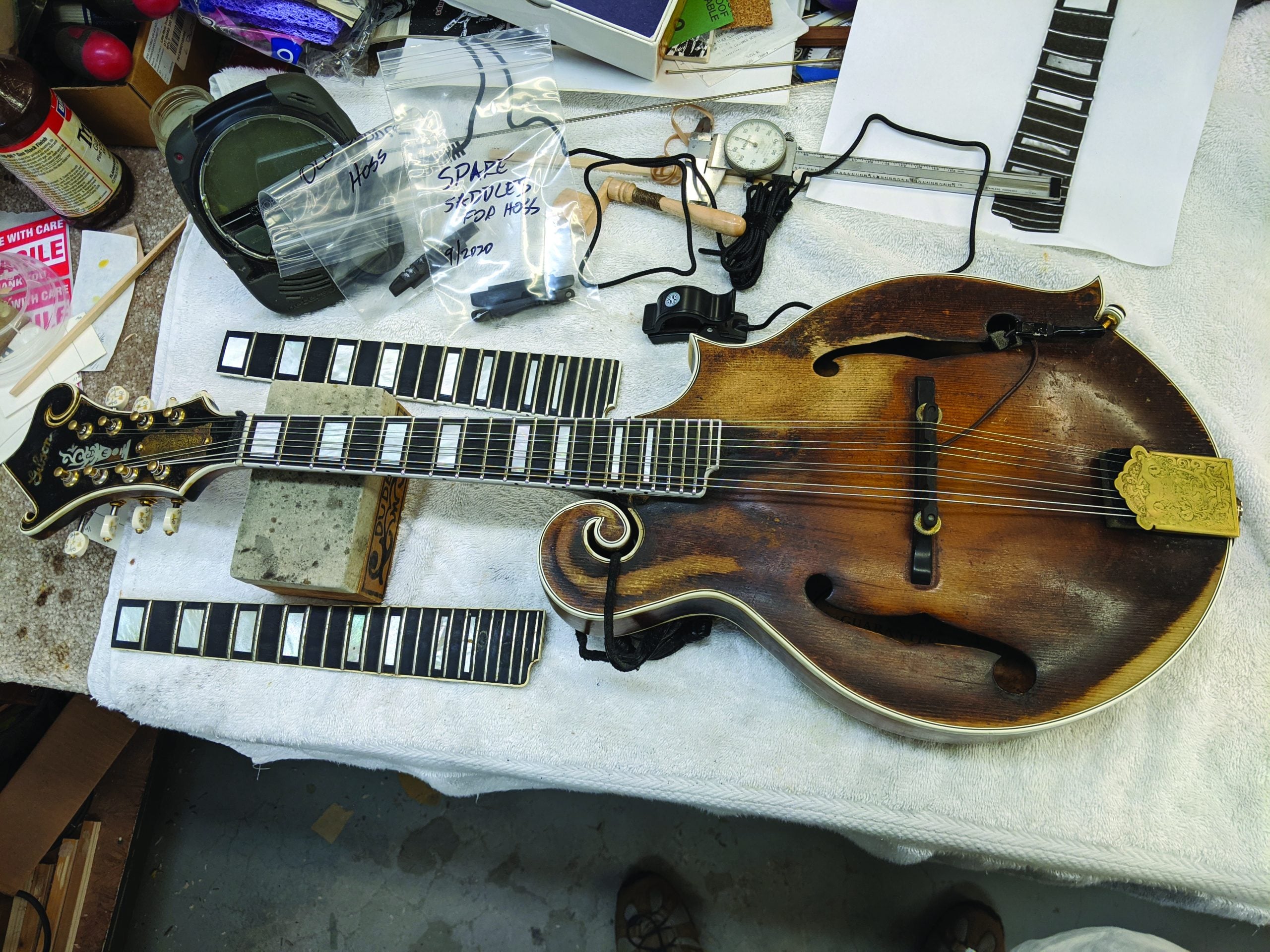
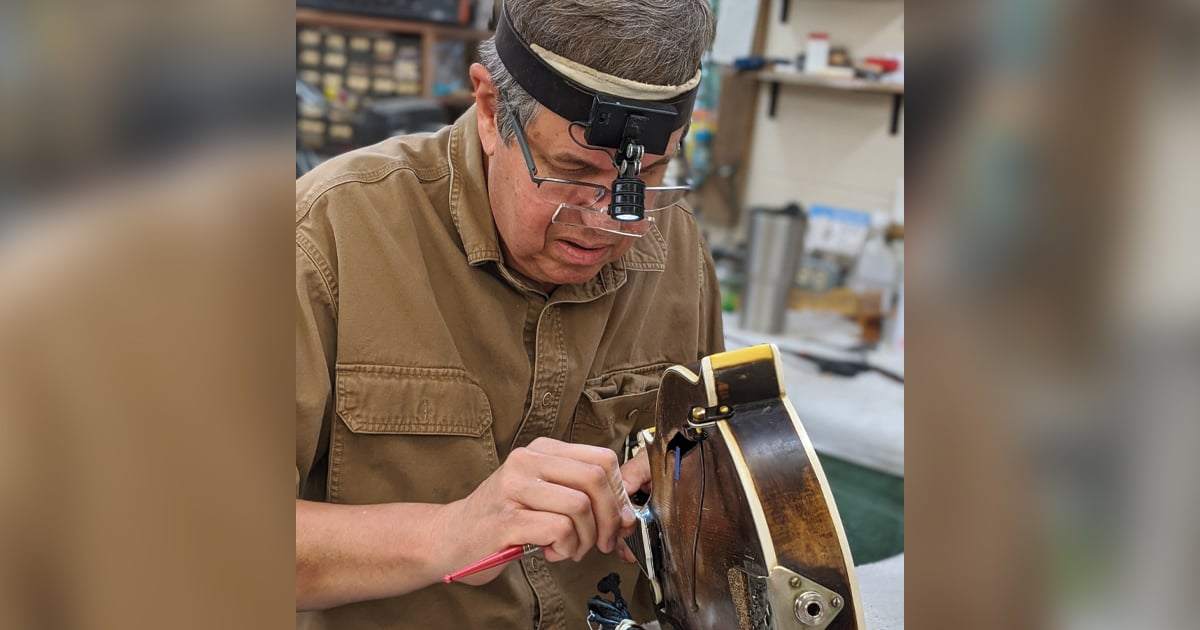
Harry called me to talk this over. Now I’ve done lots of fingerboard replacements on old mandolins, so Harry said, “Well, I think the way to handle this to have Sam drive over, I’ll drive down, and we’ll meet. I’ll bring some stuff, and we can talk over the work.” So we all met here, had lunch, talked about it for a while, and Sam finally took a deep breath and said “All right; go for it!” As design datapoints, Harry had brought Hoss’s first radiused fingerboard [from John Monteleone] along with some of the fretwire Sam prefers. I had Hoss for about three weeks, and it was a great patient. Fingerboard came off cleanly, I replicated the block inlay, and everything went fine. I did notice one thing, though. When I replace a fingerboard, I always locate the fingerboard without binding on the neck. That allows me to see exactly how much binding is going to overlap and adjust accordingly to prevent thin spots in the binding. And I noticed that because Sam had played Hoss exclusively for so long there was a very slight curvature on the treble side of the neck! It was one of those awesome moments where I realized how involved this instrument had been in the past 45 years of bluegrass history. And then I put my magnifying glasses back on and just got back to work.
I notice some shop upgrades.
I got a new lathe—actually not new, but one from the mid-90s—a Woodfast bowl lathe from Australia. As I started exploring building old-time banjos (primarily for my own entertainment more than anything), I realized I needed a bigger lathe to turn these banjo rims. My old lathe had a 12” capacity, but to turn a 12” banjo rim you need a larger lathe; I was looking for at least a 16” capacity. About two weeks later this Woodfast shows up on Craigslist here in Knoxville. The seller originally bought it up near Dandridge as a basket case and totally restored it, even replacing the shaft bearings. It had been upgraded it with a DC motor and variable speed control. The only thing it lacks (which modern lathes have) is a reverse, but I figured I could do without a reverse, since I now have far better dust control in the shop. The green is not exactly the Woodfast green—it’s more a John Deere green, but the lathe still looks great and runs like brand new.
It’s one thing to buy a lathe like this but moving a quarter-ton piece of machinery—especially when professional moving companies are unavailable due to quarantine—is something else entirely. It took a bit of lugging but we finally got it in the shop.
Each of the three layers of the banjo rim is built from eight segments of wood cut at exactly 22.5 degrees (yes, thanks to the bowl-turning community, there’s an online calculation for that) and then joined together. I also found Craig Evans’ DVD series Conversations with North American Open-Backed Banjo Builders, [Smithsonian Folkways] which taught me a ton of stuff, based his interviews with more than 30 builders. Part of building the rims is getting that 22.5 degree cut on the segments as precise as possible, but I also upgraded my jointer with helical cutter heads. That results in an incredibly clean cut and saves me a whole lot of time when I glue the segments together. These cutters eliminate tear-out even from curly maple.
I’ve always been interesting in wood turning, and these old-time banjos are a good excuse to get a new lathe. It’s been especially great at turning the handles for my string winders. [laughs]
And I’ve also been able to finally install an industrial dust control system for the shop, with all the ductwork. I’ve got cyclone separator, which draws 1,250 cubic feet per minute, so by venting it in the shop through a large and very fine filter I get a complete air exchange about six times an hour. As you can see, I’m in the process of connecting all my tools to it.
So where did this interest in old time banjo come from?
I’ve played bluegrass banjo since I was 13 and I love the sound. But 15 or 16 years ago I picked up an old Vega Whyte Laydie tenor, and Wyatt Fawley in Pennsylvania—one of the best restoration/banjo builder guys around—was building unfinished reproduction necks. His necks were fretted, inlaid, and bound; you just finished it and mounted it. So I bought one and finished it—that went well—and then mounted the dowel stick to the neck and put it in the banjo. That didn’t go as well. That was not my strong point.
Last year as the pandemic kicked up I was looking for something different. I was talking with a friend in West Virginia who’s a great old-time banjo player and he said, “Send your banjo to Bob Smakula in Elkins; he’s got a guy named Andy who can fix it right up!” I sent it to Bob. When the banjo came back it not only played better but sounded better. So I got hooked on the thing! Since late last August I have played every day but one. And old-time is so different from 3-finger style. I knew the basic things to learn, so I went through some tutorial videos on YouTube and worked to get the basics down solid. But then I found some tutorial videos by Hilarie Burhans in Athens Ohio. She’s an excellent teacher, has been playing for 40 years, and just has a way of presenting the information that gets through to me. She has a Patreon page, where for only $4 a month you get access to an incredible library of tutorials. So I got hooked on that as well, and have been learning all sort of tunes.
“Hooked”? As in MOTBAS (multiple old-time banjo acquisition syndrome)?
Well, yes. On many of her videos, Hilarie Burhans plays a 1920s Vega Little Wonder, which came in a large pot (11 13/16”) configuration as a tenor and 6-string guitar-banjo, but never as a 5-string. So I got a 1922 Little Wonder tenor, built a 5-string neck for it and sent it all up to Smakula for installation. And I love it.
But I think one of the more exciting things for me is that the adventure of building old-time banjos opens a whole spectrum of building techniques using a new selection of woods such as walnut or cherry or persimmon as well as providing the opportunity to practice engraving pearl. I’ve been experimenting with a pneumatic engraver and studying the work of Ignatio Consalvi, the master pearl engraver for Vega who did all his work with push engravers.
You had the opportunity to attended Grisman’s Mandolin Symposium as resident luthier for several years until that stopped. Are you continuing your involvement with the Swannanoa Gathering as resident luthier once that resumes in a non-virtual mode?
Absolutely! The Swannanoa Gathering is less than three hours up the road. I set up in a lounge on the second floor of the dorm and do minor repairs, refrets, and set-ups. It can involve long work days and folks are sometimes concerned that I miss the evening concerts. For me, that’s a nice quiet time to work when everyone else is occupied. Often, instructors stop by and practice for the evening show or just pick with their friends. So despite the long days, I often get personal concerts by the most amazing parade of musicians like Emory Lester, Darol Anger, Don Julin, Don Sternberg, Alan Bibey, Mark Johnson, and others! The job certainly has its perks.
Any final thoughts?
It’s has been an amazing journey over the years, and I look forward to doing this for many more years. While I don’t plan to retire, I will slow down, taking on more interesting projects and basically keeping things enjoyable. Projects like that 2-point mandolin have been on my mind for a while; it’s time to start working on some of these things and see where it goes!