
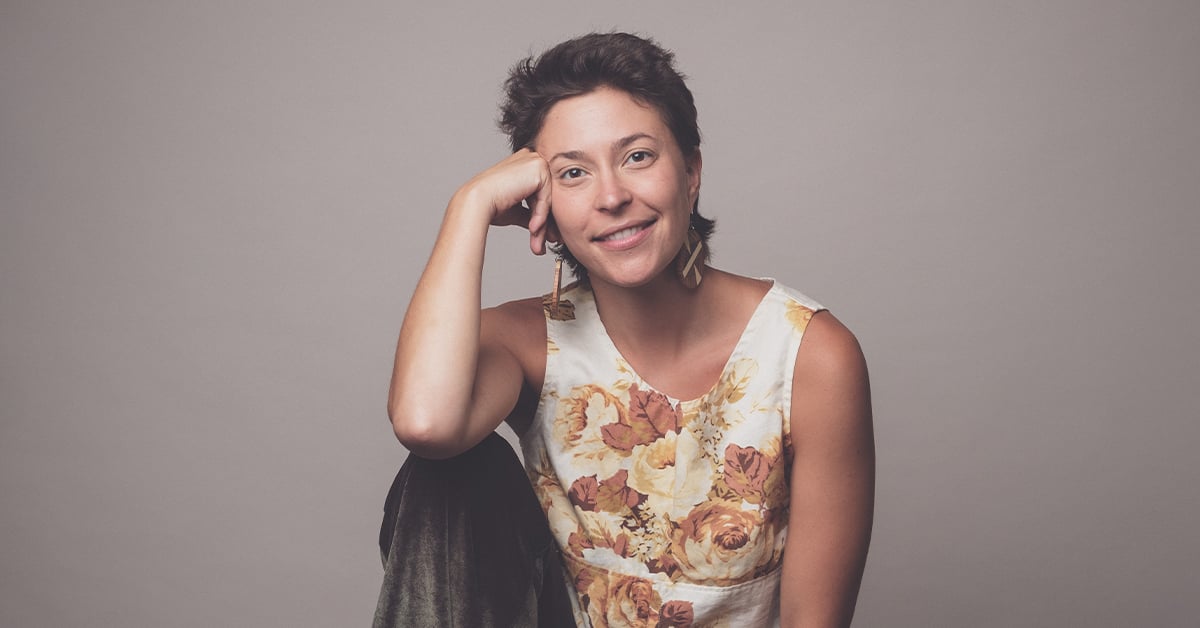
Lindsay Lou
Pushing The Boundaries Of Bluegrass
Photos By Scott Simontacchi
A modern day pioneer consistently pushing the boundaries of bluegrass, Lindsay Lou‘s music is truly ahead of the times, but she isn’t the first in her family to push the limits. Lou’s “radical grandmother,” Nancy Timbrook, a hard-working mother of eight was working as a school teacher in Detroit in 1969 when she ran into some trouble. While trying to educate her students, who were overusing a curse word, on its significance and meaning — in the hopes of teaching them to not throw it around casually — she spent a night in jail because she had written the word on the black board. The event was even the subject of a Time Magazine story titled “Obscenity: The English Lesson.” When her tactics were questioned, Timbrook defended herself by saying, “That’s what I was trying to teach—that it was indecent and immoral.” This incident is something that even now, over 50 years later, Lou talks about with pride as being a just action ahead of the times, much like her own music, which uses predominantly string-based arrangements to blur the lines between bluegrass, folk, soul, pop, gospel, blues, rock, jazz and even punk.
“My grandma has had a tremendous impact on me,” said Lou. “Obviously lyrically, the way I think, the way I write, the things that I consider in my artistic process and the music part of my foundation growing up that she was a big part of basically curating by nature of creating this community on our family farm.”
Born in Butler, Missouri, as a coal miner’s daughter 1987, Lou and her family uprooted when the artist was only 3 years old after her father lost his job in the coal mines outside of Kansas City, opting to move to Kingsford, Michigan, a short five minute drive from their family’s vegetable farm in nearby Iron Mountain bought by her great-grandfather Ratko Petroff after immigrating to the states from Bulgaria in the early 1900s.
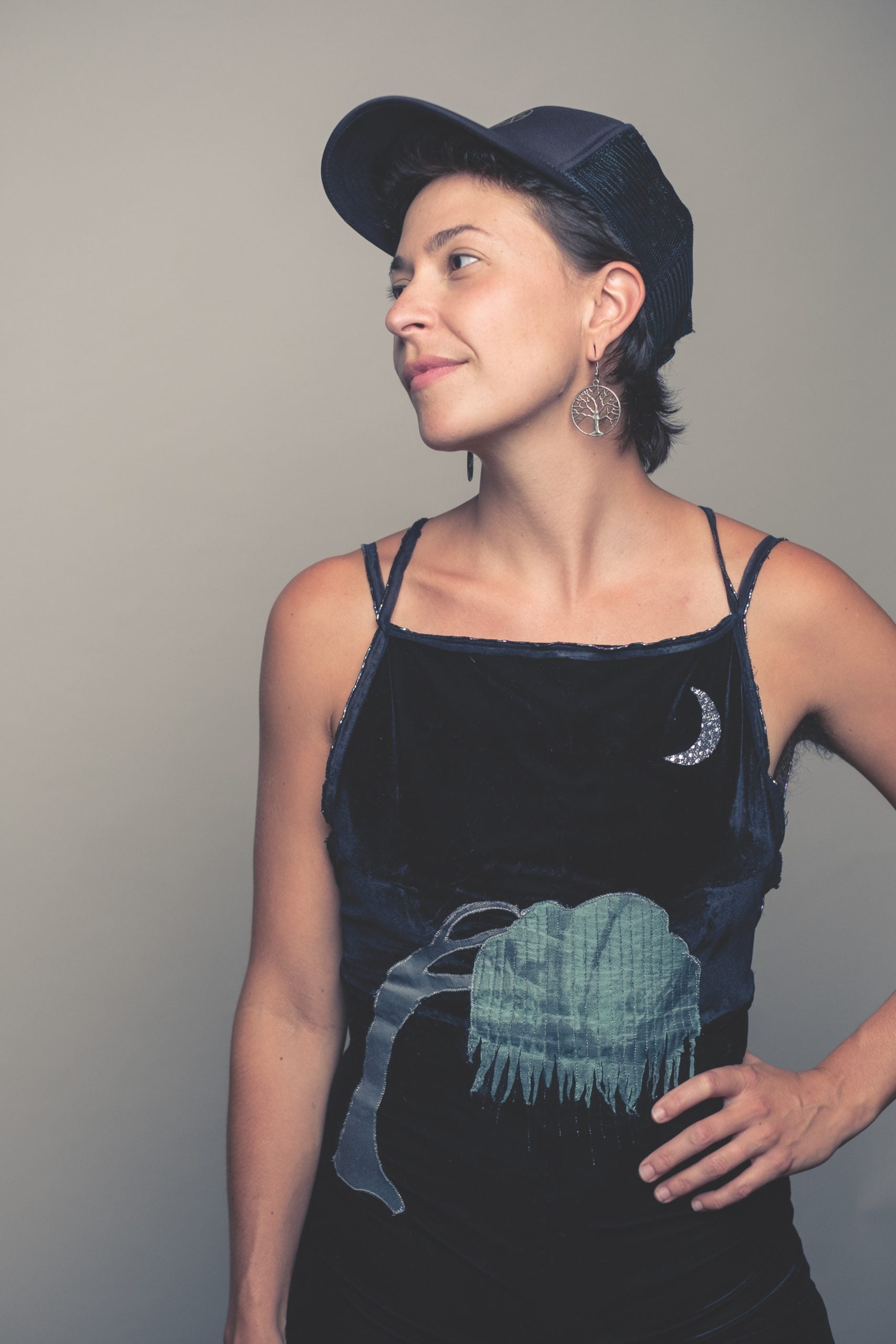
Back near the family farm and living in close proximity with her aunts, uncles, cousins and grandparents—including her aforementioned “radical grandma”—Lou recalls music being a constant means of bringing everyone together. Oftentimes the artist would wander the fields around her grandmother’s house practicing songs that she knew her uncle Nathaniel “Stuckey” Timbrook would be leading on later that evening on mandolin or guitar during their family jam sessions, which typically included a mix of gospel music, Beatles and Indigo Girls hits and whatever songs people in the family picked up along the way like “Minstrel Boy,” a song that “Stuckey” learned while working at a medieval fair from a band called The Minstrels of Mayhem that has since turned into a family standard of sorts. After watching on at first, Lou eventually joined in after watching her cousins begin to participate.
“I saw my older cousin singing harmonies with [“Stuckey”] and I wanted to be that,” said Lou. “That’s where it really started for me—my mom singing to me, my brother teaching me chords on the guitar and singing with my family—that’s my foundation.”
Long focusing solely on her singing, Lou was spurred into learning how to play guitar when she was 13 from her brother after her uncle “Stuckey” was sent off to jail. During the years that followed prior to his release in 2003, Lou learned her first song on guitar, The Indigo Girls’ “Blood And Fire,” along with continuing to dive further into the rabbit hole of family standards as she sent “Stuckey” chord charts for Harry McClintock’s “Big Rock Candy Mountain” featured in O Brother, Where Art Thou? and Nickel Creek’s “When You Come Back Down,” among others, at the same time as also learning how to play other Indigo Girls, Cranberries, and Beatles songs so that she could be ready to play them with “Stuckey” once he was back home. Unfortunately for her, their time playing together only lasted a brief three months before “Stuckey” lost his life, succumbing to injuries from a Thanksgiving night car crash.
“When ‘Stuckey’ died I felt this overwhelming responsibility to carry the torch somehow,” said Lou. “While most of my family played music, ‘Stuckey’ was the life force behind many of the jams and parties, which made losing him tragic beyond tragic. It upped the ante for me a bit in wanting to learn new songs so I could go and sing them with my family because that always has, and continues to be, one of my favorite parts about being alive.”
Before and after “Stuckey”’s death, Lou continued her deep dive into the archives of bluegrass music while at the same time exploring other genres as well, dipping into the libraries of The Cranberries, Lauryn Hill, No Doubt, NOFX, The Clash, Operation Ivy, and Joni Mitchell. In covering the later two artists, she’s been joined by guitar virtuoso Molly Tuttle for on a series of covers on her YouTube channel in recent years. The foray into rock, punk and everything in between was kickstarted for Lou when she was 9, when she had an epiphany watching people packed into every nook and cranny of her family’s farmhouse singing along to The Offspring’s “Self Esteem” at the top of their lungs, a moment that helped Lou to realize the power of music. And while the artist’s instruments of choice have always been her voice and acoustic guitar, she says that the memory still inspires and influences the music she’s making today.
“People really got to know me, and I got to know myself, through the acoustic world of music,” said Lou. “I asked for an electric guitar when I was 16 and when I got it, I just couldn’t relate to it. The acoustic world is home for me, but I’ve also spent time finding myself in punk rock music and being an angsty teenager that I sometimes feel I never grew out of.”
Then in 2008 Lou’s journey began to come full circle. After moving to Lansing to attend Michigan State University where she double-majored in human biology and Spanish with a minor in bioethics, humanities and societies; she wound up discovering bluegrass band The Flatbellys during a bluegrass open mic night at Dagwood’s Tavern, even joining them for harmonies. Lou later got to jamming with the foursome of Joshua Rilko (mandolin), Spencer Cain (bass), Joshua Brand (banjo) and Jesse Meyers (guitar), getting turned onto the likes of Doc Watson, Flatt & Scruggs, Gillian Welch and Bill Monroe in the process, and merging with the group to form Lindsay Lou & The Flatbellys soon thereafter.
“It was like finding home,” said Lou. All of the sudden I had this deep catalogue of music I could sing with people that I hardly knew, and it felt exactly like being back at home singing with my family.”
The group continued to transform in the coming years, losing Brand, who took off for Tennessee to take the bar exam, and Meyers, who left for Colorado to become a pilot, in 2009, later adding Mark Lavengood (dobro) and Keith Billik (banjo) in 2010. Then in December 2013 Billik and Cain left, opening the spot up for PJ George (banjo), known for his previous work with Nora Jane Struthers & The Party Line. Lavengood later left the band in October 2017 to pursue other musical endeavors, with Jeff Wilson (drums) coming aboard at the start of 2018 before leaving in the fall of that same year to take on the same role with Athens, Georgia, based rock band Futurebirds. Replacing him was Alex Bice in September 2018, who alongside George and Rilko rounded out Lou’s band lineup up until the start of the COVID-19 pandemic, what Lou referred to as “the great pause.”
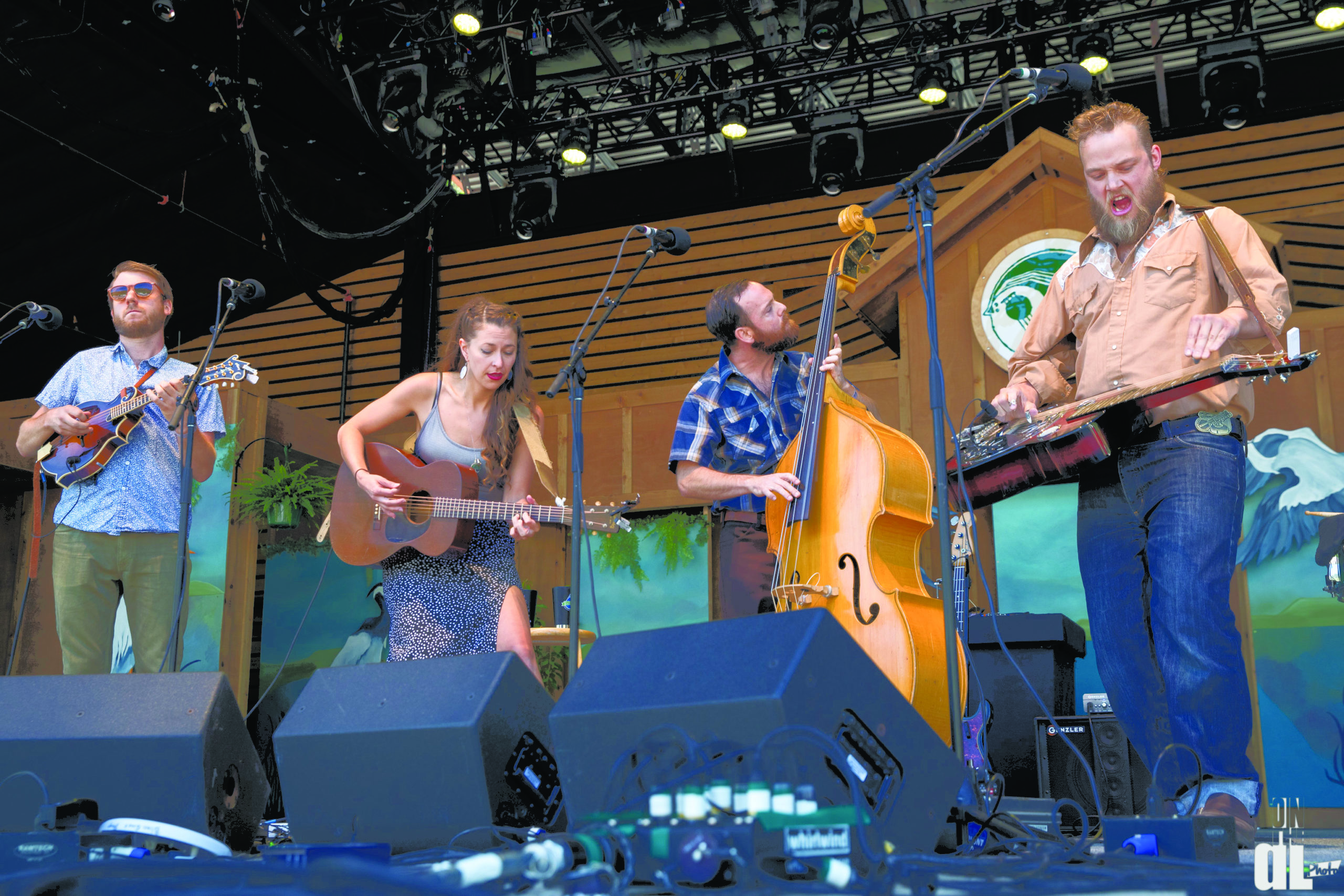
In 2010 Lou recorded her first recording project A Different Tune with the Flatbellys and other guest artists. The following year Lou and Rilko married, dropping Release Your Shrouds a year later and the 12-song duet compilation Time & Luck in 2013 right as George was coming into the fold. Then, just after a move to Nashville in 2015, her and the revamped Flatbellys came out with Ionia, a soul and pop-tinged bluegrass collection named after the small Michigan town outside of Grand Rapids where the band lived during the project’s recording. Soon after Lou was honored as one of NPR’s Best Public Radio Sessions of 2015 for a performance on Mountain Stage followed by Lou being nominated for Best Vocalist by the International Bluegrass Music Association in 2016. As the success came the band’s reach blossomed, earning the group spots on the lineups for Scotland’s Celtic Connections and Australia’s Woodford Folk Festival in addition to shows stateside at Telluride, DelFest, WinterWonderGrass and ROMP Fest. In 2018 came Lou’s next and most recent release Southland, also the first without the Flatbellys’ name on the end, instead going with the short and sweet Lindsay Lou.
Ionia, Michigan, where Lou recorded her album of the same name, is also the hometown of guitar phenom Billy Strings, whom Lou made her first connection with in 2012, describing him as “the spirit of Doc Watson reincarnating inside a 19-year-old metal head.” But as it turns out, it wasn’t Lou gawking at Strings’ musical chops upon their first meeting, but rather the other way around.
While Strings has known Lou since 2012, he said he was already familiar with and a fan of her music prior to meeting her after hearing the artist performing live with the Flatbellys on WNMC 90.7, the local college radio station in Traverse City, Mich., where Strings was living at the time. Soon after hearing the radio performance Strings connected with Lou’s then-bandmate Mark Lavengood to discuss linking up in person, a promise that Strings delivered on roughly a month later when Lindsay Lou & The Flatbellys came back to town to perform during the Traverse City Film Festival.
“There weren’t many people in the area playing bluegrass music at the time,” said Strings. “I remember hopping on my bike and riding across town, almost getting hit by a car on the way. When I arrived, I heard them warming up in the green room so I went in and introduced myself. I was the one barging into the green room on her.”
While the two both moved away from Michigan in the years to follow, their journeys came back together in Nashville, with Lou moving south first and convincing Strings to follow suit, going as far as to send him the listing for a house for rent down the street from her, an offer Strings took Lou up on. According to Strings, the next couple of years both he and Lou’s houses were like musical havens, with local friends always sitting around jamming along with touring bands like Greensky Bluegrass and Fruition stopping by as they passed through town. The moment in time also saw the two co-writing songs together including “Freedom” and “Home” from Strings’ critically acclaimed 2019 album of the same name, a process which Strings referred to as being a personal, real and honest experience that doesn’t always yield a song, but does provide him with a deeper knowledge of what they’re striving to write about.
“A lot of times we’ll just end up getting lost in a deep conversation about the subjects we’re trying to write about without making much progress on a song aside from broadening our perspective of the topic we’re focusing on,” said Strings. “Lindsay is one of the most gifted singers that I’ve ever had the opportunity of playing with. I’d put her voice up there with Alicia Keys and Beyonce, the best of the best. I’d love to see her soar.”
In addition to her well established connection with fellow Michigander Billy Strings, Lou has also spent time in recent years collaborating with May Erlewine and Rachael Davis, two other Wolverine State born songwriters, in the Sweet Water Warblers, a side project that blossomed out of what was initially planned as a one-off performance together by the organizers for Hoxeyville Music Festival in 2014. In the six years since that foreshadowing set, the group has toured together extensively, including in the United Kingdom, in addition to putting out two official releases—2017’s debut With You EP and the full length The Dream That Holds This Child out in May 2020.
“When Lindsay sings, it always feels to me like her heart is quaking within her, like her body can hardly hold all of the feeling,” said Erlewine. “One of my favorite things about collaborating with Lou is her genuine enthusiasm and joy. She truly loves music and she loves the world through the songs she writes and sings.”
Erlewine continued, “[Lindsay] seems to always be reaching for growth as a means of inspiration. This is a great thing to reach for in a life of music. I have only ever seen her striving and exploring and getting stronger through it all. As young people, we all have to wake up to our own seriousness and also our own tenderness. This is the time when we stop proving ourselves and instead become ourselves.”
Going hand in hand with her eclectic musical palette, Lou’s songwriting also pulls from a wide array of influences including poetry and other creative writing excerpts, particularly those of the late German-language poet Ranier Maria Rilke, whose works Lou described as having “helped to guide, console and be there for me during my journeys over the past several years.” One song that is a direct result of those influences is “Shining In The Distance,” a cut from Southland co-written and also performed by Maya de Vitry with her band The Stray Birds. The song, which is ripe with gospel-y vibes, was pieced together mostly from two Rilke poems, “Shining In The Distance” and “Is It Not Time?”, corresponding with each co-writers birthday and catalogued in A Year with Rilke: Daily Readings from the Best of Rainer Maria Rilke.
Even now, amid a pandemic that has slowed the band’s touring schedule from a rapid 150-200 gigs a year to a standstill, Lou is continuing to unwrap the moment, working on her first new music exclusively under her own name since Southland with producer Dave O’Donnell (James Taylor, Eric Clapton, Sheryl Crow) in addition to taking guitar classes and giving vocal lessons. When her music does come out, it may feature a new set of characters backing it, as Lou again continues to grow and evolve musically. However, prior to then, Lou marked the closing of one musical chapter and the beginning of another during a Sept. 18 livestream from Nashville’s Station Inn where she performed both Ionia and Southland in full with Mark Lavengood, Joshua Rilko, PJ George and drummer Alex Bice joining her. All the while as her bandmates change and her influences grow, Lou continues to find solace in the bluegrass community that has nourished her through her musically formative years since the days of playing with “Stuckey” and the rest of her family on their Michigan farm.
“Bluegrass is one of the most beautiful communities because it is just so down to Earth,” said Lou. “Your heroes are your friends and everyone is busy teaching and learning from one another. There’s so much emphasis on giving each other space to jam and taking turns leading. It’s practically a church for the lost soul.”