
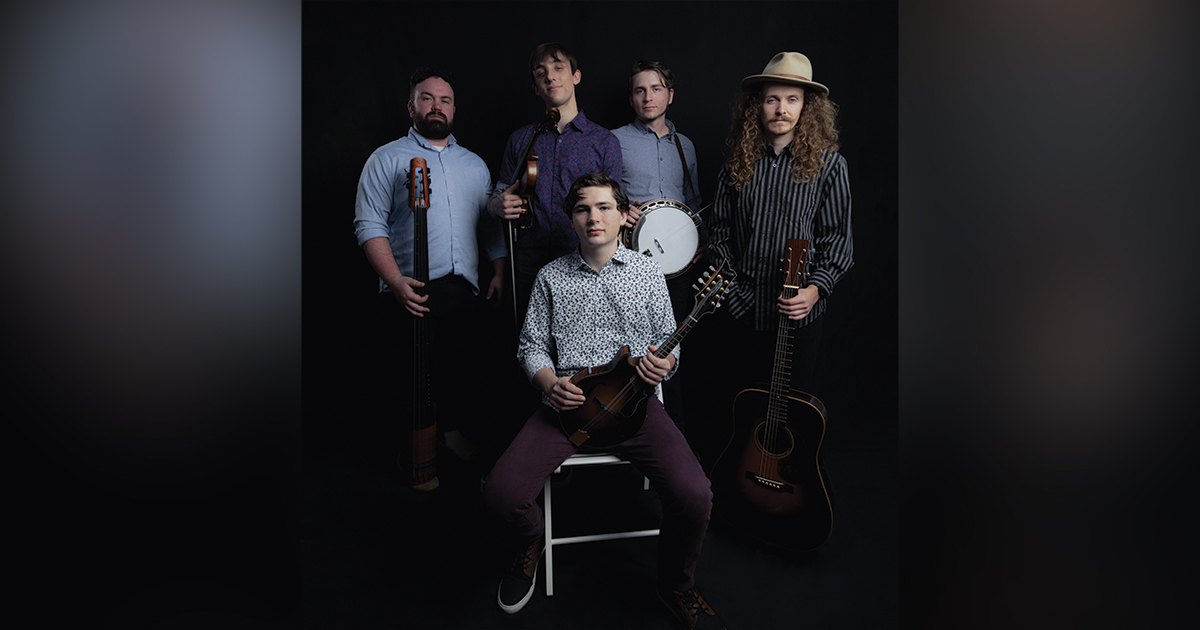
Liam Purcell and Cane Mill Road
Photo by Craig Etchison
For many musicians, releasing an album at twenty would be considered quite an achievement. At twenty, Liam Purcell of Cane Mill Road is preparing to release his fifth full-length album later this year. Now a senior at Berklee College of Music, where he studies music business and performance, Purcell continues a practice he started early—surrounding himself with talented musicians.
“Berklee is like any other university in in many senses, but there’s this atmosphere going on all the time of creativity and people connecting with one another. Many of us call it Camp Berklee because it has the aura of a conference or camp that goes on steadily for four years,” said Purcell.
Growing up in Deep Gap, North Carolina, Purcell was influenced by Doc Watson and found himself a part of the old-time music community. “I didn’t have too much interest in making friends outside of that community, so in the early stages, it was an outlet for creativity and friendship. That was a great space to come from, to learn and grow,” Purcell says.
“My parents were not folk musicians, and when I first got into it, none of us were familiar with the bluegrass world other than casually listening to a few albums,” says Purcell. When they saw his interest, his father offered to take him to guitar lessons. “Once they saw that I had a passion for music, they were incredible to do everything they could to nurture it throughout my life.”
Liam started going to fiddlers’ conventions on the weekends, and once he realized his real passion was playing music, he gave up baseball and soccer around middle school to focus on music. His father, a communications professor for most of his career, began taking Liam to music camps in the summer, such as Swannanoa Gathering, and eventually found himself hauling Liam around to gigs and helping him set up the business side of his music. Over time, he says, his parents became “very knowledgeable bluegrass fans and very much a part of the industry. That’s what they do, and they love it.”
Purcell was homeschooled through high school, taking courses and earning an associate degree at Wilkes Community College, when he first founded the band Cane Mill Road about seven years ago. The band members started as friends, playing local gigs for fun. After a couple of years, they began performing regionally, getting more professional opportunities throughout high school.
Along with Purcell, the first lineup of the band included Tray Wellingon, who released his first solo album Black Banjo last year, and Eliot Smith. Purcell’s roommate at Berklee, Smith is now a violin maker, playing less professionally. The group played festivals such as MerleFest and Grey Fox and put together a string of shows before the pandemic hit. “That brought a lot of change in the band, said Purcell. “Some left for different pursuits or career paths. After you get out of high school, the world looks a lot different, and not everybody wants to go with music for the long run.”
At the end of 2019, Purcell was joined in the band by Appalachian State professor, and long-time friend, Rob McCormac on guitar, Jacob Smith on bass, and Colton Kerchner on banjo. Sam Stage was added on fiddle, and that lineup is going into the third year. Aware that the original group was known and loved, Purcell was determined to let fans know they could continue to expect the same kind of shows from Cane Mill Road.
For Purcell, one advantage to attending a music-focused college is the leeway to participate in events. “They’ve been kind to let me do work early and play some hooky for a couple of legs of the fall tour and IBMA,” he said. In 2019, Liam Purcell and Cane Mill Road was selected IBMA Momentum Band.
“IBMA has been one of the biggest boosts to our career because of the industry connections, putting our music in front of all these eyes at once,” Liam added. “Getting the Momentum Award took that to a new level,” giving people a reason to check out the band, attending their showcases. The recognition also encouraged people to take a professional look at the band and consider partnerships for recording, representation, and publicity.
“That was good affirmation for us personally, aside from the industry recognition,” Purcell said. “It was emotional to feel like other people saw our work when all the seeds we planted were barely even out of the ground yet, but somebody saw us doing the work and wanted to recognize us.”
When the pandemic brought touring to a screeching halt for a while, some people reconsidered their music careers, and some took advantage of the time to create. The members of Cane Mill Road found themselves living in the same area during the shutdown, giving them a chance to dig into writing and arranging material for their next project, which Purcell considers a silver lining.
The band was able to begin touring again in 2022, hitting thirty-five states. “The wonders of the online world mean that we can reach a larger audience,” Purcell observed. “We’ll show up to places we’ve never been before and find people who have heard us that come out to a show.”
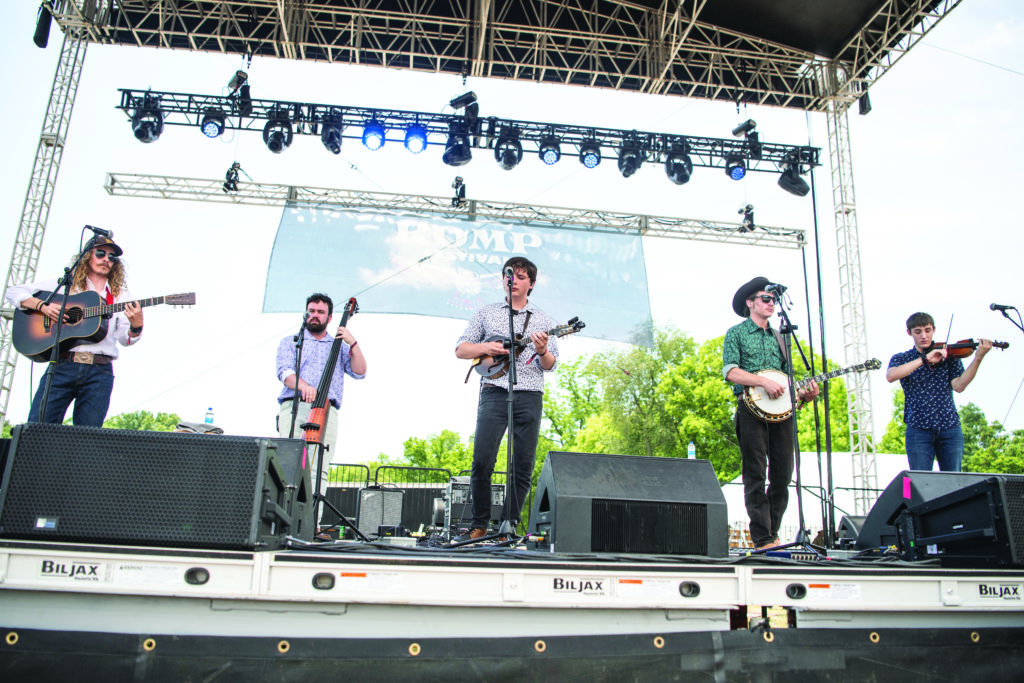
Their tour schedule has included ROMP in Owensboro, Pickin’ in the Pines, and MerleFest, which Purcell considers one of his favorite annual homecomings. While they typically break up their travel schedule, they spent 34 consecutive days on the road. They usually drive to summer shows, since they are all leaving from North Carolina, putting 40,000 miles on the van last year. During the academic year, they’re more likely to fly due to time constraints and band members living in North Carolina and Boston.
Purcell also attended the RockyGrass festival in Colorado in the summer of 2022. He said Colton Kerschner, the band’s banjo player, had been trying for a couple of years to get Liam to his favorite festival. “I finally caved, and it was just as incredible as promised, probably one of my favorite festivals in the books.” Purcell added, “Since the tickets and the trip out there were expensive, I thought I might as well enter the contests and see if I could make something back on the trip,” he said.
Purcell said he had competed at fiddlers’ convention contests when he was younger, which he credits with polishing his playing, but since he was less interested in competition, he moved towards the performative side. “I was struggling for the motivation to keep the instrumental train moving forward. I had been maintaining the skills that I had in practice,” he said, “and it was hard to keep pushing forward. Berklee helped me do that, but this was a goal I could work towards—and what a wonderful festival! My good buddy Isaiah Gardham, a fellow student at Berklee, was my accompanist through all the rounds on all the instruments.”
Purcell walked away with a trifecta—placing first in banjo, mandolin, and guitar categories. While considered a multi-instrumentalist, Purcell says he usually plays mandolin on stage with the band. All the band members pinch hit on other instruments, he noted, which helps them when writing or arranging. “I tend to gravitate toward mandolin and guitar—mandolin for expressing myself freely and guitar for writing. They tie for the first reach on the instrument rack, but I find myself mostly playing banjo at Berklee, oddly enough, because there are very few banjo players right now,” he said.
From the inception of the band, Purcell and his colleagues have achieved a balance between traditional standards, new twists on covers, and original music. Purcell says, “It’s a line that didn’t always exist the way it does now. A lot of acts fall on one side or the other. For somebody in my generation who’s looking at making a living in the industry, it’s a line you have to walk in a sense. Apart from that, I enjoy paying respect to the tradition and what came before I grew up.”
Steeped in old time music before moving into bluegrass, Purcell still likes to draw from older music traditions. “It’s less that folks are unwilling to listen to a different kind of music, but it’s more meaningful when you add to the tradition and pay respect to that music in a certain way,” he said.
“Personally, a lot of my creativity comes from drawing on music that I enjoy. That pool grows bigger every day as we see new folks going into the Hall of Fame, and more modern musicians becoming revered for their work earlier on. The genre keeps expanding so much, but it’s liberating musically to draw on so much. I can certainly appreciate a preference for a traditional style of bluegrass. Many days when I go to listen to music, that’s exactly what I want to hear, but I think it’s such a broad audience now that there’s something for everybody.” He added, “We’re influenced by musicians like Doc Watson, but people we think of as traditional now were breaking ground in their times and incorporating songs from popular music, such as Flatt and Scruggs covering some Johnny Cash or Bob Dylan or Bill Monroe covering blues tunes.”
Rather than heading to the beach for spring break this year, Liam and his band members scheduled time in the studio for a final recording session to put finishing touches on their new album. Their fifth full-length project recorded at the Rubber Room Studio in Chapel Hill, North Carolina, is due for release on Trailhead Records on July 1st. Jerry Brown, who helped launch Mandolin Orange and Mipso, headed up production.
In March, the band released Darrell Scott’s “Uncle Lloyd” as the first single, with plans to release a second single “No More,” written by bass player Jacob Smith in April. Purcell does the bulk of the writing for the band, but he says Smith has been focusing more on songwriting over the last couple of years and will be featured singing lead and playing bass. While most of their lyric writing happens individually, he says, the band collaborates during the arranging process, particularly with the instrumental aspects.
“I consider the instrumental arrangement just as important as the lyrical part, and not even in terms of chord progressions—but orchestration and the fine details—that part we do as a group,” Purcell said. “We’re also fortunate to have five vocalists in the band, so we pass it around a good bit. I do a lot of the lead singing, but Jacob has a background in classical opera singing, so whenever we have something that’s exceptionally high or needs a lot of breath, then it’s time for him to shine. Everybody has unique voices, and it’s nice to spread it around a little bit so we’re not listening to the same voice for an entire two-hour show.”
Liam Purcell and Cane Mill Road have put a lot of thought into selecting tracks for the new album. Liam noted that while some of their earlier albums were heavy with covers, in their most recent Roots, they made a shift towards more of their own original music, a trend they continue with the upcoming album. “I think it’s important to make sure that if we cover a song, we add something significant. There may be a hundred songs I would like to cover just because I love the original version, but it wouldn’t do much for us or for anybody listening if we copied the original exactly,” he said. Instead, he said, they wanted to make sure a cover was respectful to the original, maybe presenting it in a new light.
“I think the bar is higher for covers because there’s so much out there; we have to pick the most meaningful or most entertaining songs. That’s true for originals as well. We have boatloads of material that we write, arrange, and sometimes even get to recording that doesn’t make it on the final record because of process of elimination, weeding down to an eleven or twelve-song album.”
The band checks an item off their bucket list in March playing the Appalachian Theater in Boone. In October 2019, Liam helped to christen the theater, playing on stage with John McEuen and his band for the theater’s sold-out “grand-reopening” before the venue was forced to close again in March 2020 because of COVID restrictions. In April, when they release the second single, they also plan to announce the rest of their tour dates for spring and summer.
With the upcoming album, Purcell says he looks forward most to the chance to showcase the original material. “The time factors have allowed for so much freedom in terms of crafting what we want, and the landscape of how people listen to music is evolving. That allows us to do some things differently, for better or worse. We love crafting a complete story from start to end within a larger arc, so it’s been a challenge to do that, especially knowing that people may be listening to one song at a time on streaming services or on the radio.” They plan to include a bonus track or two on the CD and the vinyl.
Purcell says the album doesn’t include any traditional bluegrass covers, “partly because, those things have been done very well by a lot of people. Coming from the tradition of Appalachia, we believe in adding to that tradition, so some of the songs that are more of a traditional genre, sonically or lyrically, are actually originals.” They also pulled from outside of bluegrass and from other favorite songwriters for this album.
For this project, Purcell also wanted to use some of the production tools he has studied at Berklee that are not always used in the bluegrass world. “I think in a tasteful way I can add recording techniques, layering things in the studio that are now even possible to do live with technology we have. We can stay focused on the instrumental skills and the presentation.”
He added, “When bringing new things into the bluegrass world, we’ve tried to use all these things tastefully.” He said a lot of the songs are “bare bones, songs you could play the bluegrass jam circle. It’s important to make our music kind of accessible. At the same time, we especially wanted to craft two or three songs that fit well in a festival environment, something to get people up and moving, in addition to the kind of straight-ahead grass. I think folks will find it to be a broad palette.
“But if you’ve listened to our band in the past or kept up with our live shows,” he added, “you’ll know that’s not going to surprise anybody.” If Liam Purcell and Cane Mill Road can lay down this solid a career track by twenty, fans may be in for plenty of pleasant surprises in the future.