Learning By Ear Course
Learning how to play a musical instrument by ear is a skill that is vital to your development as a musician in traditional genres of music. While reading music can also be a valuable skill, in most forms of traditional music—folk, old-time, bluegrass, Celtic, blues—the music is historically handed down aurally. Musicians who participate in these genres of music will not typically have a music stand sitting in from of them at a jam session or during a stage performance. It is also very likely that the traditional music that you may want to learn will not be available in a written form, so the only way to learn will be by ear.
There are a multitude of benefits to obtaining a well-developed musical ear, including—learning music that has not been written down, learning music (whole tunes, licks, phrases, etc.) that you hear on recordings, learning to creating your own arrangements and improvisations, executing a musical phrase that you hear in your head, participating on songs and tunes that are played at a jam session which may be new to you, and learning from other traditional musicians who don’t read or write music.
When you are able to develop the skill and confidence to sit down with your instrument and learn any song, any lick or phrase, or any technique on your own, it can be very liberating, and it will bring a new level of excitement, enjoyment, and fulfillment to your musical life. However, if you are a beginning student, or one that has always relied on written music in the form of standard music notation or tablature, learning music by ear may seem like a very steep hill to climb. The good news is that training your musical ear takes less time than you might imagine if you have a good method, some basic guidelines, and a consistent practice routine…and Lissa Schneckenburger’s Learning By Ear Course is available to provide you with exactly what you need.
Lissa’s Background—The Early Years
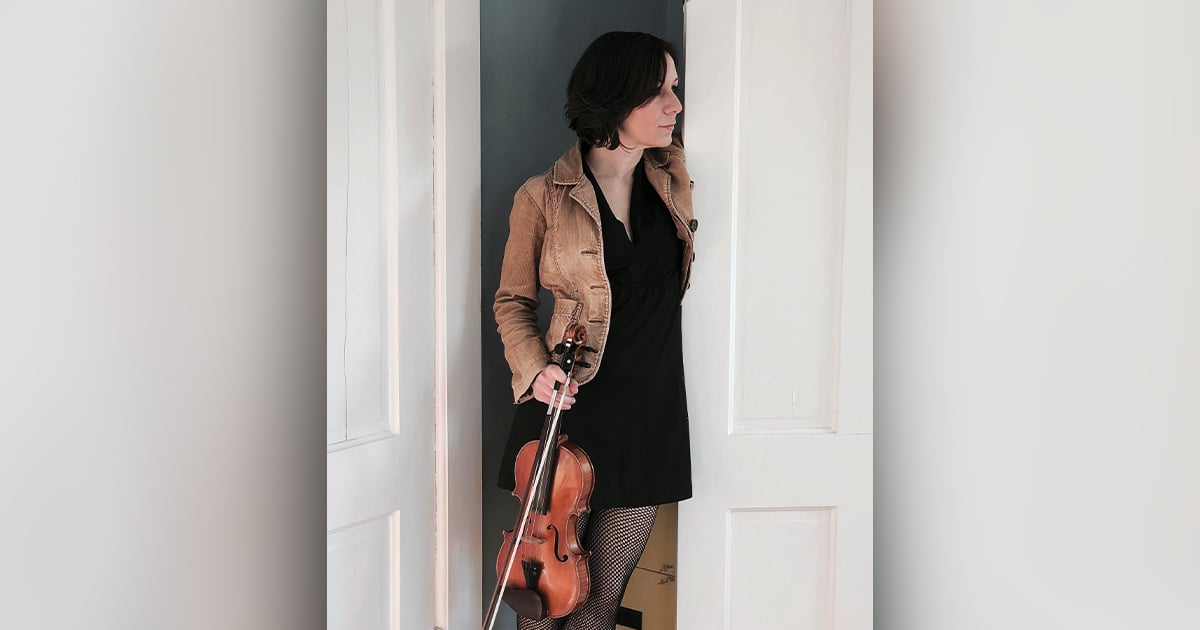
Before I present information regarding what you can expect to learn if you enroll in Lissa’s course, let me tell you something about the teacher. Lissa Schneckenburger is a fiddle player from Litchfield, Maine who started playing the fiddle at age six (her name is pronounced like Melissa, without the “Mĕ”). Many fiddle players who start at such a young age are first introduced to their instrument through classical music lessons in the school system or through programs like the Suzuki violin method. Lissa was not one of those. She started out learning traditional fiddle music that was based on traditional New England style fiddle and dance music…and she learned it by ear.
Lissa said, “I was really excited to start playing because my neighbor also played the fiddle and I thought that was super cool. As luck would have it, my mother’s good friend from college was a fiddle player and singer. She came to visit for a vacation and gave me my first lesson.” After that initial lesson, Lissa then started working with Greg Boardman, a private teacher in Lewiston, Maine. Lissa said, “Greg is a great string teacher and player. He has turned hundreds and hundreds of kids on to fiddle music. He is a great teacher and he is still going strong.”
Lissa started out studying New England style fiddling, but by the age of nine or ten she was also drawn to Scottish fiddling through the playing of Alasdair Fraser. She said, “I got his album The Road North and that was so inspiring. I loved it so much. I’m sure that all fiddlers have some album that lit them on fire and for me it was that one and I got excited about Scottish music.” Lissa learned how to play every track on the album by ear.
Shortly after Lissa discovered Alasdair Fraser’s playing—and had learned how to play the tracks from the album—her family attended the Highland Games in New Hampshire. She remembers, “Every fall there is a big Highland Games in New Hampshire and we went there and joined a fiddle contest. That is where I first met Alasdair Fraser. He was judging the contest and also performing at the games.” The tune that Lissa performed in the contest was one that she learned directly from his recording. She said, “I think that he thought that was pretty funny.”
High School Years
Lissa continued to study the fiddle from Greg Boardman through her high school years. Additionally, during high school, she started to attend various fiddle camps and festivals. She said, “I would try to get as much musical instruction as I could. I traveled to Ireland for several months and did workshops there. I was in a touring ensemble that went to Russia and did performances. I would go to Ashokan Fiddle and Dance Camp with Jay Unger and Molly Mason, I went to Valley of the Moon Scottish Fiddling School with Alasdair Fraser…I went to as many places as I could and devoured music. It was an inspiring time. I got to meet a lot of really amazing musicians who inspired my playing and helped propel me forward.”
It was during her senior year in high school (1997) that Lissa released her first album, The Mad Hatter. She said, “It is out of print now and so I don’t bring it around to gigs because I’ve developed much farther as a musician since then, but it was an awesome learning experience at the time and it ended up being a great audition piece for music school.” Lissa described the album as being a combination, or summary, of her whole high school learning experience. She said, “There were some original tunes, some Irish tunes, some Scottish tunes, and some New England tunes. It was a real hodge-podge…like a musical book report of what I did in high school.”
Off to College
After she graduated from high school, Lissa attended the New England Conservatory (NEC) in Boston. She said, “Few people know this, but they were actually one of the first conservatories to start a jazz studies program. Alongside the jazz studies program they have a contemporary improvisation program, which is where I ended up studying. That was a really good fit for me. I’m not a classical player at all. It was a perfect place for me to hone my skills, work on my technique and develop a stronger personal style. It was also at NEC that I got a lot of the teaching inspiration that I use when I teach music today. It dates back to a lot of the inspiring teachers that I studied with at NEC.”
While most students entering a music conservatory at the college level would be well acquainted with reading music, that was not the case for Lissa. She said, “I had learned primarily by ear and it was actually extremely difficult for me to learn how to read music. When I showed up at the New England Conservatory, I was suddenly exposed because I had been faking my way, pretending to read music, all through high school. I would figure out the music real quickly by ear and then fake that I was reading it. When I got to NEC, that wasn’t going to fly. I ended up having to put in some serious hard work and effort learning how to read music because I had relied on my ear so much from the beginning. The benefit of putting in that work is that I figured out that it is possible to learn hard things. I now appreciate that struggle and that informs my teaching today when I work with students who are struggling with something, whatever it happens to be.”
During her senior year of college (2001), Lissa recorded her second album, Different Game. She said, “It was, again, like a summary of all of the things that I had learned in college. Of the thirteen tracks on the recording, five are originals. Lissa said, “In New England traditional music, there is always a lot of room for new original music. There is always some older traditional stuff, and then there are always some newer things, so Different Game is definitely in that vein.” Five of the cuts on this album are medleys. Regarding the recording of tune medleys, Lissa said, “The older style New England musicians would typically just play one tune per dance. It is a real social dance tradition. The older style involved playing a specific tune to go with a specific dance, and you just play that one tune. But the modern iteration of the tradition has started to include lots of medleys, so it is evolving and I was evolving with it.”
Post College Career
Lissa had started teaching others to play the fiddle in high school and continued to do that in college and after college. She also started to tour to perform her music live in various band configurations. She said, “After college I really ramped up the touring schedule. I was touring a lot during the ten years after college. At one point I was on the road for something like 300 days a year…it was really crazy. She performed in configurations ranging from a duo with a piano player; a trio with fiddle, bass and guitar; and a quartet with three fiddles and a guitar. She also substituted in friend’s bands when she was needed and performed with a couple of Celtic rock bands.
During this time, Lissa also became interested in “digging up really old fiddle tunes and ballads from the Northeast.” In 2005 she released her third album, self-titled Lissa Schneckenburger. This album reflected her deep dive into the traditional music of New England as presented in old New England fiddle tunes and vocal tunes of New England origin. Lissa’s next three albums—2008’s Song, 2o10’s Dance, and 2013’s Covers—where focused exactly as the album titles indicated.
Having toured heavily during the early part of the current century, Lissa’s touring schedule slowed down after she became a parent in 2009. At that point she switched gears and started teaching more. She taught privately and also was invited to be an instructor at many music camps. Her 2019 album, titled Thunder In My Arms, was all original music that primarily reflected her personal experiences as a foster parent. She is currently working on new album of original fiddle music that is scheduled for release in March 2023.
Learning By Ear Video Course
While teaching at music camps Lissa decided to develop a Learning By Ear workshop. She said, “I tried it one time as something fun to do and a ton of people showed up. I thought, ‘This seems like something people really want or need.’ A lot of the exercises and concepts and different steps that I lead musicians through in the online Learning By Ear course…a lot of those were initially developed in a live workshop setting. I probably taught this workshop for the first time at least fifteen years ago. I’ve been teaching it over and over again to lots of different groups of people ever since. I have a system of exercises that I can lead people through. Every time I taught a workshop live, I always had people come up to me afterwards asking where they could get the information to bring home. They wanted to know if there was a workbook, or a CD. For many years, I had to say ‘No.’ Once the pandemic started and I had a bit of free time on my hands, I thought, ‘This is my chance. I’m going to put together a learning by ear course.’ That was my project during the first year of the pandemic.”
Regarding the importance of developing the skill of learning music by ear, Lissa said, “If you are playing any kind of folk or traditional music genre, notation is handy—it is a great tool to help you learn tunes quicker or communicate with other musicians—but the notation system that we use was developed for a different kind of music. It was developed for western classical music and it works great for that. But when you are talking about fiddling, or traditional dance music, or bluegrass there are things that you might want to do in that genre stylistically that are not accurately represented on the page. Certain subtle rhythmic things, certain kinds of ornamentation, or detailed timing of ornamentation…a lot of that you have to get from listening.
“It is super important that you develop your ears so that you can hear all of that awesome stylistic stuff that goes into making a tune sound like it is…like a Scottish tune or a bluegrass tune. You would not necessarily be able to get that from the page…the articulation, the ornamentation, the dynamics and all of that stuff.
“Learning by ear is an essential skill for you to be able to advance your music to a level where you are speaking the same language as everyone else who you want to play with. It is also really great for playing along with other musicians…so that music is more accessible to you. Nobody wants to have that frustrating situation where they show up to the jam session and they don’t know any of the music and they feel kind of left out or lost. When your ears are ‘in the game’ and working for you, you will be able to pick that stuff up quicker, and join in and even interact with other musicians on a much deeper level and get so much more satisfaction out of the music that you are playing.”
There are fourteen videos included in Lissa’s course, all available on her website (lissafiddle.com). It is a very hands-on, systematic approach. Each video builds on the skills developed in the previous video. The videos are of varying lengths, lasting anywhere between about ten and twenty minutes depending on the topic. While working with the exercises, students are encouraged to rewind and repeat. Lissa feels as though students should take roughly one week of consistent daily practice to make it through each video segment.
Without getting too specific about the content of each lesson, I’ll say that the lessons start out with training you to hear and repeat simple rhythmic phrases, then move on to listening to exercises which develop your ability to distinguish relative pitches between two notes (developing the skill to hear if the second note is higher or lower than the first). From there, through call and response, she works to develop your ability to hear and repeat musical phrases starting with simple two-note phrases and then gradually working up to three, four, five, six, seven, and eight note phrases over the course of two videos.
Throughout the course, part of the homework involves going back through these first fundamental videos and continuing to drill the lessons on a regular basis to strengthen these listening skills. Part of the problem in drilling the same videos, and thus the same patterns, over and over is that at some point you may memorize the patterns and thus not really be listening with fresh ears each time. To solve this problem, Lissa not only recommends that the student record his or herself playing random patterns, and thus develop unique practice drills, but she has also set up a Facebook group for students that are working with her course to share their own call and response exercises with other students.
After the foundation is set in the first five videos, the next three videos are spent applying those skills to learning actual fiddle tunes by ear (“Huntsman’s Chorus,” “The Tombigbee Waltz,” and “Rory O’More”). Before learning each of these tunes by ear, Lissa highly recommends that you familiarize yourself with the tune by listening closely to it without your instrument in hand. The idea is to be able to sing, hum, or whistle the whole tune before you ever try to put it on your instrument. Lissa said, “I stole that technique from my college days. That was a huge part of the contemporary improvisation curriculum at NEC was all about listening and developing your personal style through really intense, focused listening. I remember a class that I took freshman year where they would say, ‘OK, you have to learn these five pieces, but for the first four or five days you can only listen to them and you are not allowed to touch your instrument until you’ve listened to them every day. It was really…I was going to say ‘eye opening,’ but it was ‘ear opening’. It is amazing how much you can learn by paying attention, especially for beginning or intermediate musicians. It is really helpful to just focus on your ears for a little while.”
After teaching new tunes for three videos, Lissa turns the subject of the next two videos to providing tips and techniques to use that will help you pick up tunes “on the fly” at jams sessions. She also includes a segment on jam sessions etiquette. Then, videos eleven, twelve, and thirteen return to the call and response exercises that are similar to those presented in videos two, four, and five, but using different phrases. Finally, in video fourteen, Lissa provides call and response exercises for jigs, reels, waltzes, and marches to give you a feel for these different time signatures and grooves.
Lissa has done a great job presenting very practical and useful material that will help any student of any instrument improve their musical ear and musical memory. In addition to the fourteen video lessons presented here, she also provides a weekly video to anyone that signs up for her free mailing list. In these weekly videos she presents tunes, practice tips, practice challenges, and a variety of other topics relating to student’s interests.
If you are interested in checking out the Learning By Ear course, you can view a free sample video at lissafiddle.com. Once you land on the home page, click the “Store” menu and scroll down to the “Learning By Ear Video Course” graphic and click on that. Then scroll towards the bottom of that page for the free sample video. This course is highly recommended for anyone with the desire to improve their ability to learn music by ear and it is reasonably priced at an average of less than ten dollars per video lesson.