Laurie Lewis
Celebrating the Crooked Miles
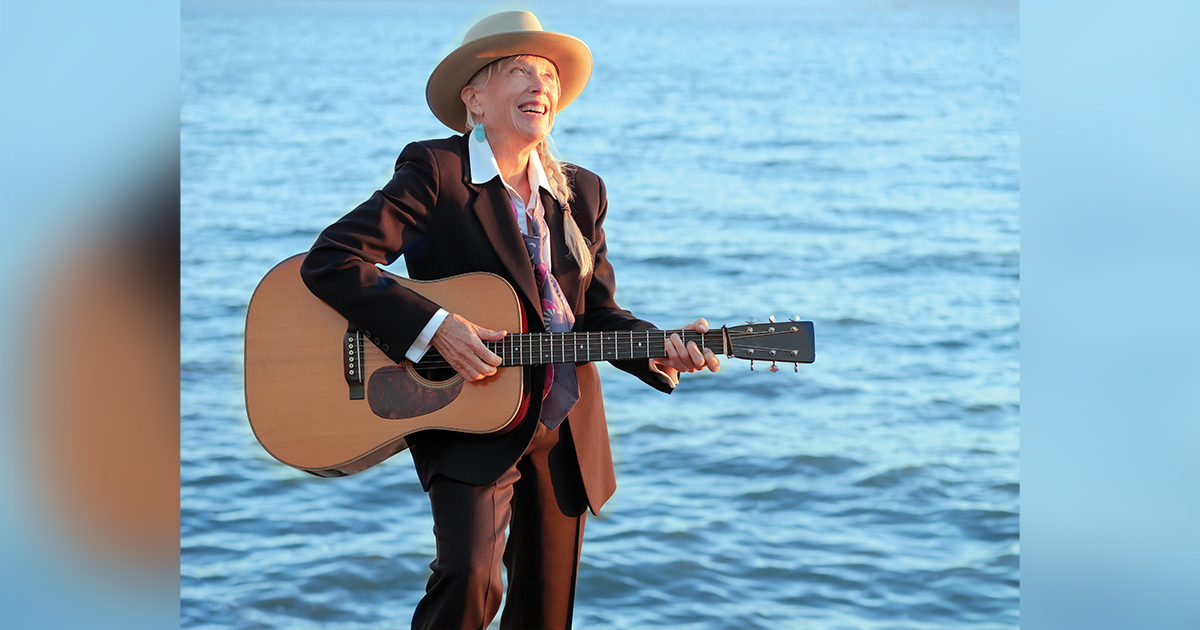
Consider Laurie Lewis. She modestly calls herself a “California hippie girl fiddler.” She’s a Grammy Award-winning recording artist, a two-time winner of IBMA’s Female Vocalist of the Year and a two-time winner of the California Women’s Fiddle Championship. She’s performed on both the Grand Ole Opry and the Prairie Home Companion radio shows.
She’s also a highly respected songwriter and band leader. Della Mae’s Kimber Ludiker says Laurie’s “music made me fall in love with bluegrass” and Molly Tuttle calls her “one of my earliest heroes and influences.” Sing Out! magazine hailed Laurie Lewis as “one of the leading lights of American acoustic music, a genuine national treasure.” She represents many things to many people.
Laurie Lewis was born in 1950 in Long Beach, California. Her parents lived in McKinney, Texas, at the time, and her pregnant mother had gone to stay with family in southern California to await Laurie’s birth. The family spent three years in Texas, then five years in Ann Arbor, Michigan, before moving to Berkeley, California, when Laurie was eight. She’s been there ever since.
After what she laughingly calls “a botched run-in with the piano” at age seven, she took several years of classical violin lessons starting at 12. “I fell in the love with the violin,” she says, “but I didn’t fall in love with classical music.”
What did fire Laurie’s imagination was the music she heard at the annual Berkeley Folk Music Festival, which she began attending when she was 14. “You could hear all kinds of music, and it just really grabbed me,” she remembers. “Everybody was there. I saw Doc Watson, Jean Ritchie, Jesse Fuller, Reverend Gary Davis, Mississippi John Hurt, Joan Baez, the New Lost City Ramblers, Phil Ochs, Pete Seeger and on and on, including the Greenbriar Boys, with Frank Wakefield on mandolin.” That was the first bluegrass band Laurie had seen, and she was an instant convert.
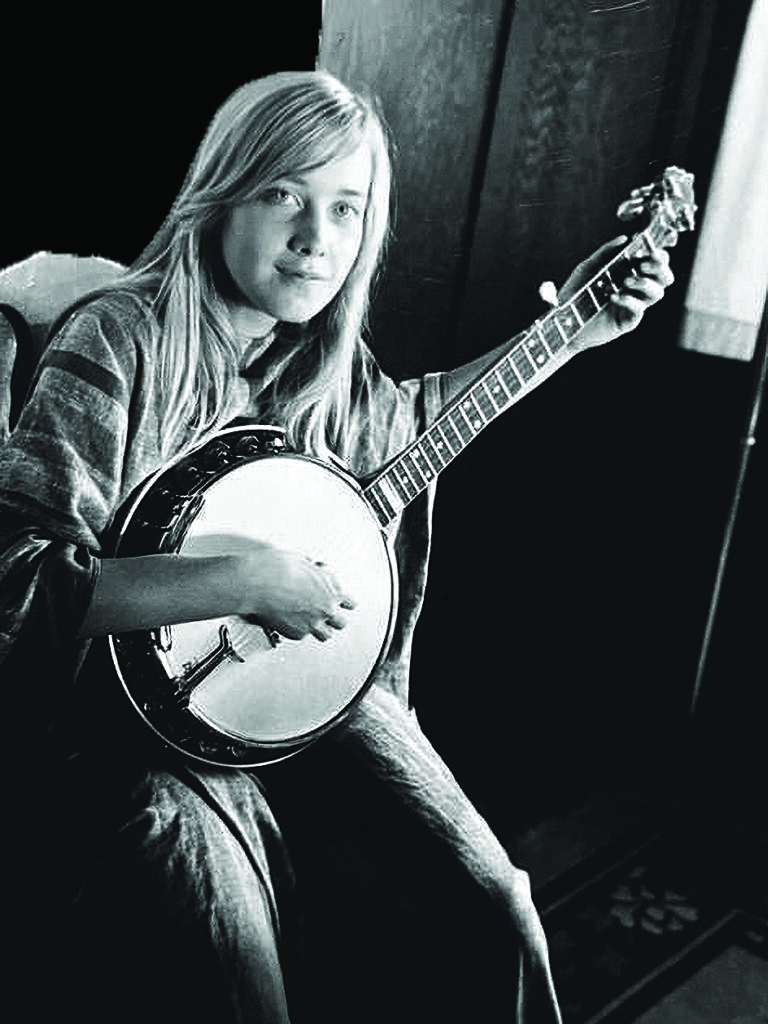
At about the same time, Laurie’s older sister took her to a Byrds concert at which the opening act was the Dillards. She heard Doug Dillard playing the banjo, and it was game over. “I just flipped,” she says. “I decided I just had to play the banjo.”
She bought a used banjo (as well as a guitar) and began taking lessons. It never really clicked, partly because Laurie was learning in a vacuum, not knowing anybody else interested in the music and completely unaware of the vibrant bluegrass scene literally just outside her door. After a while, she decided that “the lonesome-est thing in the world was solo bluegrass banjo,” and she set it aside.
A few years later, a friend took Laurie to Paul’s Saloon, the center of the Bay Area bluegrass world with live music seven nights a week. She could barely comprehend what she saw and heard. “I couldn’t believe it,” she says. “Here were all these people playing the music I loved. I had no idea. I found my community in that bar.” Ingrid Fowler was fiddling that night with her band Styx River Ferry, and Laurie had an epiphany: “I realized I could be a fiddler.”
She became a regular at Paul’s weekly jam and took fiddle lessons from Paul Shelasky. The first bluegrass band Laurie performed with was the Boomtown Lulus, in which Laurie fiddled while their regular fiddler was laid up with a broken collarbone. When that situation ended, she joined the Arkansas Sheiks, one of the Bay Area’s leading old-time bands. The band made one album, Whiskey Before Breakfast (1975). By that time, Laurie was no longer in the band, but was asked to play bass on the recording.
About six months after Laurie joined the Sheiks, Pat Enright asked her to play bass in his popular band, the Phantoms of the Opry. She’d never played bass before, but she rented one and played it all night at a picking party, teaching herself the rudiments. She tore up her fingers, but she was ready for the gig a few nights later. Laurie played with the band for several months, eventually moving to fiddle. She remembers earning $17 per night at Paul’s Saloon when she joined the Phantoms.
Her next band was the Good Ol’ Persons, an all-female band she co-founded in 1975 with Kathy Kallick, Barbara Mendelsohn, Dorothy Baxter and Sue Shelasky. They made their debut on jam night at Paul’s and were immediately hired and given their own night at the bar, and later two nights a week. The band was an immediate success, playing not just bluegrass but also folk, country, old-time, Celtic and an occasional original.
The band’s first album, Good Ol’ Persons, was released by Bay Records in 1977. Laurie played fiddle, mandolin and bass on the album and sang lead on several songs, including “Think of What You’ve Done,” “High on a Mountain,” “Southbound” and “Another Night.” She played and toured with the GOP for three years but had left the band by the time the album came out. It can be tough for a band to have two lead singers, and Laurie had grown frustrated by the push-pull dynamic.
Laurie started writing songs while in the GOP. She had realized that Kathy Kallick “owned” the songs she wrote and sang, while Laurie borrowed songs from others. She determined to fix that and is today one of the most respected and admired songwriters in acoustic music. “I think writing is my best form of self-expression,” she says. Virtually all of her albums have contained her originals, and her songs have been recorded by such artists as Kathy Mattea, Patsy Montana, Missy Raines, Jeannie Kendall, Greg Blake and Jeanette Williams.
After she left the GOP, Laurie took a step away from bluegrass and old-time music and worked several years with Dick Oxtot’s Golden Age Jazz Band, a venerable Bay Area traditional jazz outfit. Laurie played bass and sang jazz standards with the band. “That was so much fun,” she says, “and it helped me in so many ways. It made me such a better singer. Just listening to Billie Holiday a bunch and getting that sense of phrasing over the bar lines. Just being freer.”
When asked what other singers have influenced her, Laurie laughs and says there are too many to name, but then gamely starts naming names: “Bill Monroe, Ralph Stanley, Carter Stanley, Otis Redding, Amalia Rodrigues, Merle Haggard, Pat Enright, Brantley Kearns…” Her taste in fiddlers is more straightforward. Her favorites are Chubby Wise, Kenny Baker and Curly Ray Cline, three very different stylists who, collectively, cover pretty much the entire bluegrass fiddle spectrum.
Laurie formed a bluegrass band with bassist Beth Weil called Grant Street String Band in 1979, but that promising quintet broke up shortly after releasing an outstanding album in 1983 on Bonita Records. She was working at a violin shop in Marin County, repairing and selling violins, and contemplating life as a part-time musician doing an occasional weekend gig. Free weekends pretty much vanished after Laurie bought the shop in 1980 and began working even longer hours.
She had written several songs by then and had a desire to hear them played and recorded by a band—the way she heard them in her head. It was to be a kind of final fling before she hung up her fiddle and bow and became a full-time business owner. She decided to make a “vanity record” and asked Tim O’Brien of Hot Rize to produce it.
“It was through the recording process of that album,” she says, “and hearing those songs come alive and dedicating myself to the music, even if only for a few days…I just said, ‘You know, I’m done with that shop. I don’t wanna do it. I just want to play music.’
“My songs tend to be very personal, and in the recording process, it was like stripping away all my emotional armor. I was laid bare by the whole thing and I just loved it. I felt like I was alive and I wanted to keep feeling that.”
The recording, obviously much more than a “vanity album,” contained several songs that would become mainstays of Laurie’s repertoire over the years, including “Restless Rambling Heart,” “I’m Gonna Be the Wind,” “The Maple’s Lament” and “Green Fields.” Laurie was joined on the album by a handful of musicians, including O’Brien and a couple of erstwhile bandmates Greg Townsend (guitar) and Sally Van Meter (Dobro). The album, Restless Rambling Heart, was released in 1986 on Flying Fish.
In 1983, while on tour in Flagstaff, Arizona, Laurie met Tom Rozum, then playing with a band called Flying South. A native of Connecticut, Rozum is a multi-talented artist—a master musician on mandolin, guitar and fiddle; a singer and tunesmith; a cartoonist and T-shirt designer; a record company impresario; and a genuinely funny guy. The two kept in touch and after Tom moved to the Bay Area, he joined the band Laurie was putting together to promote her first album.
Tom has been a constant presence in Laurie’s life and music since then, until health issues forced his retirement a couple of years ago. He’s played on virtually all of Laurie’s subsequent “solo” recordings, including Love Chooses You, True Stories, Seeing Things, Blossoms, Skippin’ and Flyin’, One Evening in May, and Freight ’98 as well as a pair of compilation albums, Earth & Sky: Songs of Laurie Lewis and Birdsong.
The International Bluegrass Music Association (IBMA) has twice named Laurie its Female Vocalist of the Year, in 1992 and 1994. She also won the Song of the Year award in 1994 for her recording of “Who Will Watch the Home Place.” Her shared awards include Album of the Year and Recorded Event of the Year in 1997 for her and Kathy Kallick’s contributions to True Life Blues: The Songs of Bill Monroe; Recorded Event of the Year for Follow Me Back to the Fold: A Tribute to Women in Bluegrass (2001); and Collaborative Recording of the Year for The Barber’s Fiddle (2020).
In March 1994, Laurie, Tom and bass player Jerry Logan were involved in a horrific van wreck while on tour. Jerry walked away with bruises, but Laurie suffered a fractured skull and two fractured vertebrae. Tom fractured a shoulder blade and a wrist, dislocated his hip and nearly severed ligaments in his leg. Tom was already battling Meniere’s disease, an inner-ear disorder that would leave him with serious hearing loss and, as he later put it, “one ear that’s purely ornamental except as a generator of 24/7 ringing.” Their recoveries were long and arduous, but both were back playing gigs within three months.
“It threw us off the big ride,” Laurie says now of the wreck, “and I don’t think we ever really got back on it—and maybe that’s because it changed Tom’s and my priorities somewhat. It was the incentive for Tom and me to start working on duo recordings.”
The first Laurie and Tom duet album was The Oak and the Laurel (Rounder, 1995). It was a wonderful showcase for the duo, with a pair of Laurie originals alongside songs from the Carter Family, Molly O’Day, Peter Rowan and others. Subsequent albums Winter’s Grace and Guest House continued to feature the duo’s impeccable vocal harmonies and genre-stretching repertoire that blends bluegrass, old-time country and contemporary folk music.
In 1997, Laurie shared in the Grammy Award for Best Bluegrass Album for True Life Blues: The Songs of Bill Monroe; she and Kathy Kallick contributed two songs to the album, “Used to Be” and the title song. Laurie has also been nominated for two Grammy Awards—in 1995 for Best Traditional Folk Album for The Oak and the Laurel and in 2016 for Best Bluegrass Album for The Hazel and Alice Sessions.
The music on Laurie’s solo albums and the ones she’s done with Tom Rozum is drawn from old-time country, contemporary folk and more modern country music. But the beating heart of her music has always been bluegrass. “I love everything about bluegrass,” she enthuses. “I love playing in a band. I love the power of a band. I love everything happening. I love trio and quartet harmonies. I just love it all.”
Her love for bluegrass comes through loud and clear on the five albums she’s done with her bands Grant Street, the Bluegrass Pals and the Right Hands: Singin’ My Troubles Away, Laurie Lewis and Her Bluegrass Pals, The Golden West, Live and The Hazel and Alice Sessions.
Laurie’s greatest strength as a bandleader is that she has always hired outstanding musicians and let them put their individual stamps on the music. Her roster over the years is pretty amazing—mandolinists Tom Bekeny and Tom Rozum; guitarists Scott Nygaard, Mary Gibbons and Scott Huffman; fiddlers Chad Manning, Tatiana Hargreaves and Brandon Godman; bass players Tammy Faessart, Todd Phillips, Sam Grisman, Cary Black and Hasee Ciaccio; and an incredible string of banjo players, from Tony Furtado to Craig Smith to Patrick Sauber to George Guthrie, who joined the band in 2022.
Laurie met Linda Ronstadt in 2005, when Laurie, Linda and Maria Muldaur did a one-off bluegrass show at the Wintergrass festival, performing as the Bluebirds, backed by the Right Hands and fiddler Ron Stewart. Several years later Laurie and Linda were invited to contribute a duet to a planned tribute album to Hazel Dickens on Rounder. The two recorded a beautiful and stunning a cappella duet of Hazel’s song, “Pretty Bird.”
When the album didn’t happen, Rounder told Laurie and Linda they could use the cut on their own albums. “Pretty Bird” appeared on both Linda’s 2014 album Duets and, two years later, on The Hazel and Alice Sessions by Laurie and the Right Hands. As it turns out, Ronstadt was a long-time fan of Laurie’s singing and songwriting, saying “Her voice is a rare combination of grit and grace, strength and delicacy. Her stories always ring true.”
Laurie kicked off the decade in 2020 with and Laurie Lewis, a collection of duets with such prominent musicians (and old friends) as Tatiana Hargreaves, Kathy Kallick, Mike Marshall, Todd Phillips, Tom Rozum, Craig Smith, Nina Gerber and Molly Tuttle. In his review for this magazine, David McCarty wrote, “Laurie Lewis is a national treasure, one that keeps giving us fantastic music across the bluegrass and folk spheres of influence. On and Laurie Lewis, the diva of West Coast bluegrass has a CD filled with great songs, wonderful singing and glorious playing. Laurie’s music is timeless, effortless and enchanting.”
A committed music educator, mentor and facilitator, Laurie has taught music, fiddle, songwriting, vocal styles and harmony singing at prestigious camps, festivals and workshops in the U.S. and Canada. She has organized and run camps—Bluegrass Week at Augusta Heritage Center for 10 years, Bluegrass at the Beach in Oregon for 14, and Bluegrass in the Gorge in Oregon since 2018—and taught at the Telluride Bluegrass Academy, Puget Sound Guitar Workshop, Swannanoa Gathering, California Bluegrass Association Music Camp and RockyGrass Academy. She has also produced albums by such artists as Charles Sawtelle, Alice Gerrard, Tom Rozum, Peter McLaughlin, Scott Nygaard, Daisy Caire, the T Sisters and many more.
Laurie experienced every singer’s worst nightmare in June 2021: she lost her voice. For six months. “I had paresis, partial paralysis of the neck muscles,” she explains. “The right side of my larynx was not getting its signals, so I overworked the left side trying to sing. I did that until it just did not work anymore. In doing that, I picked up some really bad physical habits trying to force sound out. So, I’ve had to try to unstitch those bad habits, but getting my singing voice back is still definitely a work in progress.”
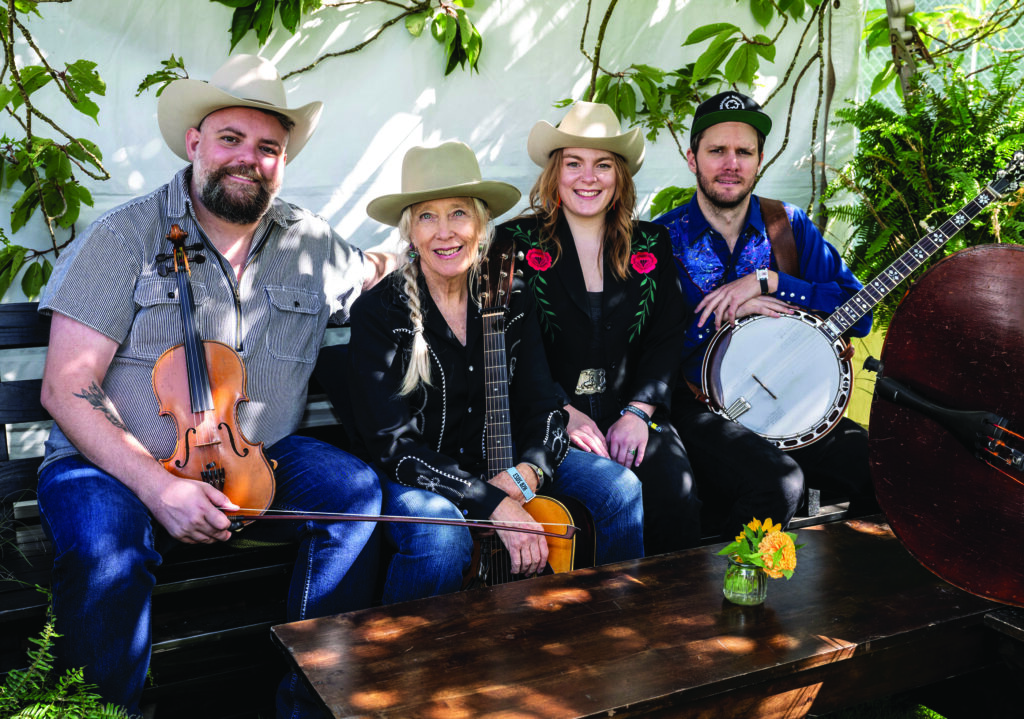
Since Tom Rozum’s retirement—due to Parkinson’s disease, a long-term degenerative disorder of the central nervous system that gradually took away Tom’s ability to play an instrument—the Right Hands now work as a four-piece band, with Laurie playing alongside George Guthrie (guitar, banjo), Brandon Godman (fiddle) and Hasee Ciaccio (bass). “It’s been very hard for me to not play music with Tom,” says Laurie, “but I’m absolutely thrilled to be playing with this group of people. It’s a great band.”
Trees, Laurie’s most recent record, will be released at the end of May by Spruce and Maple Music. Seven of the album’s songs were written or co-written by Laurie, and many display the keen environmental consciousness that has always been the hallmark of her writing. A highlight of the originals is “Why’d You Have to Break My Heart So Early in the Day,” her heartfelt homage to the great songwriter John Prine.
As Laurie says in her liner notes, “This is the first recording that I have made without my partner Tom Rozum since we started playing music together in 1986.” A transitional album in that way, Trees has been a long time coming. It’s a hard won-victory, made during Laurie’s recovery from paresis and the process of regaining her voice.
Music has taken Laurie Lewis on a wild and wonderful ride over the past half century. It has taken her to places and allowed her to do things she scarcely could have imagined. It’s given her the opportunity to meet and play with many of her heroes. Music has given her a career. But for all of that, Laurie credits it with something much more fundamental.
“I used to be so incredibly shy,” Laurie says without hesitation. “It was very difficult for me to speak, to express myself, to one person or a crowd of people. I was so afraid when I started playing music. When I first started playing fiddle in a band on stage, I would put my head down, and I had long hair that would fall over my face. And I would be crying the whole time I was playing, because I was so afraid.
“But, for some reason, I just kept doing it, which is the whole thing about facing fears. I worked really, really hard at getting better at that, and music is what enabled me to overcome that fear. Music saved my life. I can’t imagine…I was such a closed-up, scared person. It definitely saved my life.”