
Larry Sparks
Way Back When
Pure as summer sunshine, Larry Sparks makes bluegrass like Mother Nature provides warmth. Sparks, in rarefied air among living bluegrass masters, offers blankets of comfort whenever he sings a song.
So, make room for Way Back When Sparks’ latest album, released by Rebel Records on October 24, embraces nostalgia and bluegrass purity. No surprises. No shocks. But like snow in winter and sun in summer, the Bluegrass Hall of Fame member enchants the heart whenever he endeavors to record new music. “I wanted to do stuff that would take us way back when,” Sparks said days before his album’s release. “Keep things traditional. Keep things way back when, traditional. The feel is there on this album. The feel is natural. The playing and singing are natural.”
Sparks said he approached his new album much like he began with most, if not all, of his previous decades of albums. As with his personal and professional style, he sought and embraced tradition over convention, simplicity over complexity, and substance over superficiality. “I wrote all the songs down on paper first,” Sparks, 78, said. “I sat down by myself, just me and my guitar, and learned the songs. Then I worked them out with the band before we went into the studio. I want to get it into my life, my style, my sound. The songs will become me. I am the songs.”
Words matter. From the set-opening title track to the last vestiges of Hank Williams’ “How Can You Refuse Him Now?” Sparks does not simply yearn for the past. His messages project such eternal values as respect and love for one another, personal authenticity, truth and understanding, the viability and availability of unadulterated simple ways and manners of living.
Be yourself, Sparks relates in sum. That’s how he lives, and that’s how he approaches music on stage and within his albums. That explains why the songs can become him and how he can become the songs. “You have to get into the words,” Sparks said. “What are those words about? You have to think about what they mean. Go from the first word of the first song and read it through the last word of the last song. I want to hear those words, live those words, think those words.”
Consider what he said. His album opens with the title track, “Way Back When.” The first notes we hear emanate from Sparks’ beloved Martin guitar. Like brushstrokes from Norman Rockwell’s careful hand, a welcome home quality attaches right away to the song written by Gary Ferguson, Brent Moyer, and Robert Tobin.
Instrumentation spare, we then hear Sparks’ resonant voice. A gem polished with time, his first words sung: “There’s an old country store in the bend of the road. The old place is about to fall down. Once upon a time many years ago, folks would come there from all around…making a living when living was simple.” Sparks continued into the song’s chorus: “Oh, how I wish I could go back…” He means what he sings. Asked about the song and the time he would go back to, if possible, Sparks replied quickly. “I’d start in the 1950s,” he said, “and go back from there.”
Michael Feagan’s fiddle haloes the album’s second song. Written by Jimmy Work, “Tennessee Border” was a major country hit for a quartet of singers in 1949. Most prominently, Red Foley’s lively rendition peaked at number three in Billboard’s country chart during the summer of 1949. Twenty-eight days after Foley’s version debuted, “Tennessee Border” became the first charted hit by Tennessee Ernie Ford. His take reached number eight.
Lots of people have recorded “Tennessee Border.” They range from Carl Story to future rockabilly pioneer Bill Haley. Homer and Jethro lampooned it as “Tennessee Border – No. 2” in the fall of 1949. Red Foley with buddy Ernest Tubb recorded that one, too, which peaked on Billboard at number two in the winter of 1950.
But it’s been a long while since “Tennessee Border” was recorded. That appealed to Sparks. “Nobody ever records it again,” Sparks said. “But yeah, boy, I do go back. This type of music is music I grew up with. It was a part of me as a kid. Now it’s a part of me now. I appreciate the old country songs.”
Reaction to new music from Larry Sparks slides along a line of eagerness. Excitement, too. “Oh my gosh, Larry Sparks is one of the most soulful singers I’ve heard in my life,” said country singer Mo Pitney. “As soon as he opens his mouth to sing, you know exactly who it is.”
Sparks beamed when told what Pitney, the singer of the declarative “Country,” said. Understandably, Sparks takes abundant pride in his reputation as a distinctive singer of substantive songs. “When my music comes on, you know who it is,” he said. “That’s the way I want it. You hear my voice, you know who it is. You hear my guitar, you know whose guitar it is.”
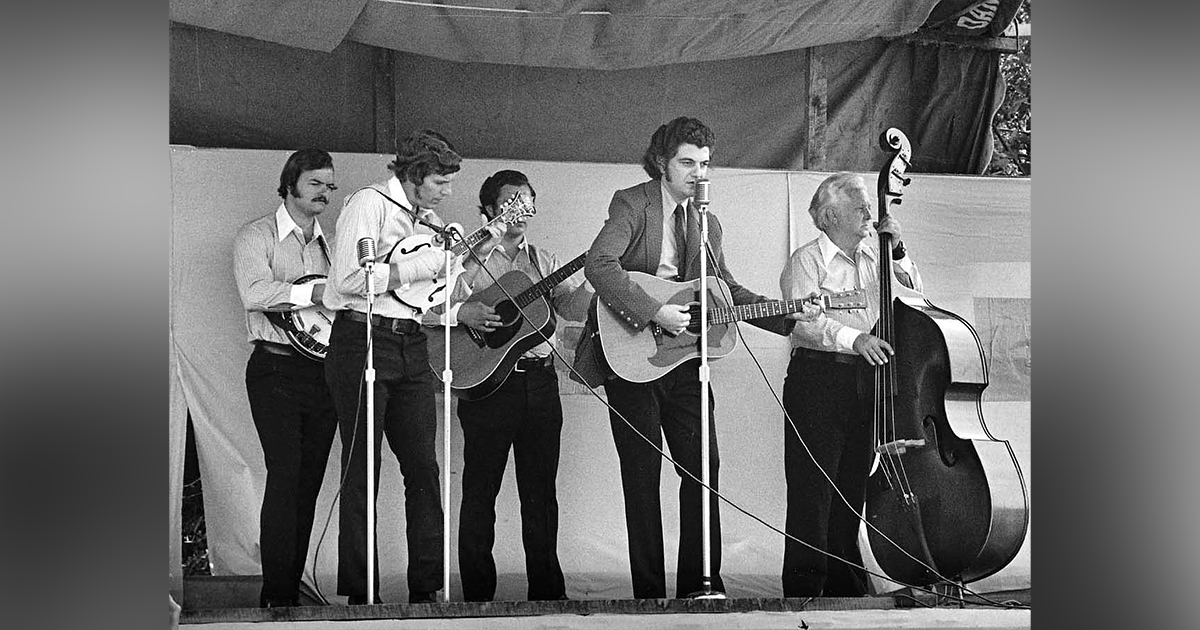
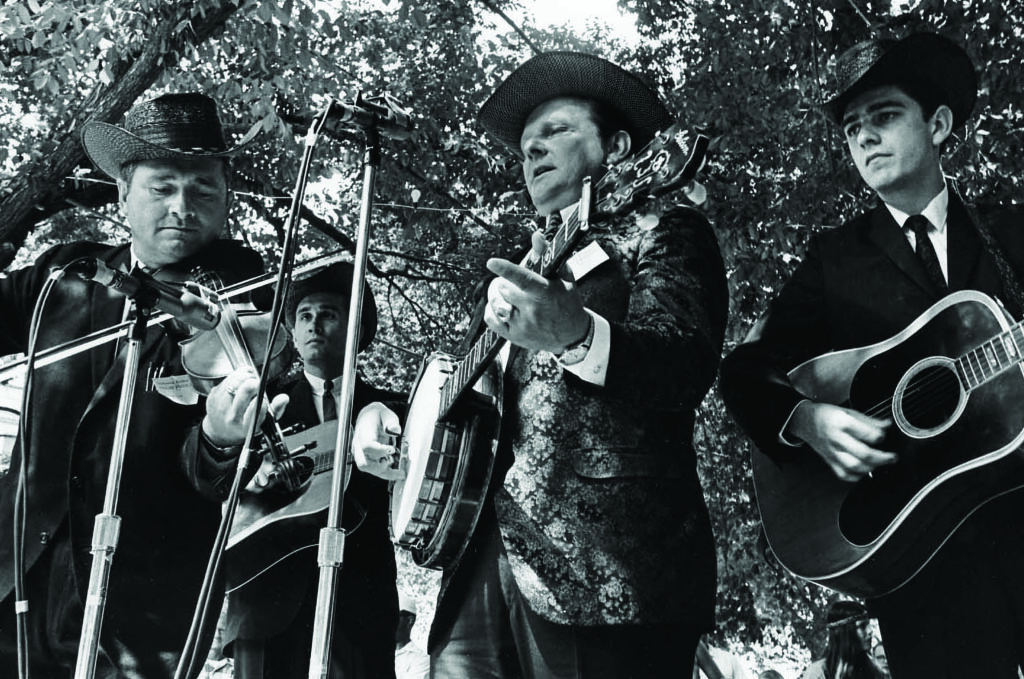
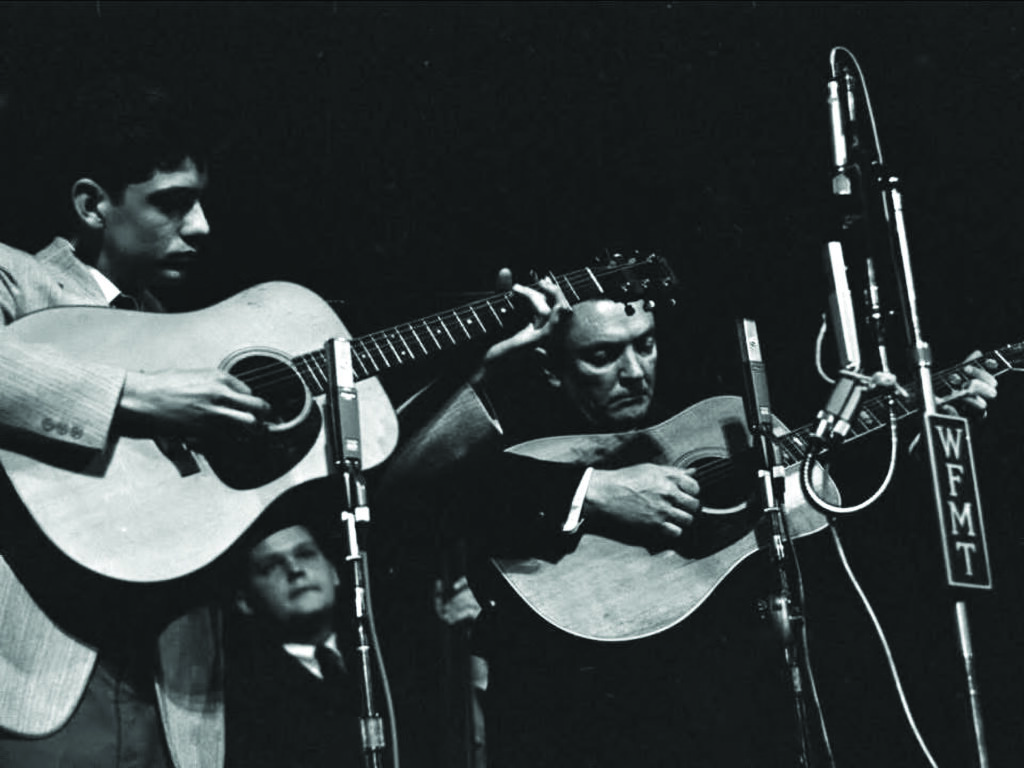
Sparks strode those pathways to eternal greatness. He started as a teenager with the legendary Stanley Brothers. Learned a lot. He stayed on with Ralph Stanley after the death of Carter Stanley. And he learned a lot more. Like how to lead a band, how to emcee a show, pick material suited for his style, and perhaps most vital of all – to embrace and evoke his own style. “It’s about being a stylist, having a sound, having a feel for what you do,” Sparks said. “When I was with Ralph, I did what they wanted me to do. When I went out on my own, I had to be me. Had to be me. It was there with me. It was embedded in me. I thought I’d do OK.”
Indeed. Sparks, inducted into the Bluegrass Hall of Fame in 2015, still performs and records as if he’s still young and hungry. As if searching for additional acclaim, on his new album, he resurrected Arthur Q. Smith’s “A Daddy’s Lullaby,” which he sings as if he is that daddy of whom he sings. In but a shade more than two and a half minutes, Sparks lives the song. “That song goes way back there,” Sparks said. “Esco Hankins had it out many, many years ago. That song just laid there for years. It’s got a good story to it. It’s a touching story. I can envision him sitting there with the baby on his knee, its mother having died. You’ve got to have a heart and feel for that kind of song.”
Likewise, “Since I Met You Baby.” Written and recorded as a ballad by Ivory Joe Hunter, his piano-tinkling take became a major R&B hit in 1956. Johnny “Guitar” Watson transformed it into a slow-jiving funk tune in 1976. Sonny James took it to number one in country in 1969, his tempo much the same as Hunter’s. Freddy Fender maintained the pace yet added a Spanish flair to his top 10 country single with the song in 1975. “I didn’t want to do it the way they did it,” Sparks said.
Mission quite well accomplished. Sparks’ guitar opens his new and quite different swing through the longtime blues-based song. Indeed, it’s full-bore bluegrass. Ron Stewart solos on fiddle and banjo, Evan Wilson provides tenor vocals and mandolin, while Sparks’ son Larry D. Sparks keeps time on bass. “I sped up the tempo and put it into the bluegrass world,” Sparks said. “It’s been 55, 56 years since Sonny James came out with the song. It can now be a brand-new song for a lot of people.”
Same goes for “On the Battlefield for My Lord.” Written by Estelle V. McKinley Banks and published in 1944, the song owns an extensive recorded history among a number of notable black gospel groups, including The Blind Boys of Alabama. In the country field, The Jordanaires performed it at the Grand Ole Opry at least one time. “It is a battlefield. I am on the battlefield,” Sparks said. “I believe in Jesus Christ. Every show I do, I’m on the battlefield to be a witness.”
A battlefield of another type altogether follows in the form of “The Fields of Gettysburg.” Penned by Gary Ferguson and Niall Edward Toner, the plaintive epic revisits the horrors of the infamous battle from the American Civil War. Therein, Sparks takes no sides. Instead, he mourns. “There’s so many ghosts still remain on the blood-soaked fields of Gettysburg,” Sparks sings.
Sparks’ voice echoes the drastic pain and soul-buckling sadness inherent in tales that yet drape Gettysburg. “I’ve had that song for a few years now,” Sparks said. “It’s a very respectful song. It has a heart for both sides. I don’t think (the Civil War) had to happen. But it did happen. The song touched me.”
The instrumental called “Sleepin’ Lula” Larry has on a cassette tape with his grandpa Lewis Dose Russell, from Jackson County, Kentucky, playing fiddle in 1953. He was born in 1877. Lula was his wife’s name (Larry’s grandma). She died in 1910. Larry got the tune worked out with the band for this CD. Larry said, “He was a very good fiddle player. Stringbean wanted him to go to Nashville and play fiddle. Grandpa, I guess, didn’t want to leave home and travel. He played local, mostly.”
As with each song contained in Larry Sparks’ new album, “Sleepin’ Lula” and the three songs that follow either date from or recall days and times and people long gone by. For instance, his spin of Gene Autry’s “Ages and Ages Ago,” which Autry wrote with Fred Rose, dates to 1946.
Sparks follows with Lester Flatt and Earl Scruggs’ gem from 1950, “Come Back Darling.” He concludes the album with his pleading version of Hank Williams’ “How Can You Refuse Him Now?” “Good gospel song,” Sparks said. “I know one thing about Hank Williams’ gospel singing. He knew who Jesus Christ was. He knew who God was. I know that. I can feel the Lord in that song and in Hank Williams’ gospel songs.”
Drop a needle onto any record by either Hank Williams or Larry Sparks. Or play a CD. Whichever and whatever, neither recorded throwaway songs. They reached for the heart and touched the souls of millions by speaking with their heart as routed through their soul. “Hank didn’t have no junk,” Sparks said. “He gave himself to the people. It’s natural. In 1953, I was just starting school. My mother had the radio on. The news came on that Hank had passed away. That always stuck with me.”
Perhaps it takes a master to truly appreciate another. Among more than one example, Larry Sparks and Hank Williams are joined at the hip in terms of an impassioned feel for music. “He’s one of the masters,” Sidney Cox of The Cox Family said of Larry Sparks. “He was meant to do what he does. He’s one of the most interesting folks I’ve ever met. He’s one of the last from his generation.”
As real as the red on a rose, Sparks sings songs that mean something to him. In so doing, he needs not to conjure a certain amount of feel. Like the blood that pumps through his ever-feeling heart, Sparks does not fake a thing. He sings what he feels. Consequently, Sparks’ latest album resonates in the heart, the mind, and the soul like tooled leather feels to the hand. Nuances intact and moving, one can feel the undulations of life with each lyric sung.
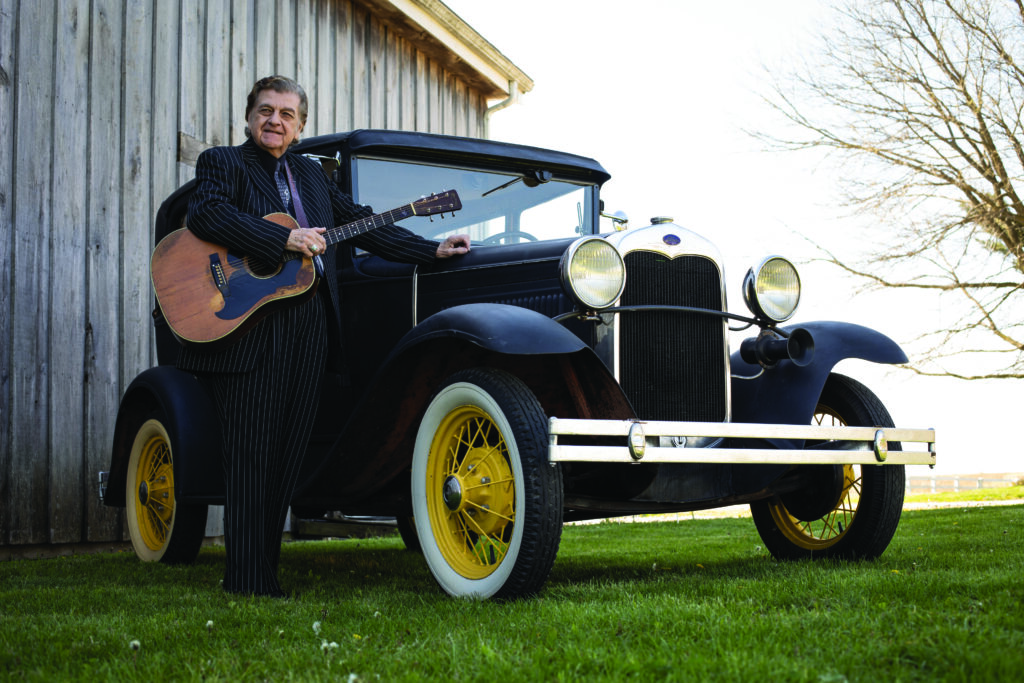
Oh, and be sure to take a good look at the album’s cover. That’s Sparks’ vintage Buick, a car with a connection that’s as subtle as the man who owns and drives it. “That’s a 1946 Buick,” he said. He paused for optimal effect. “That’s the year that Bill Monroe hired Lester Flatt and Earl Scruggs and that is the year that bluegrass music was named ‘bluegrass.’”
History rises to the forefront throughout his album. Ten gems mined from his bottomless mine and mind of songs, spellbinding crisscrosses with mesmerizing throughout Larry Sparks’ brand-new understated classic. “It’s important to keep this music alive,” Sparks said. “There are songs that have not been recorded in 75 years. Bring ‘em back. Let ‘em live again. Let ‘em breathe again. A lot of these songs are brand-new for a lot of people.”
Tom Netherland, a longtime contributor to Bluegrass Unlimited, lives and writes about music in his hometown of Bristol, Tennessee. You can reach him at [email protected].

When I brought this song idea to the table for my 2 co writing friends, Gary Ferguson and Brent Moyer, I had no idea that it would be recorded or rise to the #1 spot on the Chart. Thank you Larry Sparks !!!! One more thing off my bucket list !! Hopefully we’ll have more of our songs reach the ears of the fans. We have many to offer so stay tuned in !!!