
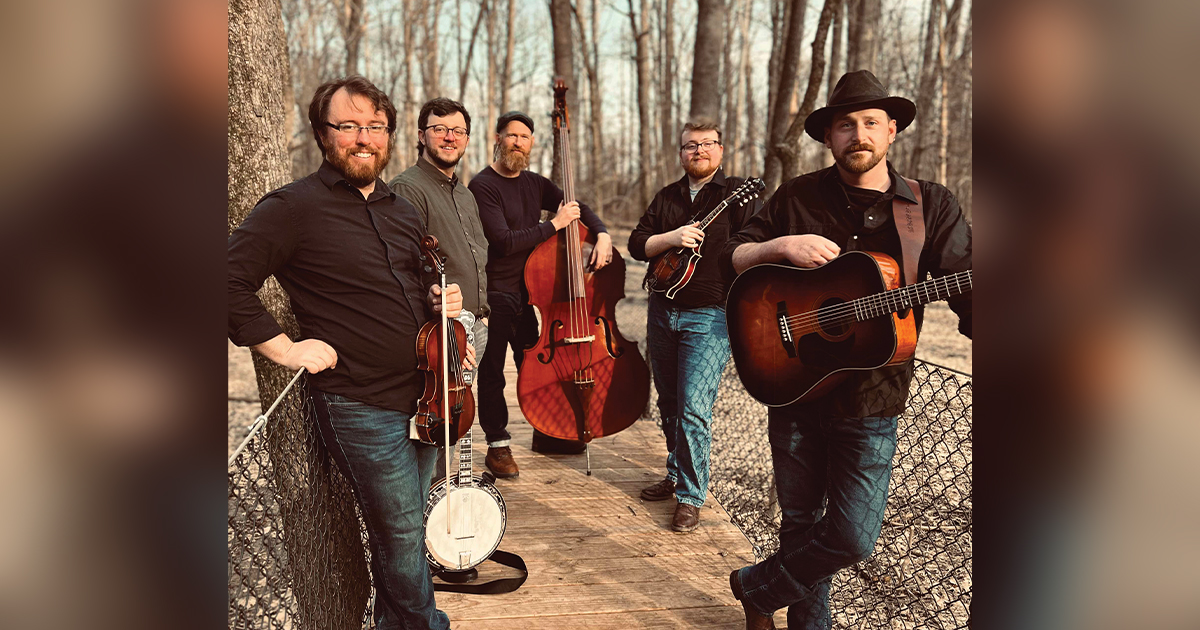
Kentucky Shine
The Bluegrass Hall of Fame in Owensboro, Kentucky is, of course, devoted to the heritage, history, and future of bluegrass music. In terms of the future, it’s also proven to be an incubator that provides showcases for promising local talent. “Everybody talks about the beginnings and Bill Monroe and Rosine,” says Steven Stewart, founding member and fiddle player for the Owensboro-based band Kentucky Shine. Stewart is referring to Bill Monroe’s birthplace and bluegrass’s spiritual shrine, just 30 or so miles down the road. “But in the last 15 or 20 years Owensboro has sort of become the central hub in this region, and the Hall of Fame has been a big part of that,” he adds. “They host weekend jams and they bring the bluegrass legends in for concerts.”
Stewart, whose band has garnered considerable favorable attention and increased exposure with its 2023 album release, Night Watch, knows of what he speaks. At least part of Kentucky Shine’s rising profile in the wider world of bluegrass, particularly when the band was starting out, came through the shows Kentucky Shine played at the Hall of Fame.
“(Former Director of the Hall of Fame) Chris Joslin has backed us since the beginning,” Stewart says. “He was one of our biggest supporters back when we were getting started in 2020. He saw potential in us and pushed us out there pretty good. He’s big on supporting local bands in the same ways he’s helped us. He wants to make sure the music stays alive and healthy in these parts.”
Lead singer and guitarist J.B. Miller explains that the band doesn’t have any direct association with the Hall of Fame as such. “It’s more along the lines of a mutual agreement,” Miller says. “If they need someone to come fill an opening spot or a lobby spot it’s awfully convenient for them to call us.”
The strength of their live performances, their robust harmonies, vivid original songwriting, and stirring reprises of traditional numbers like “Fox On the Run” and John Hartford’s “Gentle On My Mind” in the band’s videos and three record releases—the 2021 EP Leavin’ Town, Back In Again (2022) and Night Watch (2023) – have gradually raised the Kentucky Shine’s profile. The band has since performed at a number of other prestigious venues. These include the Bean Blossom Festival, Jerusalem Ridge, First City Music Festival, and the Bluegrass Brew & Barbecue Fest in Grand Rivers, Kentucky. And of course, the Hall of Fame’s annual ROMP Festival, starting in 2021. There, at various times, they’ve shared the stage with legends such as Ricky Skaggs, Russell Moore & IIIrd Tyme Out, Sister Sadie, and The Nitty Gritty Dirt Band.
What has emerged over Kentucky Shine’s three releases is not only the band members’ songwriting prowess but their instrumental versatility. While their originals run a gambit of styles while hewing fairly closely to bluegrass traditions, Kentucky Shine is just as at home serving up reprises of the folky John Hartford classic “Gentle On My Mind,” the haunting old-timey “Wayfaring Stranger” and a swingy rendition of “Sweet Georgia Brown,” among other covers.
A particular standout on Back Again is a six-minute long, out-on-the-edge instrumental called “Bonsai Me.” With a distinctly Eastern flavor, the song shifts tempo and mood and showcases the band at its very best.
Banjo player Jordan Riehm says he wrote the song after binge-watching kung fu movies. As he explains in his bio on the band’s website: “While Jackie Chan may seem like an unlikely inspiration for a banjo tune, the pentatonic scale that it’s based on can be heard both the Tai Mo Shan Mountains of Hong Kong and in the Alleghenies,”
One more of many high points on Night Watch, besides the title tune itself, is the darkly compelling story song, “The Game.” “The Game” was named Hollywood Independent Music Award for Song of the Year. Stewart measures his words carefully as he relates the origins of the song. “I went through an interesting time in my life when I was dealing with depression and working with people I shouldn’t have been working with,” Stewart recalls. “I was kind of roped into a professional association I couldn’t get out of – I guess we’ve all been there.
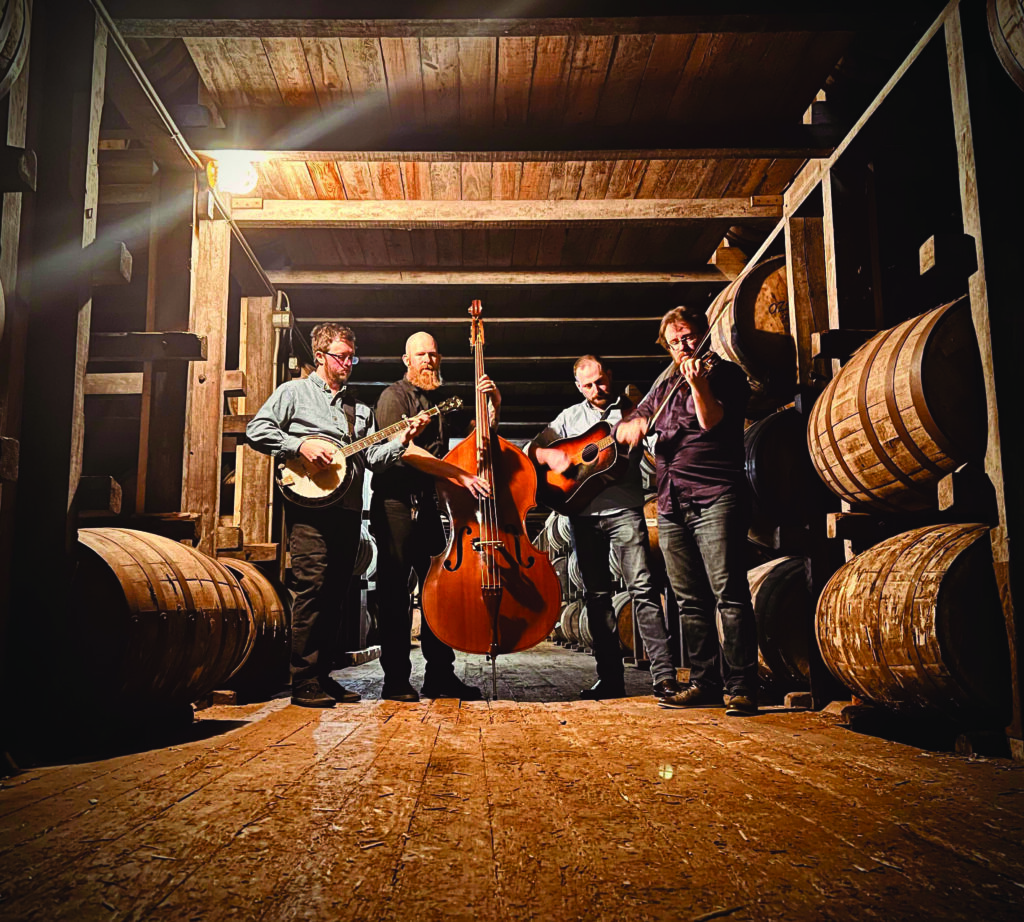
“In doing so, I was kind of gambling things I really didn’t need to gamble,” he adds. “I lost my marriage, and at the time it felt like I was losing my daughter. I really honestly sat down at the table and said ‘Here’s my chips, what’s going to happen?’ There were times when I felt like I wasn’t going to come out of it emotionally. I just didn’t know what was going to happen next, and by the time I did, it was too late.” Fortunately, Stewart is now happily remarried and is even back on good terms with the people he was working with during that rough patch. He’s also pleased with how far his band has come since they first started practicing in each other’s living rooms just five or six ago and scouring the greater Owensboro area for bookings.
“This area is rich in bluegrass talent, but in terms of venues, besides the Hall of Fame, what you’re mostly going to hear around here is modern country, outlaw country, and southern rock,” Stewart says. “So early on, we had to do some serious reaching out to let people know we existed.”
Though the band is still relatively new, its roots go all the way back to Leitchfield, Kentucky when Stewart and Miller were in grade school together. J.B. Miller’s parents used to run the Kentucky State Fiddle Contest. As a kid, Miller was especially influenced by artists like Doc Watson, The Statler Brothers, and The Eagles. “My house was a little different,” Stewart says. “My parents exposed me to a lot of different music. Various forms of rock, reggae, 80s and 90s country, gospel, and from there I started branching out and listening to a lot of big band swing, jazz, classical, bluegrass, and blues.”
What Miller and Stewart shared was a love of the violin. “Steven was in the fifth grade when he picked up a violin, and I’d been taking lessons since I was 4,” says Miller, who later, as a teenager, was the front man for a band called County Line Bluegrass and is proficient on several instruments.
“I kind of pushed and nudged Steven more in the direction of playing music rather than baseball or track and field or some other endeavor,” Miller adds. “We went on to play in orchestra together through high school and later at Western Kentucky University in Bowling Green, where we both majored in music.” After graduating from the university (“Steven stayed and graduated in 2013, but I didn’t,” Miller notes), Stewart went on to work on a master’s degree in music. All that formal training and practice has since been put to use in more ways than one. “J.B., Jordan, and I are all passionate teachers and give lessons,” Stewart says.
Time went on. Miller and Stewart taught violin/fiddle separately and did time in various local bands. “All the time, we talked a lot about starting our own band,” Stewart says. “And just before COVID hit, we said to each other, ‘Let’s make this thing go.’” Also in on the discussions was former founding member Jordan Wood, who would write and sing some memorable original songs before deciding his future lay elsewhere.
Stewart recalls a specific moment that really solidified things. It was one evening when he and Wood attended a Daily & Vincent concert and got to meet Darrin Vincent backstage. Obviously, the two of them were pretty pumped up on the music that night. “Jordan and I were standing backstage and we met Darren as he was getting on his bus,” Stewart remembers. “I just looked at Jordan and said, ‘J.B. and I have been joking around about starting a band for four or five months now, and you know what? I think it’s time we make it happen.’” Not long afterward, Riehm came on board.
The band’s first exposure came when they posted a performance video of “Green River,” a Wood original, on Facebook. “It did pretty well and people started calling us to play,” Stewart recalls. One memorable early gig was when they played center-ring at the Ohio Valley Wrestling Arena in Louisville. Miller would officially come on board a little while later, as would bass player Ross Clark who’d been playing with a local band called the Gaslight Boys. The “Green River” video featured the original lineup, which was Stewart, Wood and Riehm.
Jordan Riehm was raised and still lives in Bowling Green. He grew up on Southern rock and played guitar in various local bands. But he also listened to Sam Bush in high school. Everything changed for him when he attended the 2012 Romp Festival and heard Sammy Shelor playing banjo in the Lonesome River Band. “It was like a power station transmitting a thousand volts of electricity into my body,” he recalls. “It was the first time I actually got high on bluegrass. I went out and bought a banjo and an Earl Scruggs (instructional) book.” Not long afterward, he bought Ricky Skaggs’ Ancient Tones album, and the deal was sealed.
Jordan’s proficiency on guitar and mandolin easily translated to the banjo. (Riehm also plays every other bluegrass instrument.) He’s won Kentucky State Banjo Championships in 2022 and 2024. Here and there, along the way, he would cross paths with Stewart. “I first met Jordan six or seven years ago. We met at a jam session in a hotel here in town,” Stewart says. “We also jammed in a hallway at the Jerusalem Ridge Festival. Then later we ended up playing together a show called ‘A Bluegrass Mass’ at Western Kentucky University. That’s when I looked at him and said, ‘Can you sing baritone? You wanna come play mandolin with us?’”
As Jordan recalls: “I was playing only mandolin for a long time – that’s also what I played when we did the Bluegrass Mass together. It wasn’t until J.B. joined that I switched to banjo.”
The newest member, mandolin player Jarrid Hollander, from Evansville, Indiana, who’s worked with many regional bands, joined in early 2024. “We met Jarrid at a show about a year ago – he was playing guitar at the time and it went from there,” Stewart says.
When they decided the time was right to make their first record, they headed to Thunder Sound Studio in Franklin, Kentucky, which was owned and operated by a family friend of Riehm’s. “It was in the remnants of what had been a rubber band factory,” Riehm says. “They had this really cool vintage gear they’d gotten off some Motown guys.” The EP that resulted featured a half dozen or so original songs and a stirring rendition of “Kentucky Waltz.” Stewart says Miller is largely responsible for their musical dives into bluegrass’s and country’s past. Miller agrees, “Old bluegrass and country is primarily all I listen to. Glenn Campbell, Merle Haggard, Waylon Jennings …. I’m a big fan of those guys.”
The same year that the EP was released, Kentucky Shine played its first ROMP festival. “It was King’s Highway, the Mama Said Stringband, and us,” Stewart recalls. “Pretty good company.”
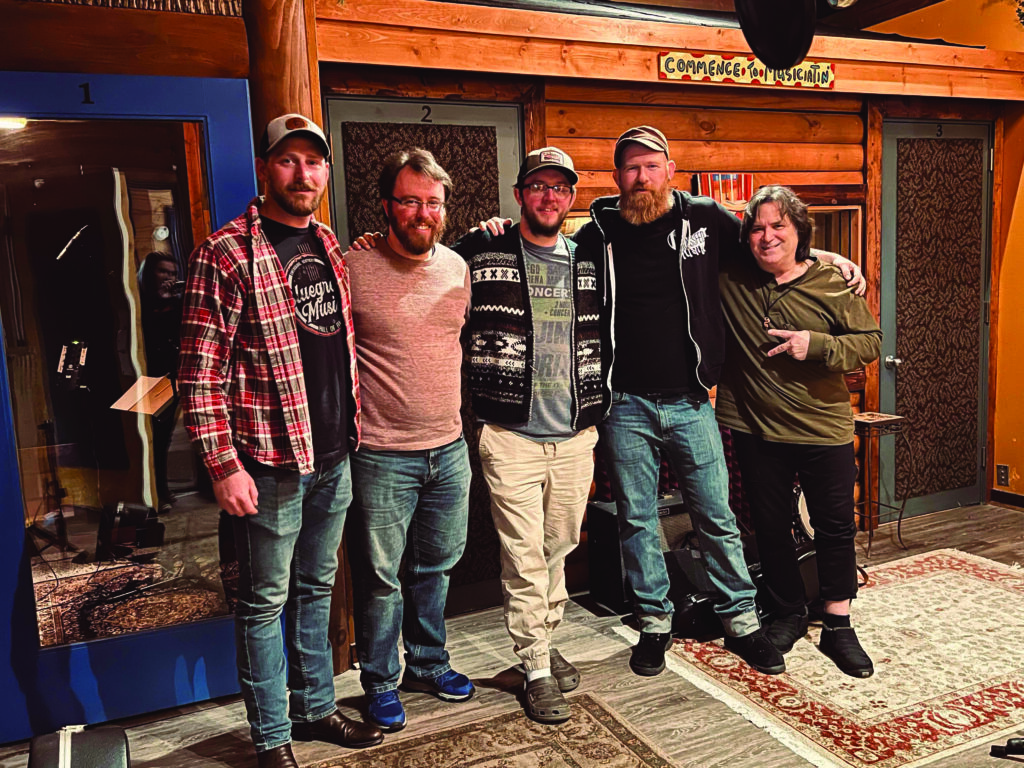
In making their next two albums, the band visited the Tree House Studio in Ridgetop, Tennessee, run by Tim Carter. “Tim has been in bluegrass for 40 years. He had a duo with his brother for years. He’s also an incredible multi-instrumentalist and songwriter and still has a band called Damn the Banjos. He’s kin to the Carter Family,” Riehm says. “My uncle used to be in a band (The Gringo Dogs) in Nashville thirty-some years ago and one of his former bandmates, a well-known Nashville percussion guy named guy Dan Sherrill, played with Tim. I met Tim through him and got to hang out with him and became friends. When we were looking for a studio for our second album, I thought of Tim and we worked it out.”
Stewart says Carter didn’t officially produce either Back In Again or Night Watch, but he was there when the band needed him. “He’s a friend,” Riehm explains. “We didn’t have the budget to pay him as an official producer, but he likes us enough to give us good advice when we need it.” Stewart agrees, “Tim has given us some really good guidance over the years in terms of studio production, and kind of making things move efficiently and just in terms of working together as a group.
“When you put four or five personalities in a room, there’s always going to be frustration,” Stewart adds. “So he’s given us a lot of insights into how to work together as a group, which we’ve taken wholeheartedly, and have used numerous times, even in practices outside the studio.” By the time the band was set to record Night Watch, Jordan Wood had departed and the members decided to make a crucial change.
“On Leavin’ Town and Back In Again everyone sang their own songs,” Stewart explains. “But, again, thanks to some advice from Tim Carter, who was our sound engineer for both Back In Again and Night Watch, we made the decision to let J.B. be our official lead singer just so we’d have a more cohesive sound. We still trade off singing on stage because it’s fun and we all like to sing, but J.B. is now our primary lead vocalist.”
Onstage, the band still likes to perform the old-timey way, with everyone gathered around one microphone, “We like the feel of the one mic and the freedom to move around the stage,” Stewart says. “It lets everyone be loose on stage and allows for a much more relaxed atmosphere.”
The band members are at work on their third album and say it is a bit of a departure from Night Watch. It features a lovely all-instrumental waltz written by Miller called “Ava’s Waltz;” a soulful meditation written by Stewart called “Brother Wind;” the mysterious, swingy “If I Could” (Stewart), and a lament called “Here with the Blues” (Miller) that features some Jimmie Rodgers-style blue yodeling.
“I’ll be honest, listening through what we’d done so far it’s completely different,” Stewart says. “The new material has remnants of the feel of Night Watch but is ultimately going to be its own animal. The cohesive feel of the Kentucky Shine sound will still be there. But we’ve developed a lot as artists and musicians over the last year or so, and we hope that shines through in this new music.”