
Kempa Guitars
A New Guitar Brand From China
Kepma Guitars is a Chinese company fresh to the New World that aims to compete in the hotly contested global market for quality acoustic guitars selling for around 2,500 US dollars, in addition to models under $500. The company claims to be the best-selling acoustic guitar brand in China, a nation of 1.4 billion people. We’ll leave the often inaccurate and xenophobic haranguing about Chinese-made musical instrument quality versus Western instrument makers alone, at least until Big Mon returns from the grave playing one.
Guitarists Jack Peng and Kevin Liu founded Kepma in 2009 after they completed university study in engineering and spent decades working for other guitar companies. Kepma manufactures acoustic guitars in China in a variety of common acoustic guitar body styles and tonewoods. Kepma USA is based in Nashville, run by two Americans with extensive musical industry experience. The company uses sophisticated CNC machine-based production and other high-tech processes, coupled with some handwork, during production. Their hope is that Kepma guitars offer “better instruments with better build quality, sound and features at affordable prices,” according to a company spokesman.
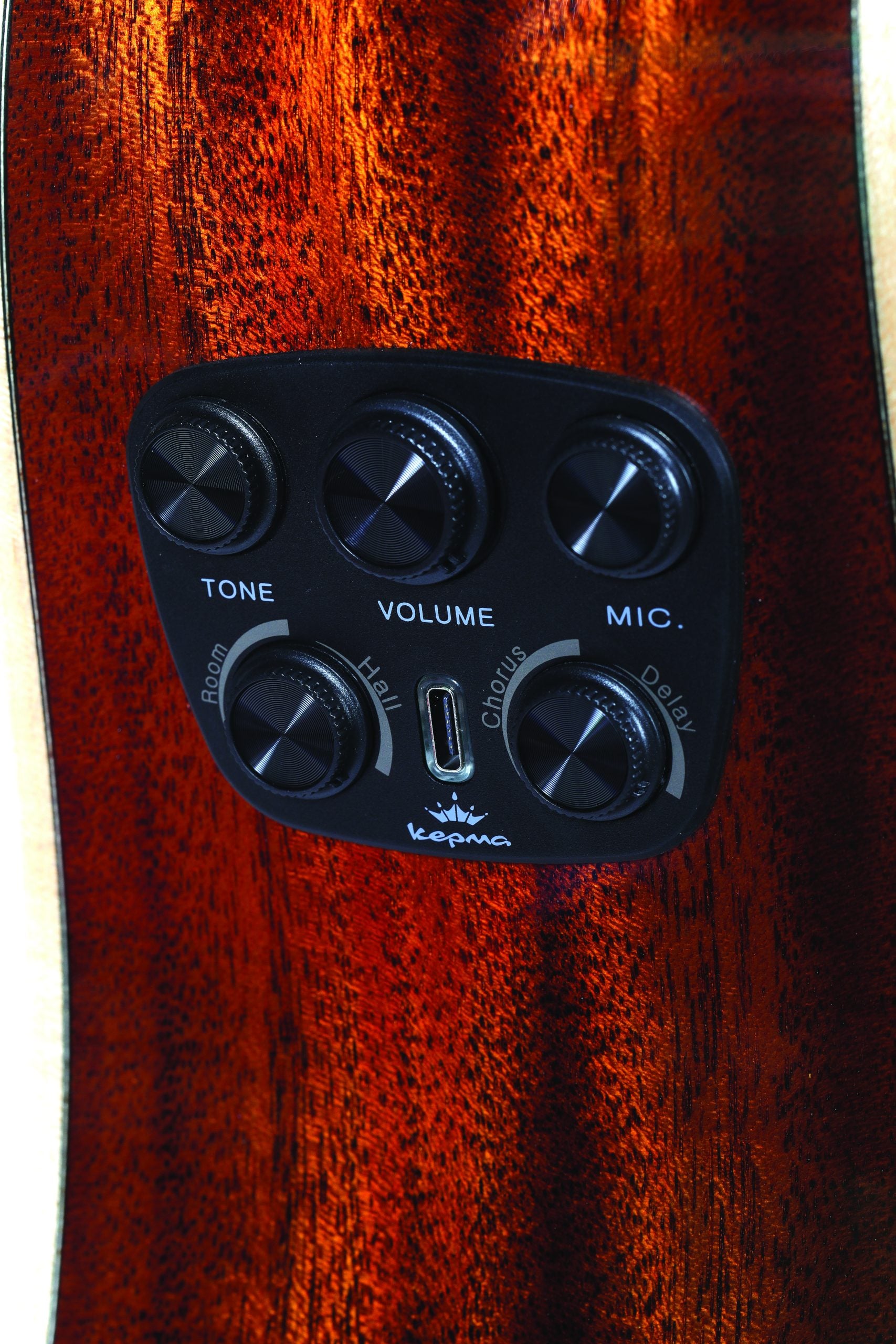
To see if they’ve achieved that goal, Bluegrass Unlimited spent more than a month testing and playing two models that fit the traditional role of “bluegrass guitar”—a rosewood and spruce dreadnought and a mahogany and spruce D with a US-patented pickup/preamp/effects system featuring onboard reverb, delay and chorus when playing acoustically, plus a blendable piezo and condenser mic for amplification.
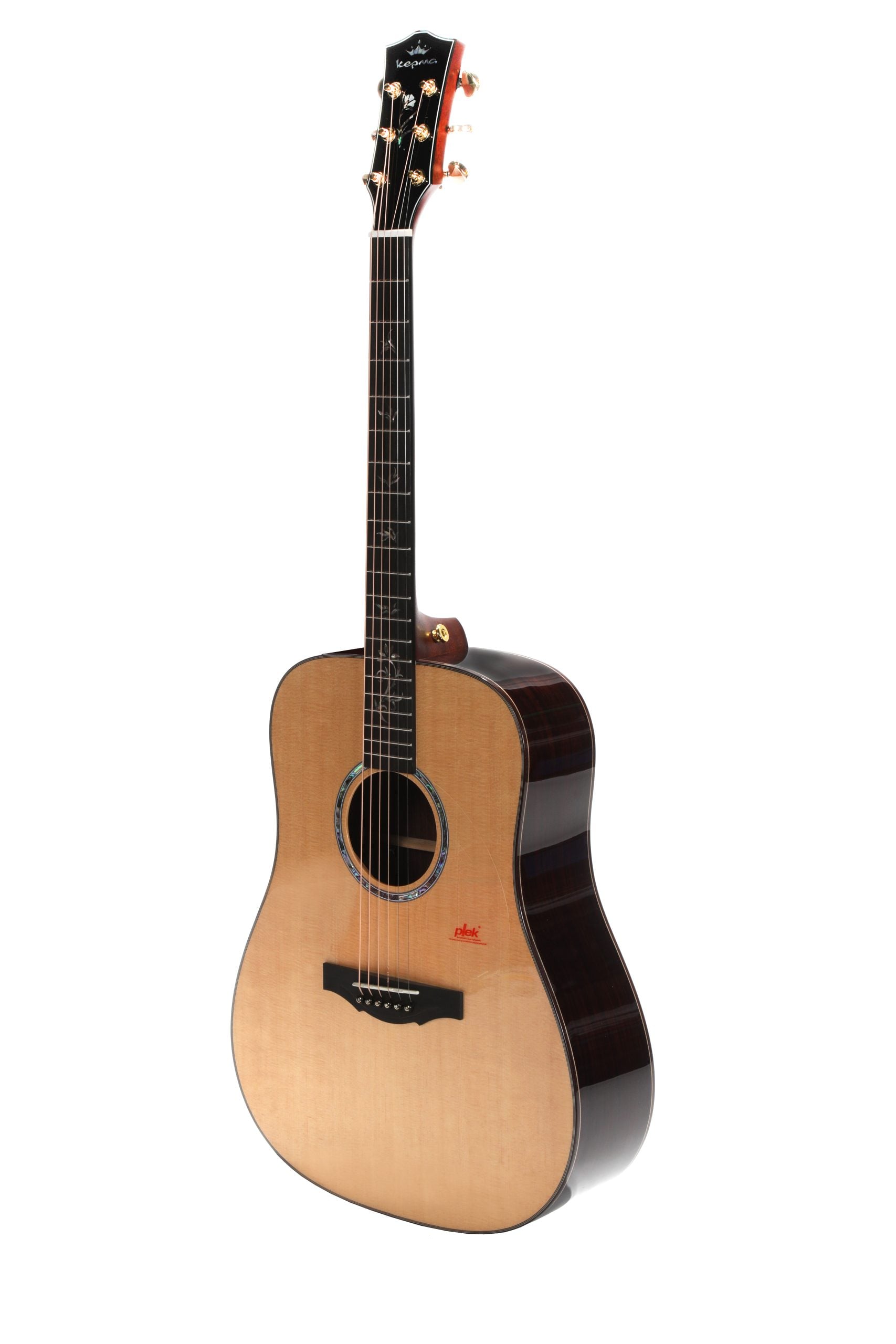
The guitars Kepma sent are part of their top-of-the-line Elite Series. The guitars came with a very nice package of high-end features. Every guitar undergoes the proven Plek fret and nut dressing, and consequently the playability and intonation of both guitars is their main highlight. Kepma also gives its guitars a 14-day vibration treatment similar to a ToneRite, a process the company claims equals a year of playing time before they’re shipped.
Kepma dreadnoughts have a 25.48” scale length and a stated 1.7” nut, which measured 1.68” on a digital caliper. String spacing at the saddle is 2 3/16ths. The nut and compensated saddle are Tusq, with very modern slotted liquidmetal bridge pins.
Both guitars feature AAA+ solid Sitka spruce tops sourced from Alaska, and equal quality tonewood backs and sides. As a result, the quality of the tonewoods here is another key sales feature. The untorrefied tops were both excellent pieces; tight-grained with copious ‘silking’ present across the grain lines. The D1-120 sent to BU features unusually handsome East Indian rosewood, while the D1-130 sports African mahogany that was left lightly stained to reveal its beautiful grain. Fretboards and bridges are African ebony, and the necks incorporate dual-action steel truss rods. Bindings are natural wood, and the extensive inlays are natural shell. And both guitars came with strap buttons already installed in the heel, a feature more acoustic guitar manufacturers should adopt.
Inside, both instruments showed proper construction and fabrication for the braces, bridgeplate, and kerfing. Given that it’s a mix of CNC fabrication and handwork, the brace shaping is fairly crude. With a bit of glue slop in the kerfing, it’s not as clean inside as some guitars in this category, but it’s more than adequate. And the braces appear to be laminated with a darker material, possibly carbon fiber for a higher strength-to-weight ratio. Kepma utilizes a bolt-on neck construction, an increasingly popular option. When done well, it has little or no sonic affect. But under the fingerboard extension here we found blocky, thick structural supports for the upper bit of the top—probably beefed up to reduce warranty claims. This likely impairs the tone and volume of the guitar to a degree, compared to other slimmer, more elegant bolt-on designs. But the Kepma neck system works and makes a neck reset amazingly quicker than steaming off a glued-in neck, when needed.
At its pinnacle models, Kepma treads the fine line between the bling desired by many guitar buyers and the more restrained aesthetic favored by bluegrass guitarists. Adorned with a lovely falling flower and vine motif inlay from the headstock down the fingerboard and an unusually wide rosette of shell on the rosewood D1-120, it’s an attention-grabbing look that would look at home on any stage. The D1-130 sports a similar level of abalone and shell inlay, this time in a leaping dolphins fretboard motif. It feels odd to see anywhere near this much abalone and shell inlay on a mahogany dreadnought, though.
When tested, the sophisticated pickup and mic system worked very well, with a bit of the piezo quack those pickups commonly suffer from. Bringing the mic level up and turning the pickup down creates a more balance natural sound, as long as you’re playing at sound pressure levels that don’t induce feedback, of course. One especially nice feature here is that the system runs off a rechargeable battery using a USB cord, so no more taking strings off to replace a dead 9-volt. An onboard tuner would be a welcome addition.
Both guitars’ necks have a somewhat rough matte finish that should be excellent in hot weather, but a bit more filler and final buffing would be welcome here. The necks and fingerboards are noticeably narrow and thin. These guitars would be especially comfortable to play for many teens and female players, or older pickers needed some hand stress relief. But any guitarist could bond with these nicely shaped, comfortable necks. More importantly, the guitars were set up for fast picking, an attribute many modern bluegrass players value over sound and appearances.
In addition to in-hand testing, several veteran bluegrass players tried the guitars, All concluded that both guitars sounded somewhat tubby and weak in the midrange frequencies and generally thin and sonically flat when played with a flatpick. They never tempted me or the other testers to play them very long. Now that may well change as the guitars are actually played and broken-in, but out of the box, the experiences were less than inspiring. Soundwise, if you’re searching for an authentic-sounding “bluegrass guitar” in this price range, you’ll find better options elsewhere.
As their spokesman put it in response to this review, “Do these guitars have a place? Absolutely, just perhaps not with a seasoned player who has a preconceived notion of bluegrass tone. They are definitely voiced more toward the singer-songwriter whose voice fills that midrange void you are referring to, but it is what it is.”
So you’re not going to find that Martinesque tone and growl most bluegrass guitarists long for here. But for modern players looking for an attractive on-stage guitar with premium on-board electronics that plays as easily an electric guitar, built from top-shelf materials at a very attractive price point, Kepma Guitars are worth consideration.
For more information, visit:
www.kepmaguitars.com