Kelley Mandolins
Banjo Slayers
Today, many small-shop mandolin builders produce what have come to be called “boutique mandolins.” The mandolins of one of those craftsmen, Thomas “Skip” Kelley, have been mentioned on the online blog, MandolinCafe.com in conversations with other high-end names. The website, Mando Mutt, is the exclusive dealer for Skip Kelley mandolins.
Mando Mutt’s owner, Kevin Douglas, praised Kelley and his handiwork. “I’ve always thought a lot of the sound of Skip’s mandolins. They’re always real powerful and real traditional sounding. I like that! They’re banjo slayers. If you’re playing bluegrass, you’ve got to compete with those banjos and they’re loud. Skip knows what he wants to hear and tap tunes the tops by hand. He’s very meticulous about that. They are powerful right out of the box.”
Skip Kelley is a 63-year-old Ohio-based luthier who specializes in mandolins. Born in Statesville, North Carolina, he relocated to Salisbury as a child when his dad was transferred due to work. He developed an interest in music early in life. “My brother was a finger picker on the guitar and he was good! He learned everything from listening to records. I always wanted to play. I got my hands on a used guitar when I was a teenager, but my brother had already moved out of the house and I didn’t have any lessons or knowledge so I just couldn’t do it. I gave it up.”
His desire to play a stringed instrument never faded. “I was about 23 years old and Garland Shuping had moved into the area. I saw an ad in the paper where he was giving lessons. I thought, ‘Well, here’s my chance.’ I met with Garland; he had picked banjo for Jim & Jesse. He had (formed) his own group, Wildfire, with Steve Kilby and Tom Isenhour. He taught me to play guitar. After a while, I started hearing the mandolin in my head and wanted to play it so I bought a mandolin. I took a few lessons from Garland at about the age of 25. I was late coming into music. Most people start when they’re kids. I was already married and had a family. I did the best I could with learning.
“After a year or so from taking lessons with Garland, I decided to try to learn on my own. He was a phenomenal teacher and I owe everything to him. He was so smart and a fantastic musician, but I started finding tab books and learning on my own. Then I tried picking things up by ear, slowing down and learning breaks.
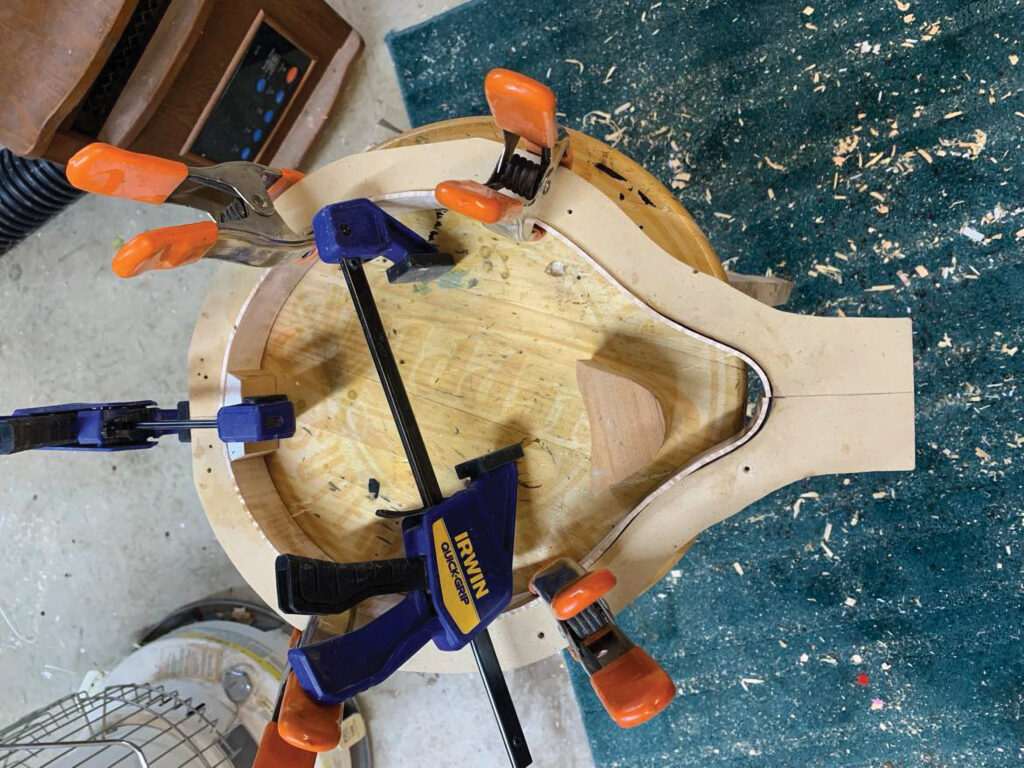
“I went through a lot of different mandolins. I had been playing mandolin for seven or eight years when I ran across someone playing one of C.E. Ward’s mandolins. I thought, ‘I really like the sound that he is getting out of those mandolins.’ So I met with C.E., talked with him, and told him that I’d like for him to build me a mandolin. I gave him a down payment and started visiting him.
“Shortly before that, I had lost my father and I probably looked at him as a father figure at the time. I had always enjoyed doing little woodworking projects for the house so I was really interested in the way C.E. was building mandolins and putting them together. He saw that I was interested and said, ‘If you’d like to learn, come down here as much as you can and I’ll teach you.’ Over a period of several years, even after I got the mandolin from him, I would visit him. I learned how to (install) frets and carve mandolin tops and backs. We did some banjo work. I helped put a big bass fiddle back together. Someone had it in their basement and due to the moisture, it came apart. We put it back together. I learned a lot from him.
“I started building mandolins (on my own) in the mid-90s. I just enjoy doing it, getting the wood, tapping, carving, and listening to it. It will come alive in my hands.”
Starting his own part-time luthier business, the instrument builder described his products. “I build mostly A-model and F-model mandolins. I’ve made a few that look like the great arch top builder, John Monteleone, that look like his grand artist model which has an elongated, open scroll. I was just fascinated by that design. I just build because I enjoy building.
“I’ve got some really nice hard sugar maple and some red maple that I use. I’ve made a few mandolins with walnut backs. It’s a good tone wood. The wood that I use for the top is really old red spruce that was cut down in the early 1900s and some California redwood that was cut down in 1850. That wood is very special wood. I got it from Brother Ken Ratcliff up in Kentucky who builds Silverangel mandolins. He’s just a gem of a person. You can’t find a better man with a better conscience.
“When I was living in North Carolina, a boy had one of Ken’s mandolins and needed some work done. Ken asked, ‘Would you fix up that mandolin instead of sending to Kentucky since he’s so close to you?’ So I did it. T he boy I did it for asked my fee. I said, ‘Nothing. This is just a favor that I’m doing for Ken.’ Then Ken wanted to know what he owed. I said, ‘Nothing, I’m just glad to do it for you because you’re my friend.’ We were planning a trip to Kentucky and Ken said, ‘Make sure that you’ve got a trunk on your car and I’ll make it worth your while.’ He gave me a trunk full of wood: old red spruce and old California redwood! He just filled my trunk up and what a blessing! That’s what I use and I have enough to last me the rest of my life!”
Ratcliff provided some history on the wood. “The red spruce came from upstate New York. It’s pretty old, around 100 (years old), I believe. The California redwood is salvaged from old tree stumps that were sawed down around 1850. The wood doesn’t rot so it was sawed up into suitable pieces.”
In 2019, the Kelleys decided to relocate to central Ohio. “I enjoyed deer hunting here.” They loved vacationing there. They had close friends there. Skip applied for a job with a hospital and was hired so the couple made the move. The settled in the small town of Mount Vernon near the center of the state. They have a son, daughter-in-law, and two grandsons back in North Carolina.
Still employed full time as an x-ray technologist, Kelley builds mandolins on the side. “It takes me months to build a mandolin. I just do it because I enjoy it. It’s been good for me. I’ve folks playing mandolins in England, Germany, and there’s one in Australia. At one time, Adam Steffey was playing one of mine. I’ve got them all over the US. It’s a good hobby. It’s fun to get a mandolin put together and string it up. It’s like hearing your child say ‘Mama or Daddy’ for the first time.
“I don’t have a strict schedule. My wife calls it piddling in my shop. I do it when I can. A lot of times, I will have two or three (mandolins) in the works. Say you got something that you’ve got to clamp up and glue, you can work on another part. Sometimes that transitions into having a couple pieces going. I bounce back and forth, but they eventually get done.”
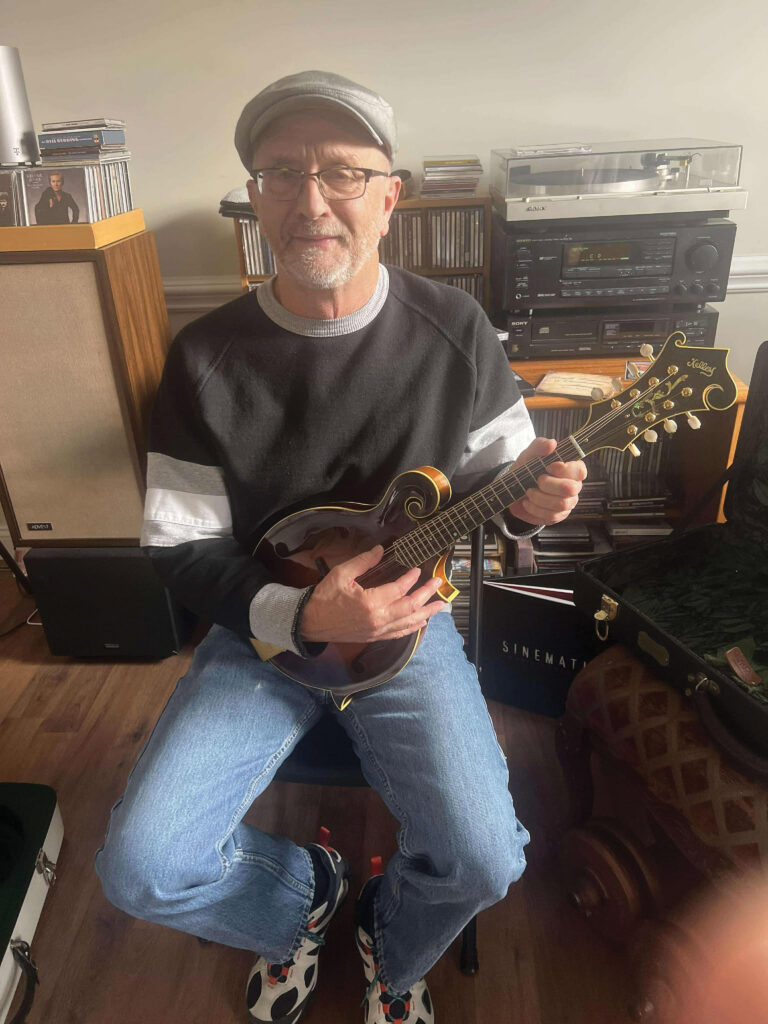
He has built almost one hundred mandolins in his spare time. “My favorite mandolin is my own personal one that I built in 2014. It is number 50. I wanted to do something special. When we got married, my wife wore an emerald green wedding gown so I stained this mandolin emerald green. I’ve always liked green mandolins. While we were living in Rowan County (North Carolina), Harry West moved there. I became really good friends with Harry and Jeannie. He had a green Paganoni. I just loved the way that mandolin looked. It was a real special one that John had made for Harry with abalone inlay.”
Each luthier has his/her own techniques that make their creations unique. Skip Kelley is one of those builders. It’s a passion and a hobby. “I give the Lord the credit for everything that I do. If I narrow it down to one thing, years ago I knew a fiddler maker named Elmer Edwards from Lexington, North Carolina. We were friends and asked him what he did. There’s this theory of tap tuning and getting your top and your tone bar to a certain note. I was struggling with that because every piece of wood is different. You can have two pieces of wood from the same tree and one section is stiffer than the other. If it’s stiffer, you have to carve it a little bit thinner. He told me that he made sure that his top and back noted out to some kind of musical relationship whether it’s a fifth apart or a third or a minor third. We sat down and looked at the scale. That’s what I try to do. I’ve got several different blueprints of different Loars. I carve pretty close to that. I leave a little bit of wood that can be removed for fine tuning. I do tap it and record what note I’m getting out of that top and back. Depending on where they’re at (on the scale), I will further refine the graduations to get the top and back within a musical relationship. Say that I’ve got a top that’s a C and a back that’s a G. That’s a fifth apart so that has really helped me have consistency in my sound. It gives me a nice ringing sound. You can really tell when it starts coming alive!
“I remember sitting outside on a really pretty day, handcarving on a piece of redwood. I kept flexing it and feeling it. It was way too thick, but that top came alive in hands. I checked it and the graduations were way thicker than anything I’d ever used, but the way it rang out in my hands I decided to sand it and be done with it. It was a hoss of a mandolin! Of course, redwood has that deep mellow tone and the trebles are really sweet. It’s a powerful mandolin. It’s a soft wood so you have to stay heavier.”
Kelley’s finish is unique, too. “I like varnish. It’s more organic. I use an oil-based varnish. I brush on a lot of very thin coats. Then I sand it and get it nice level and flat. Then add a couple more coats. Then I sand it to about 2000 grit and hand rub it to get a nice sheen on it. I want it to have a nice kind of pantina finish where it looks like an heirloom instrument: one that has an older finish, but is well cared for. It creates no change in tone.”
His favorite model to build is the A-models. “Once I started building, I figured out really quick why F-models cost more than A-models. You don’t have the scroll and the points (on A-models). That’s a lot of work!
“My very favorite wood is the sugar maple wood back and the California redwood top. Sugar maple is really hard wood and helps project the sound out of the sound chamber and the redwood has a sweet sound. It sounds like an old mandolin the minute you string it up. A fantastic tone wood! They’re my favorite combination.”
Kelley Mandolins can be purchased through Mando Mutt website managed by Douglas of Graham, North Carolina. Skip shared, “When I build one that I want to sell, I send it to him and he puts it on his website and takes care of that for me.”
Douglas started his business in 2008. “I contacted Skip to see if he’d been interested in me selling his mandolins. He lived fairly close to me at the time so he decided to give one a try. I sold it pretty quick. It’s been almost 16 years that I’ve been selling his mandolins, exclusively. I’ve sold around 60 all around the country. One of the reasons that I still sell his mandolins is because we became really good buddies. He’s the sweetest fellow and my brother in Christ. Skip is a prayer warrior and checks on me.
“My personal mandolin is Skip Kelley #35 that he built in 2011. He played it for a year and then decided to sell it. I was playing a Gibson Doyle Lawson model at the time. I loved it and had been playing it for six years. I’d pick up Skip’s mandolin and play it and think, ‘Man, this thing sure is powerful.’ The more I played it, the more I liked it. I contacted him and asked if he would sell it to me. I’ve had it since 2012 and it ain’t going nowhere. And his finish! He uses a boat varnish. It makes all the difference. When I first started selling his F-5s, we were getting around $3500. The last one I sold, we were up to $7000. It is hand-built here in America.”
Kelley confessed, “I learned a long time ago from David Osborne (a good friend who ran the Music Barn in Greensboro). He said, ‘When you’ve got a mandolin that you can’t stand to put it down, you got the right mandolin for you.’ That’s a good way to put it.”
Skip Kelley has a mando hero. “There are so many good players out there, but if I had to narrow it down to one, I’d say my favorite mandolin player in all the world was Butch Baldassari. I listened to his music and tried to emulate the tone and feel that he got. I attended a workshop in Roanoke, Virginia years ago and me and this boy was playing a tune Butch wrote called ‘Slocam Hollow’ and Butch walked in and said, ‘Hey, I know that tune!’ Everyone got to play a tune on stage with him, but I got to play about four! Maybe it was because I was playing one of his tunes when he came in and realized how much that I appreciated his music and his contributions to mandolin playing. That was real special.”
Kelley shared his plans for the future and for mandolin #100. “I found the nicest one piece of sugar maple that I could get my hands on. The sides and neck will all be out of the same piece. It is really highly figured. I’ve got a really nice piece of that old red spruce that I’ve set aside for that. I’ve never done a fern inlay so I’m going to put that in the peghead. It’s a beautiful inlay. It probably won’t be for sale. It is a milestone.”
Kelley keeps a book of notes on all his builds with the specifics. This writer’s husband, Gary, personally owns two of Kelley’s mandolins, numbers 58 and 60. “I’ll leave number 58 laying out and play it when I’m supposed to be helping with housework. That’s a good thing when a mandolin makes you want to play,” he admitted.
Though Kelley’s family isn’t in the music business, he offers advice to another area luthier. “When you have the opportunity to pass it on, that’s what you do. I’ve been grateful for this journey. As long as the Lord gives me strength, I will continue building. Life is precious and short. You have to make the best of what you can, where you can.
The bluegrass community needs more banjo slayers and Kelley is on a mission.