Justin Moses
The Quiet Assassin
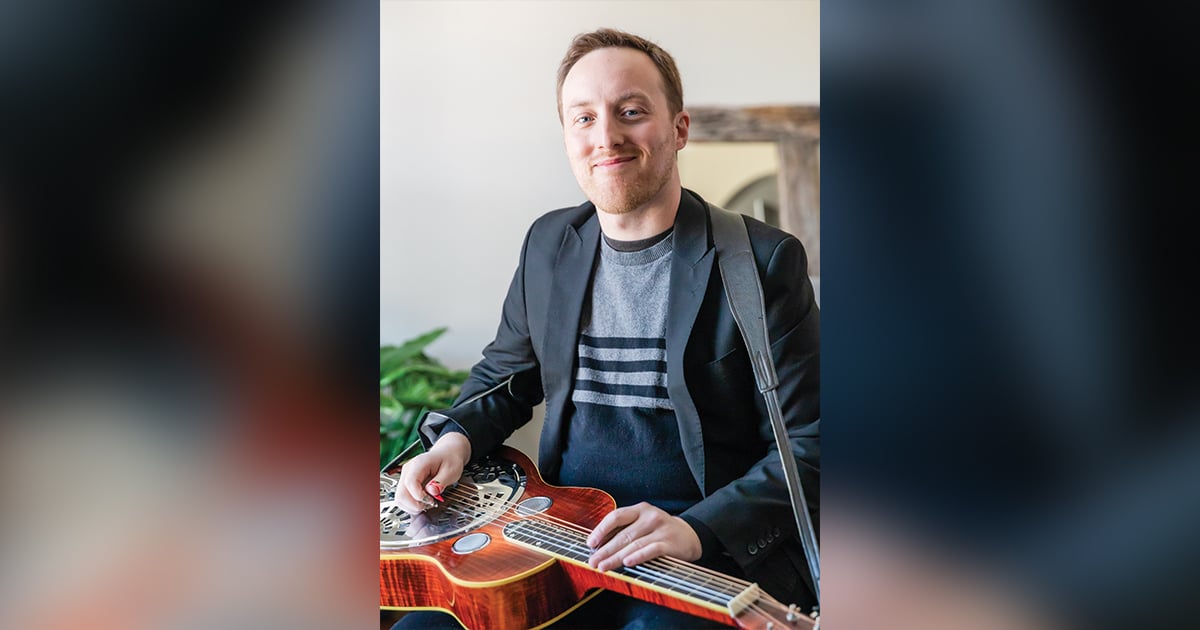
Photo by Shelly Swanger
Multi-instrumentalist Justin Moses excels at picking anything with strings. As an in-demand sideman, the modest musician lets his unassuming talents do the talking. “I call him the Quiet Assassin,” says Eric Gibson of The Gibson Brothers. “He’s over there on his side of the stage just killing it, but quietly and not being a showboat.”
Since early 2019, Moses has been traveling with The Gibson Brothers where audiences hear him mainly on mandolin and resophonic guitar. Some fans knew him first on the national bluegrass scene focusing on the fiddle with Dan Tyminski, or as the banjo whiz backing Ricky Skaggs in the band Kentucky Thunder. It’s that instrumental versatility that makes Moses a sought-after gun-for-hire in the studio and on tour.
“I feel that’s really helped my career over the last few years,” Moses tells Bluegrass Unlimited. “A lot of times people will say I didn’t even know you played that [instrument]. It seems to work out with people thinking of me for whatever might be needed.”
“Justin’s versatility is unmatched by most,” says Dan Tyminski. “One could easily spend a lifetime on any one instrument and not achieve the height Justin has reached on ALL of them. Playing different instruments myself I can say from experience that they don’t all translate to one another. Each instrument takes a level of commitment all of its own. Justin has put the time in to reach a level of mastery on all of them that most will never see. There is no substitute for talent, and Justin is pure talent.”
“I don’t understand how a person can be that good on so many instruments,” Gibson said. “I’m a decent picker, but I’m not THAT and never will be,” he says, laughing. “He can play practically any instrument with strings on it at such an amazing level. I really don’t even know what his best instrument is. And that can be a little intimidating, you know? When you’re playing with him, you think, ‘Gosh, I hope he’s not judging what I’m doing here on the banjo because he can out play me.’”
“Playing with a guy like that raises the level of the musicians around him,” Gibson adds. “Not that I would ever be able to play as well as that guy. You hear him doing certain things—it inspires you on your instrument. And he’s so humble about it. He’ll play this achingly gorgeous thing on whatever instrument he’s playing, and I’ll forget to come in and sing sometimes. I’m still thinking about what he just did. I couldn’t be more impressed by a musician. He’s a great singer too. I didn’t even know he could sing lead like he does until I heard the first single off his album, but he blends very well with us.”
Other peers recognized Moses’ talents in 2018 and again in 2020 when he was honored with the IBMA Dobro™ Player of the Year among worthy contenders of Jerry Douglas, Andy Hall, Rob Ickes, and Phil Leadbetter.
“It’s flattering that people would think of me in the league with those players,” Moses says. “It’s funny—playing the different instruments—sometimes I do feel like maybe I’m not a real Dobro player, or maybe I’m not a real fiddle player,” Moses adds, chuckling.
Juggling multiple gigs with different instruments could cause confusion for some, but Justin ably adapts.
“It’s good to have different things going on as a musician,” Moses says. “Right now I’m playing predominantly bluegrass-y stuff, but at the same time it’s just kind of like switching gears a bit. It’s not so radical for me that it takes a huge adjustment. I take a day or two to remember arrangements and remember the words to the songs on some of the shows. If I go out on the road, it’s usually three or four days at the most and then I’m usually home for a day or two. It gives me time if I need to go over stuff or learn something new for the next gig.”
Whatever the scenario Moses sees his role as complementing the performance, especially the song.
“I’ve always been the kind of person that wants to support,” Moses says. “I want to make whatever’s going on sound better. That’s sort of my number one goal when I get on stage with somebody—to lift up what they’re doing.
“He doesn’t play more than is necessary,” Gibson explains. “He’s not a look-at-me player, though he could play anything that comes to his mind. He’s not about the flash. He’s about taste and serving the song.”
“Justin makes a great sideman for anybody through his ability to listen and respond with the appropriate emotion,” says Tyminski. “His skill level is through the roof, but his choices are what set him apart from others.”
Learning the Ropes
Along with his guitar-playing dad and piano-playing mom, Moses would watch WBIR in Knoxville on Sunday mornings to see and hear his first sounds of bluegrass from the Primitive Quartet.
“At some point along the way I saw them play and thought that the mandolin looked like a cool instrument, probably because it was small,” Moses says.
At age 6 Justin unwrapped his first mandolin from under the Christmas tree and after a few lessons learned that he could play songs by ear. He picked with the 8-string instrument exclusively for a year or two until he saw his dad giving a guitar lesson.
“I remember one time Dad showing a guy a few things on a guitar, and the guy was struggling,” Moses remembers. “I told my mom, ‘I think I could do that.’ Through watching and hearing him teach other people, I started playing guitar at 8.”
The first artist that caught Justin’s attention was Doyle Lawson. After hearing a cassette of Lawson’s band and the banjo playing of Jim Mills, the teenage boy longed to play that instrument too.
“Dad bought me a pretty decent Deering banjo, and I spent a lot of hours out on our front porch playing, trying to figure out banjo rolls, Earl Scruggs style playing.”
Later, in his first non-family band, Kentucky Wind, Justin was asked to play fiddle, and at age 18, his self-study on that instrument started. Through the years Moses became proficient on each of the instruments, meeting the needs of different groups.
“Each time that happened I would get more serious about whatever instrument it was that I might be focusing on at the time. Even though I play all the different bluegrass instruments, I definitely spent time focusing on each one individually at some point along the way.”
One Man Band
Justin pooled all his instrumental talents together to play each part on his independent release, Beyond Measure: The EP. For his new label home, Mountain Fever Records, he took a different approach.
“It’s a fun challenge. I’ve never quite taken on what I’ve done with this record.”
Moses recruited many of his musical heroes for his new album, Fall Like Rain, including Barry Bales, bass; Bryan Sutton and Cody Kilby, guitar; his wife, Sierra Hull, mandolin; Stuart Duncan, Michael Cleveland, and Jason Carter, fiddle; Jerry Douglas, Dobro™, vocalists Dan Tyminski, Shawn Lane, Del McCoury, and bassist Ethan Jodziewicz.
“It was really fun to get into the studio on the tracking days. I feel like they brought their ‘A-game’ and tried to make it a really good sounding record. I’m really pleased with it.”
For years Moses had toyed with the idea of recording a project like this one, but he had a variety of different type records that he thought about making.
“I’ve not set my career on a path that people will have some big expectations for what I would do. I feel like if I made a Dobro™ record, I don’t think it would be weird. If I made a banjo record, I don’t think it would be weird.”
“I decided to combine all the ideas and try to take a lot of the best stuff from all of them and see if I couldn’t make the best record I could.”
The multi-talented musician has produced his own records before, but Fall Like Rain was his first production for a label.
“I feel like this is a different league for me. I enjoyed it most when I was sitting in front of the board being able to give my input directly without also being in a booth playing. Playing along can take part of your concentration and your attention to detail away.”
Still, handing the reigns over to someone else isn’t an option that would easily work for him.
“When I think about getting somebody to produce, it gets difficult for me because I always go back to knowing that regardless, I’m going to want it the way I want it anyway,” he says, laughing. “I get clear ideas of how I want things to end up, and I don’t want to put anybody through that.”
IBMA Hall of Famer Del McCoury sings on “My Baby’s Gone” that Lost and Found had recorded with Ronnie Bowman’s clear tenor vocal. The album’s first single and title cut is a bluegrass remake of rocker Eric Clapton’s song while Moses turned to Dan Tyminski to join him on “Between the Lightning and the Thunder,” a Thomm Jutz and Charlie Stefl composition.
“I liked both the melody and the lyrics,” Moses said. “Having played on Dan’s record Wheels a few years back and having toured with him, I really loved getting to sing with him. He’s one of my favorite singers in the world.”
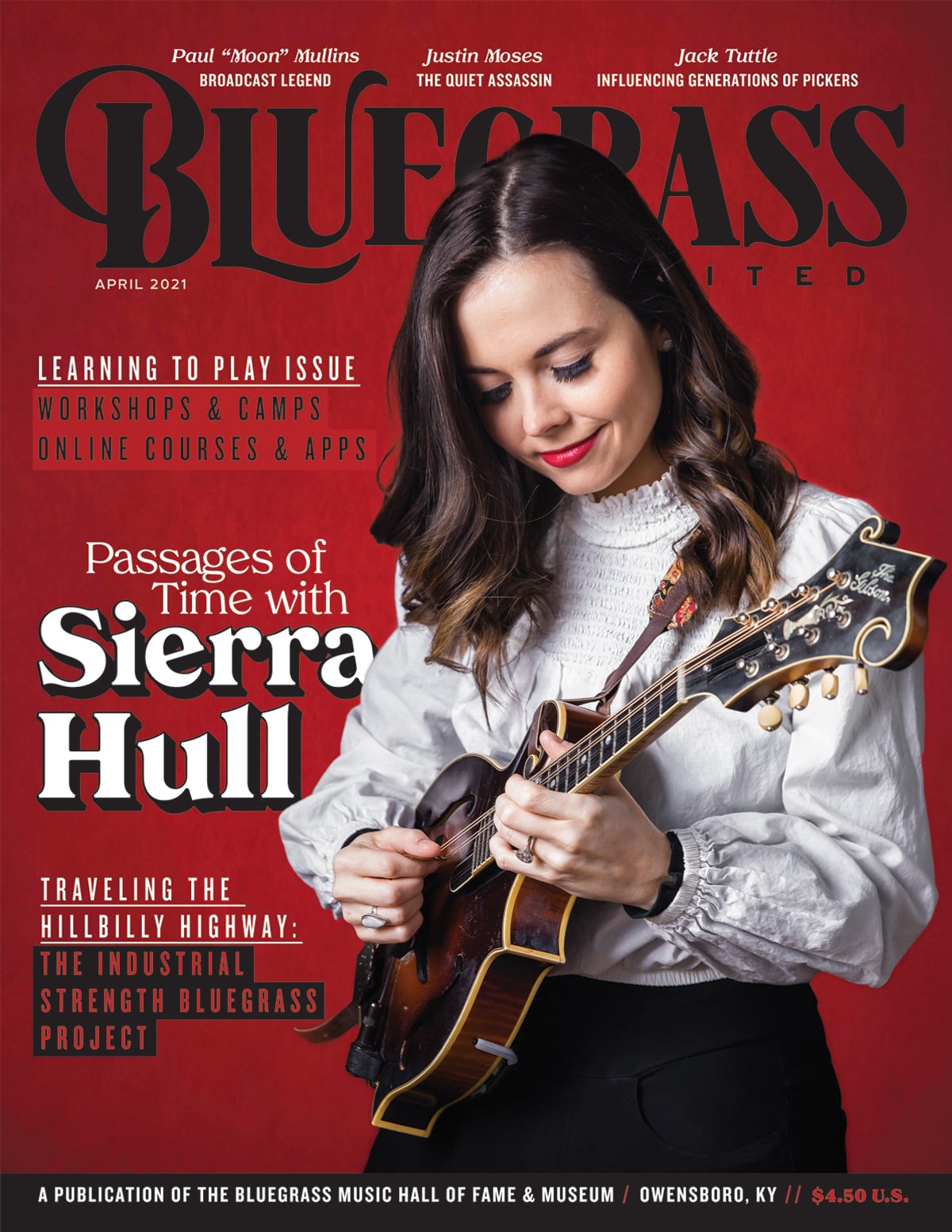
Moses went no further than his own home to enlist his wife and mandolinist extraordinaire Sierra Hull on the instrumental, “Taxland.” [See Sidebar]
“We play that song a lot with double mandolins in our duo shows. When it came time to record, I knew I wanted to do it like that with two mandolins, but I also wanted to try it with a band behind it. I knew that melody lent itself to a soaring fiddle solo. Mike Cleveland came to mind right away. I knew he would bring in exactly what I had in mind for it.”
“When you’re writing instrumental tunes, they’re always hard to name,” Moses adds, laughing. Sometimes we’ll throw a name on one that’s meant to be funny, and that’s what we did with this one. I was literally doing my taxes probably either 10 minutes before or 10 minutes after I wrote the tune.”
Under the Microscope
Although Moses was able to squeeze in time to record his own album, it was no small task for a musician who stays busy on tour and in the studio. He enjoys both, but laying down tracks takes a different perspective than performing live. Moses feels like he’s more under the microscope.
“There’s creativity in both, but I really enjoy the creativity in the studio. You’re really zoned in because you know this is something that’s going to be out there and people are possibly going to hear it even many years from now—whether it be streaming services or in some physical form. Everything is noticed whereas live, you play something and it’s over with. [But] these days people YouTube and record everything, so I feel like even in a live setting, it’s important to bring your A game and play great.”
Moses has played all the instruments in his playing arsenal on records for Ricky Skaggs, Dan Tyminski, Rhonda Vincent, Sierra Hull, Mac Wiseman, Junior Sisk, Marty Raybon, Blue Moon Rising, Lou Reid, The Band of Ruhks and Terry Baucom, among others. Rarely does Moses hear any songs before the day tracks are cut in the studio.
“I usually show up and they will either have a demo or a guitar in hand and play the song for everybody. They’ll either have charts made or we’ll make them on the spot and take the chart in and play the song down, see how everybody is feeling about it, make any changes and try to get a good track going first. Once (you have that) timing wise, usually everybody will go around and individually fix anything that they might have messed up or just want another shot at. After that three-hour session, we’ll break for lunch, come back and do the same thing basically for another three hours.”
On many other occasions, Moses does his part on the recording without leaving his house.
“It’s not bad to stay home and record tracks and get paid a little bit for it and not have to even go out. That would be me getting up, setting up some microphones, getting my tones and really doing it on my own schedule.”
Of course, modern technology allows musicians to record their parts to be punched in later without the whole band, but that’s not a huge departure from what the talented instrumentalist did growing up.
“When I was a kid mainly playing mandolin and guitar and maybe one or two more instruments—even when the only equipment I had was cassette recorders—I would record myself on one, play that back, play along with it and record it [a part] on another cassette. There’s not that much difference in that and playing along with other people that have done the same thing in digital form.”
“I’ve spent time, especially since moving to Nashville, playing with metronomes to try to have my timing down where if somebody sends me a track and it’s to a click that I can play along with it. I don’t find it all that weird.”
Still, nothing will ever take the place of that creative interaction of players in the same room, inspiring each other.
“I would miss getting to interact with other musicians and the process of arranging a song in a studio. It’s always fun to be in a room full of creative people trying to figure out how to make a song sound good. There’s no substitute for that.”