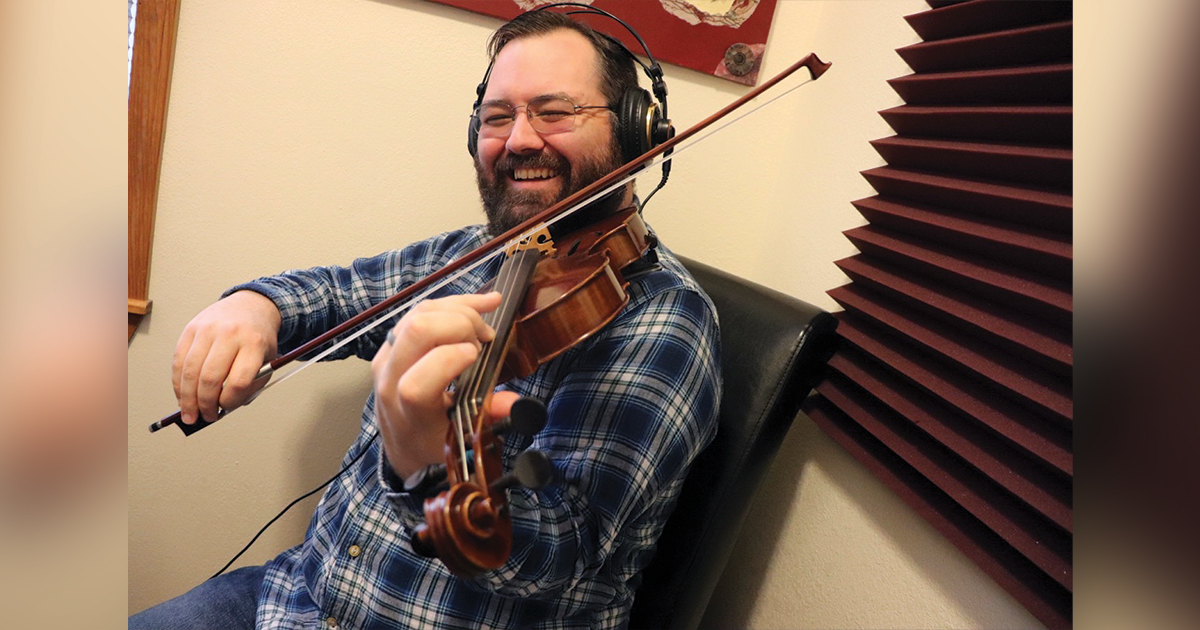
Justin Branum and masterfiddle.com
Fiddler Justin Branum was one of these musicians. Before the pandemic, Justin was on the road with Lee Ann Womack, but it wasn’t just the pandemic that prompted him to come off the road. In 2019 he got married, had already been teaching fiddle for many years, and he had also had success producing a few live online workshops with guest artists such as Buddy Spicher and Ranger Doug. So, when the pandemic hit, Justin had already started to transition into online teaching and by August of 202o his online fiddle teaching platform at www.masterfiddle.com was up and running.
Background
Born in Okinawa, Japan when his father was stationed there in the United States Marine Corps, Justin’s family moved around a lot when he was growing up. Justin said, “My dad is from Missouri and my mom is from Arkansas, so we moved back and forth between Missouri and Arkansas, but I also lived out west in Montana and Colorado.” He started learning how to play the fiddle at the age of twelve when his family lived in Montana. He remembers, “I had wanted to play and instrument for a long time. I saw some fiddle players on a parade float and I said, ‘I think I want to do that!’ So, my mom found a teacher for me and I had lessons for about five or six months. My teacher played bluegrass and contest fiddling and also had a classical background. After that we moved back to Missouri and we didn’t know anyone in the music world there, so I was pretty much self-taught from then on. I started listening to Kenny Baker and discovered western swing through Johnny Gimble. I was interested in anything that had a prominent fiddle part—from bluegrass all the way to the Sons of the Pioneers and Riders in the Sky.”
During his high school years, Justin became active in the fiddle contest scene in Missouri. He said, “In Missouri, back when I was a teenager, there were probably thirty to forty fiddle contests in the summertime. I would go to all of those. I got to meet a lot of the Missouri contest fiddlers—like Kelly Jones, Leroy Canaday and Fred Stoneking. They were pretty influential. I also did a lot of old-time fiddling, playing for square dances. As far as bands, I was mostly playing in country bands because that was what was around me.”
Justin’s interest in western swing style fiddling led him into jazz music and so after high school he went to Webster University in St. Louis and earned a master’s degree in jazz studies. He said, “In college I played guitar, violin, viola and mandolin. They let me go back and forth between all of those different things.”
After graduating from college, Justin started teaching private music lessons and also taught as an adjunct at Webster University and Washington University. About ten years ago—after teaching in the St. Louis area for a couple of years—Justin decided to make the move to Nashville. He said, “I had just turned thirty and I started getting road gigs, mostly the country thing. The last job I had before I got married was with Lee Ann Womack. I had learned a little bit from Buddy Spicher before I moved to Nashville, but after I got here, he kind of took me under his wing and showed me a lot of his trademark fiddle vocabulary and gave a lot of advice.”
In 2019 Justin married his wife Angelica, a bluegrass singer and guitar player who teaches at East Tennessee State University in their bluegrass program. Today, in addition to teaching, Justin is in rotation in the Grand Ole Opry staff band, does session work in Nashville, and is an adjunct at Belmont University in their commercial strings program. Recently Justin also became an adjunct at ETSU in their bluegrass music program. Additionally, you can see Justin perform every Monday night at the Station Inn with Carl Jackson, Larry Cordle, Val Story and their band of all-star Nashville musicians. As if that wasn’t enough to keep him busy, Justin also has four step-children and two-year-old twin boys.
Online Lessons
At masterfiddle.com, Justin offers a library of video lessons with each lesson being accompanied by detailed sheet music (including bowings and a form of tablature that shows the fingerings) and audio files and practice tracks. Justin said, “In the video lessons I break everything down by ear and some of the lessons are more about concepts than tunes. I have a lot of stuff on improvisation, theory, concepts on different styles—bluegrass, Western swing, jazz, contest fiddling, country and old-time—that is all on there.”
To access the lessons, you subscribe anywhere from a monthly to a yearly subscription and that subscription gives you access to all of the lessons offered on the site, which also includes lessons for mandolin and guitar. New lessons are added a minimum of one per month, but sometimes more than one a month are added. For those who want to consider signing up, but may not be quite sure about committing to a subscription, Justin generously offers the first three days for free. He said, “It is a three day free trail and you can have access to everything during those three days and not have to pay for it.” Justin additionally teaches online private lessons (Zoom or Skype) and offers a discount to masterfiddle.com subscribers.”
Regarding the mandolin and guitar lessons offered on the site, Justin said, “Most of it is fiddle-centric. As fiddle players we all usually get into mandolin and guitar at some point. We get into rhythm guitar that is based on some kind of fiddle tune backup. So, basically all of the mandolin and guitar lessons are based on anything that might appeal to a fiddle player who has already subscribed. Most of the guitar lessons focus on contest style or western swing back up because those are two things that are not particularly well-addressed in other places. So, I started with that because there was a demand to fill that vacuum.”
In the guitar lesson section, there is even one lesson from the “idol of American youth,” Ranger Doug of Riders In The Sky. Justin explained, “Before I started the site I was conducting some online workshops and I had Doug do one and Buddy Spicher do one. Pieces of those workshops are available on the site. I spoke to both of them specifically about things that they wouldn’t mind if I took from that and put on the site. But, I don’t have the entire workshop on the site.”
The Details
For those readers who may be interested in learning fiddle, mandolin, or guitar from this site as described above, I’ll provide more details of what to expect. First, a nice feature of each video lesson—beside Justin going through every concept or tune slowly and in great detail—is that you are able to speed up or slow down the video. Justin said, “For somebody who is more advanced, they probably don’t need me to go so slow, so they can speed me up. For someone who even needs to go slower, they can slow me down.”
The video lessons on the site can all be found under the “Catalog” menu and are organized by instrument (fiddle, mandolin or guitar), by level (beginner, intermediate and advanced), by style (bluegrass, western swing, Texas/contest style, old-time, jazz, country, or twin fiddle) and other non-tune related topics (improvisation, theory, technique and recording). Each of the above categories contains many video lessons. For instance, under the improvisation section there are 65 video lessons available. Under the fiddle section there are over 100 videos. In the bluegrass section there are 55 videos. Of course, some videos in the different categories overlap. For instance, the video in the improvisation section on Basic Improv for Fiddle/Violin can be found in all three of the above-mentioned categories.
In presenting the instruction of tunes, Justin will list a particular tune in the beginner section, the intermediate section and the advanced section and the arrangement will be appropriate for that level of learning. He said, “When I teach a tune, I like the student to learn the basic melody first, even if the student is pretty advanced. I like to say, ‘Hey, lets start here and make sure that you know the basic melody of the tune.’ The older fiddlers that I learned from in Missouri would always tell me, ‘You have to know the tune!’ I think that it works well for the beginner or intermediate level person to learn that basic version first. Instead of ‘beginner version’ I like to call it the ‘basic version.’ Once the student learns that, then we gradually learn how to beef that up. You learn to grow on top of the basic melody versus just learning the complicated versions and the hot licks without even knowing the melody.”
Since finding fiddle tunes online and lessons about theory are fairly common across many learning platforms that a student might find online, I asked Justin specifically about his approach to teaching improvisation online. He said, “It stems from having a heavy jazz background. I studied improv myself and also studied how to teach improv in college. I look at that as a good model. Whether you are going to play jazz or bluegrass, it is all of the same things that you are going to learn. I start from the ground up with basic concepts that give you a way to start improvising. So, I’ll talk about pentatonic scales and blues scales—things that make it so that you don’t have to focus too much on chords. But pretty quickly after that I like to get into how to play over different chords because that is the thing that people typically struggle with the most—especially for fiddle players, we have a tendency to not know our chords very well. So, I teach how to practice arpeggios and how to practice double stops as arpeggios in a way that makes sense on the instrument and it gives you a road map to know exactly where you are at. Most of the time, fiddlers are not too good at that because the fiddle is such a melodic instrument and we learn tunes and do not necessarily need to know anything about chords to do that. When you get into improvisation, all of the sudden, it is a little different. Fiddlers don’t necessarily know a lot about how to target chord stuff. When people are not happy with their improvisation, that is usually what they are missing. So, I focus a lot on that.”
Justin continued, “A lot of it is learning how to practice scales and arpeggios in a way that makes sense for improvisation versus more of a classical way that may give you some technical things, but not give you a thorough road map. Once the student can get a couple of patterns down, it is easy to learn how to know what to do. In addition to chord targeting, I also teach licks, but I think it is important not to just learn the lick, but know how to deconstruct it. If you take licks that are complicated and break them down to their very most basic idea, so that you have the concept, you can then do what every you want to. For instance, I have a section of Vassar Clements licks and that is great for people who already know how to do certain things, but it is more useful to take one of his licks and break it down to its most fundamental layer versus playing it exactly like he does because then you are stuck playing the same thing in the same place every time and it sounds like a stolen Vassar Clements lick instead of your own lick.”
Regarding available methods for learning how to improvise on the fiddle, Justin said, “Fiddle and violin instruction doesn’t have a great history of education geared towards improvisation. There is a hole there that needs to be filled and so I like to focus on improvisation because there is not a lot of good content out there.”
Another aspect of learning to play music that one might be less likely to find online can be found in the guitar section of Justin’s website. While there are more guitar courses offered online than one can possibly count, learning how to specifically play backup to fiddle tunes, especially in the western style, is not so common. Justin said, “Most of my students who want to get into the guitar stuff are after the Eldon Shamlin style of back up [Author’s note: Eldon was famously the guitar player for Bob Wills and helped define the western swing style of guitar] but I also get into the Freddie Green slash Ranger Doug style too. That is actually a better place to start because of the two and three note chord shapes that they used. I also sometimes hybridize those styles. Eldon used bigger chords, but you couldn’t always hear them. I like to use Eldon’s moving bass line with the smaller chord shapes because it cleans up really well and works well with an acoustic guitar style because Eldon played electric. I think that when you play the smaller chord shapes, especially when you are playing with a bass player, you get a cleaner sound.”
In addition to teaching western swing style guitar backup, Justin does also offer contest style, old-time and bluegrass back up. He said, “The western swing and contest styles of back up are a little different. I think that the contest style combines the old-time style with the western swing style. While I do teach a variety of back up styles, the people that I mostly end up working with are interested in the western swing style backup.”
While a student who wants to learn how to play bluegrass fiddle tune arrangements and variations will find very detailed instruction at masterfiddle.com, several of the main features of the instruction provided at masterfiddle.com—such as thorough method of learning improvisation and instruction on learning how to play back up guitar for fiddle players in a variety of styles—are less likely to be available on other instructional websites. For that reason alone, it is worth taking a look at masterfiddle.com. Another bonus is that whatever you want to learn on the fiddle, masterfiddle.com provides you with direct access to a very well trained and seasoned expert instructor.