Jonathan Mclanahan Embraces the Loar of the Luthier
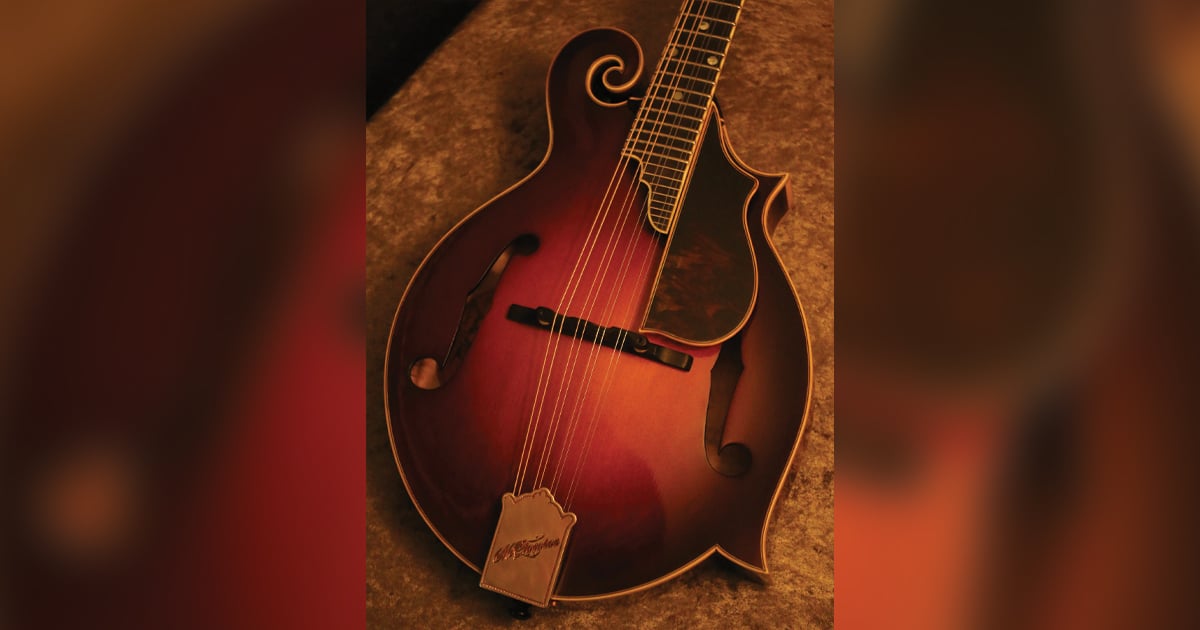
McClanahan Trinity Model F-5 Mandolin
Photos by Jonathan McClanahan
In a relatively short time, Jonathan McClanahan has earned a place amongst the highest reaches in modern bluegrass mandolin building. His Trinity and Loretto F-5 models aspire to the loftiest standards of tone, projection, playability, and build quality. Played by C.J. Lewandowski, Danny Roberts, Wayne Benson, Jesse Brock, and more pros and top amateurs, the McClanahan F-5 offers bluegrass mandolinists an instrument that takes on the vaunted Loar sound and design in a subtly modern way.
Mandolin playing has evolved radically since the mid-1920s when Kalamazoo turned out the world’s most advanced, utterly radical mandolin family instrument designs. That quantum leap in design, sound, and playability is to many modern luthiers what the Lost Dutchman Mine is to treasure hunters.
For McClanahan, like so many contemporary luthiers, the challenge is to impart his own style and personal flair on the Master Model F-5 design and tonal signature without detracting from its timeless visual appeal and beguiling sound. Some abandon earlier attempts and go avant-garde, like John Monteleone. Others, as Red Diamond has, delve into the structural engineering and physics of famous instruments like Bobby Osborne’s Fern or John Reischman’s Loar to recreate their classic sounds.
McClanahan, a fervent Loar historian and researcher, finds a middle ground on this instrument where he embraces the Lloyd Loar F-5 sound and look, but sees areas of potential improvement throughout the basic design. In his eye, every angle, every compound curve, every graduation and engineering feature of the original is something to scrutinize and reconsider.
Jonathan McClanahan digs deep for the hidden gems awaiting discovery within the complex sound and build of a Loar F-5. Talk to him about mandolin acoustic theory, design and construction, and you learn that he studies higher mathematics topics like supersymmetry and string theory, even seeing mathematical equations in his mind almost like Matt Damon in Good Will Hunting. One can only imagine the combinations of variables and design solutions McClanahan visualizes as he finds areas where his mandolins can surpass the standard.

Physically, McClanahan’s Trinity F-5 takes barely perceptible liberties with many aspects of the classic Loar-designed Master Model Gibson F-5 that combine into a big impact. For example, he has spread the treble side points apart slightly to enhance proper posture and increase player comfort. The f-holes, a crucial element in attenuating the soundwaves exiting the body, are his own design, with the curlicue points extending deeper into the soundhole opening. “It’s a lot more work, but it’s worth it,” he says. Turn the mandolin over, and he is proud to point out that the “bell,” the upper quarter of the mandolin where it meets the neck that resembles a handbell, has been broadened on the bass side to be more symmetrical, leading to a slighter more open scroll that mirrors the modification. It doesn’t take a Fields Medal winner to imagine how greater symmetry here could add new harmonic capabilities to the mandolin.
The McClanahan headstock is purposely narrowed between the center four tuners, creating a more graceful, fluid look, capped by the elegant pearl headstock logo and inlay. He matches that with subtle changes to the shape and compound curve of the headstock scrolls in a way that moves the traditional design further along its evolutionary path. It’s nothing like a complete re-do like the Monteleone Grand Artist, more of a subtle and sophisticated refinement to an established standard that just looks right.
This was the rare review opportunity when the builder and the instrument’s owner, mandolinist and luthier Danny Roberts, came to my music room, having travelled roundtrip from the Nashville area to bring the mandolin up for a review rather than risk shipping it. After spending an hour with the duo discussing the review instrument and its many subtle changes to the standard template, they left for lunch to give me time to inspect, play and assess the mandolin before driving it home in McClanahan’s roadworn Toyota pickup.
When McClanahan and Roberts returned, they asked what stood out most to me. I answered that this F-5 has a remarkably even, balanced tone from string to string and for all notes on the fingerboard. As soon as I said it, both of their eyes lit up and they explained that this exquisite tonal balance was exactly what they strive to achieve.
Not only did the McClanahan Trinity show the kind of string-to-string balance that would please a touring and recording mandolinist like Roberts on stage or in the studio, it was more than that. Each individual note demonstrated a remarkable inherent balance between its own low, mid and high frequencies. No wolf notes or unexpected harmonics, but a fully voiced sound that popped out of the f-holes in a wonderfully consistent manner. The individual notes weren’t “sweet” or “chimey” or “throaty.” They were all of that at once, with a lovely natural acoustic compression imposed by the design and the enhanced f-hole shape. This is a mandolin that doesn’t surprise the player with an unexpected overtone or underdeveloped note, a benefit any skilled studio engineer or soundman will love.

It’s almost what you don’t hear that makes this mandolin special. The top-end has that lovely crunchy sound we cherish in the best F-5s, like crushing fine crystal under heavy velvet. But those lovely shimmering upper harmonics are tempered evenly with the fundamental tones. And while bluegrass is this mandolin’s hometown, it would shine in classical music ala Mike Marshall and Caterina Lichtenberg or other genres.
Curious as to how this balance is achieved, I slipped a dental mirror and LED into the mandolin to check under the hood. What I found was another distinct difference from Chef Lloydardee’s’s classic Best of Kalamazoo Mandolin Cookbook recipe. Loar’s tone bars run asymmetrically up the top, with the bass side brace splayed out to a greater angle that comes close to the f-hole.
Inside the Trinity, I found the two tonebars angled in a mirror position, more like the long legs of a capital A where the bass bar is the opposite angle as the treble side. And the braces looked quite thin, almost flimsy compared to the braces on some other top-end mandolins. Again, when I asked about the brace shape and position, McClanahan and Roberts, who now works with McClanahan as a builder, were a bit surprised, pleasantly, to have been found out. McClanahan says he plans to talk openly about his new bracing pattern soon on YouTube, so stay tuned.
In today’s world of big expectations and often contradictory demands on bluegrass instruments, luthiers like Jonathan McClanahan continue to push the envelope, just as Loar did, to find new voices and musical flavors within the timeless design. With the Trinity F-5, McClanahan takes very interesting steps to reboot the old mandolin hardware from the 1920s and create a Loar F-5 v2.0 instrument for musicians inhabiting the 2020s.