John C. Campbell Folk School
SCENIC NORTH CAROLINA CAMPUS STRIVES TO KEEP APPALACHIAN MUSIC, DANCE AND CULTURE ALIVE IN BRASSTOWN, NORTH CAROLINA
The traditional Morningsong music program is offered several days a week at 7:45 a.m., and Friday performances are streamed live on the Folk School’s Facebook page. A socially distanced and masked crowd filled the historic Keith House Community Room to hear Baugus, who was teaching a weeklong beginning clawhammer banjo class at the school. Toes started tapping and eyes smiled as he shared stories about the songs he frailed on a black clawhammer banjo that he built.
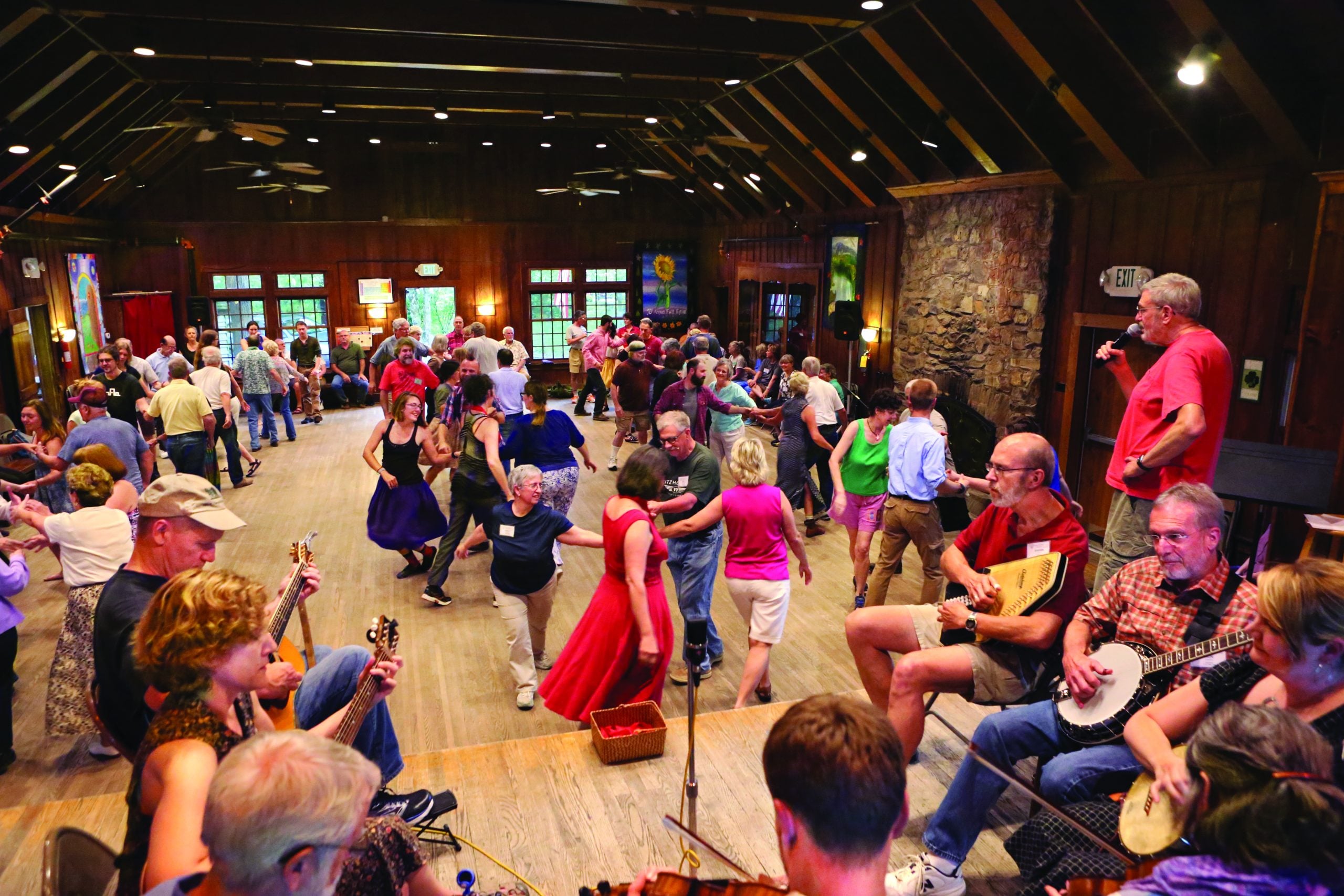
Charmaine Slaven, music and dance studio coordinator, welcomed attendees to Keith House, the second oldest building on the school’s 270-acre campus. The wood floors are scuffed from the footwork of generations of flat foot cloggers and contra dancers. “Many happy things have happened here. There’s a loving energy infused in the walls,” Slaven said.
Baugus closed his half-hour program with Ola Belle Reed’s “Undone in Sorrow.” He is steeped in the old-time ways and was schooled by his elders in his hometown of Walkertown, North Carolina. “My family, being from the Blue Ridge, they enjoyed what they called string music,” he said in an interview during a break between classes. “You learn to like what you’re offered. I found the things about the music that moved me. I found the things that evoked an emotion. I also saw the respect that the people who played music got.”
Baugus has evolved into an expert on old-time music from the North Carolina and Virginia mountains. He and Kirk Sutphin, a neighbor who plays old-time fiddle, ventured up to Mount Airy to meet old-time fiddle and banjo player Tommy Jarrell and learn the songs of old-time musicians. “Now, I seem to be seen as a bit more of an authority because all of the old folks that I learned from are no longer with us,” Baugus said. “I’m one of the torch bearers for a lot of that tradition and technique.”
Ten beginner clawhammer banjo players sat in a semi-circle in his class, trying to absorb his “bum-diddy” rhythm method and learn to string segments together in songs like “The Cuckoo.” Baugus was the a cappella singing voice of Pangle in the 2003 film Cold Mountain, and went out on the “Down from Cold Mountain” tour. He is humble and enthusiastic about sharing his playing style with the students. One asked how he came to teach the way he does having learned the way he learned. “I love teaching. I understand as a beginner, you don’t know what to do. I am trying to answer the questions for them that I had when I learned,” Baugus said. “I like to see the light bulbs go on in their little eyes when they get it. Once they get it, you can’t undo it. You can’t unhear Jimi Hendrix.”
He has been teaching at the Folk School for decades and treasures the way banjo camps and folk schools keep Appalachian traditions alive. “It takes our traditions and spreads them all over the world. People come from everywhere,” Baugus said. “I think it lets people know that we, as mountain people, with our peculiar traditions and customs, are a lot more intelligent than TV and things like ‘Hillbilly Elegy’ give us credit for. There’s so much more richness in the mountains and in the culture than people know.”
Flatfooting via Zoom
Veteran music and dance instructor Aubrey Atwater, a native of Rhode Island, has been teaching at the Folk School for nearly 30 years. “It’s a really magical, special place,” Atwater said of the John C. Campbell Folk School. “I love it there. It’s maintained the same vibe all these years. It maintains that interesting, historical vibe of really strong nurturing of noncompetitive adult learning and creativity. It’s a really cool place.”
This spring, she taught a Freestyle Flatfoot Clogging class online. About ten would-be dancers tuned in for two-hour classes on four consecutive Mondays. She started students out with basic steps, like the two-sound Buck step, the chug and the four-sound Tennessee Walking Step. They progressed to a full but simple routine for the closing ceremony.
Music and dance has been ingrained in the Folk School from the beginning. Founder Olive Dame Campbell was a song collector and her friend Marguerite Butler was a dancer. Students would sing a song from the folk school’s treasured songbook before every meal. “Music and dance is an integral part of life at the Folk School, and we’re known far and wide for it,” the school’s Executive Director Jerry Jackson said in an email. “It’s one of the many ways we bring folks together—from starting the day with Morningsong, jamming at lunchtime, to dancing in the evenings in Open House near the garden. Our music and dance classes along with our community events have something for folks at every level, even those who feel like they can’t carry a tune in a bucket, or think they were born with two left feet.”
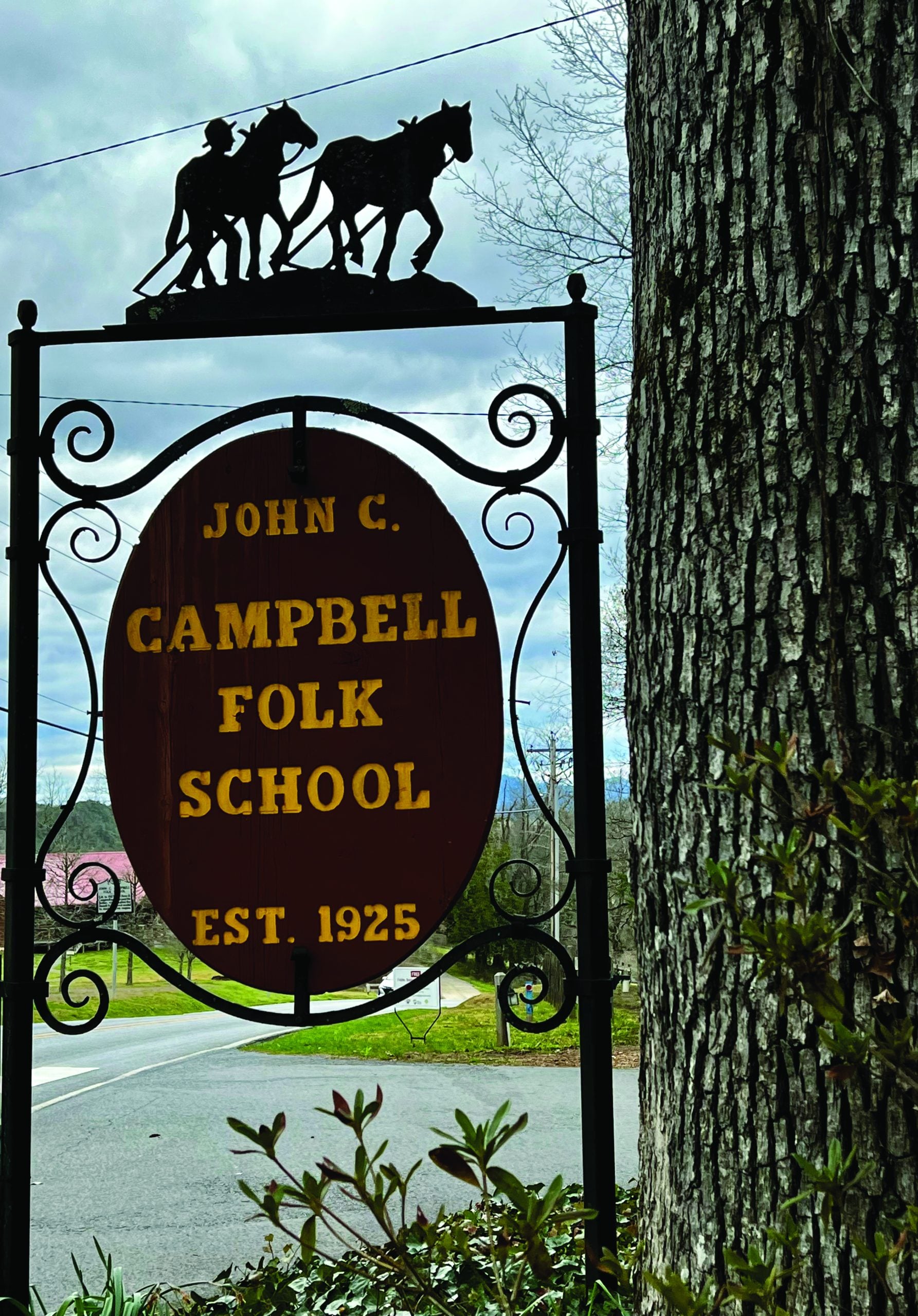
Olive Dame Campbell and her husband, John C., went to Europe to study the Danish folk school model, and traversed the mountains in a horse and wagon, looking for a place to start a school in southern Appalachia. After John’s death in 1919, Olive and Marguerite Butler stopped in Murphy, North Carolina, where shopkeeper Fred O. Scroggs suggested that they consider Brasstown. He encouraged locals to pledge labor and materials to construct the buildings. The Folk School was founded in 1925 and from its inception, the community embraced the school and helped it grow into an internationally known learning center.
There are no credits or grades and learning is noncompetitive, a method of teaching that the Danes called “The Living Word.” Discussion and conversation are emphasized, and most instruction is hands-on. The school transitioned from an agrarian boarding school in the 1970s and 1980s to more of an elderhostel model featuring weeklong classes. A recently released 124-page catalog lists classes from woodcarving to blacksmithing and from quilting to cooking. Arts and crafts take center stage, but music and dance continue to connect the community to the cause.
Toward the Future
The energetic young duo of Charmaine Slaven and T-Claw Crawford came onboard last summer to guide the Folk School’s extensive music and dance program. Slaven is the school’s Music and Dance Studio Coordinator and half of the old-time band Squirrel Butter, which also features her banjo-playing husband, Charlie Beck. They moved from Seattle, Washington, in August of 2021 with their young daughter, Hazel.
Slaven is respectful of the school’s traditions but also wants to diversify both the music faculty and student body to attract more younger folks and people of color, as well as the Native American community in the surrounding counties. “There’s a generation of people who have played music here and their moms and dads played music here and danced here,” Slaven said. “The community is still very strongly involved in the music and dance program. They are very invested.”
Slaven said months-long mentorship and work-study programs, as well as discounts for young people and teachers are key to efforts to diversify the folk school. A Little Middle school program and intergenerational week where grandparents are urged to bring their grandchildren are designed to introduce a new generation to traditional music and dance.
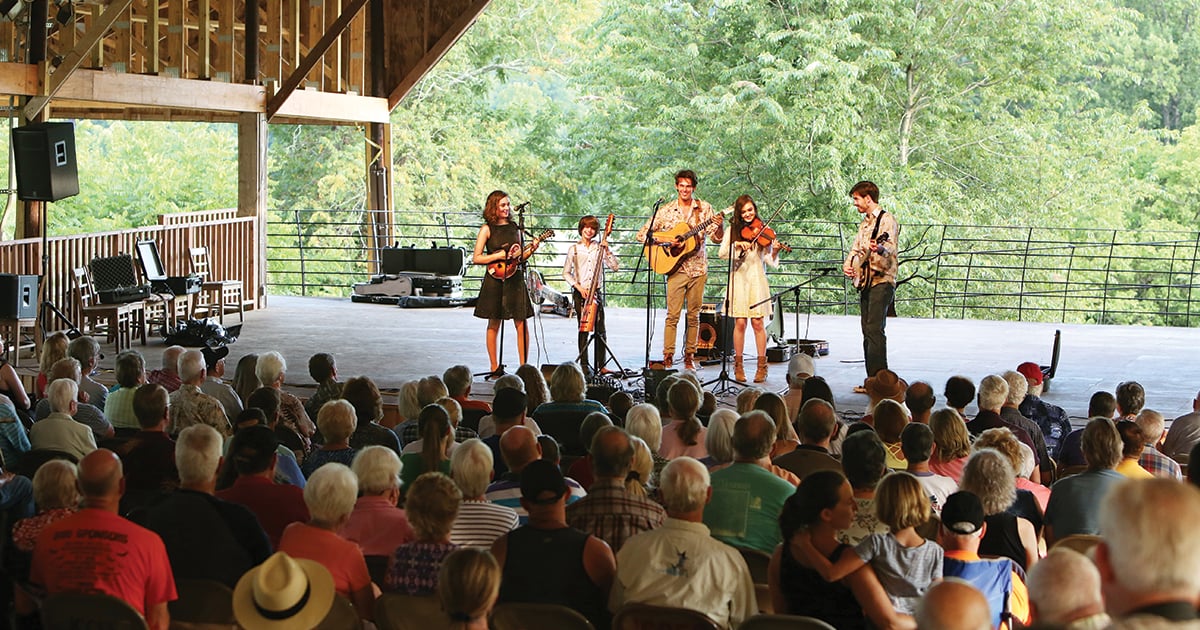
Her friend, Nashville-born musician and dancer T-Claw Crawford, was hired at the same time last spring in an effort to share the program’s demanding workload. Crawford was enthusiastic about resuming live events in early April. Tuesday night gatherings are more dance-focused while Friday night concerts bring a roster of traveling musicians from many genres to play in the outdoor Festival Barn. “It’s a dream job for me because everywhere I’ve lived I’ve tried to create little pockets of what the Folk School is in terms of music and dance and craft and culture—community,” said Crawford, who is the Music and Dance Events Coordinator. “It’s been a lot of work to pull off something like that once or twice a month. Here, it’s several times a week and it’s well attended. There’s an ample audience and a supportive institution that sees the value for all the students and the broader community. It’s my passion.”
Slaven and Crawford instigated the daily lunchtime jam of students and faculty members who play outside the communal dining hall that is nicknamed “Tuesday.” Crawford also is working on programming for Olive’s Porch, a new extension of the school in nearby Murphy that offers night and weekend programming aimed at attracting locals and tourists.
The pandemic shut down most in-person music and dance events for over two years. While the popular online class offerings through the Folk School’s partnership with Lessonface portal will continue, there is no substitute for live music. On the first Friday in April, Crawford welcomed guests back to the Festival Barn on campus for the return of community music events. An oddly configured bluegrass trio of two banjos vs. one guitar kicked off the live music series. Instructors Rick Taylor and Bruce Threkheld were joined by bluegrass banjo player Geoff Hohwald for an hour of music.
Several dozen music fans braved the cold in the open-air venue, as the last gasp of what locals call “dogwood winter” blew through the Blue Ridge Mountains. The trio sang and played bluegrass favorites like “Pig in a Pen,” “The Old Home Place” and “Foggy Mountain Breakdown.”
Crawford’s young daughter Freya stole the show as she clogged and twirled to the music while wearing a woolly unicorn toboggan. Yet another generation was moved by the Folk School’s mountain music traditions, like those who have gone before. “There’s such a huge, supportive community here that was used to having two or three things a week to do yearround,” Crawford said. “That’s huge for a small community. Big cities really struggle with a weekly dance in this kind of genre. It’s pretty awesome to have that audience.”
Vicki Dean is a freelance writer who lives in the Blue Ridge Mountains of Georgia. She retired in 2016 as the digital editor of the Sarasota (Fla.) Herald-Tribune.