
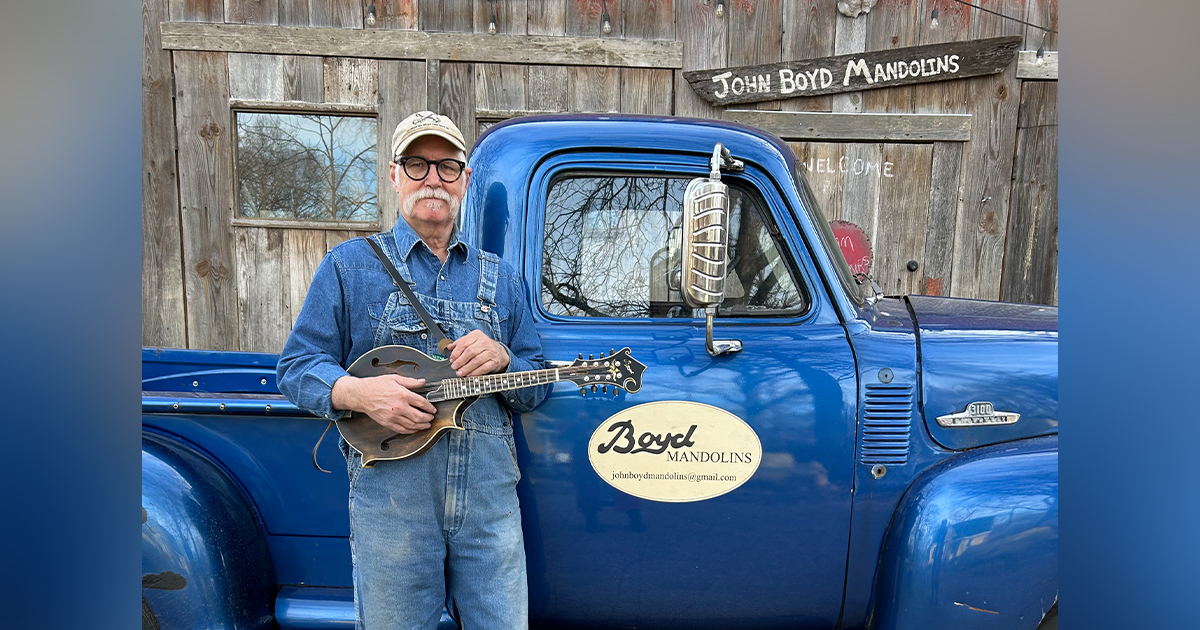
John Boyd Mandolins
At the International Bluegrass Music Association’s (IBMA) Conference in Chattanooga, Tennessee in September of 2025, I ran across a mandolin builder from Kansas City named John Boyd who is building mandolins under his name. I tried out the Boyd F-style mandolin and was impressed with its playability and tone. I later asked Lauren Price Napier, of the Price Sisters, if she had tried out the Boyd mandolins. She said, “I’ve known John for quite a few years now, and in getting to know him have realized that he is someone with great respect for what he does. When it comes to his mandolins, it is evident both in admiring and playing them that he has taken the time to make each instrument the best it can be. I know great players who have and use them. From the ones I personally have played, I feel a Boyd mandolin would make a fine asset to anyone looking for a handcrafted instrument.”
Brian McCarty, the current mandolin player for Special Consensus plays a Boyd mandolin and said, “Andrew Morris, who I was playing in the Matchsellers with, was playing Boyd mandolin #10 and I fell in love with it. It was really playable and had the old Monroe sound that I was looking for. John brought #9 up to one of the local clubs and I played it. I hit an open G chord and it rang and rang and rang. I went home and talked to my wife and said, ‘I think I have to get a mandolin.’ She said, ‘If you need a new one, you need a new one.’ And that was that. This one matched Andrew’s. I was lucky enough to pick that up from John and I used it on my audition with Special Consensus and I’ve used it with the band for the past year. It got me to Ireland and back and I played that on the 50th Anniversary record as well.”
The Boyd Story
Although luthier John Boyd started building mandolins about twelve years ago, he has been a skilled craftsman working with wood his entire life. His father was an amateur woodworker and instilled in John the belief that you can make anything with your hands and if something is broke, you can fix it. Being in an Air Force family, John was also exposed to fine handcrafted furniture and woodcraft that Air Force families obtained overseas and had in their homes. His curiosity regarding what he saw led him to wonder, “How do you take a piece of wood and make something so beautiful and functional?”
In 1974, at the age of 19, John was looking to embark on a trade as a craftsman and decided to move from his hometown of Kansas City to the Pennsylvania Dutch area in York County, Pennsylvania to learn from woodworkers who were famous for building fine furniture. He said, “I was looking for something to do and I gravitated towards wood as a medium and fell in love with it. York County Pennsylvania is a hub of woodworking—there were about eight woodworking shops.” In the 1800s York became home to numerous cabinetmakers, chair makers and joiners.
John’s connection to that area of Pennsylvania was that his wife was raised in York County. He first went to work in a commercial cabinet shop in Dallastown, Pennsylvania, about seven miles from York. John recalls, “York, Pennsylvania is the oldest inland city in the United States. There was a great appreciation for colonial era furniture in that area. We moved into an 1830s farmhouse and the old German hands-on craftsmanship was evident all around me. My landlord’s family had come over in the 1700s and the log cabin that they initially built was still there.”
Regarding the craftsmen that he worked with in York County, John said that they could do anything with their hands, like carving intricate vine, leaf and grape patterns in wood. He said, “Anyone can push wood through a sander, not everyone can carve. Not everyone can get the potential that wood has in it. One of the old guys that I studied with was born in 1900. These guys had worked around all of the different shops building all kinds of stuff…Philco radio cabinets, kitchen cabinets, furniture, tables, and chairs.”
After learning to make commercial cabinets and store fixtures in York— working at it for three years and doing some antique restoration work on the side—John moved back to Kansas City, after a short stay in Arkansas, and began working on furniture restoration. He said, “I went out on my own doing antique restoration. There are a lot of European antiques in Kansas City and old furniture always needs attention. It is interesting work because you never know what is going to come through the door. I’ve worked on a lot of museum quality furniture that people in this town own and I learned a lot. You get a lot thrown at you. You are not making whole pieces of furniture, but your making repairs on a lot of different aspects of one piece of furniture. In Pennsylvania, we sprayed the cabinets and used lacquer. The antique restoration brought in varnishes and French polishes and shellacs and waxes and all different kinds of colors. You had to do whatever you had to do to match it.”
Bluegrass and Mandolins
John continues to be involved in antique furniture restoration today, but a love for music led him to building mandolins. He said, “I had played music in high school, mostly horns, but hadn’t picked up an instrument for a long time.
I had always been a fan of bluegrass since the 1970s. The Circle album was the introduction to a lot of people of our generation. I had gone to shows…I saw Bill Monroe, the Earl Scruggs Review, John Hartford…I liked the music and was always a fan of it. I saw Steve Martin play with the Nitty Gritty Dirt Band back in the 1970s before he was famous as an actor.
“In about 2013, I picked up a mandolin at a trade show. I bought the thing and went back home and YouTubed how to play ‘Wildwood Flower.’ I decided that this was the missing piece of my life. I played that instrument for a while, it was a horrible little banjolin. In 2014, I decided that I needed a better mandolin.”
The first “better mandolin” that John bought was an Orpheon two-point mandolin that was made by the same maker of the Strad-O-Lin. He said, “By that time I had become familiar with Mandolin Café and someone asked about mandolins under $1000. Dawg, David Grisman, suggested getting a vintage Strad-O-Lin with a spruce top. I was lucky enough to find this thing on e-Bay. It needed hardware, strings and a bridge. I changed the tuners and it was very playable. It had a short scale. I still have that and use it for old-time or cross-tuning. I met Roland White and he told me his first mandolin was a Strad-O-Lin.”
Next, John bought an A-model 1914 Gibson A-Junior round-hole mandolin. He also bought a 1920 Gibson F-2. Recalling the F-2 purchase, he said, “I found it on e-Bay and they had taken all of the parts off of it. The back was off half-way around…the rib was out. I made a jig and put it all back together and rounded up reproduction parts. I still have it and it is a great mandolin.”
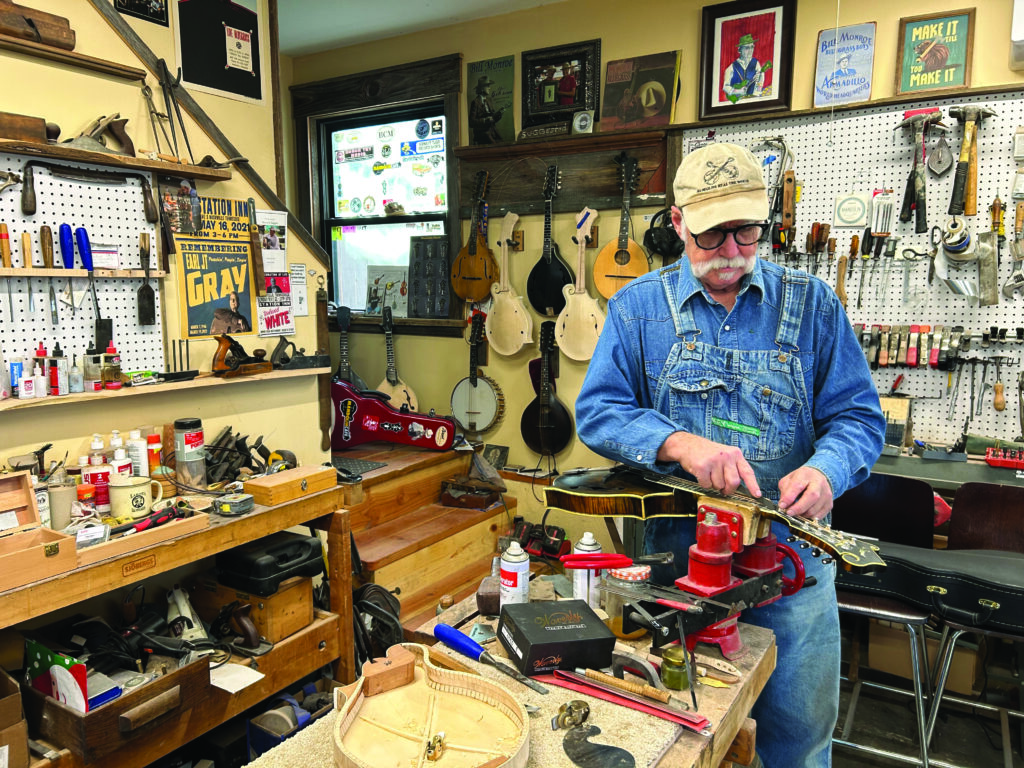
Photo by Nancy Bounds
John added, “The people who were carving the Lloyd Loar mandolins in 1922, 23 and 24 where probably at Gibson carving this mandolin in 1920. If you want to know how to carve a scroll, here is a great scroll to follow as your pattern. I think, like in York, Pennsylvania, around Kalamazoo there was a pool of woodworkers. They weren’t particularly luthiers, but they were journeyman woodworkers. When the classic instruments were built, they were built by woodworkers working the factories building anything and everything. It might be building tables, they might be building mandolins or guitars. The basic understanding of how wood works, how it flexes, how it finishes…a lot of it crosses over. However, I do remember talking to a luthier who told me that French polishing an F-5 mandolin is a lot different than a tabletop. I first thought that he was kind of being a jerk, but he wasn’t. French polishing is an art in itself. I prefer to color and French polish by hand. I don’t like to spray the colors. The French polish is still a mystery. Some days it goes real smoothly, other days—due to humidity changes or whatever—it is different than it was yesterday.
“I learned that there is a skill set when you move from furniture making and cabinet making to instrument building that has to be honed quite a bit when you jump up to the next level of building mandolins. I was also told by a really great guitar builder in Lawrence, Kansas that mandolins are the hardest instrument to build. I didn’t know that when I started. But it makes sense.”
After purchasing the Orpheon, the 1914 Gibson A-Jr and the 1920 Gibson F-2, John decided that he wanted an F-5. He recalls, “I then wanted to own a nice F-5 and I thought, ‘I’m a woodworker. How hard can it be?’ I then found out.” The first mandolin that John built was from a Roger Siminoff kit with high quality materials. He said, “I got Roger’s book and put this thing together. It is a nice mandolin. It doesn’t have everything that I would want these days, but it was a great way to start. The sides were bent and the plates were carved to a good starting point. I made a nice functional mandolin that sounded good and I was hooked. I’ve heard that there are two different kinds of people who built mandolins. One who builds one and then decides that they will never do that again. The other person says, ‘This is what I’m going to do on the next one.’ I was in that second category.”
Along with purchasing mandolins and building his first F-5, John was also taking mandolin lessons. He said, “My teacher said, ‘If you like traditional style mandolin, listen to Mike Compton.’ Going to Mike’s Monroe Style Mandolin Camp I met all of these people who had been Blue Grass Boys. One year the concert back up band was all Blue Grass Boys. Once I got interested, I went deep. I’ve got a festival rig and we go to festivals now. We host music here in Kansas City. We do live shows in the back yard in front of the shop. I’ve gone to IBMA a couple of times. We’ve gone to Nashville and hung out at the Station Inn. I’ve been to ROMP and the Bluegrass Music Hall of Fame and Museum several times. I’ve gone to Monroe Mandolin Camp eleven times. It has been a great exposure. One time John Reischman left his Lloyd Loar mandolin in the luthier room for us to check out. Having those kind of instruments show up, I love trying to figure out why they sound good.”
The Beginning of Boyd Mandolins
After building his first F-5 mandolin, John began studying all of the high quality mandolins that he could get his hands on. He said, “I looked at every aspect of them and talked with everyone that had a great mandolin. I met some of the best luthiers in the world at places like the Monroe Mandolin Camp and picked their brains. Some good instruments show up there and some great luthiers show up there. I explored how to do this…‘What are the tricks? Why are the good ones good? Why are the Loar mandolins so good?’ I put my hands on them, flexed them, tapped them…and that is how I got started.” To date (as of December 2025) John has built 20 mandolins. He said that he would like to be able to get to the point where he is building about twelve mandolins per year.
Once the mandolin building bug bit him, since he already had a woodshop, John’s first step was to buy specialty tools that he needed specifically to build mandolins. He said, “I use early 20th century technology. I use a pantograph to rough in the plates and then finish them up by hand with hand planes and scrapers and sanding discs. I like that approach. I like to have my hands on the wood, feeling it and hearing it. I’d done inlay in the antique repair business. I cut my own pearl and abalone. I do all of the inlay myself and that gives me more flexibility to do what I want to do creatively. I like having my hands involved in the process. I don’t lacquer. I believe that the varnish and French polish gives a better sound quality to the instrument. It allows the plates to flex. Thinner finishes are better than thicker.
“I think I’m on to a good recipe. I use sugar maple for the backs and ribs and I use Adirondack red spruce for the top. That is kind of the classic recipe. I’m going for dry, punchy bluegrass mandolin. I own several round hole mandolins, which I like, but what I build are f-hole mandolins. I’m trying to figure out why the hundred-year-old mandolins sound like they do.”
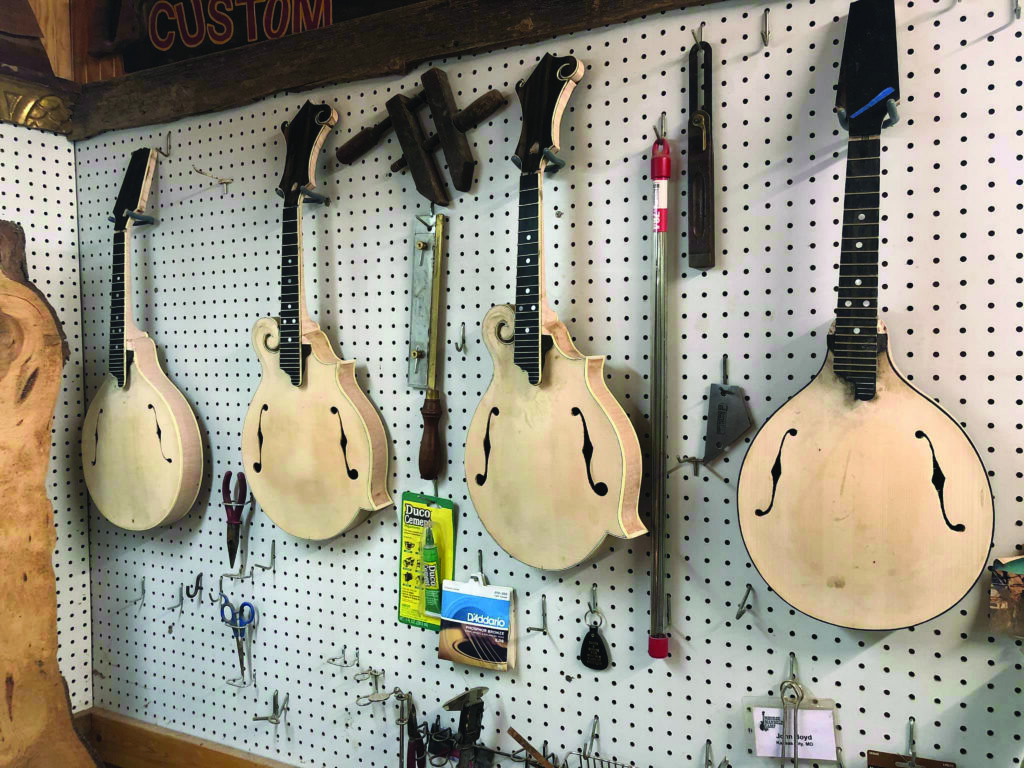
Photo by john boyd
While carving something like the scroll on a mandolin was not new to John, given his extensive background in working with antique furniture (he said, “Carving scrolls is not that much different than carving a foot on a French Louis XIV piece of furniture,”) John did add, “I didn’t know anything about tap tuning. That was an eye-opening experience. I had never thought about tuning wood to a pitch. You don’t need to tune tabletops to a pitch. But, it all makes sense. It is an art, not really a science. Each piece of wood is different, so trying to carve the plates and the tone bars to go to a specific frequency…that was one of the challenges. It makes sense that every piece of wood is going to resonate differently and you have to manipulate it to get what you can out of it. That was a revelation. I go pretty thin on my plates. I’m getting some good results and people like what I have done.”
As John continued to gain experience building mandolins, whenever he ran into various challenges, he asked other mandolin builders questions. When asked about specific questions he came up with, he said, “The one thing I did learn was that the tone bars don’t have a lot of mass. They are not braces to hold up the top. Supposedly, if the plates are carved well, you don’t need tone bars for structural reasons. The tone bars are used to tune the wood. The input that I got was to not make the tone bars too heavy. A friend of mine, who is an Australian luthier, said that when he started carving his tone bars thin, that is when his mandolins got good. That is one thing that I learned. Most of the luthiers that I’ve met have been really encouraging.”
John especially admires the Australian luthiers. He said, “You buy one of their mandolins, you get a product of their hands. I like that aspect of it, one person seeing the instrument start to finish. There are some good mandolins out there that a lot of people are involved with and builders who are using machines and CNC technology, but frankly, I’m way better with a chisel and a hammer than I am with a keyboard. So, I prefer that hand work. I understand chisels and planes a lot more than I do CNC machines. I’ll just stick with that.”
The Boyd Mandolin Models
John Boyd currently builds three different mandolin models. The first is an A-5 with the Griffith School design. The Griffith A-5 mandolin was custom built by Gibson for the wife of mandolinist W.B. Griffith in 1923. It is the only known Lloyd Loar signed A model. It features a “snake head” peghead, f-holes, long neck and elevated fingerboard. The Griffith School of Music was founded in 1898 by Mary Burke Griffith and located in Atlanta, Georgia. Willam Butt (W.B.) Griffith was Mary’s son. Stringed instruments were sold, taught and repaired at the school. W.B.’s wife, Margie Keelin Griffith taught mandolin at the school using her husband’s F-5. It is reported that while she loved the sound of his mandolin, she did not like the point sticking into her leg, so she asked if Gibson could build one without points. The mandolin was built in 1923 and signed by Lloyd Loar. Tut Taylor bought this mandolin from Mary Griffith Dobbs (W.B.’s sister) in the mid-1960s after both W.B. Griffith (1880-1964) and Margie Keelin Griffith (1891-1965) had passed. This now-famous mandolin was played by Norman Blake on John Hartford’s Steam Powered Aereo-Plain recording, by Tut Taylor on his Dobrolic Plectral Society album and by David Grisman’s on his Tone Poems album.
When asked why he decided to build to the Griffith mandolin specs, John said, “I like the looks of it and also if you want to play above the 12th fret, you have a little less mandolin in your way. You have a little more reach. You can get your hand further up the neck.”
The second mandolin model in the Boyd mandolin line is a two-point model. John said, “The plates are carved pretty much like the F-5.” The third model Boyd offers is the F-5 model. John said, “I try to keep close to the classic recipes. My goal is to be a full-time luthier and I only want to build mandolins. I’m honing in on this one thing. I think I’m barking up the right tree…I just got to keep barking.”
For more information about Boyd mandolins, you can contact John Boyd through his Instagram or Facebook pages, or check out the selection of Boyd mandolins at the Acoustic Shoppe in Springfield, Missouri (theacousticshoppe.com). Boyd mandolins purchased through The Acoustic Shoppe list from about $4200 for the A-style model, $5100 for the two-point model and $6500 for the F-5 style model.