
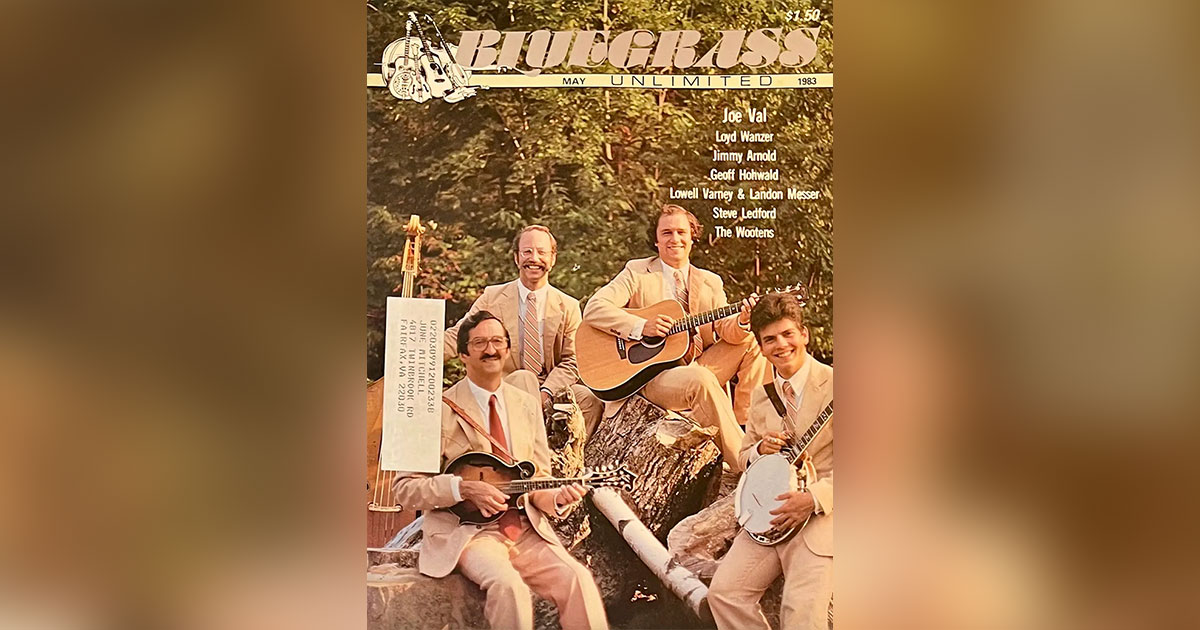
Joe Val and the New England Bluegrass Boys — One of the Best Kept Secrets in Bluegrass
By Nancy and Dick Kimmel
Reprinted from Bluegrass Unlimited Magazine
May 1983, Volume 17, Number 11
1982 was a pivotal year for Joe Val and the New England Bluegrass Boys. It was the first year this band was able to do extensive touring outside of their immediate home area. Personal contact through touring has always been necessary for a successful bluegrass band. Unlike other forms of music in which audiences are content to see their heroes through the media hype, television specials and the like, a bluegrass musician like Joe Val must carry his wares to his audience in person.
Even though Val is a dominant force in bluegrass in the northeast, his musicianship was virtually unnoticed outside of the half-dozen New England states in which he regularly performed. This 56-year-old native of Massachusetts has certainly been recognized as a premier bluegrass artist by other musicians and bluegrass diehards. His powerful tenor singing is immediately recognizable to those who know bluegrass well. Val’s vocal range seems limitless with a falsetto barely distinguishable from his full voice.
Val’s mandolin playing is traditional, yet has a sophisticated approach. His right-hand attack on this instrument has earned the continuing respect of other mandolin players. He’s been said to “fly like a butterfly and sting like a bee” as he delicately blends sharp single-string work with other techniques such as tremolo and cross-picking. He is quite sensitive in his approach to a mandolin break, always leaning towards good taste rather than flashy technique.
Val’s musical career was the subject of a number of newspaper and magazine stories, including a cover story for this magazine in July, 1977. Until this past year, however, the “average” bluegrass audience outside of New England didn’t know of Joe Val’s special talents. This audience consists of the country music fans whose major contact with bluegrass is through the live performances of a band. To reach this crowd a bluegrass band must travel as well as play good heartfelt music.
Until this past year, day-job commitments had made it impossible for Joe Val and the New England Bluegrass Boys to travel more than a single day’s drive from the band’s home base in the Boston area. Val’s band was a regular at the Meriden festival in Connecticut, the Corinth Bluegrass Festival in New York, and the Delaware Bluegrass Festival in Glasgow. The latter event has featured Val for 8 years in a row. Outside of a very few events like the Berryville (Virginia) and the old Indian Springs (Maryland) festivals, Joe Val and the New England Bluegrass Boys had managed to touch the southern bluegrass crowd only through their records that found their way south of the Mason-Dixon line. In 1982 the band broke the ice with many shows through different parts of Dixie.
Anyone who has experienced Val’s brand of solid, traditional bluegrass music knows that bluegrass audiences from any part of this country (or elsewhere) would immediately respond to Val’s music. The bluegrass audience is a suspicious bunch, but all that was necessary to win their support was getting Joe Val and the New England Bluegrass Boys up on stage in front of them.
An example of this occurred at a festival in North Carolina this past summer. As is the band’s custom, their first task at a festival is to set up the record table so they can display their 5 Rounder LPs and recent “Live in Holland” recording. Val recalls, “At most festivals where we play for the first time, the crowds only look at the records until we’ve played on stage. Then they sell like hotcakes.” Lead singer Dave Haney adds, “In North Carolina, one woman picked up the ‘Live in Holland’ album, and asked us (after hearing our accents) if we were from Holland. We said no, we were from New England. Then she said something like, ‘New England, eh? Do you get to America often?’ After we played, we had a bigger crowd than we could handle around the record table.”
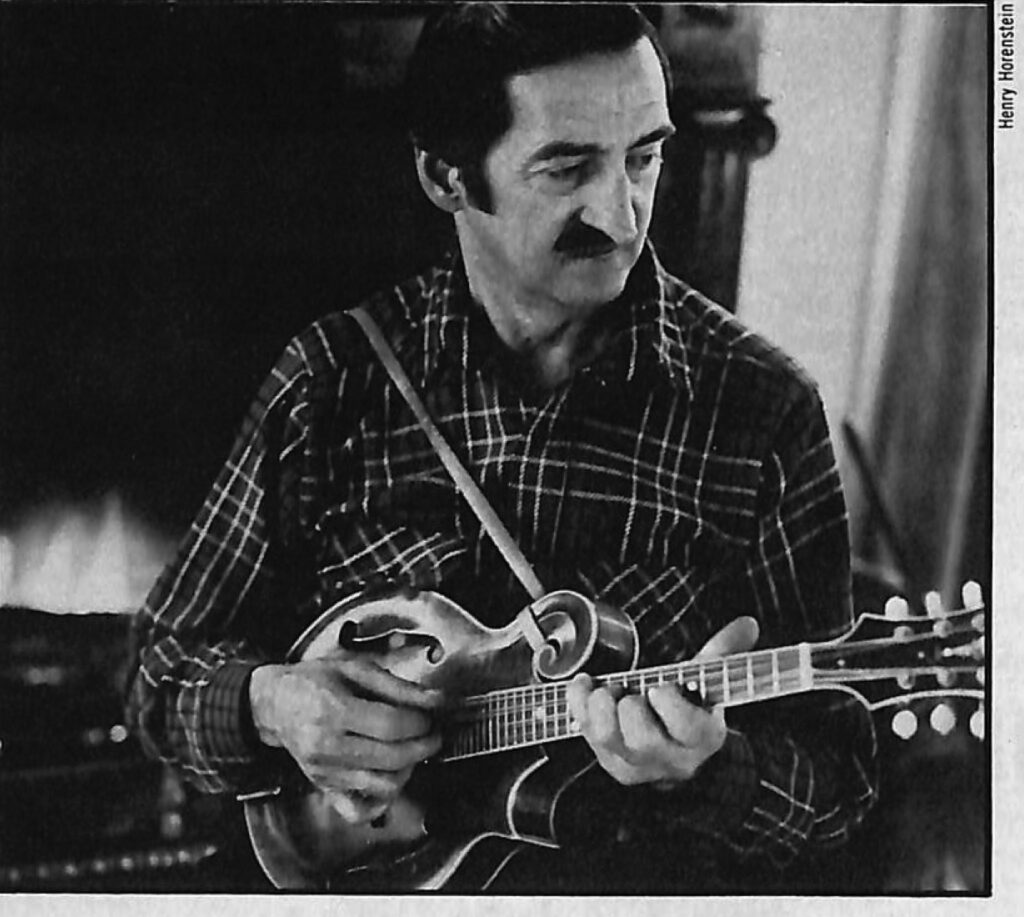
Granted, it is not an easy task to be accepted worldwide as a top-notch bluegrass band. However, Joe Val and the New England Bluegrass Boys have more than paid their dues. Val worked with the Radio Rangers and the Lilly Brothers in the 1950s. He has played and recorded with Bill Keith, Jim Rooney, Breakfast Special, and Tommy Makem. While with the Charles River Valley Boys in 1964, Val was part of the infamous “Beatle Country” album. By the time he formed his own group in 1969, Joe Val and the New England Bluegrass Boys, Val was recognized as one of the top tenors in bluegrass music. Through his yodeling abilities songs like “Sparkling Brown Eyes,” “T for Texas,” and “Freight Train Blues” have become “Joe Val songs” to the audiences who have heard him perform.
The latest version of the New England Bluegrass Boys has added a youthful shot of enthusiasm with the addition of two excellent musicians, Dave Haney and Karl Lauber. Val now has a band that is willing and able to carry his music to bluegrass audiences throughout the world. In the past, Val had to deal with personnel changes and employment commitments that kept the band locked in New England for much too long.
Despite these obstacles, Joe Val has managed to maintain through the years a continuity of style and an unwavering commitment to traditional bluegrass music.
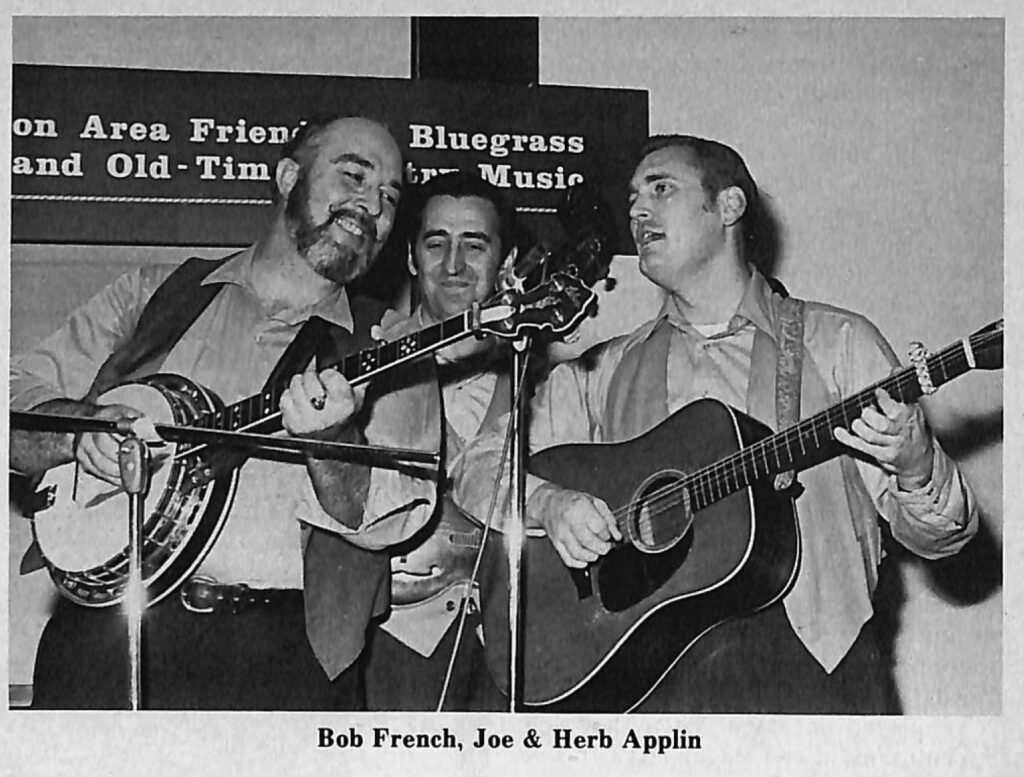
The New England Bluegrass Boys have weathered personnel changes which affected every instrument (except mandolin) since the band’s inception in 1969. Herb Applin’s role in the original group as guitarist and singer was the natural result of a long musical relationship with Val. The group’s first album “One Morning in May” (Rounder 0003) recorded in 1971 features duet singing by Val and Applin. The album presents renditions of several songs from the Louvin Brothers, who, along with the Delmores and other brother groups, remain a strong influence on Val’s choice of material. Other members of the first version of the New England Bluegrass Boys were Bob French on banjo and Bob Tidwell on bass. French had performed previously with Val and Applin as the Old Time Bluegrass Singers; Tidwell worked as mandolin player for Don Stover both before and after his five- year stint with Val.
In 1973 Val and Stover continued this precedent of exchanging personnel. In July of that year when Herb Applin went on vacation, Val ‘‘borrowed’’ lead singer/guitarist Dave Dillon from Don Stover’s White Oak Mountain Boys. The rapport between Val and Dillon quickly became apparent, and Dillon continued with Val after Applin’s return. To complete the trade, Applin joined the White Oak Mountain Boys.
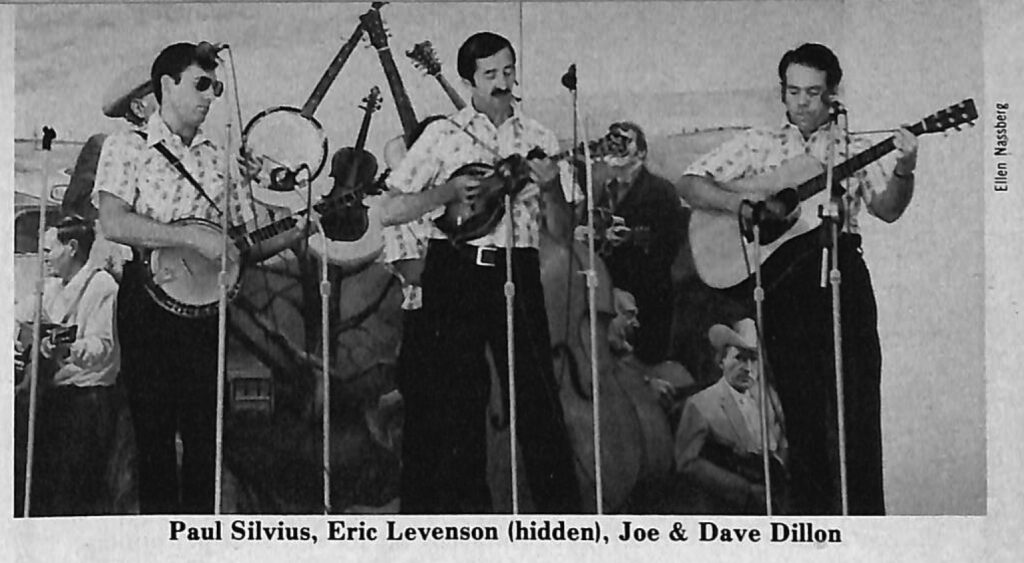
In August of the following year, banjoist Bob French made his final appearance with Val. Bill Hall, who had performed previously with the Lilly Brothers, took over on banjo for the next two years. During this transition period the band recorded “Joe Val and the New England Bluegrass Boys” (Rounder 0025). This LP utilized all of the New England Bluegrass Boys at that time, past and present: Dave Dillon and Herb Applin shared the guitar and vocal chores, and Bob French and Bill Hall took turns on the banjo. The addition of Herb Hooven on fiddle for this album marks the first of only two recordings to date on which Val utilized this instrument. Val again displayed his commitment to traditional bluegrass on this album. The group’s tight duets and trios produced “raw-boned, masculine bluegrass with… an underlying intensity that really grabs at you.” (BU, April 1976). The next major personnel change took place in 1976 when Paul Silvius became the new banjo player and Eric Levenson took over on bass. Silvius, only 21 at the time he joined Val, forsook his classical music training in favor of bluegrass. Eric Levenson and Silvius had performed together in other bands. Levenson now holds the record for remaining with the group longer than anyone except Val himself.
Levenson, originally from New York City, has lived in the Boston area since 1959. The artistic talents that he displays on the bass extend to other areas, as he is also a photographer and stage designer. His association with various Boston area bands dates back to 1970, and includes such groups as Tasty Licks and Blue Moon. In addition to his recordings with Val, Levenson has also made guest appearances on Jack Tottle’s “Backroad Mandolin” album (Rounder 0067) and “Premium Blend” with Orrin Star and Gary Mehalick (Flying Fish 234).
In 1977, Val with Dave Dillon, Paul Silvius, and Eric Levenson recorded “Not a Word from Home” (Rounder 0082). The album has a guest appearance by Dobroist Roger Williams (another White Oak Mountain Boys alumnus). In addition to the expected traditional numbers from Bill Monroe, Ralph Stanley, and Flatt and Scruggs, this album honors the frequent requests for “Beatle Country” selections by presenting “What Goes On In Your Mind.” Another contemporary cut is “High on a Hilltop” from Tommy Collins and Merle Haggard. However, “both songs emerge with the band’s unique stamp, sounding as vintage as the Roy Acuff song that serves as the title track.” (BU, September 1977).
In December of 1978, the band still consisting of Val, Dillon, Silvius, and Levenson, recorded “Bound to Ride” (Rounder 0109). This album presented songs from that particular combination of sources that by now have become Joe Val’s trademark: “Tiny Broken Heart” from Ira and Charlie Louvin, Don Williams’s “Some Broken Hearts Never Mend,” borrowed from the C & W genre, along with a liberal sprinkling of traditional (though lesser known) bluegrass numbers.
In 1980, Dave Dillon left the band because of day-job commitments. Dan Paisley was asked to fill in on guitar and vocals for the band’s first European tour in January of 1981. He appears on the “Live in Holland” album (Strictly Country 4). This album contains more bluegrass standards than the Rounder releases partly due to the concert situation and the band’s original intention that the LP would be especially for European audiences. Also, the musicians wished to avoid recording selections from earlier albums as well as selections intended for future recordings. The live performance situation of the “Live in Holland” album seems to have captured Joe’s piercing tenor better than any other recording.
The group’s latest album, “Sparkling Brown Eyes” (Rounder 0152) released this past summer, is Val’s second transition album. The Val-Dillon-Silvius- Levenson version of the New England Bluegrass Boys, which performed together for more than 4 years, is featured for most of the album. Sonny Miller, whom Val refers to as “one of the greatest bluegrass fiddlers of all time,” is the guest artist for this LP, which turned out to be Miller’s final recording before his tragic death. Featured for the first time as one of the New England Bluegrass Boys is the band’s new singer/guitarist Dave Haney.
On this LP Dave Haney serves as lead singer for the Louvin’s “The Angels Rejoiced,” and as tenor (yes, tenor) to Val’s lead for a duet version of Gene Autry’s “Silver Haired Daddy of Mine” adapted from a traditional-styled duet recorded by the Everly Brothers. Incredibly, the latter was cut the first time Haney had sung in a recording studio. In two takes, Val and Haney had the final product of this sensitive, polished duet on tape — an indication of this duo’s potential.
Haney, a 30-year-old native of Excelsior, Minnesota, learned guitar and banjo as a teenager. In between college and graduate school, Dave had performed various styles of traditional music. In 1978-80 Haney lived in Boston while completing a Ph.D. in English Literature. During this period, he performed with Bay State Bluegrass, and filled in for occasional performances with Joe Val. In 1980, Haney began a teaching job in Buffalo, New York.
“On the evening of the first day at that new job,” Haney recalls, “Joe called with the news that he needed a guitar player. I agreed to move back to Boston after completing my year’s contract.” In June of 1981, Dave Haney became the full-time singer/guitarist with the New England Bluegrass Boys. In addition to his musical talents, Haney is an asset in handling the band’s booking and promotion, as well as managing the business affairs.
In March, 1982, Paul Silvius left the Boston area to join Bob Paisley and the Southern Grass. (Bob’s son Dan and Silvius had both been with Val during the “Live in Holland” tour). Silvius’s replacement on banjo is Karl Lauber, an exceptional 20-year-old musician.
Val remembers first meeting Lauber at the Corinth festival, not far from Lauber’s home in Rome, New York. “Karl, when he was 12 or 13, would meet us backstage after our shows. Occasionally he would sing trios and play banjo with us between performances. After knowing him for 6 years there was no question who would replace Paul.” Lauber filled in with Val while completing a community college program in advertising and commercial art in Utica, New York. Despite the heavy travel schedule, Lauber performed at the band’s major shows such as the Quail Run Festival in Florida and a tour to Minnesota (including a performance on “Prairie Home Companion”) while still a student. Lauber moved to the Boston area to join Val full-time this past summer.
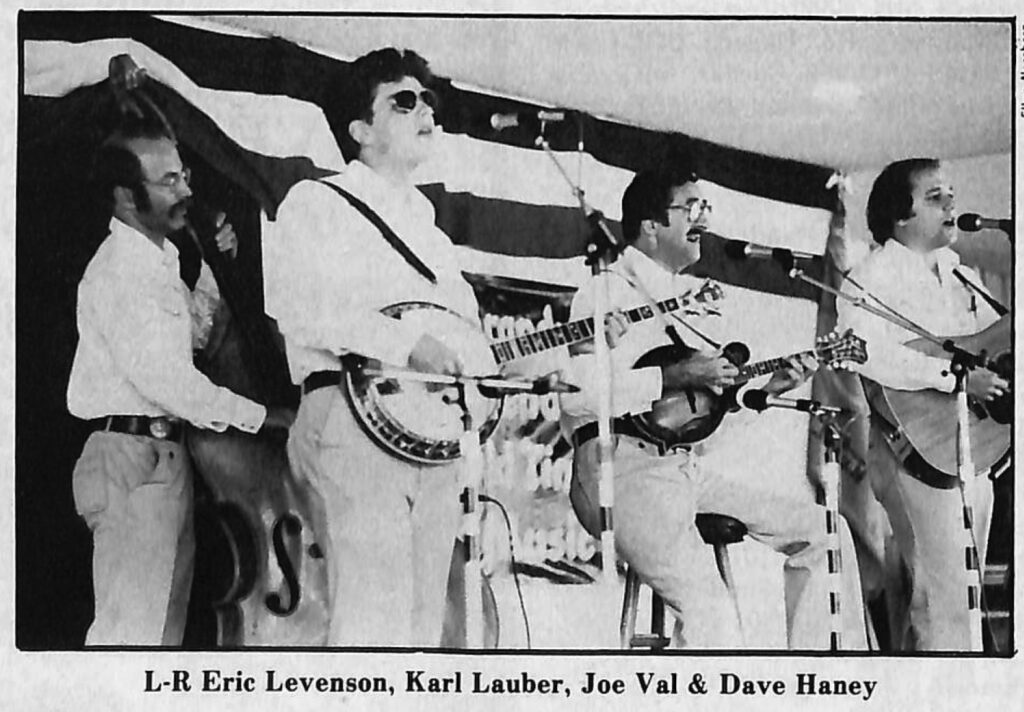
Lauber was an excellent candidate to replace Silvius. In addition to being a competent and tasteful banjo picker, Lauber plays fiddle, guitar, and clawhammer banjo, talents which are gradually being worked into the New England Bluegrass Boys’ performances. Also, he essentially grew up on Val’s music. He is at home playing banjo with Val’s material and has always had an interest in singing baritone. He has worked at mastering the baritone styles of Sonny Osborne, Eddie Adcock, and Earl Scruggs, learning how to add color by varying the notes he adds to the trios. The present band includes Joe Val, Dave Haney, Karl Lauber, and Eric Levenson.
Now that no one in the group is committed to a full-time job, the band is able to steadily increase their range and audience. Past articles on Joe Val and the New England Bluegrass Boys have concluded with statements concerning the band’s desire to perform in bluegrass country, in the southern Appalachians. In 1982, their wish was fulfilled. After 12 years of being restricted to jobs near their Massachusetts home, this past year Joe Val and the New England Bluegrass Boys performed to audiences in more than 15 states and 5 foreign countries. Val and the band deserve this recognition. They’ve truly been one of the best kept secrets in bluegrass.
Lauber was an excellent candidate to replace Silvius. In addition to being a competent and tasteful banjo picker, Lauber plays fiddle, guitar, and clawhammer banjo, talents which are gradually being worked into the New England Bluegrass Boys’performances. Also, he essentially grew up on Val’s music. He is at home playing banjo with Val’s material and has always had an interest in singing baritone. He has worked at mastering the baritone styles of Sonny Osborne, Eddie Adcock, and Earl Scruggs, learning how to add color by varying the notes he adds to the trios. The present band includes Joe Val, Dave Haney, Karl Lauber, and Eric Levenson.
Now that no one in the group is committed to a full-time job, the band is able to steadily increase their range and au-
Love Joe Val!