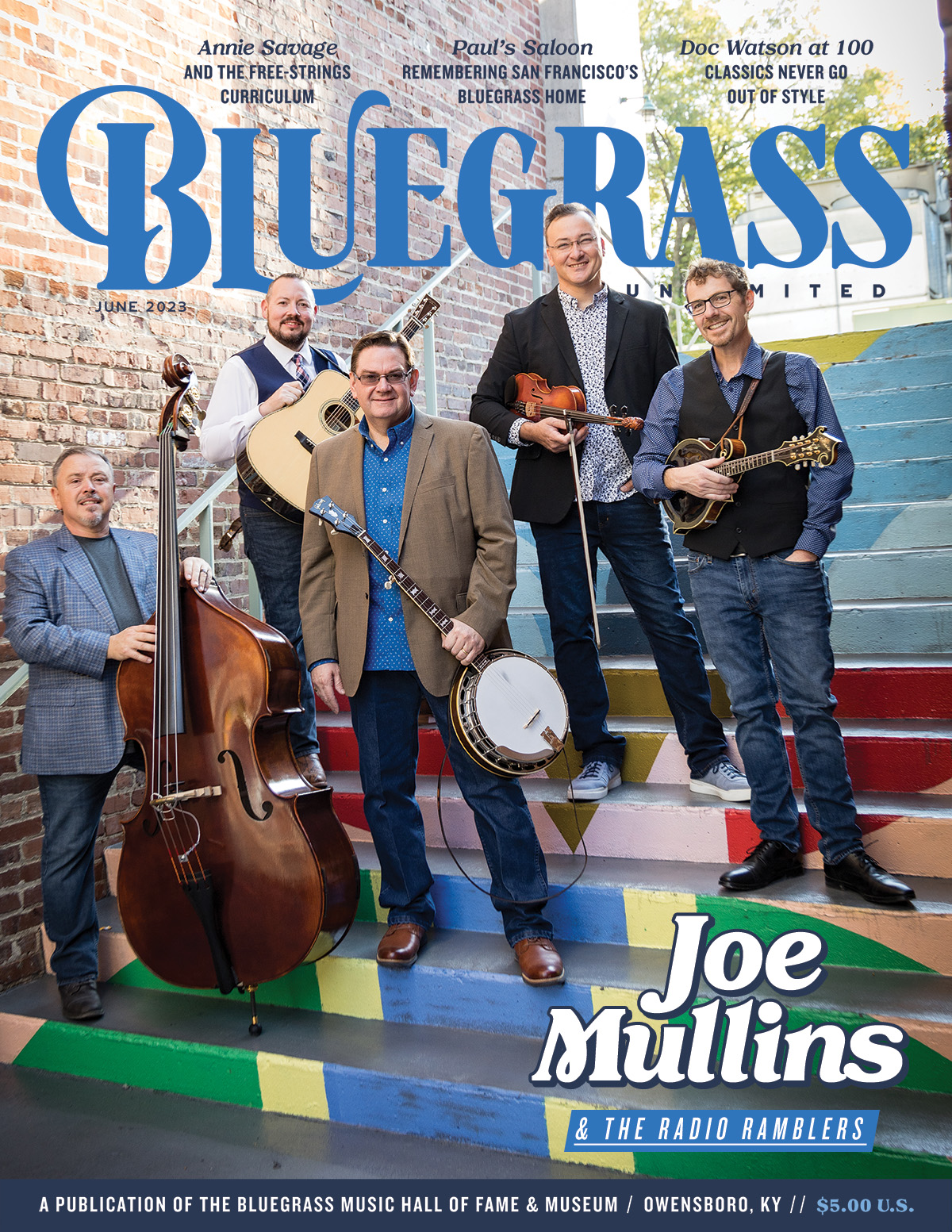
Joe Mullins
Let Time Ride
“I’m very, very thankful to be a jack of all trades and a master of none,” says Joe Mullins, smiling. “I’ve had to do everything to get anywhere.”
He’s only halfway correct here: over a career spanning more than three decades (and with no end in sight), he has certainly done everything. But in looking at his track record as a bandleader, banjo player, singer, entertainer, broadcaster, and more—he’s a master of more than he’s giving himself credit for. As we chat over Zoom in late March about the latest Joe Mullins & the Radio Ramblers album and a life lived in music, Mullins notes offhandedly that he’s the only person in International Bluegrass Music Association history to have won Broadcaster of the Year, Entertainer of the Year, and to have produced both a winning Event of the Year and Album of the Year. It’s an undeniably outstanding achievement, but one he mentions only in passing—a way to give context to his career, not to pat himself on the back.
Even with his trophy shelf slowly overflowing with the accolades given to him by his peers, he maintains his humility. His goal has never been to be the star. “I’m kind of a J.D. Crowe type of guy,” he says. “I want to find guys who know how to surround me on and off the stage. Something where the whole is greater than the sum of the parts.”
With Let Time Ride, it’s fair to say that he’s done just that. Released this past March, Joe Mullins & The Radio Ramblers’ 10th recording project is more than just a hard-driving traditional bluegrass album (not that you’d expect anything less from Mullins and his crew). Co-produced by Mullins and fellow Radio Ramblers founding band member, Adam McIntosh, Let Time Ride—as the title suggests—is a reflection on the passing seasons of life and how to adapt to an ever changing world.
Things have certainly changed quite a bit since the Radio Ramblers first hit the scene. The band was originally founded in 2006 as a traveling promotion for Mullins’ radio stations—a way to introduce Joe, his shows, and the music that he broadcasts to new audiences. Much like how the Grand Ole Opry was created as an advertising tool for National Life and Accident Insurance (with the station’s call signal, WSM, being a reference to the company’s slogan: “We Shield Millions”), having a traveling show helped make Mullins’ stations commercially viable—bringing in listeners and sponsors alike. And, similarly to the Opry, the Radio Ramblers soon became beloved to their fans, far exceeding their original promotional goal and cementing their status as an institution.
Their first full-length album, Tuned In, was released in 2007. A few short years later, they were signed by Rebel Records, who released their second album (Rambler’s Call) in 2010. From there, it wasn’t long before they were winning international awards (2012: International Bluegrass Music Association Emerging Artist of the Year), playing as featured guests on the Opry (first appearing on July 27, 2013), and hosting a music festival twice a year (Industrial Strength Bluegrass, originally called the Southern Ohio Indoor Music Festival). And they have continued to grow, year after year, for more than 16 years now. They released seven more albums, with four of them charting on the Billboard Top Album Sales charts and fifteen #1 songs on the Bluegrass Today Weekly Airplay Chart since 2013. In 2019, they won the industry’s highest annual honor, taking home the title of Entertainer of the Year at the International Bluegrass Music Association’s awards show—and they’re showing no signs of slowing down now.
“We were due a bluegrass album,” Mullins says, laughing. The Radio Ramblers have released three gospel projects through the years; they were ready for something a little less sacred. Rather than leaning on spiritual messages, the band looked into their personal catalogs: songs from their youth; demos they’d been sent over the years; songs that they’d heard and wanted to put a hard-driving spin on. Rather than writing their own originals as they had on previous albums, the band chose to lean more heavily on existing deep-catalog cuts and commissioned original tracks from writers they’d worked with on previous projects. This gave them the opportunity to focus on big picture storytelling—embracing overarching themes of time, change, healing, and loss. The album spans a wide range of human emotions, spinning narratives both quaint and existentially looming. Some tracks—like “Black and White” and “Play the Wildwood Flower”—return to themes previously trodden by the Ramblers, reflecting upon simpler days gone by and the comfort of hearing the music you grew up with. In contrast, “Old Fire” hides a story about the ravages of climate change inside the trappings of a hard-driving trucking song. In the end, they had a track listing as diverse as bluegrass itself—spanning from old-school bluegrass stalwarts like Marty Stuart and Jerry Salley to rootsy Americana artists like Jason & Pharis Romero and country superstars like Lee Ann Womack.
The one thing all the tracks have in common: they’ve all been given that undeniable industrial strength edge. In the tradition of Ohio bluegrass and its advent of three-part harmonies as a key feature of the genre, this band delivers consistently excellent vocal performances, rich with harmony and deep with emotion. Of particular note is “The Glory Road.” Though originally penned in 2016 by Marty Stuart and his band for his television show, The Marty Stuart Show, the Radio Ramblers rendition wouldn’t be out of place in a Sunday morning Bill Monroe gospel set. Featuring a Monroe Brothers-style interplay of mandolin and guitar alongside a vocal quartet harmony fit for a barbershop, the lead vocals are playfully passed between newcomer Chris Davis and founding member Adam McIntosh, and rounded out with a rich low-end harmony from bassist Randy Barnes. The song espouses a righteous message, brimming with the full-throated belief in a holy reward awaiting the narrator in the great beyond. In an album that frequently highlights the fear and loss associated with change, “The Glory Road” shines bright with its Hooverian optimism. In facing a changing world, Joe Mullins & the Radio Ramblers have planted their feet into God’s green earth, safe in the knowledge that the sun will rise once more.
It’s a sound made possible by the current lineup of the band, including the recent addition of mandolin player Chris Davis. Joining the band over the summer of 2022 as a fellow Buckeye descendent of Appalachian immigrants (alongside guitar player Adam McIntosh and Mullins himself), the industrial strength sound is his native tongue. His voice glows with warmth and feeling through the album, especially on the titular “Let Time Ride,” where his smooth tenor leads the melody alongside Jason Barie’s joyous fiddle accompaniment. It’s a song that holds a special place in Mullins’ heart, as it was originally penned by his daughter-in-law Santana Mullins (née Bell) while she was studying bluegrass music at East Tennessee State University. “It’s thrilling to have someone I already love write such a great song,” says Mullins with pride. This track will be her first cut as a songwriter, but he’s sure that it won’t be her last.
Music as family tradition has always been core to Joe Mullins. Born into a family of Appalachian expats, music was a part of his life from birth. His father, the recently inducted Bluegrass Hall of Fame member Paul “Moon” Mullins, had a nearly academic collection of bluegrass recordings for little Joe to listen to. “His playlists had the biggest impact on me. I certainly grew up learning to appreciate the same types of music that my dad did,” says Mullins. “In hindsight, that was good because my dad wasn’t exclusively a bluegrass broadcaster. He played country and bluegrass side by side. He played Conway and Loretta and Waylon and Willie right alongside J.D. [Crowe] and Doyle [Lawson]. […] And he gave just as much credence and credibility to the newest by J.D. Crowe and the New South or Doyle Lawson and Quicksilver as he did to the latest by Waylon or Willie.”
This skilled curation and showmanship is something that was passed down from father to son, as Joe Mullins later took on his own set of radio stations, later leading to the creation of the Radio Ramblers and so much more. “He was a broadcast personality… He never liked to be considered a disc jockey, because he didn’t just play records. He presented music passionately. He was larger than life. He appreciated great songs and great talent.”
But Joe learned more than just presentation and stage presence from his upbringing. As a show promoter and radio host, the elder Mullins regularly hosted a rotating cast of first- and second-generation bluegrass greats as they passed through town on tour. When a young Joe started playing music for himself—first rhythm guitar, later settling into three-finger Scruggs-style banjo—he had the entire world of bluegrass at his fingertips. Not only could he listen to a comprehensive library of nearly every bluegrass record ever made and study the style of the greats from his bedroom; he could usually also just go out to the living room and find those exact same stars sitting there, enjoying a brief moment of comfort and hospitality in between cross-country gigs. As Mullins says, “If any guy ever wanted to have a part in the bluegrass community or the bluegrass industry, I don’t know how you can fail when you grow up with a complete collection of bluegrass music available to you 24/7, and you hear it night and day, on the radio and in person.”
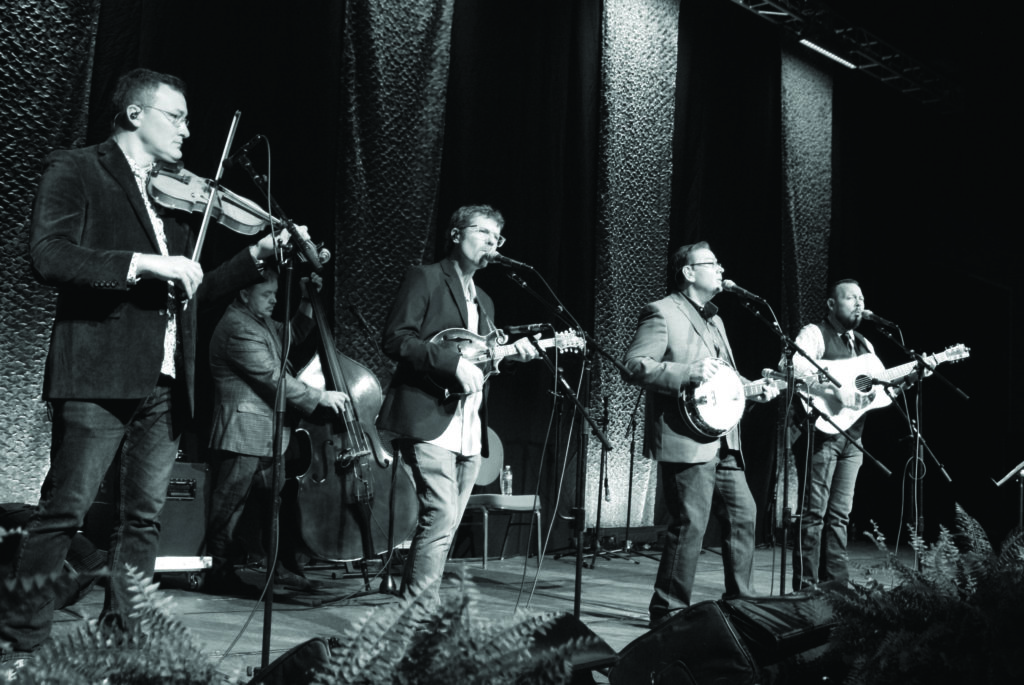
More than that, from those early memories of building a home for the music—on the air and even on the pull-out couch—Mullins learned that bluegrass is more than just a genre. From watching his mother, and the way that she opened her arms to all weary travelers in need, he learned the meaning of community. “She was the hostess with the mostest,” he says with fondness. “She’d offer hospitality, an open door, and an open bed to anyone.” This generosity, and his sense of what we owe to each other, is something he takes seriously as a community leader. It’s something that he and his wife Tammy still offer to musicians on the road to this day. In his eyes, bluegrass wouldn’t be bluegrass without it.
He hopes that some things, like the community’s sense of care for its members, will never change. But not everything can last. Time has come for many of the things he grew up with, including the music itself. “I grew up with only three channels on TV and five ice cream flavors,” jokes Mullins. “Now there’s 500 channels and my local grocery store has about 60 flavors. Bluegrass is kind of like that.”
If you’ve listened to much of his music, this quote might, at first blush, seem negative—like he thinks it’s all just gone too far. Nostalgia for quieter times is a common theme in the Radio Ramblers canon. In fact, the new album features a single, titled “Black and White”, all about how much he misses the days of black and white television and face-to-face conversations. But in this moment, his tone is one of wonder, not derision. “We have music from all corners of the world and all different flavors. The roots are still deep, but there are many branches to the bluegrass tree.”
He speaks with fondness about contemporary artists like Michael Cleveland, Bronwyn Keith-Hynes, Molly Tuttle, and Billy Strings. He recalls meeting Cleveland when he was only six or seven years old at the Bean Blossom Bluegrass Festival; young Mike wanted to meet the famous Moon Mullins. “When I get to see Mike play on stage, or I listen to his latest track… I get weepy just thinking about it,” he says, his voice spilling over with pride. “To be in a time and place where someone can accomplish everything and be recognized worldwide, to have earned himself a place on those stages, it makes me absolutely overjoyed to be a part of this community.”
He knows that to keep the music going, the torch must be passed to the next generation. He feels confident that artists like Cleveland, Tuttle, Strings, and even the younger members of his own band are more than equipped to carry on this legacy. “If there are a million Billy Strings fans, and he’s their doorway to bluegrass, that’s great,” he says. “I’m just glad they came through the door.”
When I ask Joe about what he thinks the future holds, he thinks for a second before saying, “I don’t know how to answer it, but I know it still works.” The theme he seems to land on, the key factor that makes something truly bluegrass, is authenticity. “I think every generation appreciates authenticity,” he says. “Whether we’re doing songs that Monroe or Stanley did in those early days, or we’re doing songs that spoke to our hearts in the 70s and 80s, if they’re presented with authenticity at the core, they can speak to any audience.”
He points to Billy Strings, one of the most progressive (and commercially successful) bluegrass artists the genre has ever known. Mullins went to his show in Dayton, Ohio in June of last summer. “He did a lot of great originals that resonate with today’s audience,” he recalls. “But he also sang some of the old songs that he heard Ralph Stanley sing when he was growing up. He still does ‘Katy Daley,’ first recorded by my dad in 1962. […] I suppose that the authenticity of quality bluegrass music can transcend just about anything.”
Since December 7, 1945—when Bill Monroe and the Big Bang lineup of his Blue Grass Boys first took the stage of the Grand Ole Opry and introduced the world to a brand new sound—there has been a constant question humming underneath the genre. What is bluegrass? How much can it change before it’s just not bluegrass at all anymore?
For Joe Mullins, it’s a pretty simple question to answer. “If you can write a song that speaks to the hearts of people that are seeking the authenticity that is part of bluegrass music, if you can sing with some soul, if you can play your instrument—there’s a place for you.”
If it’s bluegrass, it’s fair to trust that Joe Mullins probably knows something about it. Having grown up in the Rust Belt of southern Ohio—raised by the people who’d carried the roots of this music with them to their factory jobs—Mullins has carried a deep appreciation and awe for bluegrass music for as long as he can remember. He learned its history, spending his youth studying the greats and memorizing the canon. He learned how to play: first by haltingly strumming along on his guitar as his father played “Soldier’s Joy” and “Whiskey Before Breakfast,” all the way to now, as he has made his own name as one of the great banjo pickers of the day. He’s seen trends come and go, and has been along for the journey as the genre has grown and changed through the generations.
For Mullins, bluegrass isn’t defined by geography or genealogy. After all, the genre wouldn’t be what it is today without icons like Rhonda Vincent (Missouri), Allison Krauss (Illinois), or Tony Rice (California). Nor is it about exclusion or gate-keeping. For him—just as it was for his father and mother before him—bluegrass is about making a home for people who feel isolated. He’s quick to point out that the genre is young, not even 80 years old yet. While many outside of the genre think of it as being as old as the Appalachian mountains themselves, that’s not really true. In its earliest form, bluegrass was music made by the people who had left home, and now had to find a new way to build a life in a world that was different than the one they were born into.
“Even going back to the beginnings, Lester Flatt and Earl Scruggs did two recording sessions in 1949, both in Cincinnati,” says Mullins. “‘Little Girl of Mine in Tennessee’ and ‘Foggy Mountain Breakdown’ were recorded in these sessions, both now cornerstones of the genre. ‘Little Girl of Mine in Tennessee?’ That’s a song about a displaced hillbilly.”
He continues, pointing to “Rank Strangers,” first recorded by The Stanley Brothers in 1960, the same year that his father started on the radio, broadcasting bluegrass and country music professionally. It’s another classic first generation bluegrass song, one so universally beloved and recognizable that it’s preserved in the Library of Congress’ National Recording Registry. And as Mullins is quick to point out, “It’s a song about how you can never really go back home. About how lonely it can be to return to a place that doesn’t feel the same.”
It’s that deep emotional core that Joe Mullins knows will keep this music alive far past when his own heart stops beating. “Here I am, still loving music from 70 years ago,” he says. “I’ve never lived in a cabin on a hill, but I still love that music.”
It’s something that he hopes he has instilled in his own recordings. “We’ve brought up the names of so many of the founding fathers. […] There will never be another original—Scruggs and Monroe, Stanley, they were originators. I’m not that; I came along way down the road. But if my passion and professionalism and the music that I have been able to present—on stage, on records, on radio—if that has inspired somebody else, if it’s lightened their burdens in any way, if it’s helped them become a better person or a better performer… When I’m long gone, that’s great. Hopefully before it’s all said and done, I’ll make a contribution that will matter to somebody else.”
It’s just like he and the Radio Ramblers say in their latest album. The winds of change will never stop blowing. We can’t predict what the future may hold, be it fortune or failure. All we can do is “hold on tight and let time ride.”
Kara Kundert is an American music writer and ethnomusicologist. A native daughter of California, she found bluegrass when she needed it most—just as she was wrapping up her first career as a research astrophysicist. She made her name in the world of roots music as a founding member and the first Executive Director of Bluegrass Pride, leading to her being named the winner of the 2021 IBMA Momentum Award for Industry Involvement. She now works at the Country Music Hall of Fame and Museum. Her work can be found in No Depression, The Bluegrass Situation, and the IEEE Transactions on Antennas and Propagation. She makes her home in Nashville, TN, with her little white cat, Peach Melba.