
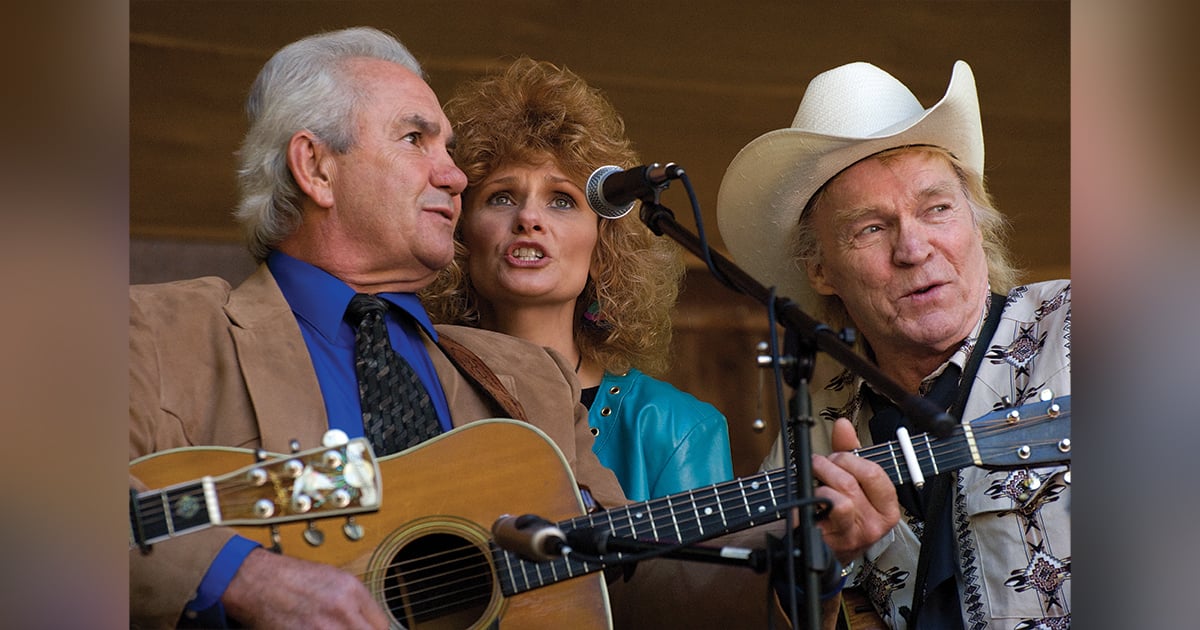
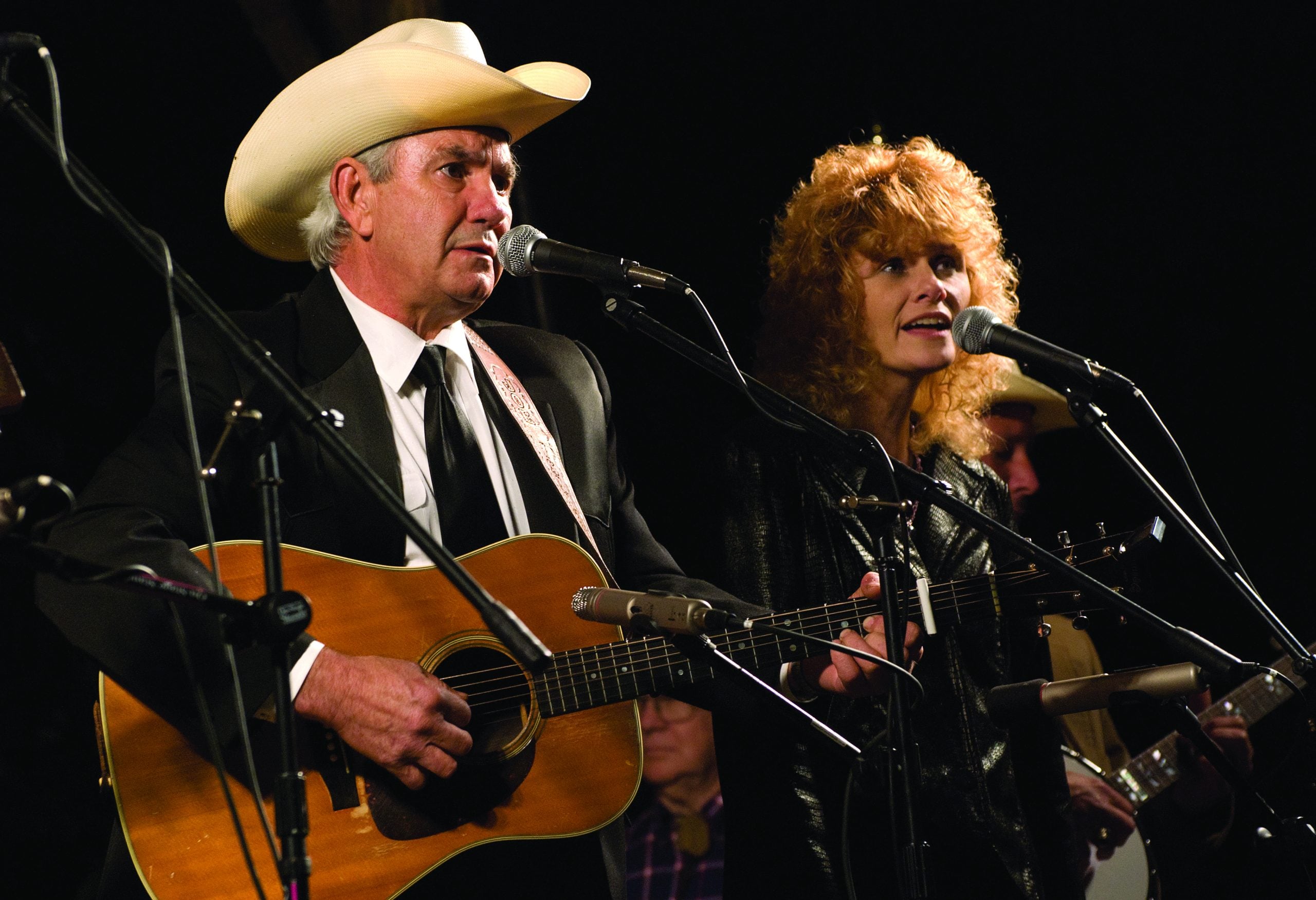
Joe and Stacy Isaacs
That Traditional Bluegrass Sound
In the February, 1967 edition of Bluegrass Unlimited Magazine, Pete Kuykendall wrote an editorial regarding the state of bluegrass music at that time. He proposed that the bluegrass music that was recorded pre-1955 was “a preference across the country of almost ten to one.” After making that statement, Kuykendall proceeded to explain why, in his opinion, the groups during the pre-1955 era had such a great sound. A few of the points that he made included: “They were much more aware of a total band togetherness.” “Their singing was more closely felt and there was less emphasis on individual musical prowess.” “Their musical attitude was ‘say something musical, and if it sells all the better’.” And, “…it has been my observation that harmony singers do not spend enough time learning the right part. Possibilities in harmony should be explored until exactly the right combination of parts is achieved.”
In 1955, Joe Isaacs was only eight years old and his wife, Stacy, was not yet born. However, if you listen to the music that they have been producing over the past twenty years, you will find that it contains every aspect of bluegrass music that Kuykendall attributed to those early bands. While there were hardly any female singers in bluegrass during those early years, Stacy Isaacs is as authentic a bluegrass singer as you will ever hear—regardless of gender. Her vocal tone and power, word pronunciation, phrasing and energy are reminiscent of Monroe, Stanley, and Martin. This is rare in a female singer, especially in this day and age. While there are a lot of very talented female singers in bluegrass, there are few that can match Stacy when it comes to traditional bluegrass authenticity.
When Stacy and Joe sing together—regardless of which one is singing lead or harmony—it is bluegrass vocal perfection. The vocal arrangement, the blend that they achieve, and the creative complexity of their phrasing and vocal lines is right out of the Stanley Brothers school of bluegrass vocals. Stacy admits, “Part of my phrasing is cultural, but my dad had Ralph and Carter albums and I studied the moves that Ralph made with Carter. You have to tweak every single move. I heard that early on and I studied everything about what to do and how to do it right. I learned to study everyone who I was singing with.” When she performs with Joe Isaacs, it is evident that she certainly did study it, because she does get it exactly right.
Joe Isaacs
Joe Isaacs is perhaps best known for his decades of work with his family’s bluegrass gospel band—The Isaacs. Prior to performing gospel music with his family, Joe was a guitar and banjo player who performed with such bluegrass luminaries as Larry Sparks, Ralph Stanley, and Frank Wakefield between 1964 and 1970.
Born in Jackson County, Kentucky, to a Pentecostal preacher, Godfey, and his wife, Bessie, in January of 1947, Joe Isaacs was the youngest of seventeen children. The family lived in a log cabin that had no running water, electricity, telephone, or indoor plumbing. Joe says that although other members of his family never took music seriously, some of his brothers and sisters could play a little bluegrass-oriented gospel music. Joe started to learn to play the guitar when he was about seventeen years old.
In 1964, in search of employment, Joe moved to Waynesville, Ohio and worked a number of different jobs—he hung drywall, worked as a carpenter and had a job as a mechanic. After moving to Ohio, he bought his first banjo at a music store in Dayton. Joe said, “There was a guy that lived there in Waynesville, Ohio and we’d all gather at his house every weekend and play music and have a good time. I got me a guitar and got to following along with them. There was a guy that played banjo with us named Garney Peak. He was from around Clintwood, Virginia. He had his banjo and I got to fooling with it and learned to play some. So, I went and bought me one. I learned real quick. It wasn’t but about six months later that I was playing with Larry Sparks.”
At the time that Joe Isaacs started playing music with Larry Sparks, Joe and Larry were both about eighteen years old. Joe said, “I played with Larry until he went with Ralph and then when he left Ralph I played with him again for about two and a half years. I was on a couple of his first albums.” Other area musicians who Joe performed with included Roy Lee Centers, Fred Spencer, Lloyd Hensley, and Buck Parker.
Early in 1967, Frank Wakefield recruited Joe to travel with him to New York City. They played a six-week engagement at Gerde’s Folk City as Frank Wakefield and the Greenbriar Boys. Other members of the band included Lloyd Hensley and Buck Parker. During that Gerde’s run, a female duo called Lily & Maria (Maria Neumann and Lily Fishman) were also performing at the club. Joe and Lily soon started dating.
The trip to New York City only lasted a few months since Frank Wakefield left to pursue other musical endeavors in Saratoga Springs. Joe later returned to New York to perform again with Frank Wakefield and continue the relationship with Lily. This time the band was called Frank Wakefield and his Country Classics and included various members, such as Kevin Smythe, Sandy Rothman, Artie Rose, Gene Yellin, Ward Verity, and Fred Bartenstein. Joe and Fred started a spinoff band that they called the Lonesome Drifters.
Towards the end of 1968 a Lonesome Drifters recording was made and later released (in 1977) on Old Homestead Records. That record was titled The Greenbriar Years. Joe (on banjo and vocals) and Fred (on guitar and vocals) were accompanied on the recording by Frank Wakefield (mandolin), Richard Greene (fiddle) and Kevin Smythe (bass). Lily Fishman made her bluegrass debut singing harmony vocals on “You’ll Be Blue.”
After the Lonesome Drifters album was recorded, Joe got a rough mix acetate to shop around to record labels. Unfortunately, there was no immediate interest in the recording and between the time the recording was made and Old Homestead picked it up, the master tapes were lost. So, the album that was put out was from the rough mixes off of the acetate. Bartenstein said, “The quality of the recording is not great, but it is crazy good stuff. It had the energy of the Stanley Brothers back in the Mercury years. It had the excitement of the Johnson Mountain Boys before there was a Johnson Mountain Boys. We had a very traditional sound, but Frank Wakefield and Richard Greene were taking wild breaks.”
The majority of the songs on the Lonesome Drifters recording were originals written by Joe and Fred. After the recording was made, and before the record was released, Joe and Fred traveled to Carlton Haney’s bluegrass festival in Berryville, Virginia to perform. They brought in Kenny Baker and Buck White to perform with them on one set and Kenny Baker and Bob Applebaum on another set. Fred remembers that he and Joe wanted to form a band together, but when Carlton Haney hired him to help out with the first Labor Day weekend festival in Camp Springs, Fred moved to North Carolina and that broke up Fred and Joe’s work together.
Soon afterward Isaacs moved back to Ohio. Although Lily was in New York, Joe wasn’t happy with his life there in the big city. Fred Bartenstein said, “Joe and I wrote a song titled ‘Restless’ that was loosely based on his experiences in New York. Rual Yarbrough and the Dixiemen recorded it in 1972 on the Old Homestead album, Secret of the Waterfall.”
Back in Ohio, Joe soon went to work with Larry Sparks in late 1969. Joe remembers, “Larry was playing in a little club in Middletown, Ohio and I went over to hear him one night and he asked me if I brought my banjo and I did. I went out and got it and we started playing together and I worked with him for two and a half years.”
After continuing their romance long distance, Lily moved to Ohio and Joe Isaacs and Lily Fishman were married in July of 1970. Joe was playing music five to six nights a week with Sparks—mostly at a club in Middletown called the Old Crow. He recorded with Spark’s on his first record, Ramblin’ Guitar, released in 1970, and on Spark’s first gospel recording, New Gospel Songs, released in 1971. Both albums were on the Pine Tree label. Joe also played some dates, singing and playing guitar, with Ralph Stanley during this period of time.
In December of 1970 the death of Joe’s brother Delmer—four years Joe’s senior—would change his life. At his brother’s funeral Joe was saved. He decided to stop drinking and playing music in bars. Lily, who was Jewish, decided to also follow the Christian faith. Joe got a job as a logger and from that day forward the husband and wife decided to only perform gospel music. Later, their children—Ben, Sonya, and Rebecca—would also join the act and the family would famously perform to great acclaim as The Isaacs. Since the stellar career of The Isaacs is well documented elsewhere in previous issues of Bluegrass Unlimited, and other publications, I will not pursue it here.
By the late 1990’s Joe and Lily’s marriage had come to an end and Joe moved to Berea, Kentucky, near his childhood home. In 2000, Joe released an album titled From A Cabin…To A Mansion as a tribute to his parents and deceased siblings. In 1996 he had also released a recording with Ralph Stanley titled Ralph Stanley and Joe Isaacs—A Gospel Gathering. This recording was nominated for a Grammy Award for “Best Southern Gospel, Country Gospel, or Bluegrass Gospel Album.” Joe did some touring with Stanley in support of that recording. In December of 2000, Joe became a cast member on RFD-TV’s Cumberland Highlanders show Crossing the Cumberlands at the urging of former Blue Grass Boy Wayne Lewis. It is on that show that he started working with Stacy.
Stacy Isaacs
Stacy McKinney was born in Indianapolis, Indiana. Her family was from Kentucky, but they had moved north to find work. Stacy recalls, “Kentucky was always our home. My dad worked in Indianapolis and then on Friday nights we would leave and come to Kentucky on weekends. Then, if there was a school break, like Christmas or during the summer, I would stay in Kentucky with aunts and cousins. Finally, when I was about eleven, we just moved back down. I was born up there, but I was basically raised in Kentucky.”
Regarding her learning to sing, Stacy remembers, “My grandpa died when I was two and a half. We went to the funeral and when we were coming home, I kept humming a tune. It was a song that was played at the funeral. When we got home Dad told Mom to play it on the piano so I could sing it. That is when they figured out that I could sing. Then, me, my mom and dad started singing gospel music in church when I was about six. When I was seven, we started singing on a gospel radio show and then started traveling to perform at other churches, revivals and meetings all the way through the early 1980s when we moved back to Kentucky.”
When she was thirteen years old Stacy started singing bluegrass. She said, “When we moved to Kentucky, Dad got sick with emphysema and so we had to put off the road. I loved bluegrass because I grew up listening to it. Dad played banjo and Mom played the guitar and I learned to play the guitar because I’d sneak off and get her guitar and learn it. Then I started sneaking out to bluegrass festivals and playing in some of the jams. Before that we had only performed in church and sung gospel, so I was afraid that Daddy would throw a fit if he knew that I was playing bluegrass—so I was sneaking. Finally, I got caught and then I told him. He was fine with it and actually supported it and it took off from there.”
Even though she was enthusiastic about playing bluegrass music, she said that it wasn’t easy being a woman in bluegrass in those days. She said, “There wasn’t a lot of women doing bluegrass. It was even hard a lot of times for the girls to get in the jams at festivals. The men, and I say this respectfully, didn’t feel that a woman could sing bluegrass because of the type of music that it was. So, you had to prove yourself. You had to prove that you could do the harmony parts, that you could get the sound. I think we had to work harder to prove that so they would let us in to that realm.”
Stacy married Larry York when she was seventeen, becoming Stacy York, and started the band Bluegrass Mountain, with her husband on bass, in 1990. She performed in that band until the late 1990s when she and her husband got divorced.
In 1999 Stacy was at a jam session that occurred every Monday night in a motel in Lafollette, Tennessee and met Joe Isaacs for the first time. Stacy said, “Joe had moved back to Berea, Kentucky and he knew about the jam and would go down there. We done a little singing together there and that is how we got associated, singing-wise.”
After Stacy and her first husband divorce she had put another band together and explains, “The banjo player that I had at that time was going to be on the Cumberland Highlanders TV show. When we got done playing one weekend, I had to take him to London, Kentucky where the TV show was based then. I took him down and stayed to watch the taping. Joe had told Campbell Mercer, the guy who was over the TV show, that I could sing. So, Campbell says, ‘Well, let me hear her.’ So, me and Joe and the banjo player that I had brought put together this song and we sang it and then I sang ‘Muleskinner Blues’ and the guy hired me. It all kind of took off from there. I was on the TV show for seventeen years and Joe was on it eighteen years.”
In about 2001, in addition to performing on the television show, Joe and Stacy started their own band, Mountain Bluegrass. In 2003, Joe recorded Dreaming Of Home for MME Records. This was the first time since recording with Larry Sparks in 1970 that Joe had recorded secular music. Stacy sang harmony on the chorus of several of the numbers and she and Joe also sang a duet.
In 2007 Stacy released a solo album on Blue Circle Records titled Kentucky in the Rain. Joe played banjo on this album and sang lead on one song. Joe’s children—Sonya, Rebecca, and Ben—also added their talents to the recording. Later, in about 2008, Stacy also joined an all-female group called Hazel Holler Girls. That band had formed in 2003 with Michelle Wallace on bass, Carly Dawn Higgins on guitar, and fiddle player Shirley Seim. When Stacy joined the band, Wallace—who hosts the ‘Bluegrass Sunday’ radio show on WMKY—was still with the band along with Jackie Thacker on banjo, Stacy on guitar, and after Shirley Seim left the band, she was replaced by Mary Rachel Nalley on fiddle. Mary Rachel, who was in high school at the time, is now Mary Rachel Nalley Norris and is a member of the Kody Norris Show. Stacy recorded an album titled Kentucky Grass with the Hazel Holler Girls.
Kody Norris has known Joe Isaacs since he was five or six years old when The Isaacs came to perform every year at the church his family attended. When Kody was sixteen years old, he attended the Jerusalem Ridge Bluegrass Festival in Rosine, Kentucky and for many years, the Cumberland Highlanders recorded the television show at the festival. In about 2003, Wayne Lewis was having heart trouble and could not make the show. Kody remembers, “I was in a random jam session and Campbell Mercer, the festival host, was listening and motioned for me to come over. He asked me if I would be willing to fill in with the band that weekend.”
Kody filled in with Joe and Stacy and the rest of the band from Wednesday through Sunday that weekend and ended up being a regular on the show. Regarding his work with Joe and Stacy, Kody said, “I learned so much vocally from those two. I don’t think anyone in history knows more about vocals than Joe. His vocal arrangements are unsurpassed. He is one of the greats and also one of the most humble human beings. Joe and Stacy are the easiest two people to sing with that I’ve ever worked with in my life. And, Joe likes to push you. He will put in little bends to see if you can follow him. Stacy knows him so well that she can easily follow.”
Kody continued, “Joe has a real command and presence on stage and knows how to work the crowd. I’ve learned so much from him and will forever be indebted.” When Kody was a teenager and doing his best to make it in the music business he said that Joe and Stacy would hire him to play in their band when they knew he needed money. Kody said, “Joe already had plenty of people in the band to do the show, but he would rework it so that I could get a job. He was always so gracious.”
When Mary Rachel was a sophomore in high school, Kody and Stacy helped her get her first professional job with the Hazel Holler Girls. She said, “Joe and Stacy have always been so supportive. Stacy took me under her wing and taught me how to be a woman in the industry and how to be around men in a professional manner. I have always admired her confidence in her abilities and I have followed her example. I am happy to have had that experience.”
In 2009, Joe and Stacy released an album titled Stacy & Joe: Mountain Bluegrass. Butch Robins, Danny Jones, and Terry Eldridge were included on this recording. Robins—well-known for his work with Charlie Moore, New Grass Revival, Bill Monroe, The Bluegrass Band, and many others—was also a member of the Cumberland Highlanders. Joe said, “Butch is a good man and a good banjo player, buddy. He is a good musician, period.” After nearly a decade of playing and singing music together, Joe and Stacy got married on June 7th, 2010.
Although the bluegrass couple are somewhat retired these days, especially since the COVID pandemic hit, they will still go out on the road and perform a bit with The Kody Norris Show. Joe said, “I’ve encouraged him ever since he was a little boy.” Stacy said, “When I worked with Hazel Holler, I helped Mary Rachel get her first job, so we have kind of watch them two grow up and evolve. When she was thirteen or fourteen years old, she had done some guest appearances with the Cumberland Highlanders. That is how we got to know her.”
Even though their performances have slowed down these days, Joe and Stacy are still willing to go out and perform on occasion, and Joe also still gets together once in a while to perform with The Isaacs, who as of 2021 are members of the Grand Ole Opry. Stacy said, “We don’t want to travel as much as we did, but we might go out about one weekend per month.” If you attend the Dr. Ralph Stanley Hills of Home festival this year Joe and Stacy will be performing with Ralph Stanley II and the Clinch Mountain Boys as their backup band.
If you want to hear true and pure traditional bluegrass music, catch a show with Joe and Stacy Isaacs, order one of their CDs, download or stream their music, or watch them on YouTube—however you want to do it—you’ll be glad that you did. If you chose to search YouTube, I recommend searching “I Just Think I’ll Go Away – The Cumberland Highlanders.” That is the way it is done right there.