
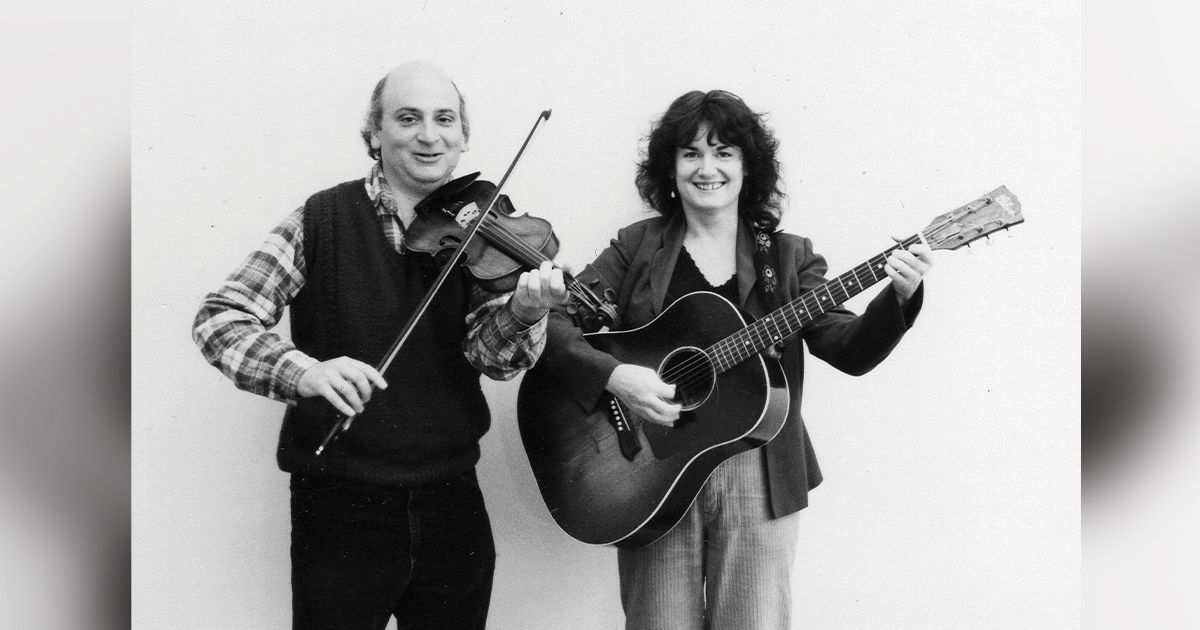
Jody Stecher and Kate Brislin
Deeply Traditional, Highly Original
The saga of the musical careers of Jody Stecher and Kate Brislin—both individually and as a duo—spans seven decades, 20 albums, thousands of performances and more than a few twists and turns. The two started working as a duo in the 1980s, earning a legion of devoted fans, a comfortable measure of international renown and a pair of Grammy nominations. This is their story, so far.
There is no one in traditional American music quite like Jody Stecher. He’s unique. In the liner notes to his most recent album, the exceptional Dreams from the Overlook, he wrote, “All my life I’ve been told that I am not an ordinary person. At last, I’ve stopped resisting the idea.” He’s not the least bit ordinary, really. When asked for this article how he was introduced to traditional music, he thought for a bit and then began, “My dad was a physics professor, and his specialty was sound and light—waves. He taught me how string instruments work.”
Stecher was born in 1946 in Brooklyn, New York City’s most populous borough. He grew up surrounded by music—his mother was an avid singer and his father played the autoharp, holding it in his lap and picking out melodies with piano hammers or long shirt stays, essentially a lap hammered dulcimer. Several older family members played mandolin, vestiges of the mandolin mania that had swept the country in the late nineteenth and early twentieth centuries.
Jody’s first instrument was the guitar, which he started playing at age eleven. He picked up the mandolin and banjo the following year. Bluegrass was readily accessible on country radio at that time, and Jody “soaked it up like a sponge.” He remembers that every fourth or fifth song on the radio was a bluegrass number by Bill Monroe, Flatt & Scruggs, the Osborne Brothers, Jim Jesse and others. Jody was particularly impressed by Jesse McReynolds’s mandolin playing and, a little later, that of Frank Wakefield and Roland White.
Washington Square Park in New York City’s Greenwich Village was transformed into a musical bazaar every Sunday afternoon, where dozens of folk and traditional musicians from all over would congregate for a few hours of making music. There were many tribes within the park: bluegrass, blues, old-time and folk musicians. Jody was a weekly visitor to the bluegrass group, playing alongside such pickers as Roger Sprung, Winnie Winston, Eric Weissberg, Marshall Brickman, David Grisman and John Herald.
Jody played in several bluegrass bands as a teenager, including the Bluegrass Straphangers, the Grassroot Boys, the Hudson Tubes, the Downstate Rebels, Death Hamburg and the Sacred Cows, and occasionally as a substitute, the King’s County Outpatients, in which his older cousin Jay Feldman played mandolin. Right after high school, Jody joined the Greenbriar Boys, when its mandolinist Ralph Rinzler left the band to manage Doc Watson and Bill Monroe; Rinzler would return for big gigs, and Jody would play bass. Jody didn’t record with the band, but did do a national tour in 1963.
Jody’s musical world continued to expand after he enrolled at City College of New York. In 1965, Jody accompanied his friend Peter Siegel on a field recording trip to the Bahamas. They went to record the idiosyncratic guitarist and singer Joseph Spence (credited as an influence on such guitarists as Ry Cooder, Taj Mahal and John Renbourn), who had been “discovered” in the late 1950s. The recordings were released in 1966 on the Nonesuch Explorer album The Real Bahamas.
“Every place I’ve lived for the last 50 years,” says Jody, “I’ve always had a photograph of Joseph Spence in a high place in one of the rooms—the presiding deity of that room—to remind me that if you think something goes like this and nobody else does, if it works for you, do it. Because that’s what he did.”
Following the example of other northern old-time and bluegrass musicians who were beginning to journey southward to seek out the roots of the music they loved, Jody made three trips to the Union Grove Old Time Fiddlers Convention in North Carolina in the 1960s. These gatherings provided a crucial opportunity for musicians—young and old, rural and urban, masters and neophytes—to find common ground and exchange ideas and tunes.
Jody did quite well in the contests that were the heart and soul of these conventions, being named World Champion Guitar Player in 1966. “Those conventions were just magical,” he says today. “A real eye-opener. I got to meet and hear a lot of great musicians, some born in the nineteenth century and some younger than I was. It was a tremendous experience.”
Beginning in 1964, Jody spent his summer vacations from college in California, where he played in such ephemeral bands as the Asphalt Jungle Mountain Boys with Eric Thompson (guitar) and Jerry Garcia (banjo) and Yreka Bakery with Thompson and fiddler Sue Draheim. After graduating from CCNY, Jody moved to California in the summer of 1968 and has been there ever since, save for a few years in the Seattle area. He’s lived in San Francisco since 1985.

Jody’s musical muse led him down many pathways once he got to the west coast. He played bluegrass with David Grisman, Fred Sokolow, Sandy Rothman and Brantley Kearns; blues with Mississippi Fred McDowell; and Hindustani raga music from the Indian subcontinent, which he studied with Ali Akbar Khan, a virtuoso sarod player, and Z. M. Dagar, a master of the rudra veena, with whom Jody studied sarod and sursingar for ten years. “Learning from Dagar was very important in my life,” he says. “He taught me a lot, not just about music but how to get along in the world.”
Celebrated roots musician David Bromberg once said, “Jody Stecher was basically my teacher. He opened my ears to more beautiful music than anyone else ever did…more than I ever knew existed. He is also one of my favorite musicians on Earth to play with. I have never known anyone so intensely and completely enveloped in music. It’s my suspicion that if you drained all the music out of Jody, you could carry what was left around in an eye dropper.”
Kate Brislin was born in 1946 in Portsmouth, Ohio; Kate’s pregnant mother was staying with her sister there while her husband was away on active duty in the U.S. Navy. His duty later took the family to many ports of call, including southern California, Washington, Maryland and Guam. The longest stretch was in Oakland, and Kate considers herself “a Bay Area person.”
Her first instrument was the ukulele, which she started at age four after her father taught her a few chords. She added piano at eight. Kate began playing guitar in high school and singing with her sisters, folk music at first and then, via Joan Baez, the Carter Family.
Like many people of her generation, she flipped for bluegrass after seeing Bonnie and Clyde, the Oscar-winning 1967 film that used Flatt & Scruggs’ 1948 recording of “Foggy Mountain Breakdown” as its theme song, and included incidental banjo music by Doug Dillard. She bought a banjo and started learning how to play, with an interest in both three-finger and clawhammer styles. Her main instruction on clawhammer came from Mike Seeger, via a public television series he hosted.
Back in California by the early-1970s, Kate decided to focus on clawhammer banjo, because it went better with singing, which she also loved to do. She was asked in 1974 to join the Arkansas Sheiks, one of the Bay Area’s leading old-time bands. That band toured and recorded an album, Whiskey Before Breakfast (Bay, 1975), and gave Kate a solid education in both performing and old-time music. She laughingly says she “earned while she learned.”
Her next band was the Any Old Time String Band, one of the first all-female bands in old-time or bluegrass music. The founding members of the band were Suzy Rothfield, Valerie Mindel, Genny Haley, Sue Draheim and Kate. All five of them sang and played at least a couple of instruments. They made their recording debut in 1978 with Any Old Time String Band on the respected roots-music label Arhoolie.
“We didn’t think about the fact that we were all women,” remembers Kate. “There was already the Good Ol’ Persons. It’s a natural progression. You’re friends with other musicians and you form a band, just like guys do. We were really close friends. We were like sisters in that band. It was never a schtick.” The group was instantly popular on the scene, earning a regular Saturday night gig at Paul’s Saloon, the San Francisco bar that was ground zero for the Bay Area bluegrass scene.
When it came to material, the band colored outside the lines, playing music from a variety of styles and genres. Kate says the band’s name served as a description of its repertoire. “We played any kind of old-time music,” she says. “Old-time blues from the ’20s, old-time country, old-time Cajun, old-time jazz—we drew from anything we loved. It was so much fun playing all those different kinds of music.”
Both Suzy Rothfield and Valerie Mindel left the band in the late 1970s. Mindel was replaced by Barb Montoro on bass, and the band continued working as a quartet. They toured extensively throughout the west, played in Hawaii, made an appearance on the Prairie Home Companion radio show and recorded a second album, Ladies Choice (Bay, 1980).
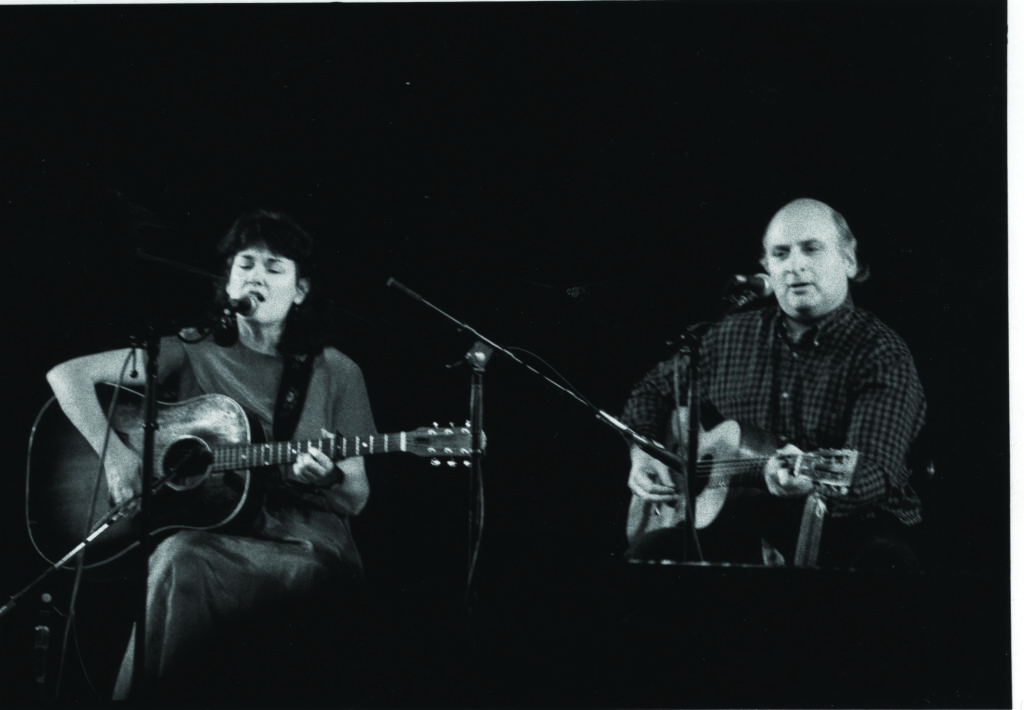
After the Any Old Time String Band disbanded, Kate joined a new band with her former bandmate Suzy Rothfield, who was now Suzy Thompson, since marrying guitarist Eric Thompson. The Blue Flame Stringband was a quartet with Kate, Eric and Suzy Thompson, and mandolinist Alan Senauke, a former editor of Sing Out! magazine and a friend of the Thompsons from New York. This band also toured heavily and recorded a wonderfully diverse album for Flying Fish in 1983, Blue Flame Stringband, with material ranging from Cajun music to the Louvin Brothers to jug band blues to Jimmy Martin to old-time fiddle tunes to the South African vocal ensemble Ladysmith Black Mambazo. Jody recorded his first “solo” album, Snake Baked a Hoecake (Bay), in 1974 with such friends as Eric Thompson and Fred Sokolow. The album includes a mix of traditional American songs and tunes (“Lee Highway Blues,” “The Blind Fiddler”), Celtic fiddle tunes (“Thompson’s Reel,” “The Battle of Aughrim”) and an Indian-flavored song called “Leela Leela.” “I had an agenda for that record,” Jody says today. “I was a bit misguided in that respect, in retrospect.
“Many of the friends I had grown up playing bluegrass with were now established professional musicians and were making really slick records. I deliberately made that record very bare, almost like a field recording. I wanted to make a statement to my old friends: How about making a record that sounds like people playing music, instead of like ‘a record’?”
His next record, Going Up on the Mountain (Bay, 1977), was made with “no agenda at all,” Jody says. “It was just an outpouring of energy with songs that I liked and musicians that I liked. The focus was the singing and the songs. The record was a bigger sound and, in a way, a purer musical statement. I had nothing to prove, nothing to say, except ‘Here listen to this.’”
The album is one of the indispensable old-time albums of the modern era, a superb collection of (mostly) traditional American music. Jody’s singing is remarkable throughout, a clear, pure mountain tenor that belies his Brooklyn roots, heard to great advantage on “Oh the Wind and Rain,” “Black Waters” and one of the best versions of “Wild Bill Jones” you’ll ever hear.
More bluegrass-oriented than its predecessor, the album’s sole instrumental is an original bluegrass tune called “Rhinoceros” (written because Jody thought “there ought to be” a tune of that title). The album’s focus on singing included some great harmony singing, especially by bass singer Larry Hanks, who’s featured prominently on several songs, and Kate Brislin. The first recorded Jody and Kate duet is on this album, the hauntingly beautiful “The Hills of Isle Au Haut.” (The album is still available as a digital download at acousticdisc.com/product/jody-stecher-going-up-on-the-mountain-download.)
Jody’s next two recordings, both duet projects, showed that his musical interests extended far beyond the traditional American songs and tunes for which he was known. The first, Rasa (Claddagh, 1981), is an intriguing East/West synthesis with Indian sitarist Krishna Bhatt. The combination of sitar and guitar is not the most logical pairing one might imagine, but these two masters made sublime music together, augmented by banjo, mandolin, fiddle, bass and Kate’s harmony vocals. The duo toured “all over this country and a month and a half in England, a month in Ireland and about two weeks in Europe,” remembers Jody. Don Giovanni Records has reissued the album on CD, LP and as a download.
The Driven Bow (Culburnie, 1988), is a magisterial, subtly powerful album with Scottish fiddler Alasdair Fraser, on which the two play through a set of tunes that were collected from Scottish Highland fiddlers in the late-19th and early-20th centuries, as well as a few tunes played in Cape Breton, Nova Scotia. The music is contemplative and somewhat reserved, but it’s not hard to imagine Highlanders dancing to these pipe and fiddle tunes way back when.
Jody Stecher met Kate Brislin in the Folklife Pavilion—appropriately enough—at Expo ’74, the world’s fair held in Spokane, Washington, that year. She was appearing with the Arkansas Sheiks, Jody with a Seattle-based band called Houseboat Music. They hit it off musically and found they really liked singing together. It was the beginning of a friendship that would lead to a partnership a decade later.
“When I burned out on Blue Flame (in 1984), got off the road and quit the band, I was kind of mess,” says Kate. “I also had some health issues that needed attention. I needed to rest. Then Jody started wanting to perform with me once I got back on my feet. I was very reluctant, because I was just really tired of the whole thing. I wanted to give up music as a career.
“An old friend of Jody’s named Frannie Leopold would get Jody and I together for singing sessions at Jody’s place in Mendocino. Pretty soon, I started to really love it again. I remembered what it was I loved—just doing it for fun. I kind of rediscovered that in myself. I was back in the game.”
Jody and Kate became musical and romantic partners in 1984 and married three years later. Their first gig was at a local restaurant for a couple of months, playing for the after-work crowd a couple of nights a week. It was an ideal situation for developing a repertoire. “After a while, we realized we could perform as a duet,” remembers Kate. “We had enough material. So, we got a gig at the Freight (and Salvage Coffeehouse in Berkeley) and then just branched out from there.”
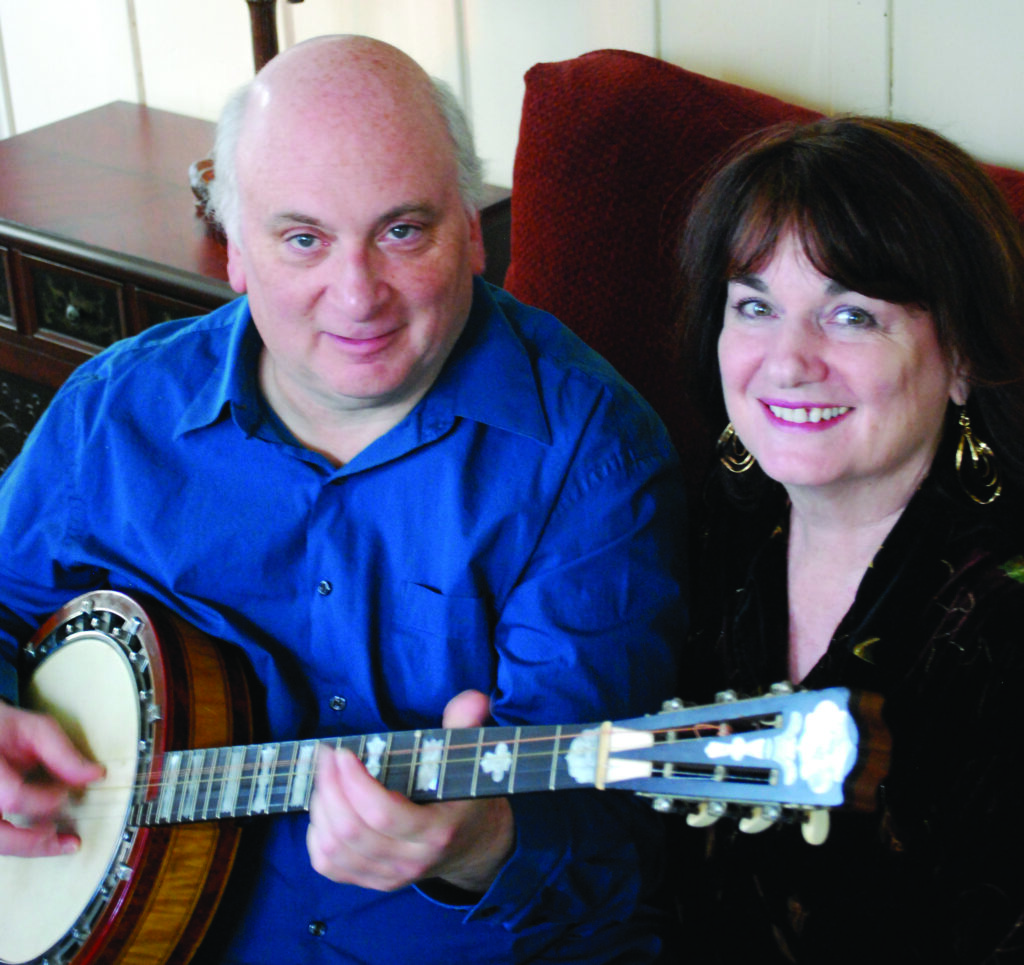
The duo signed a record deal with Rounder, thanks in part to a recommendation from Hazel Dickens, and ended up doing five popular albums for the label: A Song That Will Linger (1989), Blue Lightning (1991), Our Town (1993), Stay Awhile (1995) and Heart Songs: The Old Time Country Songs of Utah Phillips (1997). Our Town and Heart Songs were both nominated for a Grammy Award in the Best Traditional Folk Album category. Jody and Kate also recorded Songs of the Carter Family (Appleseed, 2000) and Return (self-released, 2010).
The music of Jody and Kate is a rich tapestry of sounds, old and new, and all rooted deep in the human condition. They’ve recorded traditional songs and tunes; Jody originals; new(ish) songs by writers such as Iris DeMent, Hazel Dickens and Jean Ritchie; the Stanley Brothers and the Louvin Brothers; the blues; pre-bluegrass country music; and, of course, the songs of the Carter Family and Utah Phillips.
Jody’s and Kate’s voices blend beautifully together, with what Kate calls “an almost familial closeness.” There is an honesty and sincerity in their singing that is almost palpable, and fans have connected deeply with that through the years. Often using just two voices and two instruments, Jody and Kate possess a power that isn’t dependent on volume or gimmickry. It is just honest, deeply felt music, delivered with soul and grace.
Jody’s return to bluegrass came with the regrettably under-recorded bluegrass band Perfect Strangers, which came together during the recording of Wanderlust (Copper Creek, 1999), the debut record by the gifted singer, songwriter and multi-instrumentalist Chris Brashear. Jody was hired to produce the album, because Chris said he wanted to “record an album Jody Stecher would like,” and Jody’s participation seemed a logical way to that end.
Chris assembled his dream band for the project: Peter McLaughlin (guitar), Bob Black (banjo), John Averill (mandolin), Ed Neff (fiddle) and Laurie Lewis (bass). Jody added mandolin, fiddle, guitar and vocals as needed.
Things went well during the sessions, so, as musicians are wont to do, they decided to form a band. Averill and Lewis were too busy with their own careers to commit to the new band, so Jody filled the mandolin slot and Forrest Rose took over the bass chores. The band recorded just one album, Perfect Strangers (Rebel, 2003), with guest Ed Neff. When Forrest Rose died in 2005, Paul Knight took his place. The band worked steadily for seven years, playing at several major festivals and clubs, but eventually broke up when Chris Brashear moved to Italy for a year. Jody next played for four years in the Peter Rowan Bluegrass Band, with Rowan, Knight and Keith Little (banjo), recording one album with the band, the Grammy-nominated Legacy (Compass, 2010). It was a more spontaneous atmosphere than Jody was used to.
“We would practice for a gig,” he explains, “and then go on stage and not play a single song we’d practiced. We soon discovered that not only did Peter change the keys and the timing and the phrasing of his songs, but sometimes the words. Now Keith and I are harmony singers, and we were the perfect guys for this because we thought this was fun.
“Peter would say, ‘If you don’t practice, it’s a mess. You sound like amateurs, and you can’t do that. But if you practice too much and get everything exact and perfect, you have what’s called “an act,” and it’s dead. You have to leave some room for something new to happen.’”
Jody has been active as a session musician for decades and has played on recordings by a multitude of musicians, including Jerry Jeff Walker, David Bromberg, David Grisman and Jerry Garcia, Mike Seeger, John Cohen, John Herald, Alice Gerrard, Chris Brashear, Kathy Kallick, Frankie Armstrong, Chad Manning and countless others, plus, as Jody says, “film scores, commercials, 45-rpm pop records on which I played fiddle in the 1960s and other things I have forgotten at the moment.”
Kate recorded a duet album, Sleepless Nights, with singer/songwriter Katy Moffatt in 1995, and has appeared on albums by such musicians as Laurie Lewis, Mike Seeger, Alice Gerrard, Kathy Kallick and Alan Senauke. Kate and Jody together have appeared on compilations paying tribute to the music of Lal and Mike Waterson, Blind Willie Johnson and Joseph Spence.
As one might expect, Jody and Kate have a few favorite instruments. Jody’s include a Stan Miller A model mandolin with f-holes; a Santa Cruz 12-fret shallow body dreadnought guitar and a Santa Cruz H model whose neck meets the body at 13th fret; a 1926 Gibson RB-4 with a ball-bearing tone ring and 5-string neck made by Larry Cohea; and a fiddle, of which he says, “It’s American. I’ve had others, but now I have but one.”
Kate’s instruments include a pair of guitars, a 1945 Gibson J-45 and a recent Santa Cruz 000 with koa back and sides and spruce top, and a pair of banjos, a late-19th-century S.S. Stewart Universal Favorite and a Bart Reiter Grand Concert model, both strung with nylon strings.
Jody continued to record solo albums while working and recording Kate, including Oh the Wind and Rain (Appleseed, 1999), a collection of eleven traditional ballads, with an old-time feel that evokes Going Up on the Mountain; Wonders & Signs (self-released, 2012), a bluegrass album of Stecher originals featuring banjoist Bill Evans, Eric and Suzy Thompson, Keith Little and fiddler Chad Manning; and Dreams from the Overlook (self-released, 2020).
Dreams from the Overlook is an ambitious two-CD release that contains 30 original songs and tunes. It is quintessential Jody Stecher. “A good chunk of the repertoire came to me in dreams while I sleep,” says Jody “so it reflects what I’ve absorbed. I wake up and remember enough to catch it before it flies away. It’s rare that I’ll dream the whole thing, but I’ll get part of it.”
Jody plays mandolin, mandola, guitar, ukulele, five-string banjo and tenor banjo on the album and is joined by Tony Trischka, Keith Little, Paul Knight, Chad Manning, Tashina Clarridge, Tristan Clarridge, Ethan Jodziewicz and Kate Brislin. The musicians were organized into three discrete bands, each of which played on roughly a third of the album. “I just couldn’t ask anybody, let alone a group of people, to learn 30 new tunes,” says Jody.
Shortly after his 77th birthday, in 2023, Jody joined forces with the young, award-winning band Mile Twelve to record Mile 77, an album of mostly Jody’s originals. “One might think that Mile Twelve would not be an obvious choice for my music,” says Jody. “I was sure it would work. When we came together to record, I found that our voices, instruments, timing and expressive approaches were a perfect fit.
“I’ll be recording a second album with Mile Twelve in 2024. The repertoire is set, and we are putting the final touches on the arrangements. Once again, I wrote most of the songs, plus a few that I learned. The band is enthusiastic about the repertoire, and I’m very much looking forward to making music with them again.”
Jody’s songs are generally light-hearted, displaying his off-beat sense of humor. His tunes, however, have rare depth and texture and sound like classic old-time chestnuts that you’ve somehow missed hearing over the years. Jody has the rare gift (shared by fellow mandolinists John Reischman and Tim O’Brien) for composing tunes that are instantly accessible and memorable and that sound old the first time you hear them. “I am told,” writes Jody in the liner notes, “that my tunes sound as if they have always existed.” Exactly.
Pete Kuykendall, a founder and longtime editor/publisher of this magazine, was an advocate and connoisseur of honest, heartfelt music and a huge fan of Jody Stecher and Kate Brislin. In his liner notes to their album Our Town, he wrote of the duo, “Their music captures the essence and core of traditional music. Jody’s and Kate’s music is truly unequalled in capturing the heart and soul of a number of styles. They open the doors and lead us into a completely different universe of classic traditional sound. Their bare-bones approach to this art form ranks them among the legends.”
What the future holds for Jody Stecher and Kate Brislin is unclear in this pandemic world. They have retired from the road, but still play music and sing songs. Jody says he has “seven or eight albums (he) could record right now,” but is wary of going into a studio because of Covid. Kate says she’s more focused on getting Jody’s new compositions out to the public than on making records herself.
It would be great to hear those “seven or eight albums” someday, because Jody has a lot of music left in him. And as he says in his song “Oh The Rolling Wave, “I intend to stay/I’ll stay on and make my music/Till Rolling Wave rolls me away.”