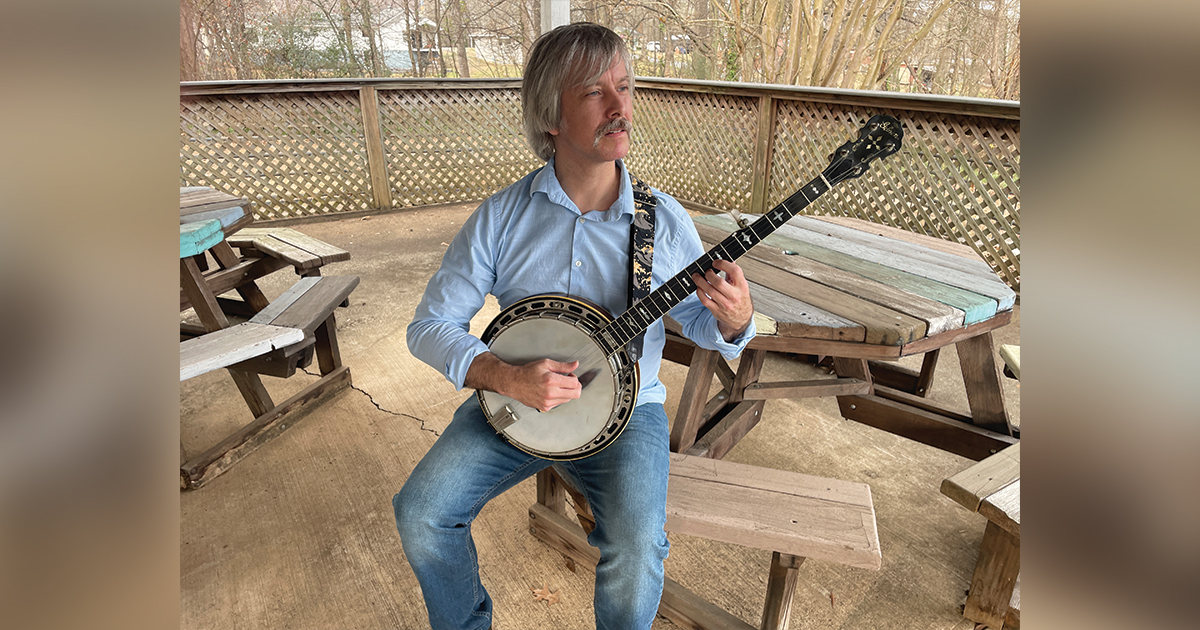
Jody Hughes
Online Lessons for Guitar and Banjo
While researching an article that I wrote about Allen Shelton in the December 2023 issue of Bluegrass Unlimited, I ran across a YouTube lesson on Allen Shelton “ideas” by Jody Hughes. I was not familiar with Jody, but he mentioned in the video that Allen Shelton was his “largest banjo influence,” so I contacted Jody and asked if he would provide a quote for my article and if he would allow us to post his Allen Shelton YouTube video on the lessons page of our website. Jody provided the quote and graciously allowed us to add his video to our lessons page.
Jody’s Allen Shelton video inspired me to explore what other banjo lessons Jody offers and I not only discovered that he has uploaded nearly 170 instructional and performance videos to his YouTube channel, but he is engaged in teaching guitar and banjo private lessons online over Skype and maintains a Patreon page which includes additional lessons and tabs that are not available on YouTube. Interested students can also find courses for banjo that Jody offers on the Udemy instructional platform.
My intention in offering this “Learning To Play” column in Bluegrass Unlimited is to introduce readers to a variety of instructors and instructional platforms and methods so that those who are interested in learning how to play a bluegrass instrument can easily explore their options. In this article, I am happy to introduce you to Jody Hughes.
Background
Jody, a native of Marietta, Georgia, started his musical life as an electric guitar player at about the age of thirteen. The music that inspired him was being recorded and performed by Stevie Ray Vaughn, Metallica and Nirvana. He said, “I didn’t know anything about bluegrass or the banjo.”
As a young teenager, Jody spent time taking care of his grandfather and on an outing with his grandfather to a local flea market, they ran across an “old man” playing a banjo. Jody said, “My grandfather had always wanted to learn how to play the banjo and he bought that banjo for me. But I didn’t know what to do with it. I knew nothing about bluegrass.”
At a family reunion an aunt suggested that if Jody wanted to learn about the banjo, he needed to listen to Flatt & Scruggs. Soon after, as fate would have it, Jody was looking through a cassette tape bin in a department store and found a Flatt & Scruggs cassette. When he got home he listened to the tape and the tune “Flint Hill Special” grabbed him. He said, “I was attracted to the speed.”
Jody’s grandfather bought the banjo for him when he was about fifteen. Six or seven months later he bought the Flatt & Scruggs tape. He said, “I had bought the Earl Scruggs banjo book and I had tried to teach myself, but I didn’t understand the rhythm and timing.” It wasn’t until he started taking banjo lessons with Dan Atcheson, in about 1995, that he started to get a feel for how to play the banjo.
Before he obtained his banjo, Jody had been taking guitar lessons at a local music store, Jennings Music. Atcheson was a banjo teacher at the store. He introduced Jody to the banjo by first teaching him how to play “Cumberland Gap.” While Atcheson’s banjo lessons were valuable to Jody, another aspect of bluegrass that his teacher introduced him to that was of tremendous help was the bluegrass jam session. Jody said, “Dan told me about local bluegrass jams.”
For a teenager who had been playing Nirvana on the guitar, it was the jam sessions that really sparked his interest in bluegrass. Jody said, “Jamming was what really attracted me to bluegrass. I made new friends, the people were very welcoming and the banjo players at the jams were open to showing me things. It was much better than playing Nirvana in my room.”
At the jams Jody played the tunes that Dan had taught him and would write out the names of tunes that people played at the jam session that he didn’t know and take those back to Dan to learn. Jody continued to take lessons with Atcheson for about a year. At that point, Atcheson told him, “You are ready to learn on your own.”
As Jody’s skill on the banjo improved, players at the Friday night jam sessions started to invite him to perform with them on Saturday nights at a local music barn. Throughout his high school and college years (at Kennesaw State), Jody continued to attend jam sessions, perform with a number of bands and play various pick-up gigs.
After receiving a bachelor’s degree in chemistry, Jody worked for seven years as an Analytical Chemist. During that time he continued to play in bands and enter some contests (he won the Merlefest banjo contest in 2004 and was three times the winner of the Georgia state banjo and flatpick guitar contest), but his job as a chemist took time away from his music. The band that he performed with the longest was called Broad River. He was with them for four years.
After his years as a chemist, Jody decided it was time to focus on music full time and he hasn’t looked back. In 2003, while still working the chemistry job, he started teaching private lessons for guitar and banjo (for a short while he also taught mandolin and beginning fiddle). He would work his chemistry job during the day and teach lessons after work to five or six students a week. In 2008 he started teaching students online over Skype. At first he had more students coming to him in person than learning over the internet. Over time he started to shift more towards the online teaching and focus primarily on teaching banjo and guitar.
After he left his chemistry job, opportunities to perform started to pick up. Highlights of his performing career over the past fifteen years include performing on the Grand Ole Opry with Randy Kohrs Band (playing guitar) and performing at Carnegie Hall (2017) and the Ryman Auditorium (2018) with The Chuck Nation Band. With that band he has also toured in China, Mongolia, Argentina and Chile.
Jody joined the Chuck Nation Band in 2016 and continues to perform with them today. He started out in that band on the guitar and then later switched to the banjo. He says that this band performs a “High Lonesome Mass,” which he describes as “a choral production combining choral mass music and bluegrass.”
Jody’s Approach to Teaching
Although he still performs with the Chuck Nation Band and plays music for weddings and private parties, Jody said, “I’m primarily a teacher. Performance comes second.”
For beginning banjo students, Jody starts with Scruggs-style roll patterns and teaches basic songs using those patterns. While most bluegrass banjo teachers start with the Scruggs style and have their students stay there for quite a while before introducing melodic or single-string ideas, Jody likes to introduce those concepts earlier. He said, “Many people feel like melodic style is an advanced thing. I don’t see it as being more difficult. I will introduce a G major scale played single-string style early and start with melodic ideas within the first year.” He feels like introducing scale work makes it easier for the student to learn music theory on the banjo and he has found that some students develop a knack for one approach over the other. In other words, some might gravitate more towards Scruggs style, while other feel more comfortable with the melodic or single string approach.
Having spent six years studying jazz guitar with pianist Kevin Bales, Jody says, “I’m big on improvisation. I will teach tunes so that students are not only learning theory or exercise, but I tell students that they are not going to be able to memorize their way into everything that they want to play. I always encourage them to play around and improvise.”
On the guitar, Jody’s approach to teaching improvisation is to teach chord triads up and down the neck and improvise out of those positions. For banjo, he teaches students how to change roll patterns and also shows them how to move chords to different areas of the neck. He said, “My approach to improvisation is organized by chords.”
Learning the form of the song is something that Jody also emphasizes. He said, “If you are going to learn how to improvise, you have to know the form of the song. People that learn by memorizing don’t tend to have the form in their mind.” Knowing the form of the tune goes beyond knowing the layout of the A and B parts, or the verses and chorus of a vocal song. Really knowing the form also involves developing an innate feel for exactly when the chords are changing. If the approach to improvisation is chord-based (using chord triads or targeting chord tones), it is vital that the player develop a feel for exactly when the chords are changing in relation to their solo.”
In order to help develop this feel, Jody starts with vocal tunes. He has the student learn a verse and sing it (even if they are not a singer) so that they can start to get a sense for when the chords change as related to the words of the song. He has them strum the chords and sing the song or hum the tune. He feels that this helps the student begin to internalize the song.
Jody also encourages students to jam with other people and play along with recordings. He said, “When you play along with a recording, you don’t have to worry about not getting it right. Some students are scared of improvising. I show them how to make simple variations…maybe a couple of different licks that they can insert into the song. They can then build up slowly and learn how to change the song more and more. If they know the form, they will not get lost. I find that playing along with records helps your ears grow.” In jamming with others, Jody encourages his students to find anyone to jam with, even if they don’t play bluegrass.
Another thing that Jody emphasized about his approach to teaching is that he is a firm believer in catering the lessons to the student’s individual goals. He said, “I like to meet students where they are at and make it about their goals. That way I can cut off some of the fat.”
If you’d like to study with Jody Hughes, you can contact him through his website: jodyhughesmusic.com.