Jim Pankey
Teaching Millions to Play the Banjo
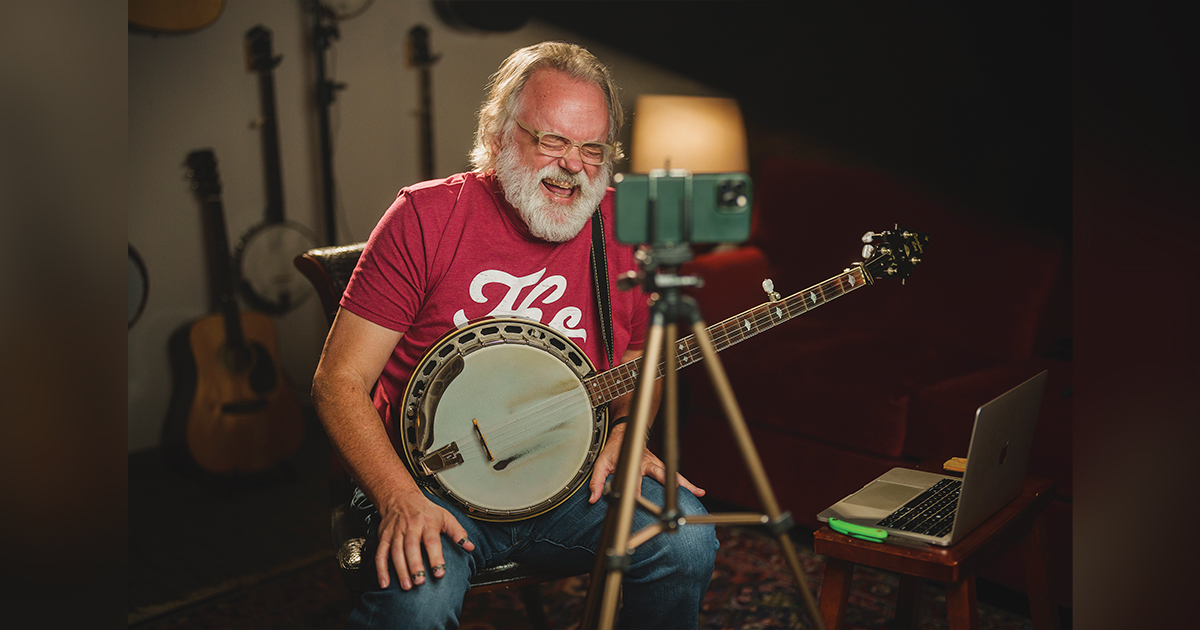
You might look at the title of this article and think, “Are there really millions of people learning how to play the banjo?” If you look at Jim Pankey’s YouTube channel and check out his “Learn To Play Bluegrass Banjo – Lesson 1,” you will see that this one video has had over 1.5 million views in the past six years. So, either there are over a million people interested in learning to play bluegrass banjo, or there are just a couple of hundred slow learners who are watching that 13-minute video thousands of times.
Pankey’s success at teaching the banjo on YouTube is staggering. In addition to the astounding number of views listed for Lesson 1, over the past eight years he has amassed an impressive 122,000 subscribers to his YouTube channel, which currently contains over 550 videos. The channel is titled “Jim Pankey—Bluegrass and Old-Time Banjo lessons and a smattering of guitar, mandolin and ukulele.”
Background
Jim Pankey says that he has always had a love for the banjo. When he was a young kid growing up in north Georgia, he would take a skillet and imitate Grandpa Jones playing the banjo. Whenever the banjo was on the TV or the radio, Jim always wanted to hear it. Jim’s father played the guitar and his sisters sang. His father bought him a guitar when he was in fourth or fifth grade.
In the summer after eighth grade, Jim found his dad’s mandolin and guitar. But, he always had an interest in the banjo and about the time he began learning mandolin he found an old banjo that had originally belonged to his grandmother in the back of a closet. He said, “It was an old open-back banjo that was mostly unplayable.” He tried to play it, but it was not in good shape. That Christmas (1977) his father bought Jim his first banjo and gave him the record that accompanied the Earl Scruggs banjo book. Jim said that he had the LP, but not the book. He said, “On the LP Earl slowly talked through the rolls” and that is how he started learning to play.
In addition to having the Earl Scruggs LP, Jim said that his father also had a good collection of bluegrass albums. He started slowing those down and trying to figure out how to play by ear. Although Jim had the opportunity to watch some local banjo players perform, the first “known” professional player that he saw in person was Raymond Fairchild. Jim said, “I had been playing for about a year at that point. My dad was talking with Raymond after the show and he let me play his banjo. He told me, ‘You’re doing real good boy, but don’t copy nobody.’ To me it was like he was giving me permission to blaze my own trail and figure things out for myself. It was nice to know that I didn’t have to copy other players.”
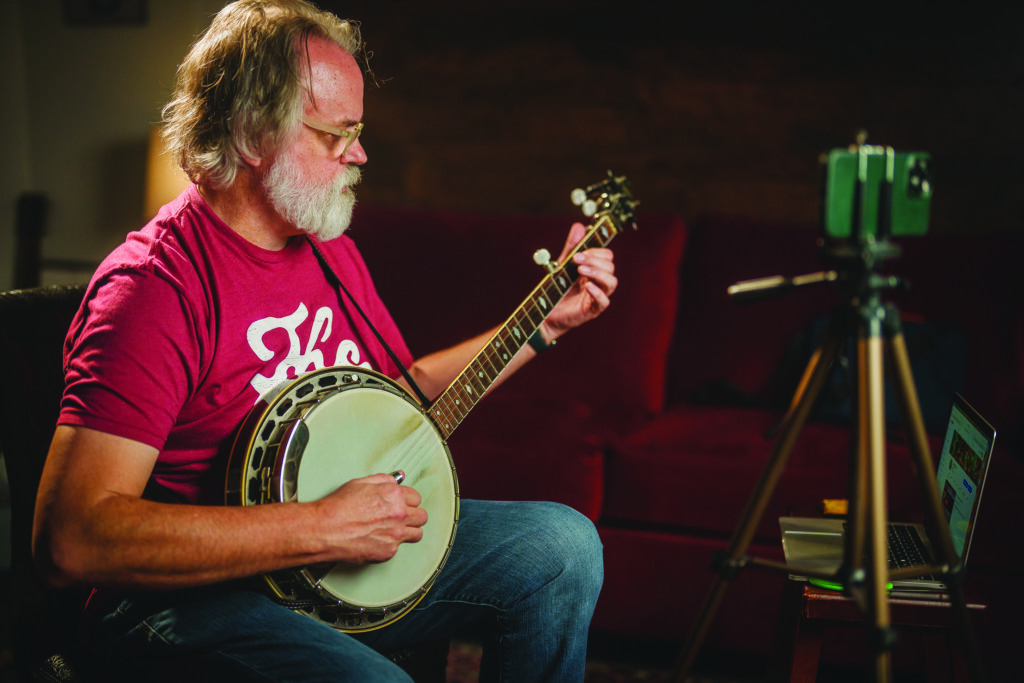
When asked about his early influences on the banjo, Jim said that he listened to a lot of Earl Scruggs, Ralph Stanley, Curtis McPeak and Little Roy Lewis. He said, “I didn’t discover Don Reno until I was in college.” Early on, Jim’s mother had bought him the Alan Munde Banjo Kid Picks Again album. He said, “I listened to that and could not figure out what he was doing. It was like a foreign language. My mom took the album back to the store.”
A little later, Jim said that he did learn some melodic licks from a local player named Harley Rider (yes, his real name). Rider showed Jim how to play “Sailor’s Hornpipe.” While still in high school, Jim also discovered the Tony Trischka Melodic Banjo book and started learning out of that. He later revisited Alan Munde by buying the Banjo Sandwich album. By then his melodic vocabulary had improved and he was able to learn some of the songs on that recording, like “Blackberry Blossom.” He said, “I was trying to figure out the melodic style, but the note selection and tone of the Scruggs style captivated me, so I was more interested in that.”
When Jim was in tenth grade he met a kid on the school bus who had a guitar. They started a band and played for local nursing homes, civic clubs and the county fair, and even the FFA National Convention. By the time he entered college he found more people to pick with and played with several different regional bands. For many years after graduating from college Jim held down a regular job during the week and was a musician on the weekends.
Although he had started to teach others how to play as early as his high school years, in the 1990s he began to teach more students and at one point had up to 40 students per week. Originally, he had been working in the banking industry and teaching students on the side, but for a couple of years during the 1990s he left banking, rented a teaching space and focused on teaching banjo. For seven years he primarily taught and played the banjo, but in 1999 he and his wife were expecting a child and he felt like he needed a job with more stability, so in 2000 he went back to banking for the next 12 years.
Although he continued to teach students and play music on the side, Jim did not go back to full-time teaching until 2012. He said, “A lawyer friend had opened up a satellite office here in town and only worked out of it one day a week. He let me use it the other days to teach lessons.”
YouTube Lessons
As mentioned at the start of this article, today Jim is very well-known for his lessons on YouTube. He said that the first videos that he posted where just performance videos, not lessons. He also posted some YouTube banjo reviews for Recording King. He remembers, “After I posted a few videos, people asked if I would post banjo lessons. I originally did not do that because there were a lot of banjo lessons online and I didn’t feel like I needed to add to the noise.”
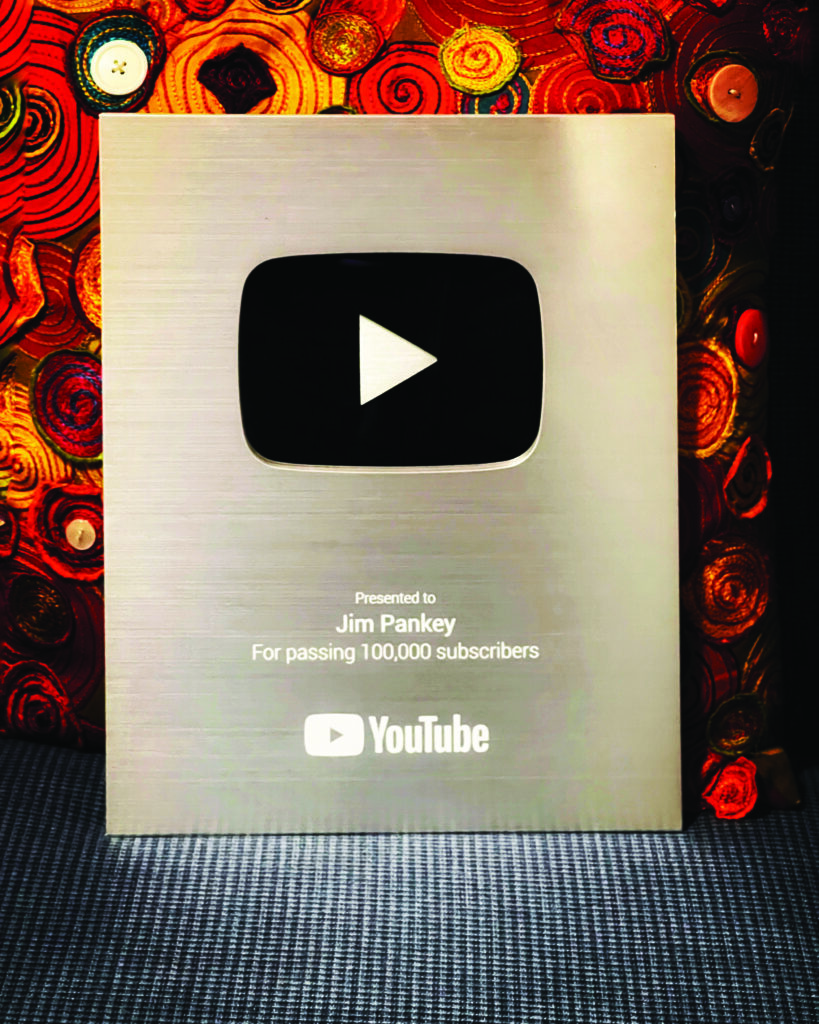
In 2016, Jim “gave in” to those who wanted him to post lessons. He said, “There was a local guy that wanted lessons, but didn’t want to come to my house. He asked that I make him videos instead.” Making videos for that student led to Jim developing a ten lesson beginning banjo video series. He posted the series on his YouTube channel and in 2017, his channel started to take off. Within the first two years of posting video lessons on YouTube, his channel had 30,000 subscribers and that number continued to rise.
Jim said, “I had a background in education. I have bachelor’s degree in agriculture education. My videos are very homespun and real basic. I go through things step-by-step. I do the same thing in the videos that I do for private lessons.” When the pandemic hit, a lot of people found Jim’s videos. His subscriber numbers quickly doubled. He said, “I think that as my subscriber numbers grew, the algorithm started handing people the link.”
Regarding his approach to posting new videos today, Jim said, “The idea behind everything is to build on what is already there. I try to introduce a new concept in each video. I don’t teach songs for the sake of teaching songs. I like to teach concepts that you can use anyplace. A lot of my videos are geared towards older beginners. I think my demographic tends to be about 90% males over 50.”
A genius move that Jim made to get plugged into the short attention span crowd was to make videos called “Bluegrass Banjo in a Minute.” He took ideas from his beginning lessons and created a series of fourteen one minute long videos and those have been trending online since their release.
With over 122,000 subscribers to his YouTube channel and millions and millions of views of over 550 videos, Jim Pankey is someone who is teaching the world about the bluegrass banjo and as bluegrass enthusiasts we are grateful. Keep it up Jim!