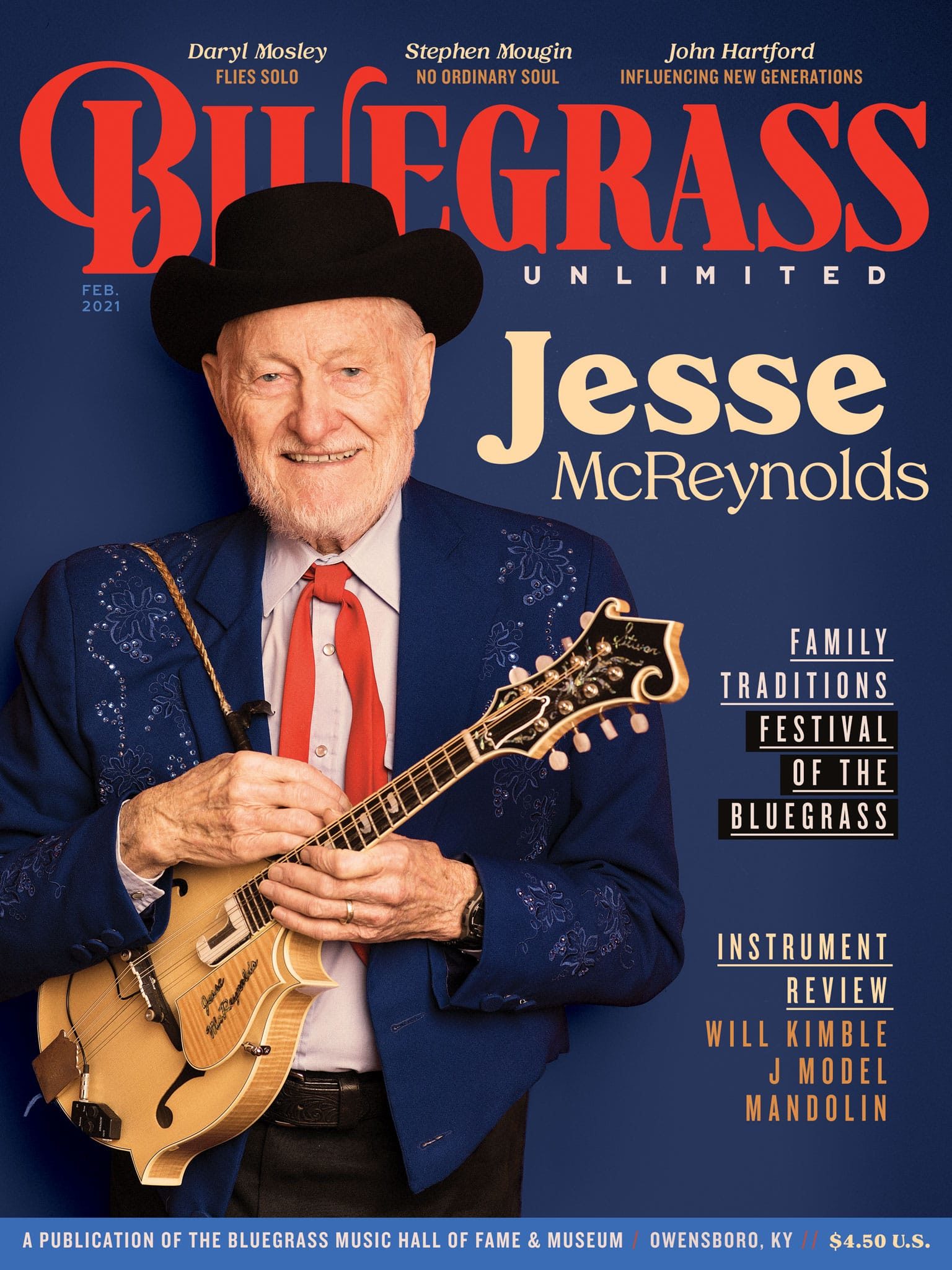
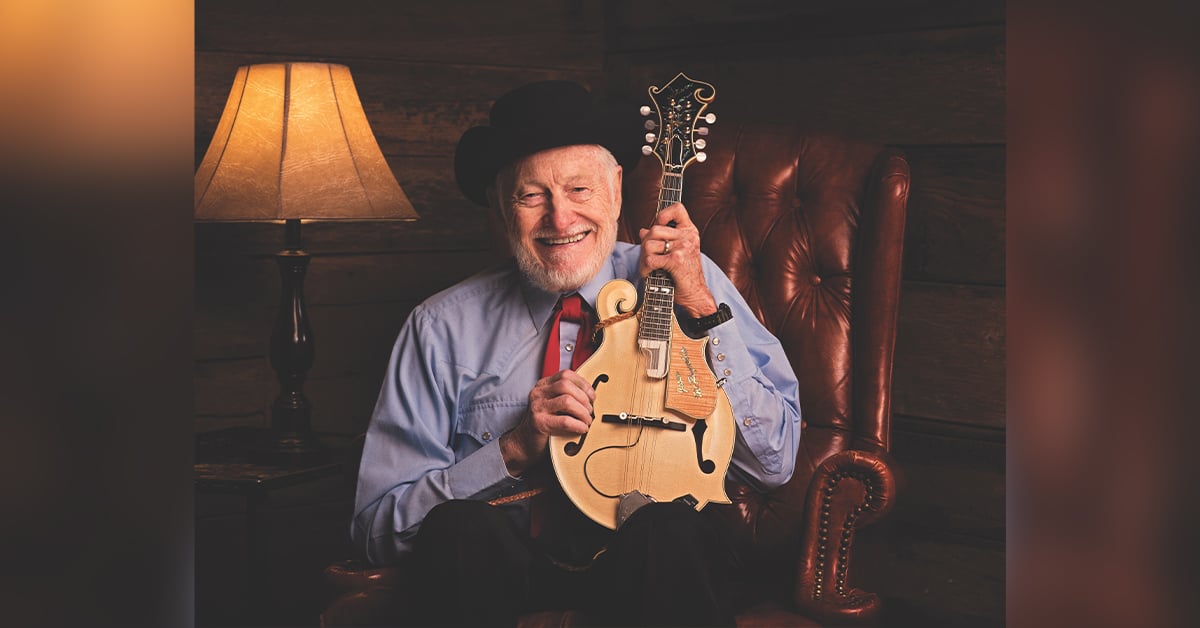
Jesse McReynolds Opry Memories
Photos By Michael Gomez
After the passing of Jan Howard last March, Bluegrass Hall of Fame member Jesse McReynolds became the oldest living member of the Grand Ole Opry. In 2021 he will celebrate 57 years as a member—38 of those with his brother as “Jim and Jesse,” the longest running brother duo in the history of country music.
There’s an old John Sebastian song about the life of a musician on the road called “Stories We Could Tell.” The chorus goes: “If you ever wonder why you ride the carousel; you did it for the stories you could tell.” At 91, Jesse McReynolds certainly has some stories – many of them based around his years at the Opry.
“I was just watching a TV show video the other day we did,” Jesse said, “and I got to thinking, ‘Jim Buchanan and I are the only ones left in this bunch!’ We had a good band: Jim (Buchanan) on fiddle and Don (McHan) on guitar, with Allen Shelton on banjo and David Sutherland on bass. I’ve been going through tapes of places we worked in the ‘60s and ‘70s and ‘80s. The fans send them to me, and it’s enjoyable to remember what was going on then,” he said.
Raised in Carfax, Virginia, near Coeburn, Jim and Jesse launched their professional career in 1947 at WNVA radio in nearby Norton. Music ran in the family; their grandfather, Charlie McReynolds, was on the famous Victor Bristol sessions in 1927.
After Jim’s death in 2002 and at age 73, Jesse fearlessly launched a solo career. He continues to front the Virginia Boys band, which performed nearly every weekend at the Opry up until the COVID-19 virus hit in March 2020.
Jim and Jesse made their major-label debut on Capitol Records in 1952, and in 1967 the duo had a top 20 country hit with “Diesel on My Tail.” The brothers recorded for several labels, including their own Old Dominion Records. They regularly appeared on the country charts from the ’60s through the ’80s, with songs like “Better Times A-Coming,” “Ballad of Thunder Road,” and “Freight Train.”
During the folk music boom, they played the Newport festival and college campuses. A worldwide audience was built through appearances in the British Isles, Europe, Japan, and Africa. Jim and Jesse were favorites for decades on the bluegrass festival and cruise circuits. Inducted into the IBMA Hall of Fame in 1993, they received the prestigious National Heritage Fellowship Award in 1997.
Jesse’s staggering creativity and talent led him in several musical directions. The brothers released one of the first bluegrass-rock crossovers in 1965 with their Chuck Berry tribute album, Berry Pickin’ in the Country. In 1969, the Doors’ Jim Morrison picked Jesse to play mandolin on The Soft Parade. In 2010 Jesse collaborated with David Nelson of New Riders of the Purple Sage and Stu Allen of the Jerry Garcia Band to record Songs of the Grateful Dead. Jesse even found himself playing an acting role on the CMT television series, Nashville, in the 2017 season premier opener!
Jesse’s most recent Pinecastle recording, a tribute to his grandfather, included fiddlers Jim Buchanan, Michael Cleveland, Glen Duncan, Buddy Griffin, Corrina Rose Logston, and Eddie Stubbs—all playing the historic fiddle that belonged to Charlie McReynolds. “Soldier’s Joy,” a collaboration with Michael Cleveland, made Jesse the only bluegrass musician in history still getting IBMA award nominations into his 90s.
“I first heard the music of Jesse McReynolds at my grandparents’ home in Flora, Illinois,” said Dan Rogers, Grand Ole Opry vice president and executive producer. “My grandmother was in charge of the record collection. Even at that young age, [Jim and Jesse’s] sound stood out among the mainstream country albums. As I’ve gotten older and spent time working in the music industry, I’ve discovered I was far from alone in having been influenced by Jim and Jesse’s music.
“An accurate description of the Grand Ole Opry that was shared with me years ago, is ‘It never changes. It always changes.’” Rogers said. “I love that description, because it encapsulates two qualities that are so important to the Opry’s success: it needs to remain true to its roots and traditions, yet it needs to stretch, grow, and remain relevant to new generations of artists and fans. I think the same can be said for Jesse McReynolds. He never changes. He always changes. It was an honor to work with some of the greatest musicians in our business to celebrate Jesse’s 90th birthday on the Opry stage last year,” Rogers added. “How quickly those artists agreed to surprise Jesse on stage with mandolins in hand to play for him says so much about Jesse’s influence.”
“I used to listen to the Opry when I was a kid,” Jesse said, but in the early 1960s Jim and Jesse were too busy scrambling for work to pursue that dream. Logging more than 12 radio shows in 10 different states and then adding a regional television circuit, “Jim and I had gone to Florida and we were doing a show for a mobile home company, Jim Walter Homes,” Jesse said.
“We moved from Florida to Alabama, and we were doing four or five TV shows a week. After a TV show, we would go to play regular shows, traveling 1,300 miles a week. The TV shows were at 6:00 p.m. We’d leave after that and go to a high school somewhere. We had TV shows in Pensacola, Florida, and Thomasville, Georgia, and then Tallahassee, Florida. Ford Tractor started sponsoring us in Savannah and Albany, Georgia; Dothan, Alabama; and Pensacola. We were traveling every day. My brother was always trying to find a sponsor for our TV shows, so he called the people at the Pillsbury company in Atlanta, and he had a meeting with them.
“A.O. Stinson and Cohen Williams from Martha White came to Valdosta, Georgia, looking for us, the same week Jim was talking to Pillsbury. They wanted to put us on the Opry when Flatt and Scruggs were on the road.” An agreement was made and everything that Jim and Jesse did for Martha White was cleared with Flatt and Scruggs, who were traveling to California to tape The Beverly Hillbillies at the time.

Photo Courtesy of Opry Entertainment
“We recorded for Starday in Jacksonville,” Jesse recalled—“songs like ‘Hard Hearted’ and ‘I’ll Love Nobody but You.’ I was trying to write some pop songs. Elvis was getting pretty hot, and I started singing, as a joke: ‘I’ll love nobody but you, baby, baby . . .” It was one of the simplest songs I wrote, but it turned out to be a hit for us.” The first song Jim and Jesse played as guests at the Opry was “I’ll Love Nobody but You,” Jesse said. “It was an honor to get to do your own song. The first time we worked the Opry, we also played the Ernest Tubb Record Shop later that night and Jimmy Martin was on the show. I had Allen Shelton and Don McHan in the band and we were going over some songs. Jimmy called his band around and said, ‘Now you all listen to this. That’s the way bluegrass is done.’”
Jim and Jesse did Martha White package shows in Pensacola and Charlotte, opening for country artists like Don Gibson, Bill Anderson, and David Houston. “Then our agent, Joe Taylor, came to the show in Charlotte and said, ‘I’ve got news for you. You’re on the Grand Ole Opry!’” They had been invited to be members, beginning March 2, 1964.
“Ralph Emery had a morning TV show in Nashville at the time, and we went down to be on that the next morning,” Jesse said. “Ralph interviewed us and we never mentioned anything on the show because I told Jim, ‘We’ve got to see this to believe it.’ Ralph always bugged us about that later, that we knew we’d been invited to join the Opry and we didn’t tell him about it.
“We stayed at the Opry for 56 years, and it went by faster than I could think about it,” Jesse said. “Some strange things happened to us out of the clear blue sky. We went to Jacksonville and taped a TV show over there. Then Martha White said, ‘We’re going to change things. We’re going to give Flatt and Scruggs all the TV shows we’ve got left, and we’re going to give Jim and Jesse all the morning shows on WSM radio.’ Flatt and Scruggs preferred the radio shows, but they went along with it. We moved to Nashville at that time.”
Martha White wanted Jim and Jesse to join Flatt and Scruggs on the Columbia record label. “They cleared it with Lester and Earl, and we were signed with Epic, which was a new imprint of Columbia,” Jesse recalled. “We only had one conflict with Flatt and Scruggs when we were on Epic, when we recorded the Chuck Berry tribute album.” Both acts recorded the song, “Memphis, Tennessee” without realizing it. “We did it on the Opry and said we had the record coming out. Flatt and Scruggs heard us on the radio, and they said they were planning to do the same thing. In order to settle the problem, the label released the song by both bands on the same day [September 27, 1965]. Bob Luman, another Opry member, was also doing the song rock ‘n’ roll style, so there were three Opry artists playing that song every weekend.”
Bill Monroe always had this greeting when we’d go into the Opry,” Jesse said. “Bill would shake hands with us and look at me and say, ‘You’d be OK if you could get yourself a guitar player!’ He’d tell us sometimes, ‘You boys ain’t gonna quit bluegrass, are you?’ We went country for a little while and got flak from everybody. I was playing some electric mandolin, and the fans would write notes and put them on the edge of the stage, saying, ‘Unplug that mandolin!’ I thought we should do a regular country song, and that’s when we cut ‘Diesel on My Tail.’ Of course, ‘Diesel on My Tail’ was the biggest song we ever had on the country charts. We finally went through that phase and went back to playing bluegrass.”
Although Monroe would sit and talk to Jim for an hour at a time at festivals, Jesse said, “I had a hard time getting his attention. He commented on my cross-picking, though. We played Bean Blossom once and he wanted me to play ‘Rawhide’ with him onstage. I played some cross-picking on it and did some crazy stuff, I guess. When we were done, he handed me his mandolin and said, ‘You can have it,’ Jesse laughed, remembering. “I wrote a song once about one of Bill’s sayings called ‘I Ain’t No Part of Nothin’ Anymore.’”
Backstage at the Opry in the 1960s and ‘70s, “Hal Durham (former Opry manager) and Roy Acuff were always joking around,” Jesse said. “Roy would holler at me if I’d go by his door and not go in and speak to him. He’d say, ‘Come in here and sing that song about your home place, ‘My Time is Running Out.’” There were jam sessions in the dressing rooms and a tangible spirit of camaraderie.
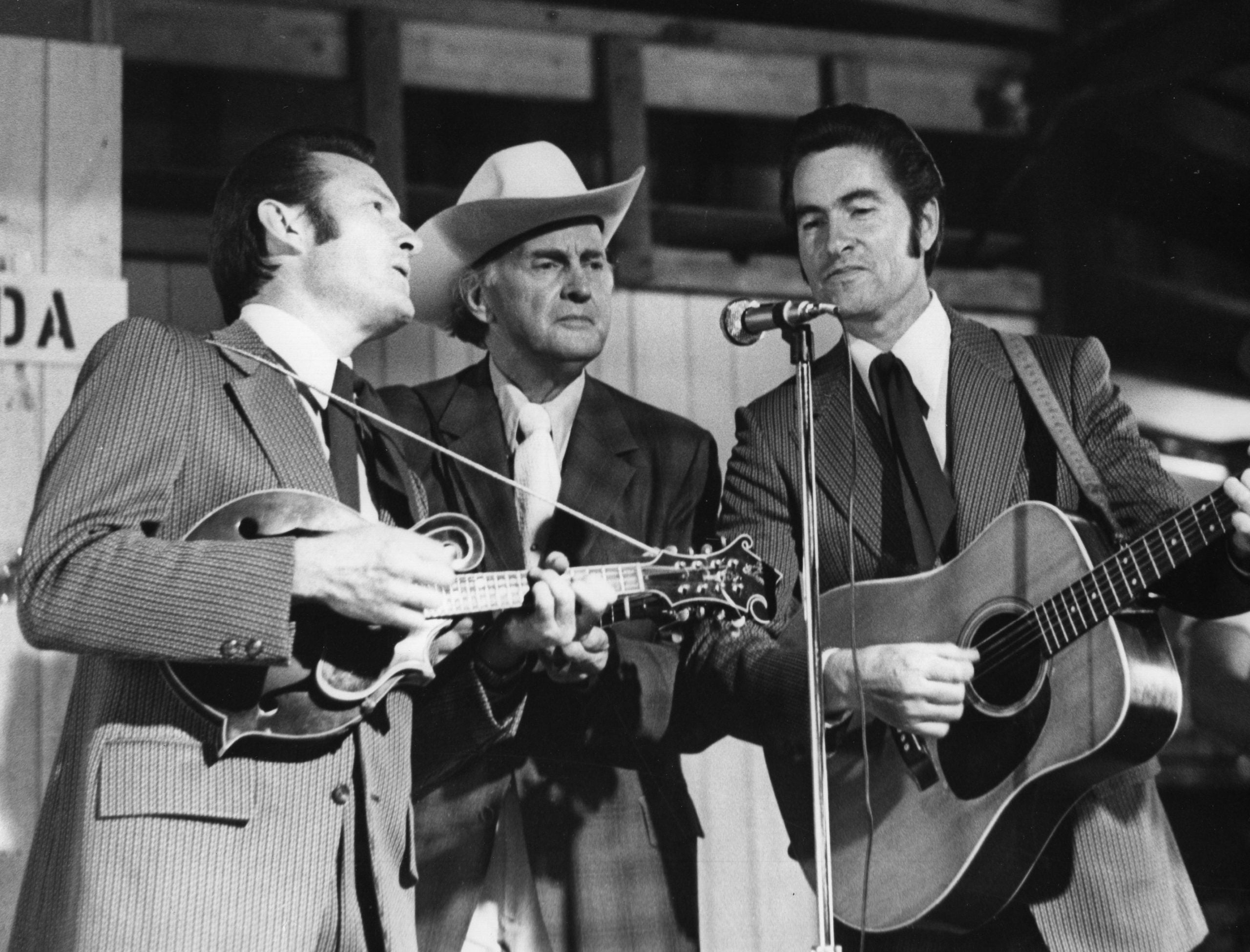
Photo Courtesy Tom Henderson, Friends of Bluegrass
Everybody was friendly with each other, McReynolds recalled—more open dressing room doors than closed ones in those days. “I did have a little thing with Charlie Daniels one time,” he chuckled. “Charlie was on the Opry one night and he walked up to me backstage, and I thought he was an impersonator. He told me how he enjoyed our music, and I didn’t say anything back about his music. Then later Jim said, ‘Did you talk to Charlie Daniels tonight?’ I said, ‘I talked to somebody who was trying to look like him.’”
To this day, the door of dressing room #2 (the Bluegrass Room) is rarely closed, unless someone is changing a shirt. Other Opry members, guests, and backstage tours stop and listen as Jesse and his Virginia Boys warm up and decide what to play that night. Ditto for the nights when Bobby Osborne is in the room with the Rocky Top X-Press.
“Johnny Russell was always a clown at the Opry,” Jesse recalled. “He’d come in the dressing room and just take over and start telling jokes. He came in Friday night and was telling some of his jokes. When he came back the next night, Jim [McReynolds] let Johnny know that he didn’t appreciate the tone of his jokes. “Johnny did a quick U-turn and never did come back,” Jesse said. “Jim was good at saying things to people in a joking way that sounded like he was serious. But I know better. When you live with someone all your life, you know them.
“The first time we went to Nashville, we met Bud Wendell, an insurance salesman for the National Life Insurance Company,” Jesse said. “Within a couple of years he was manager of the Grand Ole Opry. Every time we did anything, we’d call Bud. When he retired, he asked us to play for him, along with Vince Gill and some others. I will always be grateful to him.” Gaylord Entertainment acquired the Opry in 1983; from 1991 to 1997 Wendell was Gaylord’s president and CEO.
Jim and Jesse played at Opryland about once a month and they hosted a bluegrass festival there. Jim and Jesse’s Paradise album was released on the Opryland Records label, and the cover photo was taken by Opry photographer Les Leverett. Les, age 93, recalled a meandering trip through the hills of western Kentucky with Jim and Jesse, trying to find the town of Paradise. Like the song said, “Mr. Peabody’s coal train had hauled it away,” and there was nothing to be found except a gas station and the mine.
In their heyday, Jim and Jesse played 50 festivals a year in addition to Opry dates. The COVID-19 virus has been a challenge, limiting the number of Opry performers per night who play for a virtual and now socially distanced audience. Only two Opry square dancers perform, standing on opposite ends of the stage. Jesse and his wife, Joy stay busy at home in Gallatin, Tennessee. “I built a 30 x 40 foot building out behind my house to put my stuff in,” he said. “My grandson, Luke McKnight, is building a building beside the one I’m building.
“‘Time changes everything,’ as Tommy Duncan wrote in the song,” Jesse said. “I enjoyed what time I’ve spent at the Opry,” he muses. “I never thought I’d be on it for over 50 years. The lady at the physical therapy company told me, ‘If you get to be 91, you don’t need to do all this stuff,’” he laughed. “I’m a little weak and I get tired pretty quick, but I’m doing OK. I’m grateful that I can still go out and play.
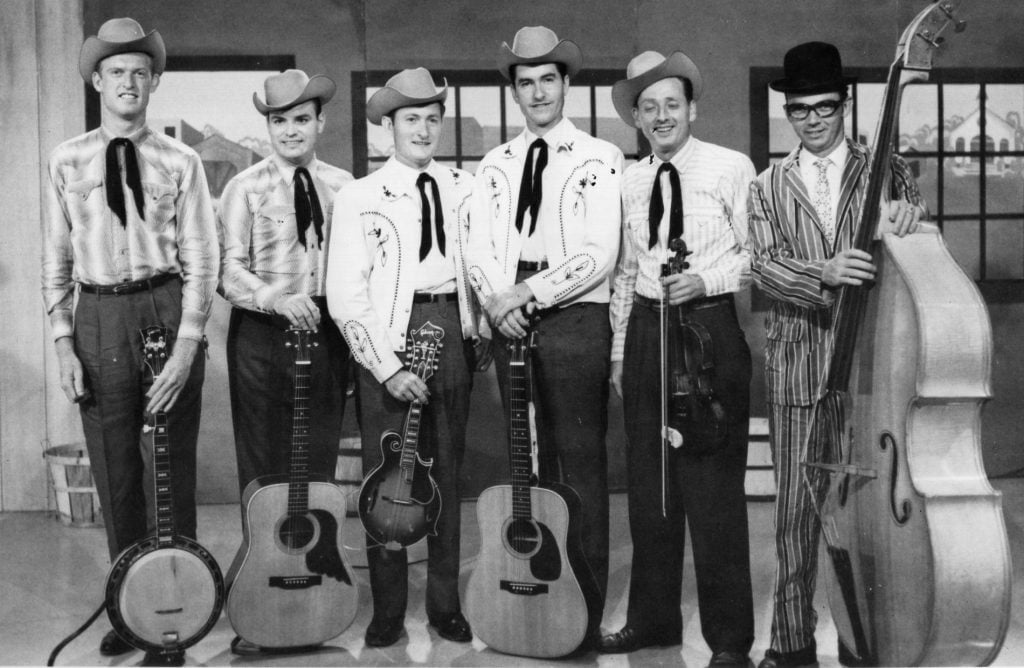
Photo by J & J Photo
“I look at all these new people coming up and this new type of music they’re playing,” Jesse continued. “I listen to a radio station in Murfreesboro (WMOT). They play strange music,” he grinned. “It’s like old-time music played in a different form—what they call Americana, I guess. I like the Old Crow Medicine Show. Those guys have been real nice to me, and I’ve played some festivals with them.”
Jesse is planning his next album, which will feature a new mandolin style. “Since I was successful doing cross-picking, I’m working on some split-string stuff with triple strings instead of two. I use two sets of double strings. You have to get your notes by splitting your fingernail and picking up the harmony. I’m trying to create a new McReynolds pinky finger style,” he laughed.
To this day, when Jesse McReynolds performs he tilts his head toward the place where his brother, Jim, used to stand, as if he’s listening for that high, soaring tenor. When Jesse dreams about playing music, Jim is always there. “It was different going back to the Opry after Jim died,” he said. “That was one of the reasons I did the Grateful Dead tribute. Jim never would have gone that far out.”
Jesse started an autobiography and then sent the 200 pages written in longhand on legal pads to Dennis McNally in California to finish the book. McNally is official historian of the Grateful Dead.
“It’s hard to figure, sometimes, what direction to go,” Jesse said. “That’s the problem I have—deciding what I should do that I didn’t do last week! I try to do something different, but still stay in my ‘category,’” he smiled. “My goal is to try and entertain people and do what I’m capable of doing.”
At the Opry, he noted, “you’ve got all kinds of people that like all kinds of music. I’ve always tried to be flexible,” he said. “I would like to do something with the Opry square dancers on a song. I watch a lot of television where they have Spanish music with a big production. I’d like to involve as many people as possible in my music. We’re one type of people, and we try to get along with everybody. I want to play good music that everybody will comment on.” Another one of Jesse’s dreams has been to host an orchestra of mandolins on the Ryman Auditorium stage playing Bill Monroe’s music.
“I’m thankful that the Opry has been nice to me,” McReynolds said. “A lot of people have come and gone, and we’ve stayed through the storm, you might say. I’m thankful for the 56 years. It’s been a nice journey, and I’m looking forward to the next few years, whatever they are. And I thank all the fans,” he added. “I can put out one email or a post on Facebook and get 5,000 answers. I just thank everybody for being who they are.”