
Jason Keiser
Carrying On The Jazz Grass Tradition
Some readers are going to look at the title to this article and take exception to the words “Jazz Grass” and “tradition” being used in the same sentence. However, if you think about it, the melding of jazz and bluegrass started early in the history of bluegrass music with artists such as Earl Scruggs drawing tunes like “Bugle Call Rag” and “Farewell Blues” from the jazz standard repertoire and writing swing-influenced songs like “Foggy Mountain Special.” George Shuffler’s walking bass style, which he used playing with the Stanley Brothers, was born when he listened to the swing-jazz inspired western swing music prior to joining the Stanley’s. Kenny Baker was a jazz fan and recorded “Charmaine” in 1972. That song had been recorded by Guy Lombardo in 1927.
But even earlier than the specific examples noted above, there are those—like former Blue Grass Boy Butch Robins—who feel like Bill Monroe was influenced by jazz musicians while he was working in Chicago and that the improvisational aspects of bluegrass music were born of that influence. So, the mash-up of jazz and bluegrass is not something that is new.
In the early-to-mid 1970s David Grisman, working with Richard Greene, John Carlini and others (in the Great American Music Band)—and later Tony Rice, Darol Anger, Mike Marshall, Todd Phillips, Joe Carroll, and Bill Amatneek (with the David Grisman Quintet) explored jazz-influenced acoustic music using the instruments of traditional bluegrass and informed by their respective backgrounds in bluegrass music. Stemming from Grisman’s nickname, this genre-melding music was labeled “Dawg” music. Extending from the music he played with Grisman, Tony Rice later recorded his “spacegrass” albums. Since that time the term “new acoustic music” has been given to the branches that grew from these early roots.
All of that to say that the wave of acoustic bluegrass-based jazz music that began to form and swell in the early 1970s is now over fifty years old. In my opinion, fifty years of existence probably has enough age to it to say that there is an established “tradition” with this branch of the big and broad bluegrass tree.
Jason Keiser’s Background
Jason Keiser is one of the young musicians who is enthusiastic about carrying on with the music that David Grisman and Tony Rice started playing in the 1970s. Working with his mentor, Wyatt Rice, Jason has connected with a direct lineage back to the Dawg and spacegrass music that he fell in love with when he was in high school.
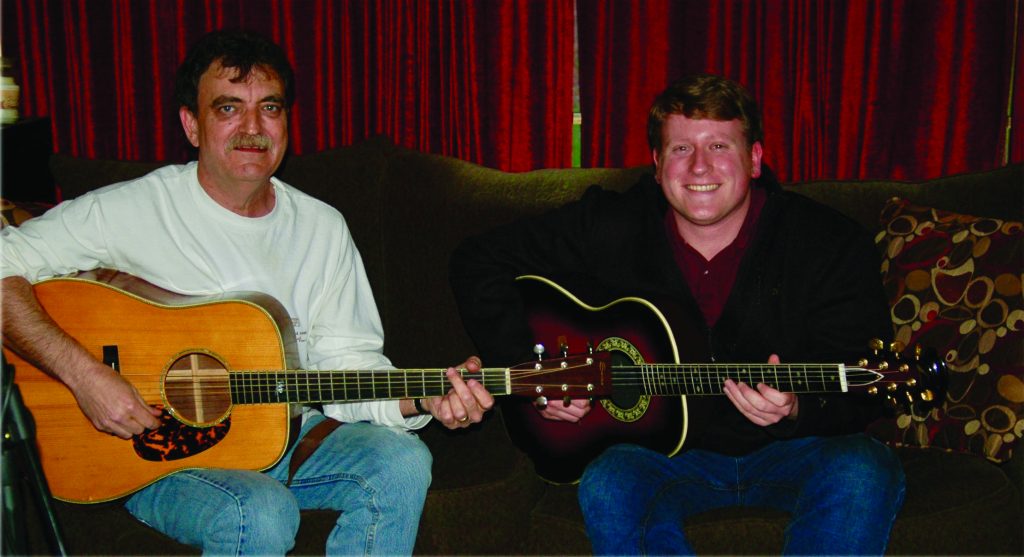
Jason started learning to play the guitar during middle school. His older sister, Krisanne, had an electric guitar and Jason started learning on that instrument. Jason said, “My great grandmother also had an acoustic guitar, so I started out by teaching myself using those two guitars. I was learning songs by bands like Creedence Clearwater Revival and stuff with easy chords.” When he entered Leland High School in San Jose, California, Jason discovered that the school had a jazz band, led by instructor Rian Rodriguez. He said, “I wanted to get into the jazz band in tenth grade because it was an excuse to play the guitar.”
Jason did not discover bluegrass music until his paternal grandfather brought a banjo to a family gathering. He said, “I started picking on that banjo. It was probably in about 2010. I had a buddy who owned a mandolin and I borrowed that. At that point I started diving into bluegrass and soon after I found out about Tony Rice and David Grisman.” Playing bluegrass at home and jazz at school led to Jason’s growing interest to learning about what Rice and Grisman had recorded.
After graduating from high school, Jason entered West Valley Community College in Saratoga, California because they were known for their jazz program under program director Gus Kambeitz and local professional guitar player Rick Vandivier. He said, “At that point I did not know that they offered a bluegrass degree program at East Tennessee State. I was mainly playing jazz, but still practicing bluegrass and slowly getting more into spacegrass, finding more acoustic music. Then in 2014 I really started getting into David Grisman’s Dawg music.”
Sometime in mid-to-late 2014, Jason found out that East Tennessee State University (ETSU) offered a degree in bluegrass music and that Wyatt Rice was teaching there. Jason remembers, “I thought, ‘Oh man, if I could have a chance to learn from somebody who has really worked in that music and been around it, like Wyatt Rice, I can do jazz later.’ I wanted to do something different.” In 2016, Jason transferred to ETSU.
Regarding his decision to leave a jazz program for a bluegrass program, Jason said, “With bluegrass and jazz, there are so many parallels through improvisation. Even though instrumentation can be different, there are quite a lot of cool connections. So, I felt as though I was just musically pivoting…and I was super excited to have the chance to study with Wyatt. That is how the relationship with Wyatt started.”
During that time, at ETSU, Wyatt Rice was teaching private instruction through the program. Regarding his private lessons with Wyatt, Jason said, “I think that when Wyatt discovered that I had a jazzier background he found that refreshing. We just connected and I think that the music sounded good when we were playing.”
Wyatt Rice fondly remembers his time working with Jason. He said, “Jason had been bitten by the spacegrass/Dawg music bug. He was a straight-A student in my class. We’d sit down and I’d show him alternate chords to tunes and I’d throw just about every spacegrass tune that I knew at him and the next week he’d come back and be able to play it. He took every semester from me and as time went by we became friends outside of class. He’d come over to the house and we recorded together. He was an excellent student and I’m proud of what he is doing. He is a real go-getter. He doesn’t give up on anything. He knew exactly what he wanted to do, and he has done it.”
Regarding Wyatt Rice’s influence on his playing, Jason said, “I could probably talk for another hour about it. Wyatt is really humble and he has a great attitude. That is something that I’ve tried to keep with me. His rhythm guitar work has always been really inspiring to me. His chordal vocabulary—his ability to play voicings, even in a fiddle tune—is amazing. He will lay down all of these complex chords with syncopation. That kind of stuff was inspiring. In terms of lead playing, Wyatt is very melodic. That has inspired me a lot…I try and think about the melody. His compositional work with tunes like ‘Damascus’ is so cool. That melody is so intricate—its scalar motion and eastern sound.”
While the majority of the music that ETSU students study and play is traditional bluegrass, Jason did find some kindred spirits in fellow students Thomas Cassell (founding member of Circus No. 9) and Alex Genova (now with Fireside Collective). Jason said, “Thomas and I connected almost right away. We figured out that we both liked to play that kind of music, so we tried to create opportunities where we could play more of that. He was recently featured on my band’s latest record, so we are still playing together. With Alex, I found out that he had actually studied some jazz in Boston, so we were having a great time playing together and exploring different things.”
Another great outlet for Jason was a course called “The Acoustic Music Seminar” that was created by Professor Nate Olson. He said, “That class gave kids like Thomas, Alex and I a weekly class where we could try out different progressive methods of exploring new acoustic music in different ways and writing new melodies and arranging and trying to learn how to improvise within certain limitations. That seminar was really cool. Part of my degree was to study more traditional bluegrass, so I was doing that…but I was really into the Dawg music and spacegrass music. That is what I was going to Wyatt to learn.”
During his sessions with Wyatt Rice, Jason was learning to play some of Tony Rice’s tunes like “Manzanita,” “Waltz for Indira,” “Port Tobacco” and “Swing 51.” Jason said, “I was so into ‘Swing 51’ that I recorded it as a piano and guitar duet on my first album Conversations with Jason featuring jazz pianist Jason Day. With Wyatt, I started out with Tony’s stuff and then we moved on to Grisman’s stuff and then Wyatt started teaching me some of his music. I was really psyched about that because it was cool to be learning tunes directly from the composer.”
During the course of his private lessons, Wyatt Rice told Jason that there were some aspects of acoustic jazz that he could best learn from John Carlini. Wyatt recalls, “I told him, ‘If you want to take it a step further and learn more technical stuff than I can show you, John Carlini is your guy because he was one of Tony’s mentors back in the early Grisman days.’” Jason took Wyatt’s advice and started studying via Skype with John Carlini.
Carlini has had a very long relationship with David Grisman, Tony Rice and the David Grisman Quintet, having been in the pre-Grisman Quintet band (the Great American Music Band, with Grisman and Richard Greene). He was also the Grisman Quitent’s musical director in the early days of its formation. Additionally, he also spent time as a band member and recorded with the band on Dawg ‘90. Jason said, “John was teaching me the jazz chops, the jazz theory, and the chordal vocabulary that I could use while learning the new acoustic areas that Wyatt and I were delving into.” Along the way, Jason also began learning some of Carlini’s original tunes.
John Carlini remembers, “Jason is a very talented young up-and-coming guitar player. He is now developing a band called the New Acoustic Collective, which I think is a very nice name…I should have thought of it myself! I’m proud that he is going in the direction that he is going. He also recorded one of my tunes ‘Mugavero’ and did a great job on that.”
After Jason had spent time studying with both Wyatt Rice and John Carlini, Wyatt suggested that Jason come over to his home studio to do some recording. Jason had written a tune titled “Back In California” that he had written with Wyatt in mind and suggested that they record that tune. Jason said, “We ended up recording that, and a few other things. We cut a beautiful version of ‘Alice in Wonderland’ that I still listen to.”
Regarding his work with the traditional bluegrass bands at school, Jason said, “When I’d be in a band I’d be totally cool playing mostly the traditional stuff, but I would also try to throw in one or two of the tunes that I was learning with Wyatt so that I could practice them in a performance context and really try to explore improvising. I was also trying to challenge the other musicians to learn this other type of music. I was trying to turn them on to it. One of the tunes that we did was ‘Old Gray Coat,’ which was a ton of fun. Learning stuff in the classroom is one thing, but you have to perform it in context and that is what I was trying to do.”
In addition to his course work at ETSU in the Bluegrass, Old-Time & Country Music Studies department, Jason was also an active member of the jazz department and studied with Jason Day and Martin Walters. He alsoperformed regularly in the ETSU Jazz Ensemble & Combo. In 2017, Jason performed in the ETSU Mandolin Orchestra, under the direction of Dr. Lee Bidgood, in which the ensemble performed various works including the Nutcracker, Czechoslovakian traditional dances, tango’s, and old-time classics.
When Jason graduated from ETSU in May of 2018 with a Bachelor of Arts in Bluegrass, Old-Time & Country Music Studies. He returned to the bay area of California and by August he was enrolled in a master’s degree program in jazz studies, with a focus on jazz guitar, at San Jose State University (SJSU). While at SJSU, Jason began applied lessons with his former teacher and mentor Rick Vandivier—studying jazz guitar, continuing to learn jazz standards, fine tuning his improvisation, and composing bluegrass jazz fusion music. Looking back, Jason says “I can’t thank Rick, Aaron Lington; the Director of Jazz Studies, and all the jazz faculty enough for their support and help. Each of them taught me so many things that I continue to use in my music to this day.”
During his time at SJSU, he performed with the Latin Jazz Ensemble, Jazz Orchestra, and Jazz Combos. He also directed and conducted the Jazz Ensemble at San Jose State University as a Teaching Associate for two semesters. He said, “I wanted to dial in the rest of what I thought was loose in my jazz theory and all that stuff.” Jason completed that program in May of 2020.
The New Acoustic Collective
While visiting California on a semester break from ETSU in 2017, Jason began to put together a band that he called The New Acoustic Collective. He continued working with that band through his master program years, with various musicians moving in and out of the band. He said, “When I was studying for my master’s I started writing more original music and built up a body of work and repertoire and I found musicians who were interested in pursuing this other side of jazz.”
For the past two years, The New Acoustic Collective have been recording and releasing a variety of singles. They also released an EP titled Buckwild in 2020, a full album titled Art of Acoustics in September of 2021 (featuring special guest Wyatt Rice on Tony Rice’s “Old Gray Coat”), and in September of 2022 they released an album titled Amor en Ritmo (featuring Thomas Cassell, Melissa Garay, Jim Kerwin and Mike Mullins). Each of these recordings are predominantly comprised of Jason Keiser’s original material. The majority of the two or three cover tunes from each recording were written either by David Grisman, Tony Rice, Wyatt Rice, or John Carlini.
In addition to Jason’s work as the band leader of The New Acoustic Collective, he is also highly sought after as a jazz guitarist in the Bay Area, as well as a composer, recording artist, and freelancer. In May of 2022 he released a new jazz guitar project The Axe Axis featuring Rick Vandivier and John Stowell. In August 2022, he released a new single “Mimi’s Mode” featuring jazz guitar master Mimi Fox, and is currently finishing up post production on an album tribute to the late great modern jazz trumpeter Woody Shaw, featuring a jazz sextet composed of some of the best jazz musicians in the Bay Area.
www.newacousticcollective.com, www.jasonkeisermusic.com,