Jack Tuttle
Influencing Generations of Bluegrass Pickers
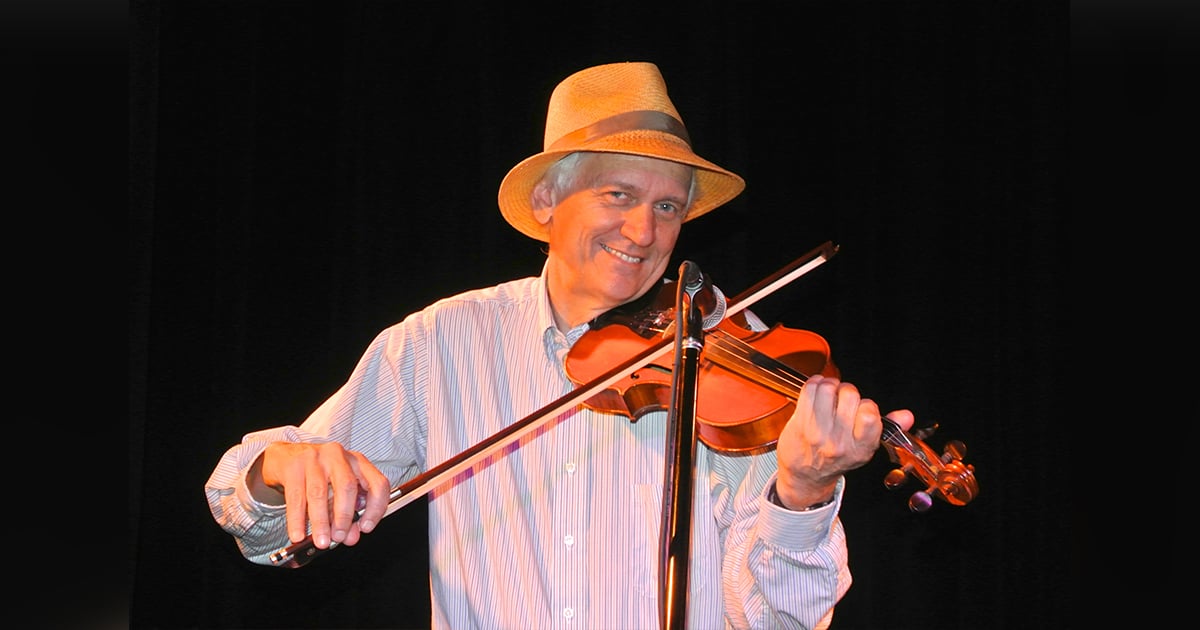
Jack Tuttle is a multi-instrumentalist, author, and teacher based in the San Francisco Bay Area who has the distinction of being one of, if not the first to ever teach a bluegrass jam class. For more than four decades, Jack has taught bluegrass mandolin, guitar, banjo, fiddle, vocal, and jam classes at Gryphon Stringed Instruments in Palo Alto, California. Jack has taught hundreds, if not thousands, of students including Brittany Haas, A.J. Lee, and his children, Michael, Sullivan, and Molly Tuttle. For those too far away to take a lesson, Jack’s self-published bluegrass method books have helped even more people all over the world learn how to play bluegrass.
Jack was raised in rural Illinois by a family of farmers who exposed him to music at a young age. “I started on guitar when I was around 6 years old just learning from the little old lady down the road, but my dad played banjo. I didn’t take the time back then to become a good banjo player, but I would pick his up and mess around with it and he would show me some things, so I ended up having an ear for it before I ever really figured it out.” Even though he had grown up with the sound, it wasn’t until his family went to a bluegrass festival that Jack started to take more of an interest in bluegrass. “It changed everything. Seeing other people play in person really made an impression on me and I thought, ‘Wow, this looks really fun,’” he tells Bluegrass Unlimited.
After that experience, Jack and his family started to make music a bigger part of their lives. “On the drive back from the festival, my sister decided she wanted to get a mandolin and my dad decided we needed an upright bass. So, my sister bought this cheapo Epiphone mandolin, but she never played it. I took to it because I already knew how to use a flatpick on a guitar.” In what would later set the scene for Jack’s band with his kids, they decided to start a family band. “My sister ended up playing bass and the three of us played with two guys from town. One played Dobro™ and jug and the other guy played guitar. We called it the Tuttle Family Band. It wasn’t anything serious—no tours—but we had fun.”
At this point, Jack had gotten the bug and was eager to learn. Fortunately, there was quite the bluegrass scene in the area. “There were a bunch of good bands around the Missouri/Illinois area at the time. Dub Crouch, Don Brown, Norman Ford, and some other interesting bands were playing back then. Really ultra-traditional.”
Jack continued to play music throughout his childhood but came to a crossroads once he became an adult. “When I graduated from the University of Illinois, I had no idea what to do because I got a degree in agricultural economics. I knew if I stayed anywhere near where I grew up, I’d end up working for my dad on the farm. So, I decided to move west. I knew that there was a scene in the Bay Area because of the David Grisman Quintet and I knew that Tony Rice and Mark O’Connor all lived here. I wouldn’t have had the confidence to move here without knowing I could meet people through music, but bluegrass gave me that opportunity.”
Jack moved to Palo Alto in 1979 and quickly became a part of the community. Anyone who spends time playing acoustic music in the Bay Area eventually learns about Gryphon Stringed Instruments. Established in a garage in the late 60s, Gryphon was a luthier shop before becoming a brick-and-mortar instrument retail store and repair shop in 1973. It has since become one of the leading retailers of new and vintage mandolins, guitars, and banjos in America.
“I had heard about Gryphon,” says Jack, “but I couldn’t track the store down until I saw an ad for banjo lessons at the library. My idea was to go there to talk to the banjo teacher and find out more about the local scene. I walked into Gryphon and said, ‘Hey, you guys have a banjo teacher here, right?’ And Frank Ford, one of the owners, was behind the counter and he said, ‘No, our banjo teacher just left. Why, can you teach banjo?’ That was kind of the start of it. At that point, I was a mandolin player who was really interested in fiddle and somebody who sort of played guitar growing up. But, as I said, I knew how the banjo worked from growing up around my father. I grabbed a banjo off the wall and started playing around because I didn’t own one at that point. And Frank said, ‘You know, you’re a better banjo player than the last guy that was here and he had 70 students.’ So, I knew then that I’d be able to make teaching work.
“I started teaching banjo, but they had teachers for the other instruments. They had a guy who was teaching a little bit of mandolin, but he wasn’t really a bluegrass person. So, eventually, I started teaching bluegrass mandolin. And I was working on the fiddle like crazy, but that’s the one instrument that was difficult for me to learn. I didn’t feel prepared to teach fiddle for a long time but eventually, I started teaching that as well. And then, when I started teaching jam classes, I had a shortage of bluegrass guitar players, which is what made me realize I had to teach guitar because it’s crazy to have a shortage of guitar players. They had a couple of guitar teachers at that point but none of them were bluegrass guitar teachers.”
While bluegrass jam classes are now prolific at music camps, festivals, and online, in the early ‘80s it was a new idea. “It wasn’t a thing,” Jack says. “This would have been 1980 or 1981. Pete Wernick had just started teaching classes that would eventually become his jam camps but when we met many years later, he seemed to think that I was the first person he knew of to have that sort of jam class. I was teaching on three different instruments at that point, so it seemed only natural to get them together and show them how to play with each other.”
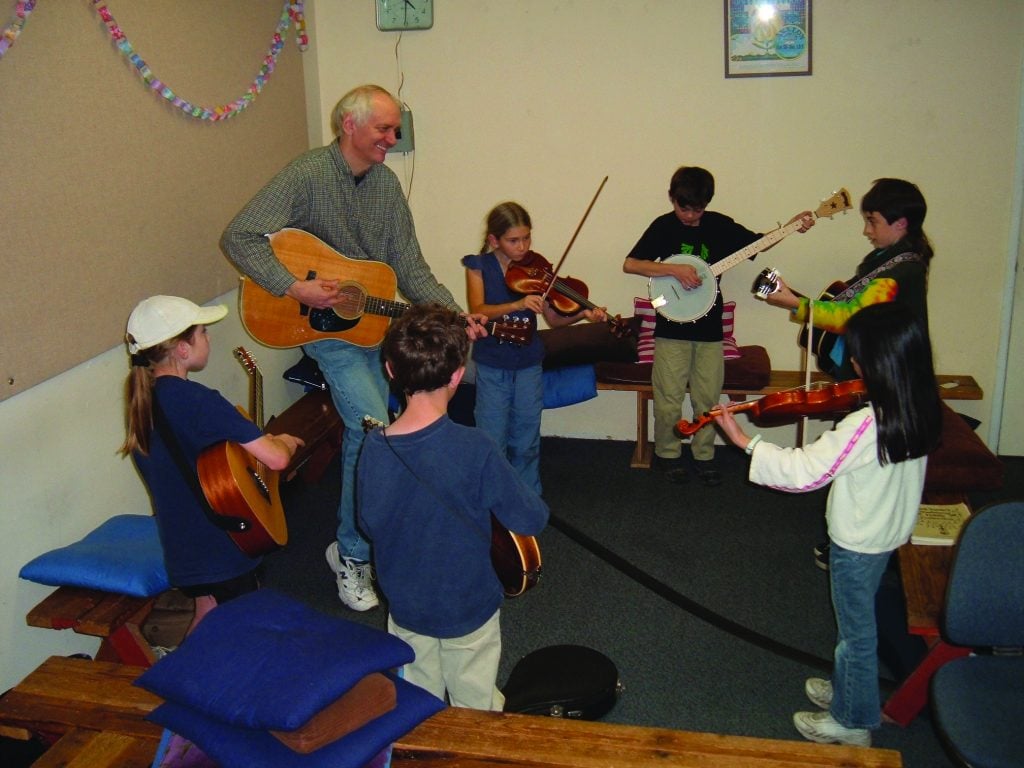
They held the first jam class in a Quaker Friends meeting house that a student had access to and the next at a nearby public park. Now, Jack’s jam classes consistently sell out and a room for the large group classes has been added to Gryphon. These classes are very popular with the adult beginner and amateurs. “Probably 70 percent of my students are adults and these days not all, but most of them work in the tech industry and just play music for fun.”
Jack embodies the Latin phrase docendo discimus which means “by teaching, we learn.” During his career as an instructor, he has become a very talented musician himself. “Because of the way I taught, I was doing a lot of transcribing. I didn’t rely too much on printed works out there so putting together lessons for my best students required me to learn a lot myself. So, I learned quite a bit. When you’re teaching things, you can’t be sloppy because you’re trying to teach your students to not be sloppy. I got in the habit of transcribing tons of stuff for all those instruments. I transcribed hundreds and hundreds of things back then. So, I learned a lot of the vocabulary that way myself.”
Eventually, those transcriptions naturally led to Jack developing “method” books. “The original incentive to put material into book form was to reduce my filing of loose sheet music, which was starting to overwhelm me. I had about a thousand sheets of music for banjo, mandolin, guitar and fiddle at that point. It also gave me a push to refine a logical and graduated sequence of pieces for skill-building. I started out doing small print runs of the books to use with my students. Then I’d find areas where students would struggle a bit too much and I’d re-think the arrangement or the piece. So, I’ve made dozens of revisions of each of the four “Primer” books over the years.”
In addition to refining the material as he went, Jack also made some of those resources available online. “I made audio files that corresponded to the transcriptions available on my website. Just recently I’ve added a pdf option for instant downloading of the books. It’s been a continuous project. Next in line is to add actual video instructions for many of the songs.”
While teaching at the store, Jack and some fellow teachers formed a band together called the Gryphon Quintet which would become a touchstone band in the Bay Area acoustic music scene. “The first year I taught at Gryphon they had a Christmas party and the teachers were there; Carol McComb, Ed Johnson and a guy named Richard Hammond—who was one of the owners of the store—and myself. We ended up jamming together and everybody said, ‘Hey, we should go play somewhere.’ So we did. And we ended up grabbing a bass player that I had been playing with regularly named Bob Kolb, and that was the start of the Gryphon Quintet.”
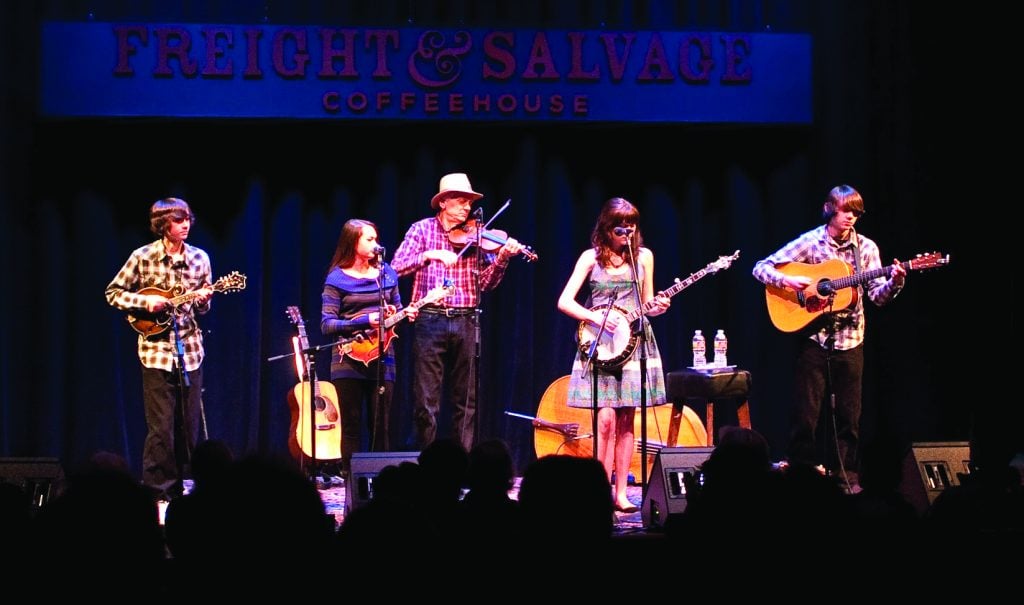
Teaching and performing have made Jack’s name and influence well-known on the West Coast, but he is often known further east for the family band he started with his children called The Tuttles with A.J. Lee. The Tuttle kids became well-known early on as YouTube sensations after videos of them playing, posted for relatives back in Illinois to see, surpassed three million views. “People have this assumption that I had a master plan in teaching my kids, but I didn’t really. I just thought it would be fun to be able to play music with my kids. I certainly did not expect that they were going to become really good musicians. I just thought that since I had fun playing with my sister and my dad that it would be nice if we could play some songs together. But they had it pretty good, education-wise.”
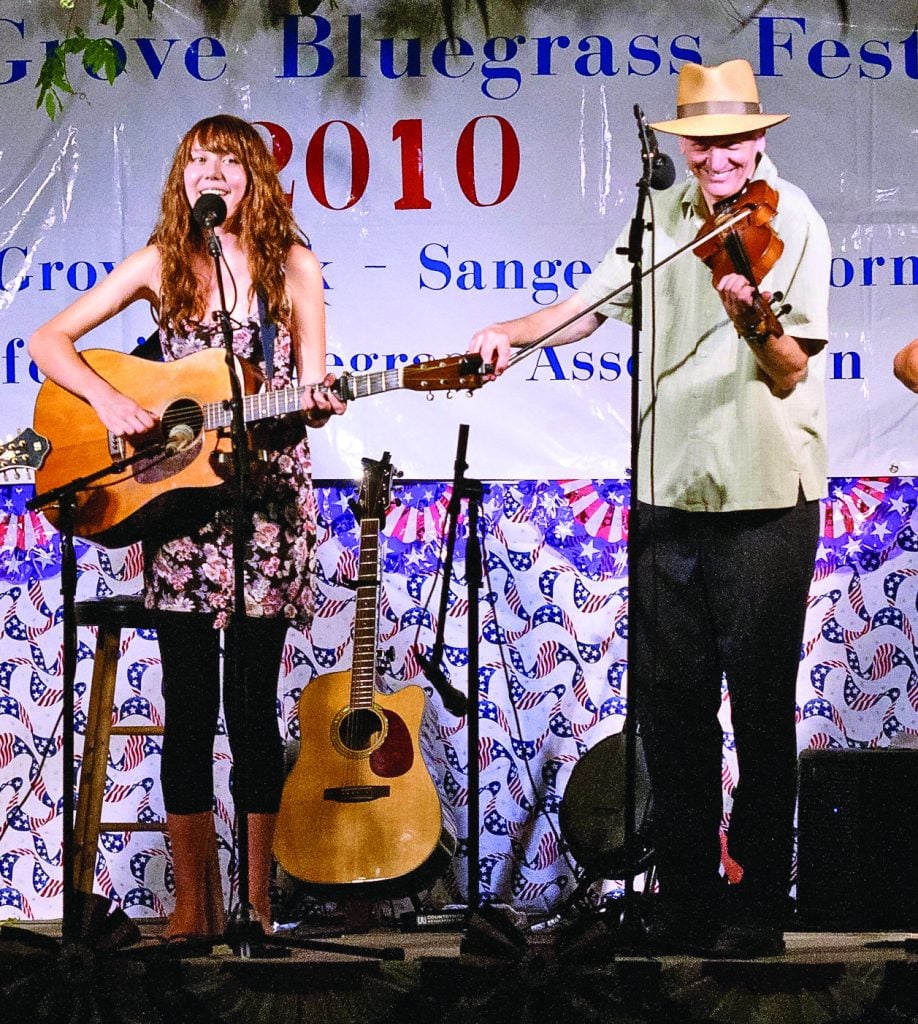
Two of Jack’s three children currently play music full-time. Molly Tuttle (featured on the July 2018 cover of Bluegrass Unlimited), Jack’s oldest, was the first woman to ever be nominated for the International Bluegrass Music Association’s “Guitar Player of the Year” award, which she won in 2017 and again in 2018. Also, in 2018, she won the Americana Music Association’s Instrumentalist of the Year award and Folk Alliance International’s Song of the Year award. In 2019 The Country Music Hall of Fame and Museum featured her in their American Currents exhibit for her work with the First Ladies of Bluegrass. Jack and Molly released a duet CD in 2007 called Old Apple Tree and, in 2012, were finalists for the annual Prairie Home Companion Duet Contest.
Sullivan Tuttle also learned the guitar from Jack. Sullivan continues to play with A.J. Lee in a band that she fronts called A.J. Lee and Blue Summit which won the Freshgrass band competition in 2019. That same year, Jack accompanied Sullivan when he was the runner-up at the National Flatpicking Guitar Championship in Winfield, KS.
Michael, Jack’s youngest, played mandolin in the family band but is currently a Ph.D. student. “The way Michael tells it, he came into Gryphon one time and saw all the mandolins on the wall, plucked one of them, and thought, ‘That’s what I want to do.’ Haha…even though we had multiple mandolins hanging on the wall in our house.”
When it came to teaching the kids, Jack’s history of transcribing became a valuable tool. “I was always interested in swing and had heard how kids over in Europe learned to improvise by learning Django Reinhardt solos note-for-note. Here in America, there’s an attitude that just feeding kids solos is not good for them and they don’t learn how to extrapolate that into improvising. But ever since I heard about that hot club jazz tradition of kids learning Django solos and then the vocabulary becoming natural to them, I always had faith that that would work for my kids in terms of bluegrass vocabulary. And I think it has. When I listen to both Sully and Molly, I still see their moves and see things that I taught them when they were 10 years old.”
Jack still maintains a full teaching schedule but since the rise of COVID-19, his lessons are now all online. More information can be found on his website (jacktuttle.com) where he sells his bluegrass method books and offers a variety of bluegrass resources including hundreds of song charts and practice recordings.