
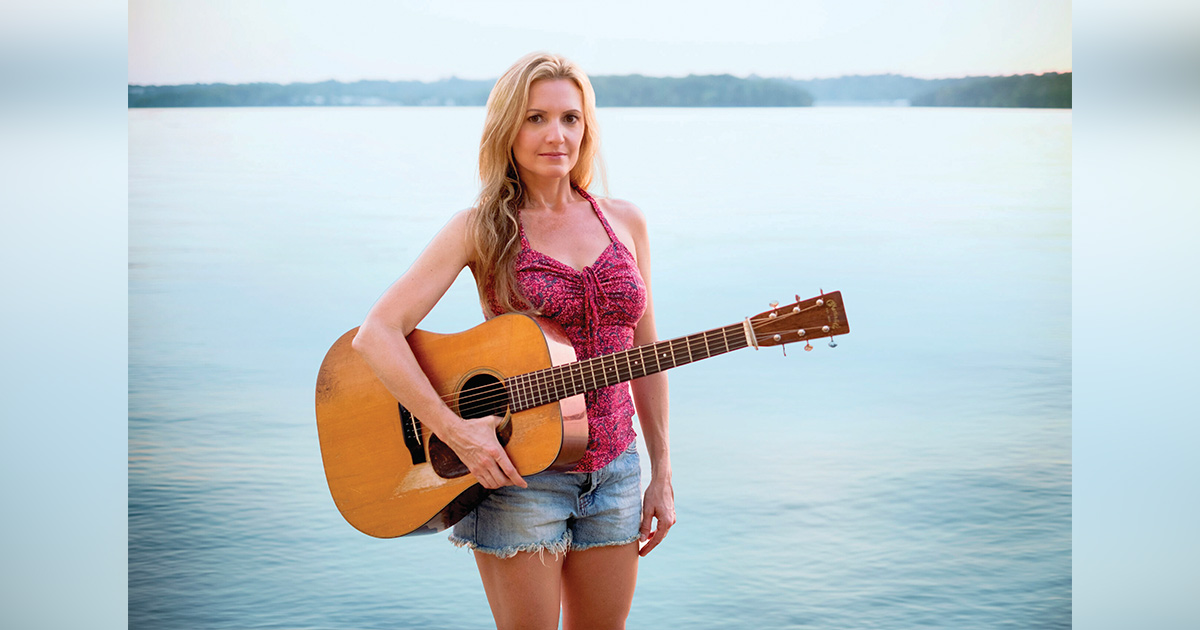
In the Moment with Rebecca Frazier
Photos By Scott Simontacchi
The unintentional decade-long wait between the release of Rebecca Frazier’s last album When We Fall (in 2013) and her latest Boarding Windows in Paradise (in 2024) reflects Rebecca’s continued maturation as an artist in the face of modern life. Boarding Windows in Paradise – currently #4 on the Billboard Bluegrass Albums chart – is the result of thoughtful collaborations in songwriting and production to create a celebration of the paradise that is the here-and-now.
The 2001 release of her first album Born in East Virginia; her 2006 appearance on the cover of Flatpicking Guitar Magazine; the trifecta best-band win of Hit & Run at Telluride, Rockygrass, and SPBGMA; the releases of the Hit & Run albums Beauty Fades and Without Maps or Charts; and her extended tenure with the band Rebecca Frazier have honed her abilities as a performing guitarist, a bandleader, and a productive songwriter. Add into that equation her responsibilities as a single parent raising two teenagers and the stress of the pandemic and the reason for that hiatus in recorded projects becomes evident.
Focus has been a hallmark of Rebecca’s pursuit of a career in music. She recalls her “early days” in the business: “When you devote yourself to anything, you start with a ‘fake it until you make it’ syndrome. For the entire decade of my 20s I definitely had imposter syndrome, even while the band was winning prestigious band contests. Even when Dan Miller asked me to be on the cover of Flatpicking Guitar, I was still hesitant: ‘are you sure, Dan?’”
Nevertheless, Rebecca had to accept that she was a modern pioneer, or at very least the most evident member of a small cadre of young female flatpickers and women in bluegrass.
“That Flatpicking Guitar Magazine cover happened at a very transitional time. Going from single musician to married musician to mom musician and then single mom musician were huge paradigm shifts. I had to figure out who I was, and out of that came a lot of the songs in this album. Not to say that I had not written tunes and some songs before, but the songs I wrote for Boarding Windows in Paradise – like ‘Seasons’ – are more emotional, more vulnerable, more authentic, and they started to be more characteristic of the artist I wanted to become.”
“Even more exposing was the idea of working with other writers in town, to collaborate and to share my experiences and emotions with them. I worried about throwing out ideas to folks I respected and that they might think those ideas as flippant. But I had to dip my toe into the process with people I felt comfortable with and finally realized it was no big deal: everyone feels that way, and overcoming those concerns is just part of the growth process.”
To produce Boarding Windows in Paradise, Rebecca collaborated with Bill Wolf, legendary producer who has worked with the Grateful Dead, David Grisman, Tony Rice, the Rice Brothers, Vassar Clements, and a host of other musical luminaries extending back to the ‘70s.
In Wolf, Rebecca found a kindred spirit in her quest for “the old-fashioned style of making an album – where we hang out together outside the studio and both feel an energy and investment in the project.” She continues: “When I first talked to Bill around Easter 2021, we were in his backyard drinking very strong coffee. ‘Tell me about your project,’ he asked. After I explained what I wanted he got very quiet and looked at the sky for a long time. Finally he said, ‘Well, I can imagine what you’re describing and I know which players I would call for this project. He then suggested the A-list players – such as Béla Fleck, Sam Bush, and Stuart Duncan – who eventually played on the album.

Repeatedly, Rebecca found Wolf to be serious about his commitment to her music. “He’s looking for quality, for authenticity in tone, for the right cut. He will have me play a solo as many times as necessary until he is satisfied with the execution and vibe of the cut.” Wolf was as particular with vocals. “At one point I was singing,” Rebecca relates, “and he stopped me. ‘I don’t believe you,’ he said. ‘I’m not taken away by the story in the song. You need to see the mental movie of the song when you sing. Inhabit the song.’ I took that approach when I sang “It’s Over”; I was mining my feelings. Bill suggested the pizzicato introduction and the fiddle and Dobro section which modulates in a dramatic way.”
“Cantie Reel” – an original tune that sounds traditional – had a bounce Rebecca and Bill loved from the start. Wolf leveraged the bounce, adding Stuart Duncan’s fiddle work; the lyrical call-and-response interchange between mandolin, fiddle, and Dobro; and finally suggested the drone in the introduction to the tune.
“Bill’s focus and commitment to the artist and the music, his amount of preparation, and his professionalism when working with artists is a master class in itself,” Rebecca notes. When asked about the inspiration for her music, Rebecca answers: “If you listen closely to ‘Seasons’ each verse has different chord changes. The song is not just a standard verse-chorus-verse; the song embodies changes. I like to give songs depth.”
“Maybe that complexity has always been there,” she continues. “‘Seasons’ does not seem complex to me when I play it: the changes make sense in the context of the entire song. It’s a progression of emotion that’s mirrored in the music, through seasons of emotions. My grandmother was divorced in 1950 and died in 1990 and she never remarried. She was sort of hung up on my grandfather and never moved forward. I was working on ‘Seasons’ when I was newly divorced, so I was wondering how I would reframe my own story moving forward. That’s the theme of the song: will I move on as the seasons do or will I just stay. The music itself embodies the nature and lyrics of the song, and it represents how I question and move on. Seasons change. Divorce is a pretty wrenching process to go through, when you have to figure out what next to do. I remember the day I wrote it: the lyrics flowed out of me and when I sat down with the guitar the chord changes came out as well.”
“In the same way, ‘Cantie Reel’ just popped into my head when I was running out the door to pick up my daughter. I sang the tune into my phone, and then later put it on guitar. The same thing happened with the guitar reel in the middle of ‘Borderline’: it just came to me.” Rebecca continued, “For me, as an artist, the goal is to become – to be – someone who is constantly tapping into the creative mode. The diversity of being a songwriter and a singer and a bandleader/band member and a session player is very rewarding, musically. For example, Becky Buller asking me to play guitar in her band at Elkins College this summer was a treat because it required me to quickly figure out how to meld into that group. That’s a great practical exercise.”
Another role that Rebecca takes very seriously is her responsibility as a teacher. “During Covid – like almost every other musician in town – I was playing a lot. And I also had time – when the kids let me – to read a lot of Deepak Chopra. I was thinking a lot about being in the moment, appreciating it. Maybe that set my mind in different way, but I was able to connect with my guitar in an entirely new way. I had been running through all my standard drills and practice scales and had an ‘AHA!’ moment. I could feel the guitar more and was able to improvise more easily. I recorded myself a lot playing and teaching, and a lot of the feedback was ‘you make it look so easy.’ For a guitarist that’s a huge compliment. I felt more authentic as a guitarist, but that new awareness also brought a clearer understanding of how long the musical road ahead of me was. And that clarity has affected how I teach as well. At Elkins this summer I worked on a lot of those drills and scales with my students. I also worked on ear training, to help them more quickly recognize chord changes and appreciate the movement. You have to start somewhere.”

When asked if her fans will need to wait another decade for her next album, Rebecca laughed. “I don’t think so. ‘Reframing’ is one of the themes of the album, in addition to nature and the power of storms and the disruption of hurricanes. Despite the disruption, people keep living in paradise and every year continue to board up their windows. ‘Boarding windows in paradise’ is one of my favorite lines I’ve written, because it’s a paradox: how can paradise – supposedly perfect – have all this turmoil? So this place, this time, is paradise, and we just deal with it and endure. Another theme on the album is being in the moment with what you care about – family, friends, music. ‘High Country Road Trip’ describes a choice: driving to Santa Fe or to Gunnison, or simply not think about it and enjoy the drive and where it might go. Both ‘Train is Moving’ and ‘Make Hay While the Moon Shines’ are about appreciating the moment, the here-and-now.” Rebecca laughs, “I’m working on taking my own advice.”
“And,” Rebecca adds, “about that next project: When I spoke with Bill a few weeks ago, I mentioned that I was working on several ideas. ‘Great,’ he said. ‘Why don’t you bring charts for those when you are next up this way and we can talk about it over coffee.’”
For further information about that next project or to catch up on her concert schedule, go to rebeccafrazier.com.
If you are not a blonde lady, can you still be in a bluegrass band?