
Hatfield Banjos
Hatfield Delivers the Real McCoy
It’s an age-old conundrum for anyone trying to learn a new instrument. You first buy a cheap banjo, guitar or mandolin to see if you even enjoy playing it. The further you progress, and the more time you put in, the more your instrument’s shortcomings become apparent. Pretty soon you’re ready to make the leap to buying a professional-quality instrument. But, if you’re not looking to make a living playing music, how do you do that without emptying your savings account?
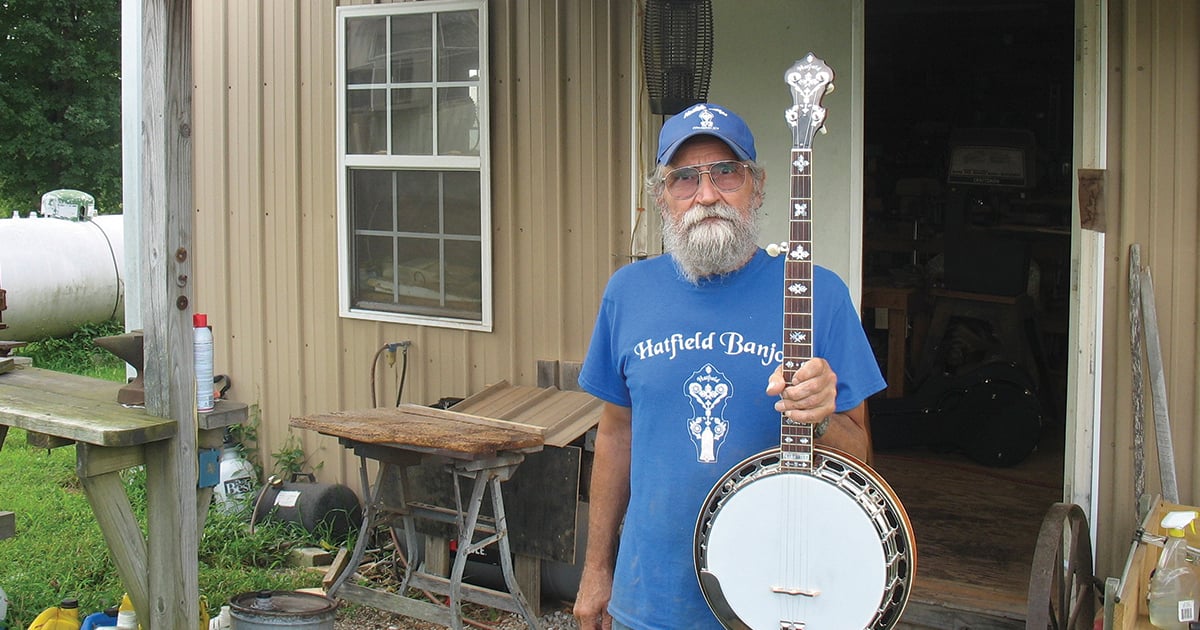
For more than twenty years, Arthur Hatfield’s mission has been to provide an answer to that question for banjo players. Working out of his shop near Glasgow, Kentucky, Hatfield has managed to steadily produce a line of instruments living up to his tagline: “The most reasonably priced quality banjo on the market.”
Hatfield said he holds his production costs down by keeping his operation small. He builds all his instruments himself and sells directly to customers rather than going through dealers. “With me being a one-person operation and having my shop at home and not paying any workman’s comp, I could be cheaper with a professional quality banjo,” he said. “I have less overhead.”
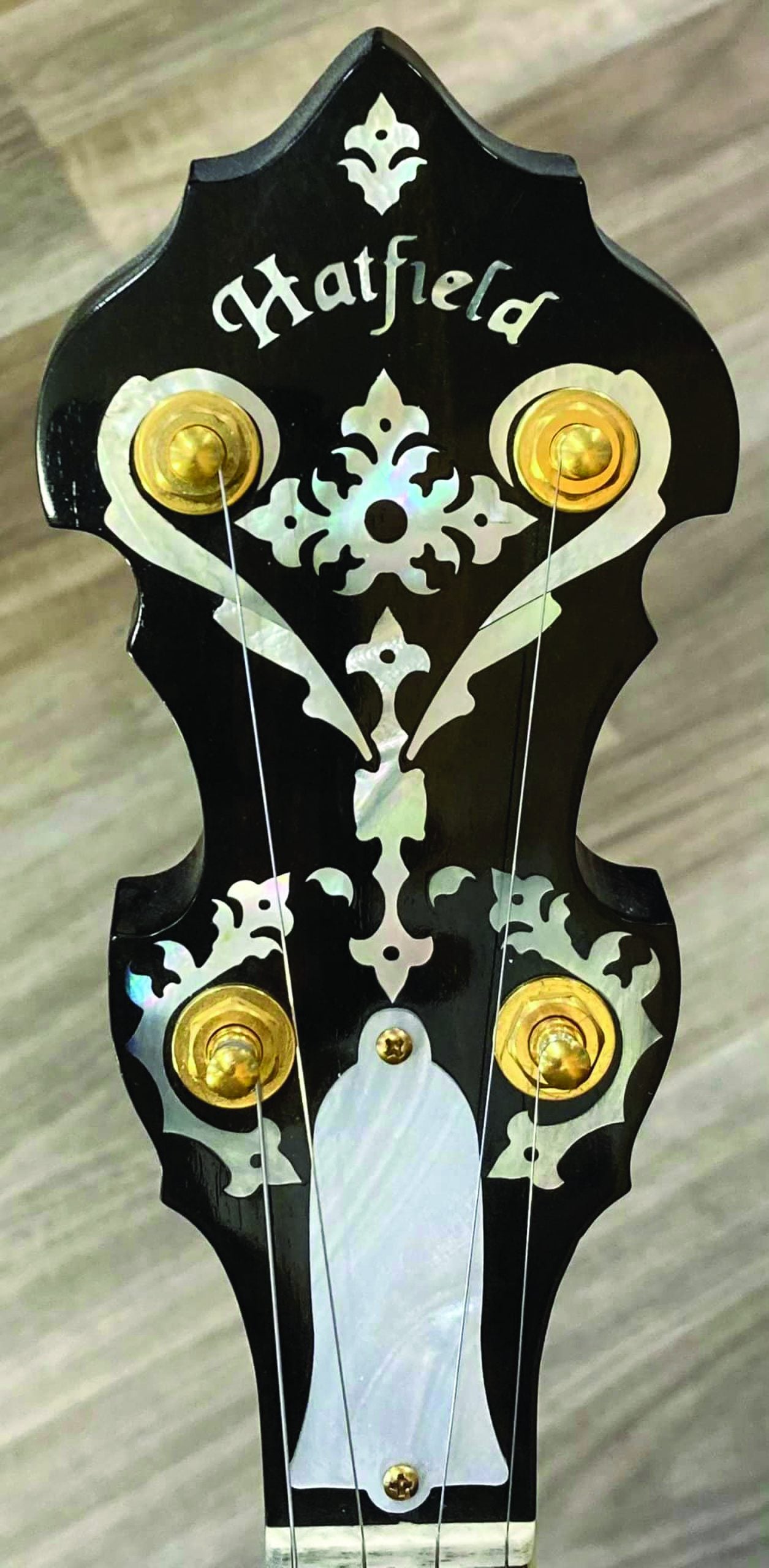
Hatfield, himself an accomplished player, makes his own necks out of carefully chosen pieces of mahogany, maple and walnut. He then pairs them with other manufacturers’ rims (most often from Cox Banjos) and resonators (usually from Gill Manufacturing or Cox). The metal parts also come from elsewhere. His tone rings are usually poured in Nashville and then taken to Huber Banjos for plating. His neck and headstock inlays are done at an engraving shop nearby in Kentucky.
For sales, Hatfield mainly relies on word-of-mouth. When he founded his company, in 2001, he made it a point to bring his banjos to festivals and put them on display in a booth for players to come by and try. It was a grueling way to start a business. “I wasn’t doing much good,” Hatfield said. “The traveling might cost me a whole lot of money and, at first, I didn’t hardly ever sell a banjo. But I know all that contributed to people ordering from me later.”
His break came when Dale Perry, then the banjo player for Doyle Lawson and Quicksilver, decided to start playing a Hatfield. Soon enough word was circulating that a new, high-quality builder had entered the market. “I’ve never needed for work since,” Hatfield said. “I know have several pros who play them.”
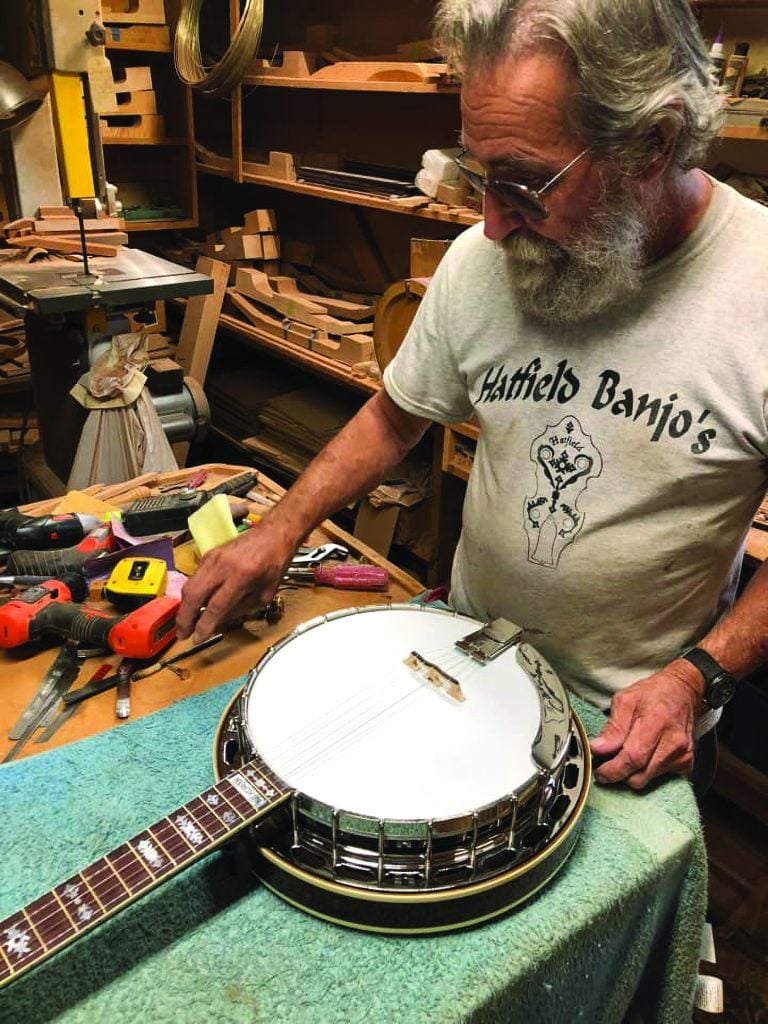
Rather than distributing his banjos to dealers, Hatfield usually builds them to order. The advantage to that system is avoiding dealers’ mark-ups, which can amount to between 30% and 40% of an instrument’s sale price. The disadvantage is that it means most players end up buying his banjos without being able to try them out first.
Players who do want to hear a Hatfield in person before making a purchase can often only do so “if they know somebody that’s got one, that lives close to them or something,” Hatfield said. “But lots of customers end up ordering one sight unseen.” The system seems not to have inhibited demand. Hatfield is now working on orders for 13 of his banjos.
Another alternative for players who insist on giving a banjo a listen before buying is to simply venture out to Hatfield’s shop. That’s what Gena Britt, banjo player in the all-women group Sister Sadie, did a few years ago when she became an endorser of Hatfield’s products.
Like so many banjo players, Britt had an instrument she loved—a Gibson RB250—that was starting to seem too heavy for long gigs. One day she heard Dale Perry on of Hatfield’s banjos, The Woody model, and found herself attracted not only to its tone but also its light weight. The Woody takes its name from the fact that its tone is made of wood, rather than the standard metals. Along with giving the instrument a distinctive sound, the modification helps keep the weight down.
While on a trip to Owensboro, Kentucky, to play at the annual ROMP Fest as a substitute banjo player in Balsam Range, Britt decided to stop by Glasgow to visit Hatfield in his shop. Britt soon became the owner of her own Woody model banjo.
Britt said she’ll never give up her Gibson. But she now tends to favor using The Woody for longer gigs, when a heavier instrument would wear on her shoulder. The first time she played her Hatfield on stage—at ROMP with Balsam Range—she won immediate praise from the sound man. “The tone is so even,” Britt said. “I’ve heard anything but praise from everyone that’s played it. Without the metal tone ring, it’s not as loud as some banjos. And it does have a mellow tone, which I love. Of course, everybody has their own preferences.”
The Woody was far from being Hatfield’s starting point. First came the Buck Creek, which remains one of his most popular banjos. Its straightforward design features a mahogany neck and resonator while holding inlays and other decorations to a minimum to keep down costs. Built along similar lines, but with a tad more embellishment, are the Special, made of walnut, and the Celebrity, made of maple. According to Hatfield’s website (hatfieldbanjos.com) they range in price from $2,900 to $3,700. Hatfield said he’s confident players will have a hard time finding a way to spend less on any other new, American-made banjo of such high quality.
Over the years, Hatfield has augmented his product line with an arch top, The Rocky Hill, and a model with a specially designed tone ring, the Stonycreek—as well as the aforementioned Woody. His most distinctive banjo is The Feud, a reference to his ancestors’ storied conflict with the rival McCoy clan. Its resonator features a painting of two of the primary combatants in the feuding families—”Devil Anse” Hatfield and Randell McCoy—along with a depiction of the Tug River.
Ben Greene, the banjo player in Lorraine Jordan and Carolina Road, said he first encountered Hatfield and his instruments at a festival seven or eight years ago. He has since used the banjo Hatfield built for him, a gold-plated Celebrity, for both recordings and stage performances. “It’s got beautiful wood,” said Greene, who endorses Hatfield banjos. “The neck’s made of curly maple and the resonator of quilted maple. It’ got a warmer sound —not a harsh sound—but a good sweet tone.”
Greene particularly credits Hatfield for working to accommodate his preferences rather than churning out a one-size-fits-all instrument. Greene said his only complaint about the Celebrity was that, when it first came into his hands, its neck was too wide. Hatfield came to the motel room where Greene was then staying and cut the neck down on the spot.
“He’s such a good guy – Arthur,” Greene said. Greene likens the sound of his Celebrity is closest to that of the classic Mastertones used by so many banjo builders as models over the years. Hatfield himself, though, said he never set out to reproduce some hallowed instrument of yore. Instead, he’s relied mostly on his own ears—and advice from other players—to design a banjo he’s proud to put his name on. “I used to have people call me up and say, ‘Would you build me a better banjo if I paid more for it?’” he said. “But the truth is: I couldn’t have built a better banjo because I build all of them as good as I know how. All I could to do was add decorations if I wanted to charge a lot more.”
Hatfield came to banjo building somewhat late in life. For most of his working years, he was a cabinet maker and trim carpenter. By the time he reached his 50s, though, he was beginning to find the physical demands of his craft too burdensome. He had already been using his shop to make instruments—including some mandolins. Hatfield said the late 90s and early 2000s were a time when many of the Gibson banjos on the market varied greatly in quality. Various independent builders had stepped up to meet the market demand for professional-grade instruments. But a lot of their banjos were priced beyond the reach of players who weren’t necessarily trying to make a living in music.
Hatfield said he saw his opening and has had no reason to second-guess his decision. If the market for independently built, professional-quality banjos is in anyway oversaturated, Hatfield said, he’d probably be the last to know it. He has never wanted for business ever since word started circulating in bluegrass circles about his products and one-man operation. His banjos are in such demand that it’s rare to find a used one for sale online or in a shop.
If someone wants one, it usually involves paying a deposit and then waiting for Hatfield to build it. For most stock models, the wait is from three to four months—although it can be as little as two months when Hatfield isn’t particularly busy. Custom builds can take as long as six months.
Jereme Brown, banjo player in the Po’ Ramblin’ Boys—another endorser of Hatfield’s instruments—estimated he has sold three Hatfield banjos in the past fifteen months. He said he’s now waiting for another Rocky Hill archtop model. “The woods and the metal parts and everything is pro quality,” Brown said. “It’s all built to the standards of the classic Gibson stuff.”
Hatfield said his biggest struggle comes from the need to hold down his prices. Like nearly everything else, banjo components have become only more expensive in recent years. He has responded to the increases by raising his prices by as much he thinks the market will bear. At the beginning of 2021, for instance, he began charging $200 more for all his models save The Feud. Of course, he can only go so high while still staying true to his founding principles.
“Metal parts have gone up in price a whole lot and so has wood, especially if you are used to getting wood of the first quality,” Hatfield said. He added that the Louisville lumber yard he used to rely on recently closed, forcing him to search farther afield for instrument-grade wood. The increasing costs have inevitably begun to eat into his profits. “So I am making less per banjo,” he said. “Fortunately, I’ve gotten faster at building them over the years. I’ve got a little more machinery too.”
Now in his 70s, Hatfield sees little reason to plan for retirement. For one, the orders keep coming in. And then there’s the sense that he and his banjos are meeting a real need. “I always give people who are starting on the banjo this advice: Maybe start with something real cheap. If it’s playable, you’ll at least be able to see how you’re going to do with it,” Hatfield said. “And then when you’re read to make the next step to a professional quality banjo, maybe come see me.”
Your banjos look great. Do you make open backs? What sort of tone ring do you use? I live in Harrodsburg. Not far from you. Thanks.