
Hammons Family Banjo & Fiddle Contest and World Class Jam Returns to Rural West Virginia
Photos by Will Price
When it comes to the rich history of American roots music that collectively pre-dated and led to the creation of bluegrass in 1945, local culture and geography were key to different styles arising. That phenomenon often happens with music that organically evolves, no matter the genre. In the 1700s and 1800s, Black musicians led the way when it came to a lot of the traveling string bands, with the banjo originating in Africa and the fiddle coming from the violin tradition in Europe. In the Appalachians, the European immigrants took the same instruments and created their version of what would later be called roots music. Yet, all of that music became diverse amongst various communities because different styles came from different life experiences and geography.
Here is a perfect example, which comes from my interview with the great Cajun musician Michael Doucet from Louisiana that I did 20 years ago. Doucet is widely known for his band BeauSoleil. The word ‘Cajun’ covers a lot of ground, referring to the French folks who were living in what is now Canada, yet were kicked out in the 1700s by the British, who then migrated to western Louisiana. Cajun music has a strong fiddle tradition, just like old-time music and bluegrass, and yet, as Doucet tells it, different styles arose just miles apart.
“I played in the Savoy-Doucet band with Marc Savoy, who is from a different part of Louisiana,” said Doucet. “Marc is from a different parish. It may be only 40 miles north of here, but it’s a whole different place musically. Back in the day, you played with people in your town and in your community, and there was no sharing of the music. Everybody was living in a closed community and a closed music scene, and that is how the music developed incredibly. You had people who were probably in Nova Scotia together earlier, who were then deported together, and whose family came here to Louisiana together, and so they settled here together. They still had that tie, and that common language. But even the Acadian language, our French language, it changes from parish to parish. Everyone has got their own versions of tunes, in other words, and that’s what is crazy, because the artistry of the individual shines through that way. That’s what makes the culture. That is what makes traditional music.”
The same is true when you use bluegrass music as your North Star. Bill Monroe came up in a particular part of Kentucky where he learned under the tutelage of a Black guitarist named Arnold Schultz and his fiddle-playing Uncle Pen. But what are the roots of Schultz and Uncle Pen’s musical tradition, following it back to many years before Monroe was born? It is fascinating to think about.
Just like North Carolina, Kentucky, Tennessee, Virginia, and other hotbeds of Appalachian roots music, West Virginia also had its own fiddle styles, in the plural, that evolved through the centuries. One group of Kentuckians that migrated to West Virginia in the 19th century and brought their music with them was the Hammons Family.
The Hammons Family lived in Kentucky until the 1850s, when they noticed the events around them that were leading to great conflict, which would become the Civil War. And so, that is when they tried to find a new place to live far away from the civilized world that was about to get bloody, and that is when members of the Hammons Family ended up in what would become the state of West Virginia on June 20, 1863.
Along the way, as the 20th century began, the Hammons Family became famous for their unique way of playing Appalachian roots music. Back in 1947, a musicologist named Louis Chappell recorded the music of family patriarch Edden Hammons and released the sides under the name The Edden Hammons Collection – Volume One. Edden lived in nearby Webster County, West Virginia, and won many fiddle contests in the Mountain State before his death in 1955.
A few decades later, musicologists like Alan Jabbour, Carl Fleischhauer, and others sought the Hammons Family out and tried to learn their unique ways of playing tunes. The end result was the recording titled The Hammons Family: The Traditions of a West Virginia Family and Their Friends.
The Hammons Family as a whole were inducted into the West Virginia Music Hall of Fame in 2020. Sherman Hammons, Burl Hammons, and Maggie Hammons lived along the Williams River in Pocahontas County. All of them were musicians in the old style, and they even spoke with a kind of brogue accent that had the British Isles as its source.
In the 1970s, Sherman, Burl, Maggie, and others of the Hammons Family met the Bing Brothers, who were a trio of burgeoning musicians from Barboursville, West Virginia, which is near Huntington. The Bing Family would vacation in Pocahontas County, and when they went fishing, they happened to meet Sherman Hammons, who would sell bait worms in front of his house.
After becoming friends with siblings Mike Bing, Dave Bing, and Tim Bing, the Hammons Family shared their music with the trio throughout the 1970s and 1980s, teaching them everything they could offer. When the Bing Brothers became famous as one of the top Appalachian roots music bands on the planet, they continued to tell the story of the Hammons Family, and they played their tunes long after many of them passed away. Even now, as they perform as The Bing Brothers with Jake Krack, with Krack being one of the best award-winning fiddlers to ever strike a bow, the legacy of the Hammons Family continues to be shared at their concerts.
Now, the folks in Pocahontas County have taken a step further and have created the Hammons Family Banjo and Fiddle Contest and World Class Jam. Combining categories in both bluegrass style and the old-time style, the banjo and fiddle contests have been successful from the event’s start just four years ago.
This year, however, the Hammons Family Banjo and Fiddle Contest and World Class Jam has been moved to September 27, 2025. This puts the event on the same weekend as Pocahontas County’s Autumn Harvest Festival & Roadkill Cook-off, truly making it a well-rounded and fun destination.
What is wonderful about the event is not only the music, but the location. Pocahontas County can best be described as a natural wonder, being the source of eight different rivers, and being a rural area that has no university in it. That makes its main town of Marlinton a true oasis, as it exists along the banks of the beautiful and famous Greenbrier River. Pocahontas County is where the decades-old Allegheny Echoes roots music instructional week takes place, which is a great tradition when it comes to hands-on teaching of playing bluegrass and old-time music.
The biggest attractions in the county include the Snowshoe Ski Resort, found higher up on the mountain, and the famous Green Bank Observatory, with its popular Science Center and giant radio telescopes that explore the universe around us.
As for the Autumn Harvest Festival & Roadkill Cook-off and the Hammons Family Banjo and Fiddle Contest and World Class Jam, they all happen simultaneously on the blocked off streets of Marlinton. The same will be true of the big town square dance that will happen during the weekend as well.
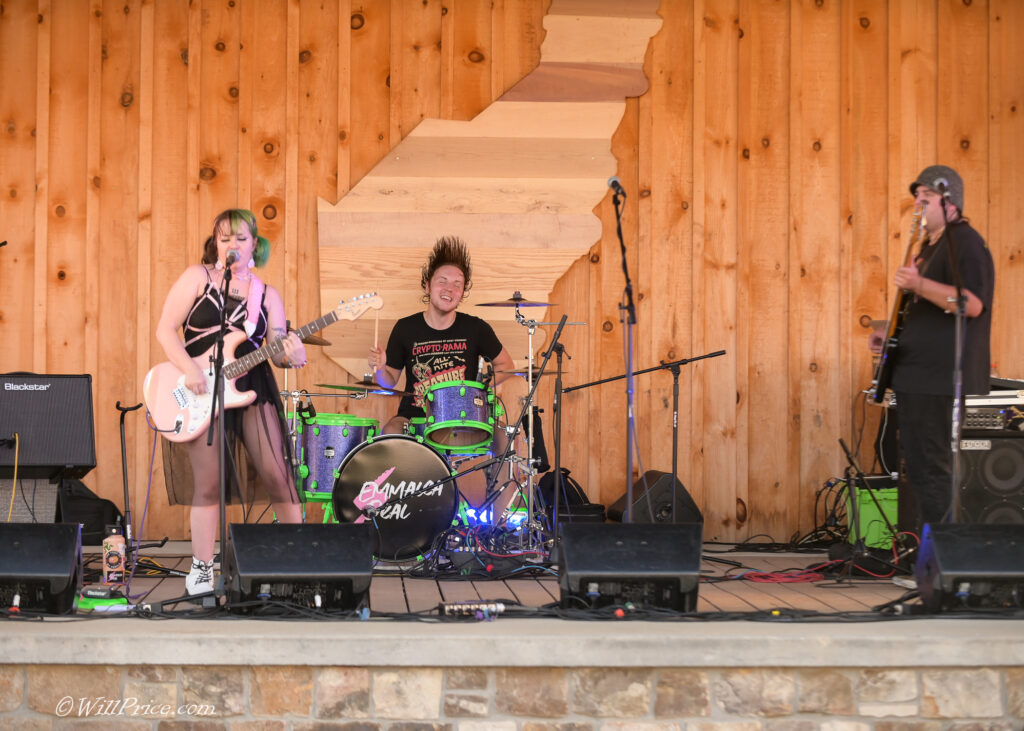
For the music side of the weekend, Marlinton has an impressively large outdoor stage right in the middle of town where the banjo and fiddle contest will take place, along with the bands that have been brought in to entertain all who come. And, the event is rain or shine, and is in the middle of the town, at the historic Pocahontas County Opera House, which opened in 1907.
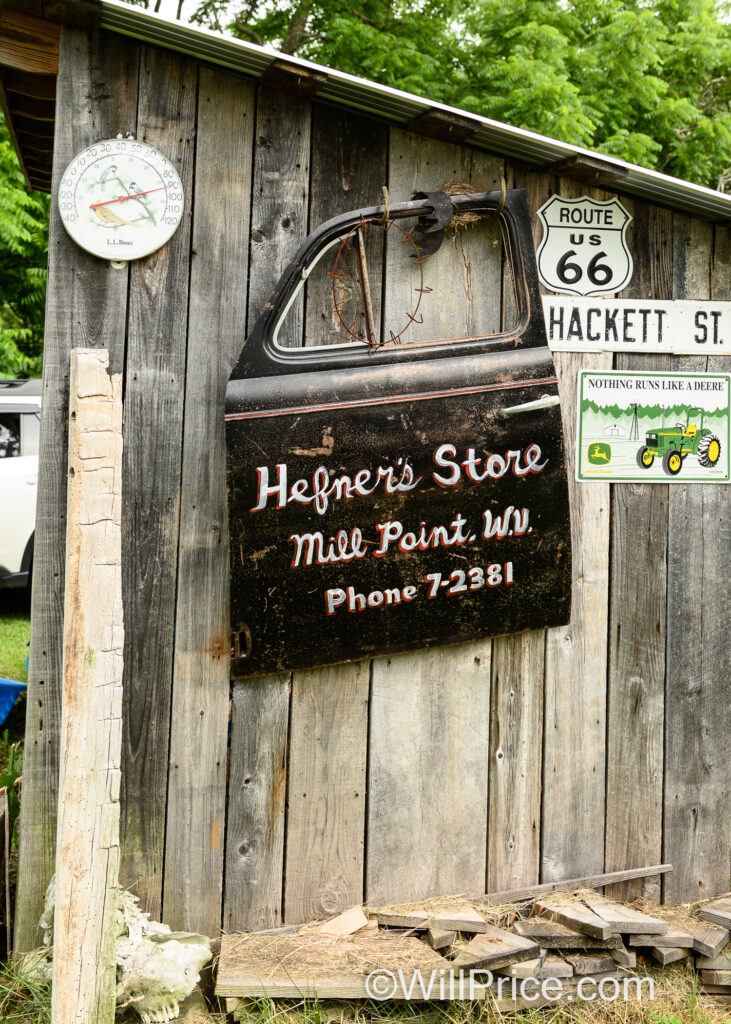
The groups scheduled to perform at the free concert hosted by the festival will include The Kody Norris Show, the aforementioned Bing Brothers with the award-winning fiddler Jake Krack, The State Birds, featuring Grand Champion Fiddler Tessa McCoy and Old Crow Medicine Show multi-instrumentalist Chance McCoy, the Black Mountain Bluegrass Boys featuring the legendary Richard Hefner, whose classic bluegrass song “Million Lonely Days” was just resurrected and released as a new single by Kenny and Amanda Smith, and a Hammons Family Tribute featuring Trevor Hammons, who represents the current generation of Hammons Family musicians.
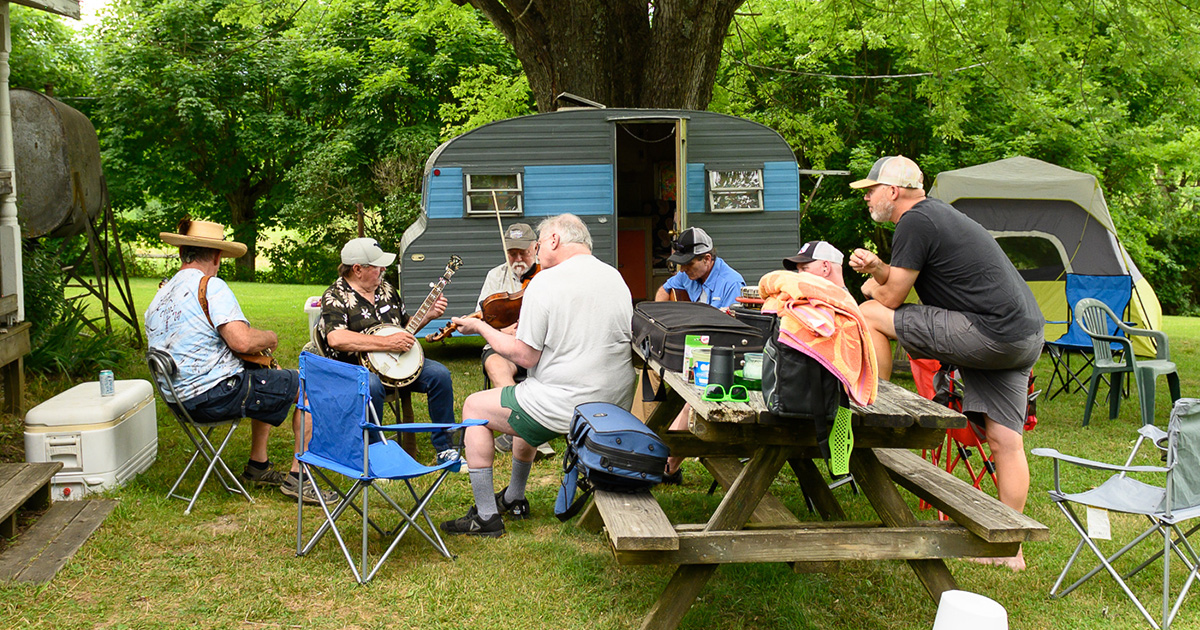
As for the World Class Jam, many designated areas of downtown Marlinton will feature places where musicians of all levels can jam in a welcoming, non-judgmental environment while playing with top musicians who host each circle and lead the musical fun.
Bobby Taylor is an American roots music legend based in West Virginia who has created and hosted many instrument contests over the years, and he is a renowned fiddler as well. For many years, Taylor was the Library Manager at the West Virginia Division of Culture and History, and he helped to create the contests at the annual Vandalia Gathering held at the West Virginia State Capitol every spring, as well as at the Appalachian String Band Festival known around the world simply as ‘Clifftop.’ Smartly, the organizers of the Hammons Family Banjo and Fiddle Contest and World Class Jam brought Taylor in to coordinate the contests.
“Pocahontas County is very rural, and the feeling there is peaceful, and the music is peaceful, because it’s like a gentle breeze on a summer day,” said Taylor. “And, the banjo contest and the fiddle contest are just as good as it gets. You have unbelievable talent that shows up with musicians who have a wonderful feeling and soul about them. Those contests, when we started four years ago, it was like they were meant to be, because from the beginning, fiddlers come in from many different places, and the competitions have showcased a lot of talent. You get glimpses of the past with some of the performers, and you also get the artistry and modern versions of songs and tunes that have risen up in current times. The fiddlers have proven to be a wonderful melting pot of the many old styles of playing mixed with their own contemporary styles.
“The contests are hard to judge, and yet we have the very best people judging them,” continues Taylor. “I have been involved with music festivals and musician contests for over 30 years now, and I can say that the Hammons Family Director and co-creator, Joanna Burt-Kinderman, has done everything right with this event. In my opinion, it is one of the best shows on Earth when it comes to traditional music. The festival also features local bluegrass veteran Richard Hefner and his Black Mountain Bluegrass Boys band, and I think Richard is a national treasure (Richard Hefner was featured in the May 2025 issue of BU).”
As for the aforementioned Director of the Hammons Family Festival, Joanna Burt-Kinderman views the creation of this event as a labor of love and a great way to highlight one of the most beautiful counties in all of the U.S.
“What I have learned from running this festival is that if you want to know how to create a great contest, you ask Bobby Taylor, and if you want to know how to put on an awesome open jam, you ask the Bing Brothers or Richard Hefner,” said Burt-Kinderman. “I have been really lucky to have spent time with the right people like those guys, and then to ask and just listen. Here in Pocahontas County, we had big fiddle contests in July back in the 1960s and 1970s at our Pioneer Days Festival, and the competitions were run by a great fiddler named Woody Simmons, and now we are reviving that historical tradition. That happened around the same time that Alan Jabbour and Carl Fleischhauer were here recording the Hammons family out in the county along the Williams River.”
More than anything, Burt-Kinderman feels like this great music and participation in the music by all the visitors who come is best experienced in Pocahontas County in the fall of the year, when the temperatures are cooler and the music is hot.
“This place is magical,” said Burt-Kinderman. “A big part of it is that the musical traditions here are so strong. The Hammons Family, Dwight Diller, and others passed those tunes on to each other and other people, ear to ear and generation to generation, with little in the way of big city life getting in the way of it. And, this festival has meant a lot of hard work, but I feel like it is my contribution back to what music has given to me.”
More information can be found at hammonsfiddlebanjo.com.