Greg Davis
Many skilled musicians just skirt the forefront of the listening public’s immediate recognition. But these are the musicians other artists call for session work, ask to stand-in when a band member is unavailable, or to select as part of a special show or short tour. These are the artists who analyze other musicians’ styles, record those styles in tablature, and preserve them for study by subsequent generations. They instruct at music camps, conduct festival workshops, hold panel discussions about the music, and patiently teach and promote their chosen instruments. Fulfilling all these roles and more, Greg Davis has been a dedicated student of the banjo since he was ten.
For the last 14 years, Greg has held the banjo position in Donna Ulisse’s Poor Mountain Boys. Originally from Irving, TX, Greg now resides near Nashville and splits his time between playing banjo and restoring historical buildings. Greg’s fascination with the banjo was initially kindled by the theme to the movie Bonnie & Clyde (Flatt & Scruggs’ “Foggy Mountain Banjo”) and then reinforced with Saturday evening doses of Roy Clark and other banjo players on Hee Haw.
“We lived in Irving, Texas. When I was ten my parents bought me a $100 Bentley banjo with strings about a half-inch off the fingerboard. For a year I took lessons from Dick Applegate at a local music store. Dick was a great teacher, combining practical musical experience with the ability to teach. After the first year of lessons, I was still enthusiastic, so for the next two years my parents had Dick come out to the house. When I stopped taking lessons with Dick, I began listening to LPs at half-speed, trying to figure out the correct key and tabbing out the result. “
“Listening to other players was critical. For me, hearing the music performed live was a major incentive for musical growth. When I was ten, my father played washtub bass with an early version of Tom Uhr and the Shady Grove Ramblers. My brother and I went with him to practices and we would sit listening in the corner. The sound of the music was unforgettable. Once back at home I was driven to figure out some of the banjo licks I had seen. Uhr’s music inspired and encouraged a lot of growing musicians in the area: Randy Stewart [Jon Randall Stewart], Scott and Curtis Vestal, Brad and me, and many more.”
While still in high school, Davis began accepting his own banjo students and started an intensive study of the styles of the banjo luminaries of the time. “I modeled my teaching style on Dick Applegate’s lessons. While still in high school I wrote my banjo books, some of which may still be in print. Creating tab by listening and re-listening to a phrase and tabbing note by note was tedious. But it was a rewarding study, especially 40 years later when I go to a festival and someone says ‘Hey – I bought that JD Crowe Volume 1 you did!’”
After graduating from high school, Greg and his brother Brad opened Davis Picking Parts and Parlor Acoustic Music Store, in Grapevine, Texas. Greg and Brad sold instruments, gave lessons, and provided a place where local folks could gather to play. “Every Saturday people would line up in the parking lot, wait until we opened at 10am, and then come in, set up, and pick all day. We’d break for lunch and everyone would walk across the street for BBQ and come back and play until we closed. It was a lot of fun. It was especially great when one of the younger players would toss something off, and then I would either record it or grab some paper and quickly tab it out.”
Over the next few years, Greg’s studies of the work of other banjo players helped him codify his personal banjo style. “Studying banjo styles helped me identify Bela Fleck and JD Crowe as my two favorite players. I love traditional banjo, but I know I just don’t have that right hand—‘the claw’—of JD Crowe, as much as I’ve studied it. When I get hired to perform it’s more for a progressive style, more along the Bela Fleck lines.
“Alan Munde was another of my big banjo heroes. Although I don’t play like him, when I was young I soaked up everything Alan had recorded to learn his style. When Alan was in Country Gazette, he learned fiddle licks from Byron Berline and applied them to the banjo. As far as I’m concerned, no one can play fiddle tunes like Alan. Realizing that banjo licks could come from other instruments was revolutionary.
“As part of my banjo studies I did tab music by Ralph Stanley and Don Reno. Reno’s single-string work is core to a lot of progressive bluegrass. I don’t recall many, if any, bands from the Tennessee/North Carolina/Virginia area performing in Texas. Of course, Earl was everywhere. But I was personally drawn more to the bluesy sound of JD Crowe. Maybe if I had heard some of those bands perform, things might have been different. For me, listening to tunes on records was never the same as hearing those tunes performed live.”
In 1987 Greg relocated to Nashville, where he found work as both a session musician and as an occasional band member with Marty Stuart, Sam Bush, Jon Randall, Dale Ann Bradley, Emmy Lou Harris, among many others. He’s been with Donna Ulisse since 2008. “I played with Sam Bush over a span of three years,” Greg recalls. “I didn’t record anything with him, but we played a lot of shows or ‘selected dates,’ if you will. I did a lot of those and got to record with a whole bunch of other folks, including with my brother [Brad] on his recordings for Flatpicking Guitar (FGM Records).We had a great time.”
Questioned about learning and practice techniques, Greg returns to familiar ground: finding a way to systematically study the styles of other musicians (which, for Greg, is developing tab), the importance of using a metronome to build timing, and developing an awareness of the obligations of performance to both bandmates and the audience. “I’ve been tabbing stuff for a quite a while now, so I can’t see how you can learn without it. It requires the writer to accurately hear the music. You also need to know the fingerboard and determine whether that A note is on the 7th fret of the first string or the 10th fret of the second string, based either on the easiest or most logical roll pattern. It’s not for the faint of heart.
“My early teacher Dick Applegate pushed working with a metronome to build control over the banjo rolls. And I learned that applies even in the studio: Doyle Lawson, who has produced Donna’s last four projects, likes to have a click track in the studio. I believe that if someone is serious about being a student of music, a metronome is essential, especially if you want to perform with a band.
“When I go out on stage to play, I am not one of those banjo players who just likes to play loud. I think about the folks who sit in front of the festival stage in the hot sun for three days of performances. If all they hear again and again is an obnoxiously loud banjo, that’s not pleasant. So when a mandolinist is soloing, I’ll play a simple drum beat behind the solo, and then come back into the chorus with some nice backup. For diversity, I have a 1941 Kalamazoo tenor guitar that I tune like a banjo, and I occasionally play that on stage. Since we usually play original Donna vocals, that gives me the chance to think differently about the banjo’s role in a band setting.
“When we were young, Brad and I used to drive up to the Hugo Oklahoma festival. We’d pick all day and all night and occasionally go to the stage shows. While the older pickers would watch out for us, we—Brad and I, and Scott and Curtis Vestal, Tammie Rogers, and others—were there to jam, to learn, to hear new tunes, to expand. That was our musical experience growing up.
“I treasure those memories. It’s rare now that we get booked into a festival for multiple days. Most festival promoters book a variety of different bands on different days to bring in more people. A band may perform an afternoon and maybe an evening show in one place, then drive to another festival for a late afternoon or evening show there. But if we do have a two-day appearance, I still enjoy walking out and seeing if anyone wants to jam.
“One thing I have noticed looking out at the audiences: at big festivals that offer a variety of bands, there are a lot of younger people. But for some of the long-running more-traditional festivals there is a marked lack of under-50 audience members. Festivals like DelFest are changing the old tried-and-true approach and are mixing progressive bands like the Punch Brothers or Sierra Hull with traditional bands like Volume 5. Diverse music may bother the traditionalists, but it brings in a younger audience and helps the music endure to the next millennium. As much as most folks don’t like it, things must change and evolve to survive.
“Finally, practice time: After playing for many years, I don’t have as much focused practice time as I used to, but over the years I’ve filled multiple tablature books with licks. If Donna has a new song in F, I can either look through my lick book or experiment and then tab some cool runs in F or Em. After an hour of just noodling around I have lots of examples which I can immediately use in the tune I’m learning or use later elsewhere.”
A musician’s grimoire, those notebooks are basically an encyclopedia of licks Greg has collected over his playing life. Greg laughs at the suggestion of publishing the notebooks. “I have been approached about publishing them, but it would a major project to organize them in a way other folks could use. I collect licks from everywhere. I listen to Stephane Grappelli and use slow-down software to tab out his fiddle licks. Same thing with Johnny Gimble, the Texas swing fiddle player. Taking licks from other instruments expands your musical awareness. Tony Rice has a lead on “Your Love is Like a Flower” from The Bluegrass Album Band Volume 2. When we play it, of course I use JD’s break first time through. Second time through I play Tony’s lead, and I get a lot of response from folks who ‘have never heard a Tony Rice break on a banjo.’ Working that out took quite a while, but it’s different and fun. In the same way, younger banjoists like Noam Pikelny, Cory Walker, and Ryan Cavanaugh are some of the new and upcoming players who take jazz licks from other instruments and incorporate them into their playing and get great results.”
Playing for many years has enabled Greg to cover a lot of ground musically. While other musicians might be looking towards retirement, that’s not necessarily the case for Greg. “Since ’96 I’ve been a general contractor, working primarily on historical properties in the Tennessee area, bringing them back to life as useful buildings. I work with the state historical societies, structural and civil engineers, fire marshals, and building codes. There’s lots of project management stuff which can be stressful. I balance that with working with Donna Ulisse, who I’ve been with since 2008. She plays maybe 40 to 50 dates in a year, and I’ve performed on her last four recorded projects.
“This year I turned 60. I feel good and I still love to play, but touring is just hard. Donna and I are about the same age while the bass player and mandolin player are young, so we will have to see what happens to the touring component of the band long-term. Kenny [Ingram] toured until he was 65. I’ve got a nice recording set-up here at the house, so we could continue to record with less time on the road.”
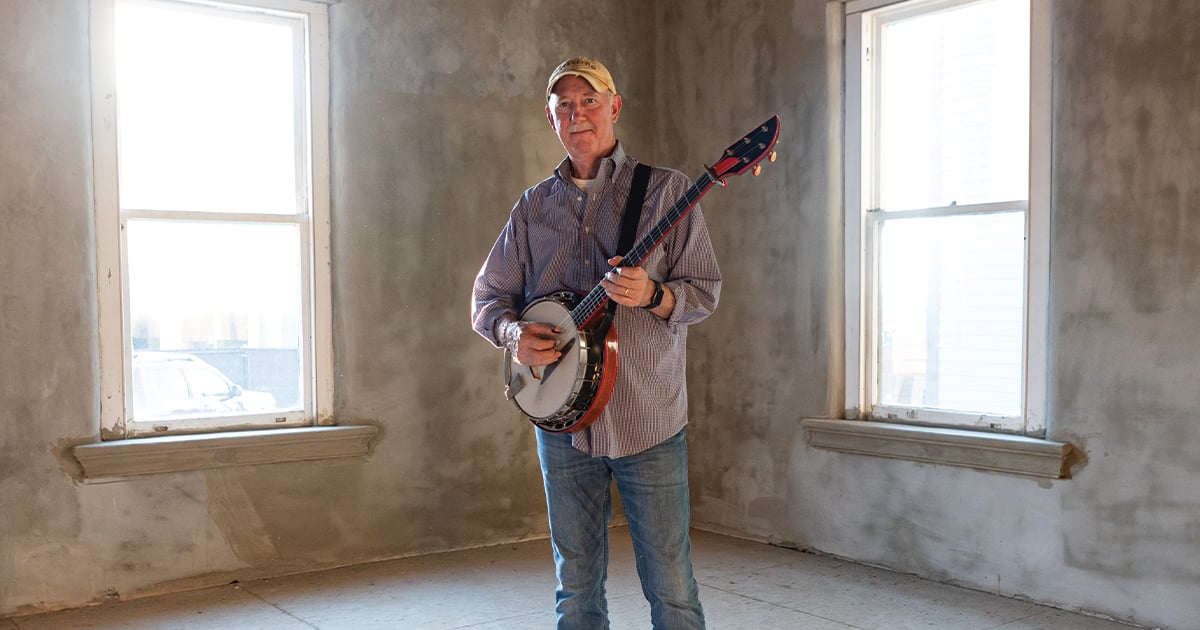
On the subject of instruments, Greg’s primary banjo is distinctive and the product of a collaboration with now-retired builder Jim Yarboro of Texas. “I usually have someone else work on my instruments. That may be odd, given my day job as a contractor, but it’s a question of having the finer tools to work on instruments, the time, and the skill. I designed the banjo I play and record with in 1986. Jim Yarboro built it just before I moved to Nashville. Jim’s since sold maybe 30 or 40 of these banjos. It’s a “tunnel-fifth” design, which was originally invented in England. [Tunnel-fifth banjos place the fifth-string tuner on the peghead and run the fifth string through a metal tube in the neck, where it joins the fingerboard at the usual 5th-string location.] I just wanted a different-looking instrument, and this was before Nechville, Stealth, or Bishline started producing banjos using the tunnel-fifth design. My peghead is shaped like a knife blade and the fingerboard is arched. I have other banjos—even a 7-string that Jim built me for jazz banjo—but this is my primary instrument. And I also should mention that I’ve been a solid endorser for D’Addario strings for the past 15 or so years.”
Although his golden musical anniversary is now in the rear-view mirror, Greg Davis has projects yet to complete. “For the past few years, I’ve been thinking seriously about a solo project with maybe a dozen tracks. It’s now a priority. I have some original tunes, but I don’t want to produce just another banjo instrumental recording. I anticipate using about six of my original banjo tunes, with the remaining tunes original vocal material. For that I may have to rely on some of my brother’s materials (he’s an incredible writer) or Donna may have an idea or two to toss in as well. Rather than a static band for all the tunes, I want to use different combinations of musicians on each track. Since we’re still in the planning stages, right now I don’t have a release date.”
Despite his minimal online presence, rest assured that when Greg’s banjo project is released, he will have it available at his performances with Donna Ulisse. A project 50+ years in the making should be a worthwhile listening for any banjo fan.