Skip to content
Register |
Lost your password?
Subscribe
logo
  • Magazine
  • The Tradition
  • The Artists
  • The Sound
  • The Venue
  • Reviews
  • Podcasts
  • Lessons
  • Jam Tracks
  • The Archives
  • Log in to Your Account
  • Contact
  • Subscribe
  • Search
  • Login
  • Contact
Search
  • Magazine
    • Current Issue
    • Past Issues
    • Festival Guide
    • Talent Directory
    • Workshops/Camps
    • Our History
    • Staff
    • Advertise
    • Contact
  • The Tradition
  • The Artists
  • The Sound
  • The Venue
  • Reviews
  • Podcasts
  • Lessons
  • Jam Track
  • The Archives

Home > Articles > The Sound > Great Big Sound Production

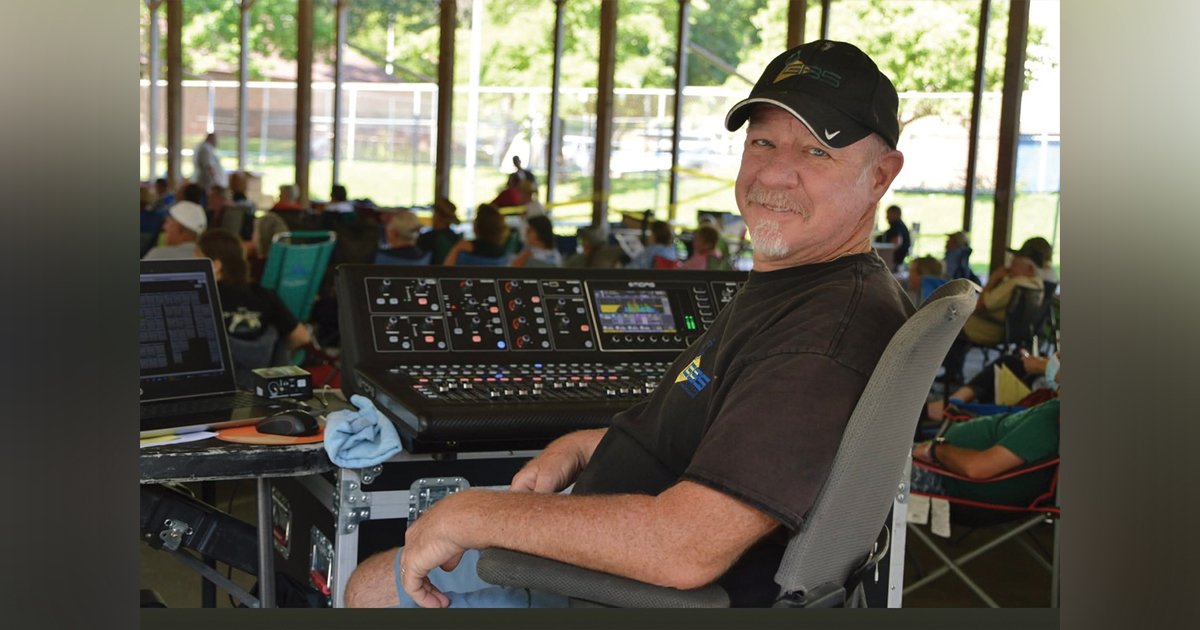
David Chichearter of GBS Sound.

Great Big Sound Production

Sandy Hatley|Posted on March 1, 2026|The Sound|No Comments
FacebookTweetPrint

David Chichester is a bluegrass sound engineer whose profession began as a hobby that evolved into a career. He and his wife, Traci, own and operate GBS Productions (Great Big Sound) out of Ohio.

He explained his audio company’s name. “Great big was a catch phrase before social media: “great big hair” or “great big” something. I just adopted Great Big Sound. My motto became ‘Life is too short, not to be heard’.

“I got interested in playing music when I was 30 years old. I’m 65 now. I didn’t grow up with parents who played bluegrass. I just knew I liked it, and I wasn’t sure why. I decided I was going to learn to play guitar. Where I lived, outside of Parkersburg, West Virginia, there was a pretty good community of bluegrass pickers. They had jam sessions all summer at different places. I started going to those and liked it.”   His quest for music continued.  “I decided to learn to play the banjo, and I pretty much taught myself.”

Then the aspiring musician suffered an injury.  “I ended up tearing tendons in my right hand from lifting weights at the YMCA. They tried to operate on it, and it ended up messing up my wrist, and that slowed my speed down. After several years of trying, I got a little disheartened with that. I liked music too much to give it up, so I bought an upright bass and decided to play bass. I had friends who played music that were very helpful. It wasn’t long before I was playing bass in a band called Tall Grass out of southeast Ohio. We were running the roads and running the bars. It was a weekend warrior band. I played with them for five years.

“We needed to do our own sound. We were self-contained, so I started doing our sound. I learned how to do it better and better. Then other bands would hear and ask, ‘Hey, would you come do sound for us?’ It just developed from that. I’ve been doing it for 20 years now. It’s been kind of a self-created career, so to speak.”

The GBS Sound speaker stack.

So the sound job just happened. It was not planned, but Chichester found his purpose.  “I think it’s where I naturally ended up being. It seems to be my better strength. I still play music just for myself. I don’t play for anybody else. I think I’m where I’m supposed to be.”

News of his audio skills spread.  “AJ Joyner had a festival in Ohio called New Beginnings. They had something like a showcase stage. An organization called COBA, the Central Ohio Bluegrass Association, sponsored this stage and had local bands compete in a contest situation. Whoever won got to play on the main stage of the festival. That’s how I jumped from doing bar bands to the festival scene. An old guy named Jack Kitzmiller saw something in me and invited me to do the sound for the showcase guest stage, which I did for probably four years for free.”

Starting in the trenches, he worked his way up.  “I did a lot of years and a lot of rain storms and a lot of knob-twisting and learning as I went. I paid my share of dues to get where I am at.   From that festival, I went to their summertime festival called the COBA Festival. Then Don Morgan of the Brown County Festival came to COBA, and he saw something in me. Their soundman had passed away, and they weren’t sure what they were going to do. He asked if I would do their show.

“That was a huge step for me, going from a free side stage to a small stage to a big stage. It was a jump to say the least. Marty Raybon was there. Traci (my wife) said that I would be fine, but I was a nervous wreck. He was so gracious, and we are friends to this day now. He said that I did a great job. That kind of gave me the encouragement to go out, spend a bunch more money, and keep going.”

More folks began to notice Chichester’s unique skill set.  “Dean Osborne of the Osborne Brothers’ Hometown Festival was there. He played with Rob Morgan, who was Don Morgan’s son. Dean said, ‘I want you to come and do the Osborne Brothers and JD Crowe festivals.’ To me, that was just crazy to be able to do that. I was still working a day job at the time. Sound wasn’t my livelihood by any means. I used all my vacation to go out and do these shows. I spent every minute I could learning and every dollar I had buying speakers.”

Chichester worked the events.  “I did the Osborne Brothers’ festival. Ralph Stanley was there. I was a nervous wreck again, but it was awesome. Then I did the JD Crowe festival in Kentucky for five years before the venue got sold. They ended up shutting that festival down.”

The work continued to pour in.  “I’ve never gone out and quoted a job. I never tried to acquire a job that somebody else was doing. I’ve always just done what I’ve done. I’d get a call when somebody retired, passed away, or just couldn’t do it anymore. It’s like John Holder. He went through this flood (in western North Carolina) and decided not to replace (his equipment). So I got five or six calls to help cover shows that he had done for years. I didn’t go after them. I just lay back and figure when the time is right, I’ll get the invite to go.”  GBS has a broad reach, covering eleven states. “I actually got a chance to do sound for Billy Strings in Michigan this year. That was phenomenal!”

Sound work carries a lot of responsibility.   “I worked with Billy’s people for three months (prior) through email and phone to make sure it worked the way that he wanted it to work.  When folks walk out the stage and ask what I want them to do, I say, ‘I want you to do you. If you want to do ears, single mic, wedges, I’ll do my best to make you be you.’ I approach it that way. I really don’t have an ego. I’m proud of what I do. Traci, my wife, brags on me way more than I brag on myself. I’ve always just tried to be the nice guy.”

GBS knows the importance of good audio at events.  “Live sound is more damage control than anything else. You get young guns coming out of college with knowledge of all the digital boards and other modern equipment, but it’s like computers. The second you buy it, it’s an antique. There’s something bigger and better coming out tomorrow. It’s hard for old guys to pick up on the new stuff. At the same time, you can’t be at the top of your game without learning the basics. There’s only one way to do live sound, and it isn’t in a college class. You just get out there and do it. You can’t learn it sitting behind a desk.”

The sound man shared one of the many lessons that he learned in the field. “When I was pretty green, I was doing sound at the Brown County Festival. There was a band that I was not familiar with, and an old guy came up and said, ‘Hey, turn the guitar up! He’s playing way harder than you’re getting him. ‘So I started digging into it. When you sit there for hours, after a while, everything starts blending together. I paid attention and started working on just the guitar, and BAM! This guy WAS playing, and I was missing getting what he was doing. The guy was Gary Brewer, and the man who told me to turn him up was his dad. I learned two things that day: I can miss something, and never discount audience members’ input. That was 17 years ago. I guarantee that you can hear his guitar now. That’s what I learned.

“I’m 100 percent self-taught. I’ve spent countless hours in books, online, and talking with pros to learn. I learn something new every time I go out. Maybe that’s why I like it so much. It’s trial and error and knowledge that I’ve picked up along the way.

“When Traci first started helping me, she would be nervous and say, ‘What do I do?’ I told her, ‘If you want to add some mids or take out some highs, just do it. If you make a mistake, just undo what you did and try something different.’ That’s what live sound is.  I’ve done sound for just about everybody in the bluegrass world. I’ve done Ricky Skaggs and Rhonda Vincent, of course, a lot of them have their own sound people, but I’m working hard to accommodate their needs to make their show the best it can be.

David setting up microphones at the Osborne Brothers Hometown Festival.
Screenshot

“I’ve had the opportunity to work with Ronnie Milsap and Marty Stuart. It’s been a lot of fun to be close to these bigger names and work with them. I’m never star-struck by the artist, I’m more interested in who their sound people are and gain knowledge off of them while they’re there. For example, Ronnie Milsap’s sound man may be the best that I’ve ever been around. He grew up in the business, and I learned a lot from just observing what he did. Come to find out that his name is Kerry West, and he’s Dottie West’s son.

“Then there’s Tony Morgan that does sound for Diamond Rio. There’s several others with whom we’re pretty good friends: Elijah Doty, Kevin McKinnon, Keith Kerran, and more. We all have a good working relationship. We take care of each other. We’ve built relationships with other sound guys because there aren’t many guys that do what we do.

“There’s a lot of other sound companies that either don’t want to or can’t (do sound for bluegrass). They haven’t devoted the time to learn how to do that acoustic thing. It’s my life, so it’s easy for me. It’s the obvious place for me to be.

“My best friends in the whole world came out of music and bluegrass. At the end of the day, when I wrap all this stuff up, sell this stuff, and quit running the road, I’m still going to have all those friends. That is, by far, the most important thing to me.”

Technology keeps changing, and sound men like Chichester have to continually upgrade their equipment.  “When I first started out, I used a Yamaha analog board. As you grow a business, you’re always replacing your weakest point. If you’re satisfied with your mixer, then you start looking at your speakers. I started out with 12 Peaveys on scaffolds. It was very, very work-intensive. It sounded really good, but it was too big and too bulky. Here comes new stuff, so you replace the speakers. Then all of a sudden, the mixer isn’t quite as good. It doesn’t match the quality of the new speakers. Then along comes lighting and that’s one of the weak spots in the bluegrass world. Most promoters don’t want to pay extra for lighting, so I acquired a modest amount of lights. That’s another whole thing: how to deploy the lights and make them look good and not make it look like a discotheque. I am proud. I light my shows so it is pleasing and professional. It’s a lot of work for a 65-year-old.”

Working in sound for two decades takes commitment and dedication to your craft.  “When a band goes out and plays Friday night, that’s Friday night. When I go, I’m there for five days.”

Set up varies with the venue.  “That’s one of my strengths, I think. I look at a venue and decide what is the best way to cover the area. I’ve been to festivals, and it was so loud if you were sitting in front of the speakers, then farther back you couldn’t hear very well. It didn’t make sense why it was that way. That’s one of the things that I dug into: how can I make every seat in the house a good experience? Line arrays have been a huge help to that. I have lifts that I bring in and get my speakers up 17 feet in the air. They’re not in anybody’s face.”

GBS is a two-person operation.  “It’s always been me and Traci. We have been married 20 years and doing sound 20 years. Traci is a huge part of why I do what I do. I’ve only been doing this 100 percent (the past) six years. Traci and I are both real estate agents, so we write our own schedules. If it wasn’t for her, I wouldn’t be where I’m at. She’s a huge support. We help each other. It’s been a great way to make a living and be happy.”

Promoters praise the Chichesters’ work.  “GBS has done Bluegrass Christmas in the Smokies for ten years. Their sound work is outstanding. They fit in with our Bluegrass Festival family and are team players. The bands that play Bluegrass Christmas in the Smokies are very complimentary and comfortable with GBS,” stated promoter, Lorraine Jordan.

“Dave’s a great guy! He and his wife, Traci, have worked so hard to make each of our festivals a success. The bands know they’re in good hands with him. Not only is he well-versed in sound, but he’s extremely knowledgeable about the bluegrass genre. Nobody better in the business than Dave!” stressed Molly Wobbecke Shaw of the Mohican Festival in Ohio.

Dean Osborne is a GBS fan. “After many years of having great sound with Eddie and Martha Adcock, they retired from that part of the business. We used a couple of other sound people that were able to help for the year. While I was playing a festival in Ohio the next year, I saw their new sound man helping in a weather emergency without being asked, and thought …that’s the kind of company we need. After doing both our festivals for a year, I offered “Uncle” Dave and Ms. Traci a lifetime contract, for as long as they wanted to do our shows! That was 18 years ago, and I have never known anybody more dedicated to doing a first-rate job than GBS Productions. More importantly, they have become like family to us. They are the best!”

Others in the industry chimed in.  Performer, Junior Sisk, declared, “David is one of those sound guys that when we show up to a festival and see him at the board, it’s a big relief knowing we are going to hear ourselves and everyone in the audience is too!”

Kevin McKinnon, audio engineer for Authentic Unlimited, said, “Dave is a true professional when it comes to production and live audio. He cares about the product he’s trying to deliver. He treats every band the same and works hard to give them what they need and deliver their music to the audience in the best way he possibly can. I know when I see GBS as my production contact for a festival, that my day will go smooth!”

David Chichester is a family man with two children, four granddaughters, and two great-grandsons. He loves his family and his job.  He concluded, “I’m not ready to retire, but I am going to slow down a little bit. I’ll probably be the old sound guy that somebody in the audience says, ‘You need to get rid of him, he can’t hear anymore.’”

Right now, Dave Chichester hears just fine, and he’s got Great Big Sound going strong. 

FacebookTweetPrint
Share this article
Facebook
X (Twitter)
Linkedin

Leave a Comment Cancel Reply


This site uses Akismet to reduce spam. Learn how your comment data is processed.

March 2026

Flipbook

logo
A Publication of the Bluegrass Music Hall of Fame & Museum / Owensboro, KY
  • Magazine
  • The Tradition
  • The Artists
  • The Sound
  • The Venue
  • Reviews
  • Survey
  • New Releases
  • Online
  • Directories
  • Archives
  • About
  • Our History
  • Staff
  • Advertise
  • Contact
  • Subscriptions
Connect With Us
Facebook
Instagram
Twitter
YouTube
bluegrasshalloffame
black-box-logo
Subscribe
Give as a Gift
Send a Story Idea

Copyright © 2026 Black Box Media Group. All Rights Reserved. Privacy Policy
Website by Tanner+West

Subscribe For Full Access

Digital Magazines are available to paid subscribers only. Subscribe now or log in for access.