

Good Water
How Pitney Meyer Brought Together A Red Jeep, Analog Tape, And Johnny Cash To Form A Redemptive Parable
Photos by Nathaniel Maddux/Slate + Glass
March 10th, 2023
The historic Ryman Auditorium is packed to the brim with a sold-out crowd. On the digital signage outside above the steps facing 5th Ave North, there is a poster boldly promoting “Sam Hunt: One Night at the Ryman” — on the lower third are the words “with special guest PITNEY MEYER”. A roaring applause is echoing throughout the Mother Church of Country Music, and a five-piece bluegrass band is walking off stage. A young man carrying a banjo in one hand is patting another young man on the back as they walk together after their opening set. You can tell they are friends or brothers. The man with the banjo has movie-star hair and is smiling so brightly that his eyes look nearly closed. The other young man is carrying a guitar, has a neatly trimmed beard, and is grinning from ear to ear — borderline giddy. A woman approaches the man with the guitar — obviously a colleague.
“Mo! You’ve always struck me as this melancholy guy, and you look like a kid again. I’ve never seen you like this since I’ve met you! Whatever this is, you’ve got to tap into it. You just look so happy. You have to do something with this.”
Pitney Meyer brings together two young but experienced musical talents: Mo Pitney and John Meyer. Mo Pitney was raised on bluegrass music and developed his passion for singing and songwriting into a respected country music career for Curb Records. He has constantly remained connected to the bluegrass scene though, always appearing at bluegrass gatherings like the SPBGMA (Society of the Preservation in Bluegrass Music in America) convention in Nashville and IBMA’s (International Bluegrass Music Association) annual World of Bluegrass to jam with his many bluegrass buddies, still playing bluegrass gigs and festivals while climbing the country music ladder, and appearing on many bluegrass recordings over the years, including Rickey Wasson’s Croweology saluting J.D. Crowe, the award-winning Industrial Strength Bluegrass album, and most recently, the highly celebrated re-recording of “Jordan” alongside Darin & Brooke Aldridge. Even Mo’s country albums were known to sometimes include a shade of his bluegrass influences, as his 2020 release for Curb Records included a new version of the bluegrass standard, “Old Home Place” to honor J.D. Crowe; the all-star recording even featured New South alum Ricky Skaggs and Jerry Douglas, in addition to Marty Stuart, Barry Bales, Aubrey Haynie, Jon Randall, and J.D. Crowe himself on the banjo — one of J.D.’s final recordings.
John Meyer grew up performing on the bluegrass festival circuit with his siblings as The Meyerband, even winning SPBGMA’s International Band Competition in 2013. He then spent valuable time as a sideman, playing with bluegrass acts such as The Clay Hess Band and the Band of Ruhks. He also worked for several years with Jimmy Fortune of the Country Music Hall of Fame. Mo and John’s friendship began through bluegrass music, and over the years has grown and deepened not just as bluegrass brothers, but brothers in Christ as well.
Mo and John had the unique opportunity to have a residency of sorts at the historic Station Inn in Nashville beginning in May of 2022. They had often enjoyed pickin’ together in bluegrass jam sessions, so the opportunity to replicate the same kind of energy on a semi-regular basis at the Station Inn, joined by friends Nate Burie on mandolin, Blake Pitney (Mo’s brother) on bass, and Jenee Fleenor and Ivy Phillips rotating on fiddle sounded like too much fun.
“Of course, when we first started playing at the Station Inn, we’re just coming up with a list of all our old standards, which we love, and we’re just playing the stuff we grew up playing,” says John Meyer. They tackled many favorites from Flatt & Scruggs, J.D. Crowe & The New South, and more that had inspired both of their musical origin stories. Eventually, Pitney Meyer (as they would come to be called collectively) transitioned into applying their already developed talents for songwriting and applying it to this bluegrass context. “John and I had already written a lot of songs as friends and kind of country music singer-songwriter buddies, so in the middle of those jams, we were just starting to write songs,” says Mo Pitney. “We’d play ‘Don’t This Road Look Rough and Rocky’, and then somebody would say ‘That sounds lonesome,’ and we’d just write a chorus and then finish it the next day.” (A reference to Pitney Meyer’s debut single, “That Sounds Lonesome”, which intentionally introduced the band to the bluegrass world and purposefully is not included on their debut album. “The last line of that song is “That sounds a little too lonesome to me,” says John. “The record is kind of our answer to that.”)
To Mo Pitney and John Meyer, the opportunity to get back to playing bluegrass in a unit with close friends, and even write some originals to keep it fun, was truly their aim at the time — the fellowship was rewarding enough. Their residency at the Station Inn would wind down by the spring of 2023, as John had moved to Missouri at the beginning of that year, making a standing gig harder to manage. However, their bluegrass adventure was not ending — it was just beginning.
“March of ’23, I was working at a shop out here in Missouri,” says John Meyer. “Mo called me and says, ‘Hey, this is really weird, but do you know who Sam Hunt is?’” Being plugged into the country scene for years and having just moved from Nashville, John Meyer definitely knew who Sam Hunt was — Hunt has had ten Top Ten Country Songs including five Number One hits over the last decade or so. What Mo said next is what really floored John: “He [Sam] wants us to come open for him down at the Ryman.” Apparently, Sam Hunt had seen a video of Mo and John jamming at the annual SPBGMA get-together in Nashville. (“I just love the fact that Sam Hunt’s on YouTube watching SPBGMA jam videos like the rest of us,” laughs John.)
It was through this opportunity that Mo and John’s bluegrass jams began to transition into something much larger. “His [Sam’s] generosity of spirit in having us out there to open the show, I think it kind of opened the door even with Curb Records for us to cut this record because some of their people came out and got to see the music,” says John. “They got to experience it in a room like the Ryman, which is made for bluegrass music essentially.”
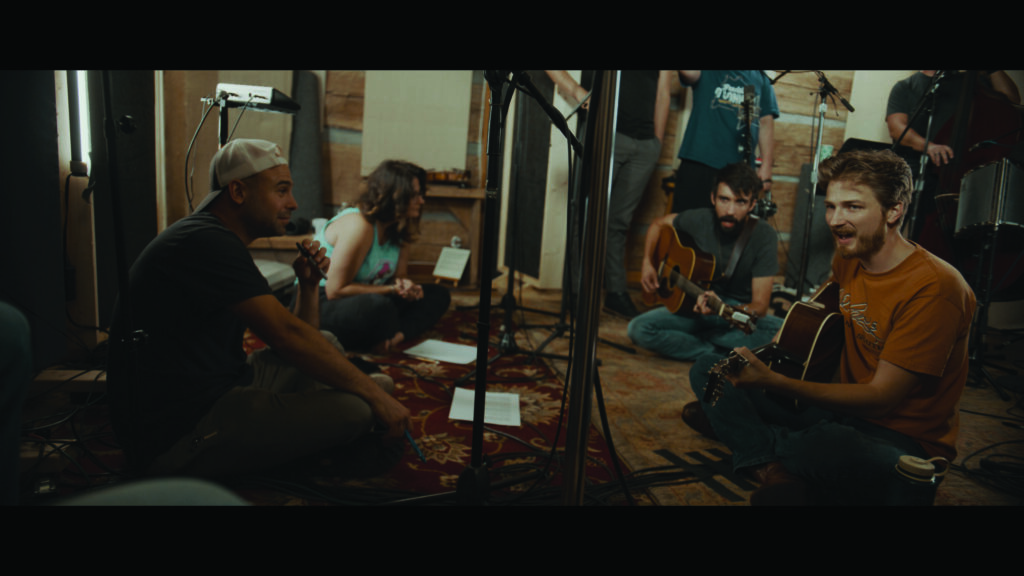
The power and excitement generated by this live bluegrass ensemble was not lost on Curb Records, particularly Ciara Shortridge who works A&R for the respected Nashville label whose roster has included legendary country artists such as The Judds, Hank Williams Jr, Tim McGraw, and more. “Ciara helped me look for songs for my country records and has seen me kind of struggle through finding the ‘right’ way to produce records and all of that,” says Mo Pitney. “She was really the one that vouched for us making this album… She said, ‘Go make a record.’”
With the freedom to tackle this project how he and John saw fit, it particularly inspired Mo to reevaluate how he got to this point in his career, and how he could re-discover what about making music inspired him to chase this dream in the first place. “God was teaching me a lot through this process about what he meant about unless you become little children, you’ll not enter the kingdom of heaven’ [Matthew 18:3] and how that related to my childhood love of bluegrass music,” says Mo. “Moving to town, taking music seriously in my life, in order for me to have some future in the music business, I grew up a little too much and needed to remember why I fell in love with music.” This process, took Mo and John on a journey of spiritual growth as well, teaching them many valuable lessons in the process, many of which are explored through their new album.
Without Curb’s willingness to see the importance of Mo returning to his bluegrass heritage, this project may not have happened, particularly in the fashion in which it was made. “I think the nature of the project, they knew it was kind of a passion project that was just really me having to work some things out with my buddies about ‘Why do I love music?’,” says Mo. “They’re just like, ‘We can’t touch that kind of a thing,’ and that was such a blessing.”
To Mo, this was a dream come true because it afforded him the opportunity to tackle a challenge, as he puts it, “That was exactly what I wanted to do my entire life in music, which was make a live bluegrass album with people that I loved and cared about.”
John Meyer is sleeping in a plain bed in a plain farmhouse bedroom. Its simple white walls and antique furniture are not the only things that give the room a museum-like essence. He is sleeping on a white pillowcase under white sheets. He is alone in this cabin, built two centuries ago. Between that and the anticipation of the musical journey on which he and his friends are going to embark tomorrow, John finds himself waking up throughout the night. The ominous photograph of the former owner hanging on the wall next to the bed is not helping matters either. John is lying there looking at the man’s unkempt black hair. He is wearing a light blue shirt with a very seventies-style wide collar, that is unbuttoned to where chest hairs are starting to peak out and the end of his necklace is disappearing. What’s most compelling are the icon’s eyes that are staring at him, in both a piercing but understanding manner. John looks back at those eyes, and can’t help but feel the gravity of the reality that he is sleeping in Johnny Cash’s bed.
“We knew we wanted to do something a little bit unique,” says John. “We were already talking about somehow wrangling together tape — machine tape — and just doing the whole thing analog, both to honor our own kind of bluegrass and musical heroes, but also to challenge ourselves and also to get us in the frame of mind of creating music as a unit rather than sort of chopped up and fractioned out.”
“We knew we wanted it to be a little outside the box,” says Mo Pitney. “We toyed with the idea of making it anywhere but a studio.”
They were wrestling with where to record the album when a friend of John’s stopped by to see them perform at the Station Inn: Kyle Majnaric, who was the General Manager of the Storytellers Hideaway Farm & Museum in Bon Aqua, Tennessee at the time. The sprawling property contains a small museum that doubles as an intimate music venue. Most notably, the land also houses an antique log cabin farmhouse that was famously once owned by Johnny Cash.
The next day, as John was heading back to Missouri, he had an epiphany of sorts. “I was driving home, and it’s like a voice went off in my head: ‘You’re going to take the bluegrass band out to Bon Aqua and make a record.’” John had never visited Johnny Cash’s Bon Aqua farm, so he had no previous conception of whether this would work or not; regardless, he quickly reached out to Mo, as well as Eric Quinlan and Daniel Kohavi, who would co-produce the album along with Mo and John. They drove out to Bon Aqua, Tennessee to scout out the cabin to see if it would be feasible to record a live bluegrass album straight to tape in this rustic 19th-century farmhouse. “Within a few hours, we had it already figured out, ‘Hey, we’re going to go out to this log cabin, we’re going to make a record a hundred percent to tape, and we’re just going to hunt down, rent, buy, borrow, or steal enough analog gear to make it happen,’” laughs John.
Built in 1837, it was truly a unique place to make a record. “It’s just a big kind of double-room log cabin,” explains John. “They called this style a dog trot log cabin, and then the middle part, the dog trot, was later framed in, but it’s a hand-hewed log cabin.” With it being a double-style cabin, it does take on the appearance of a farmhouse-cabin hybrid. It has stone chimneys on each end, a pair of porch swings adorning each side of the front door, and generations of stories to tell.
“When you hear the whole album, you can almost hear the cabin,” says Mo. “We wanted it to be this way.” In addition to making for a rich, intimate experience for the listener, where it does convey a personal, down-home feel, it is also symbolic of not only the live nature of the album but also connects to the messages that Pitney Meyer are illustrating through the album. “There are some imperfections in it, that remind me of the ax marks in the cabin walls that I can see when I’m standing in it.”
The cabin’s relationship to Johnny Cash made for a unique environment as well. Cash acquired the Bon Aqua farm in the early 1970s, and referred to it as the “center of his universe”, using the property as a respite and getaway for him and his family. “I got out to the farm the first night before anyone else,” says John Meyer. “I spent the first night by myself at that old farm, and I slept in Johnny Cash’s bed.” Throughout the night, he kept waking up and seeing this massive photograph of Johnny Cash looming large over the room. “It’s like, ‘You’re sleeping in my bed, son’,” John Meyer says with a laugh.
The Johnny Cash connection was particularly special for Mo, as the country music legend was a huge musical influence on the singer. One of the earliest albums that Mo studied as a kid was Cash’s famous Live At San Quentin album — “I learned every song on it!” says Mo. The opportunity to not only walk through Cash’s private hideaway but record an album there was surreal. The day they arrived at Bon Aqua to start the recording process, Mo couldn’t help but notice the big family Bible on display in the living room. “I walked over to that Bible and looked down on the page and it was open to ‘delight yourself in the Lord and he will give you the desires of your heart’ [Psalm 37:4],” says Mo. “I had this weird flashback of sitting on the end of my bed switching back and forth from the banjo to the guitar to play Johnny Cash music, and then J.D. Crowe music, and then Johnny Cash music, and J.D. Crowe music.”
The guitar he brought with him to the cabin was a 1952 Martin D28 that was bestowed upon him by J.D. Crowe. It had belonged to Crowe and served as the go-to guitar during J.D. Crowe & The Kentucky Mountain Boys’ legendary residency at the Red Slipper Lounge, having been played by Red Allen and Doyle Lawson at Lexington’s Holiday Inn and on the band’s The Model Church and Bluegrass Holiday albums. When J.D. Crowe gifted it to Mo, he told him “Now, go take that guitar out and play it. Don’t put it under glass.” Standing in Johnny Cash’s Bon Aqua farmhouse, he was about to do just that, as his childhood influences were truly coming full circle. “Now, I’m standing in Johnny Cash’s living room making a bluegrass album with my best friend and my brother, and it was a fulfillment of Him giving me the desires of our hearts, I think.”

Bon Aqua is Latin for “good water”. “There’s some water themes on the record as well,” says Mo Pitney. This is an understatement. Five of the album’s eleven tracks involve water specifically; this is not a coincidence nor is it only because of the location of where the album is recorded — the songs were written before they found the location or even learned Bon Aqua’s translation. Water is one of many motifs running throughout this project.
A motif is a theme that is typically revealed through recognizable patterns, symbols, and imagery throughout a larger body of work. In films, motifs can be used to signal a greater theme or message within the piece. One of the most common is the intentional use of lighting on a character who is experiencing some sort of dynamic arc, such as the light creating a dividing line down the center of a character’s face, resulting in a “two-faced” effect at the same time they are experiencing some sort of identity crisis.
Motifs are a great way to communicate a deeper meaning and underscore an important theme within a work. Christian motifs are common in pieces that draw on scriptural themes of redemption, atonement, forgiveness, and more. In the movie Cool Hand Luke starring Paul Newman, Christian imagery and motifs are scattered throughout this secular film, such as the titular character doing the “impossible” task of eating fifty eggs to inspire hope in the inmates — not only that, but the number of eggs is equivalent to the number of prisoners and after the sacrificial act, he lies on the wooden table in a crucifix-like pose, arms outstretched and feet crossed.
Pitney Meyer’s album is littered with motifs to communicate its messages of restoration and reconciliation. Though not a gospel album, (the final three tracks are the most likely to be featured on bluegrass gospel radio programs) the message of the gospel is signaled throughout the project’s entirety, both explicitly and implicitly. Many themes and motifs are running through this well-structured LP.
Even the track listing is meant to follow a narrative, aiming to communicate a story of restoration. “I felt this freedom with John to explore in parable form a lot of different topics about love, about loss, about the shedding of innocent blood, about the reconciliation of people groups,” says Mo.
This idea of parable is crucial to understanding the album. Parables are short stories used to teach a particular theme, lesson, moral, or other wisdom, often involving metaphors and similes to illustrate an idea. Parables are not unique to Christianity but are closely associated with the teachings of Jesus Christ. They were one of Jesus’ preferred ways of teaching in the New Testament, such as the parables of the Good Samaritan, the Lost (or Prodigal) Son, the Rich Man and Lazarus, the Pearl of Great Price, and many, more. Christ’s parables frequently connect to His teachings on the Kingdom of God.
“What you’re hearing is, I guess, just the themes of that story that we’ve walked ourselves,” says John. “Or that we’ve lived ourselves — sometimes symbolically, sometimes more literally — but you’re hearing those threads throughout the record.” While the album is comprised of individual songs that work as parables, collectively, they work together to tell a greater story. “There is sort of a narrative arc to the record itself and even to the song order,” explains John. While presented as eleven tracks making up a cohesive metaphor, the storyline naturally falls into what can be perceived as five chapters or acts. “You kind of take a journey. You face some hard subjects. There’s sort of a fall in this redemptive arc where finally at the end of the record, we are approaching the holiest of all, which is Christ’s table where he gives us himself in a truly reconciling act in bringing together people and bringing us together with Him ultimately.” In addition to the arc of the album, the songs on the album connect with one another through motifs that are woven throughout the project, further solidifying their overarching message and aim. “I guess it was just the fleshing out of all of that while we’re recording ten years of friendship or more of Mo and I leading up to this recording.”
Act I, if you will, consists of the songs “Banjo Picker (in a Bluegrass Band)” and “Old Friend”, establishing the origins of the arc and the impetus behind the record and Pitney Meyer — their lasting friendship and their calling to return to their bluegrass roots. John likens “Banjo Picker” to the “Bluegrass Garden of Eden”. “You’re sitting on the front porch just playing the banjo,” says John. “Your friends are coming over, and you’ve got food on the stove.”
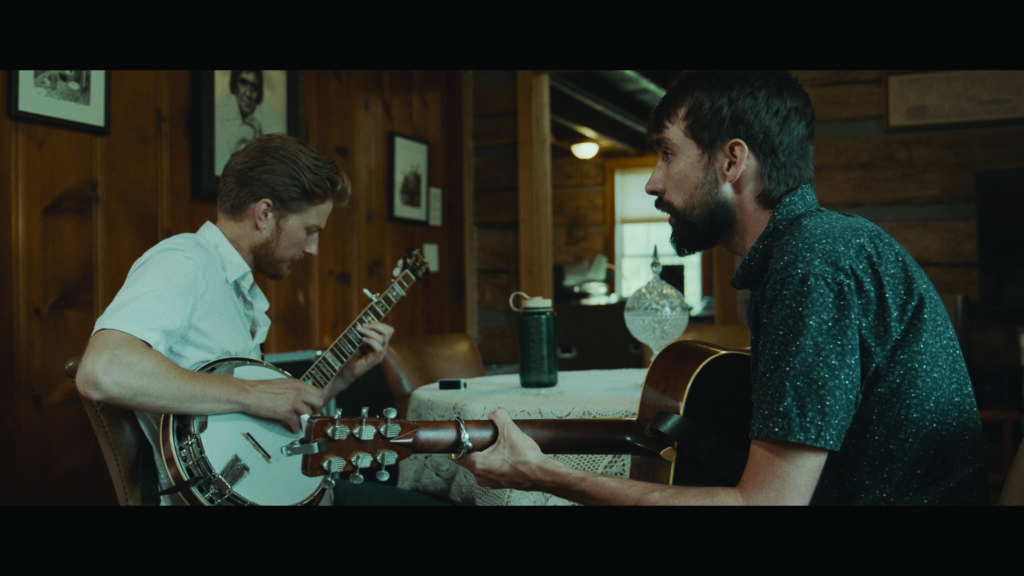
This is the environment in which this album was recorded — food included. The log cabin not only served as their studio, but also their temporary home as the core of the band along with the co-producers stayed together for the duration of the recording, sleeping in the bedrooms, eating at the table, and enjoying community and fellowship one with another. “We had made the whole cabin our home and made the album,” says Mo, noting that the atmosphere was meant to embody “just feeling like a bunch of friends in the living room after having dinner, picking at the old homestead.”
Their friend, Henry Thompson stayed at the cabin as well, cooking for the crew for the duration of the process. “I would wake up in the morning and there would already be eggs and bacon,” says John. “It was breakfast, lunch, and dinner,” adds Mo. Steak, prime rib, and lamb gyros were just some of the amazing dishes that were cooked at the cabin for the team to enjoy. In addition to the additional fellowship, the idea of having home-cooked meals at the farmhouse goes hand-in-hand with the way the album was made — the emphasis on the process being as vital as the product. “There’s a parable in caring for how something is presented, how something is prepared: the thought, the heart, the love that goes into something like that,” says Mo.
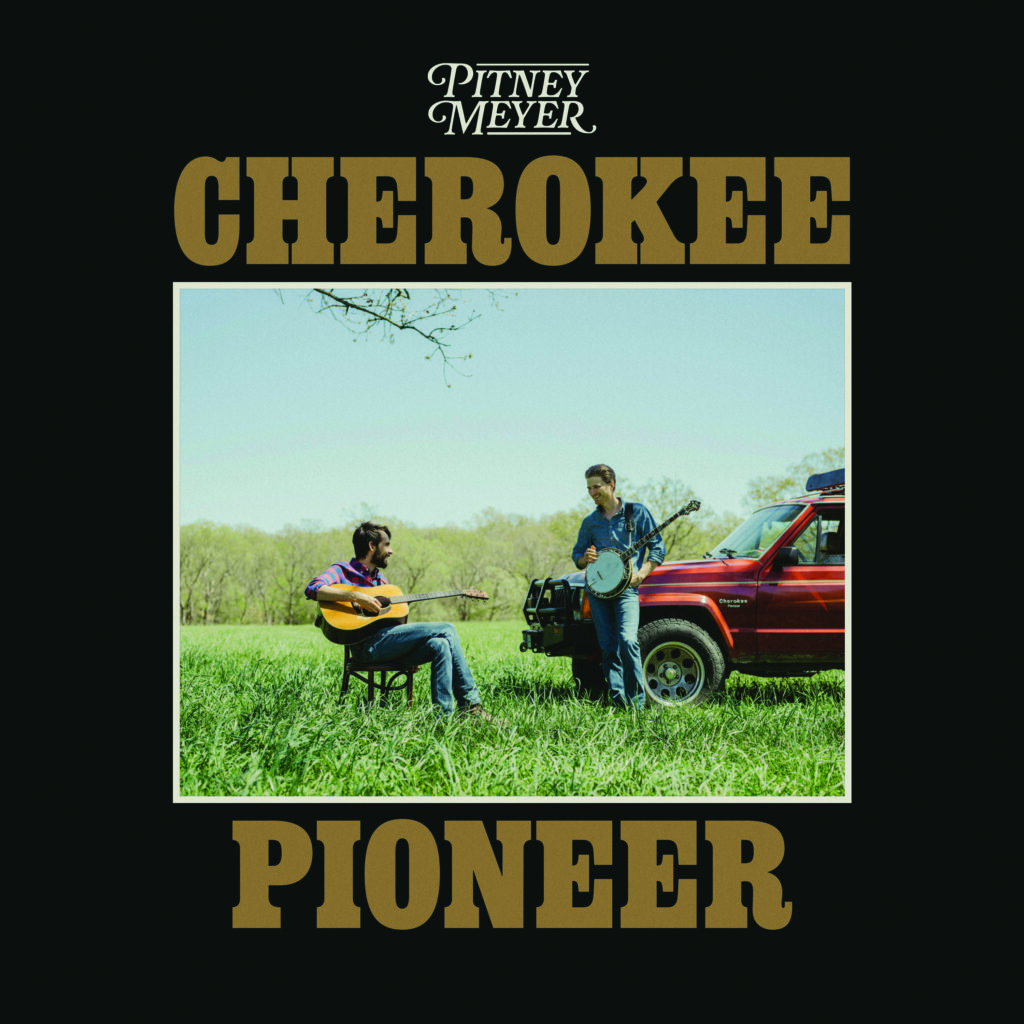
“Old Friend” was the band’s second single, and the first single from Pitney Meyer’s debut album. The song highlights the value of lifelong friendship, particularly between Mo Pitney and John Meyer. Not only did their friendship inspire the album, but it helped inspire the album title as well. “John and I have [not only] a history in bluegrass, but a history in a lot of other endeavors in our life that are too long to describe,” says Mo. “We’ve done a lot of it riding around in John’s old Jeep Cherokee that John named Suzanne: Suzanne goin’ down the road, carryin’ everybody’s load.” (Named after the Harley Allen-penned bluegrass favorite of the same title, which Mo happened to sing on the Industrial Strength Bluegrass album a few years ago.)
“I drive an 88 Jeep Cherokee with an obscene amount of miles on it,” says John. “It’s got over 750,000 miles — original engine. I think I bought it at 629,000 miles, and it was in such great shape, I had to buy it! I couldn’t believe I was buying a vehicle with this many miles on it, but it’s just kept trucking.”
“We were writing a song on the porch,” says Mo, “and I look past John’s shoulder, and on the side of his Jeep it says ‘Cherokee Pioneer’ — that’s the name of that era of that Jeep that we’ve shared a lot of life in.” The Cherokee Pioneer title also connects to different motifs within the album.
John Meyer, Mo Pitney, and one of their producers, Daniel Kohavi are loaded up in John’s Jeep Cherokee Pioneer, “Suzanne”. They are heading to the place John saw while driving to the cabin in Bon Aqua. The discovery had stuck with him since he saw the name on the map the other day. He parked Suzanne, and he, Mo, and Daniel piled out of the Jeep and they made their way down to the water’s edge. The banks were swollen. Brown, muddy water raced by — the jagged rocks appearing as ripped edges where the creek had torn through the earth. They stood there soaking in the moment. It was another instance that further confirmed that the path they were on was the direction they were meant to take. John and Mo carefully walked to the water’s edge, bent down, and washed off their faces with the rushing water, then walked back up the hill.
Act II of Cherokee Pioneer is where Pitney Meyer begins taking listeners on a journey — literally. “Bear Creek Clay” is a bit of an adventure song about settlers setting out to stake their claim, while “Mourning Dove” deals with the peace that comes from soaking in the sights and sounds of nature, particularly after a day of working hard by the sweat of one’s brow. Both songs point to a rest as their conclusion, serving as a subtle allusion to the end of the album.
“Bear Creek Clay” was the center of one of the more surreal moments during Pitney Meyer’s time recording the album, and just like the inception of recording at Bon Aqua, it occurred while John was driving. He and Mo had already had the song written long before John knew where they were going to record the project. “As I was driving from Missouri to Bon Aqua to make this record, I’m driving in the Jeep, of course, the Cherokee Pioneer,” says John. “I look on the map, and as I’m getting close to the cabin, I see a road coming up that’s called Bear Creek Road. Literally, a few miles from the cabin, there’s a creek called Bear Creek.”
To commemorate the unbelievable realization, there was a special field trip that he and Mo had to make in John’s red Jeep Cherokee Pioneer on the day they were to record “Bear Creek Clay”. “We go down and ‘bend down and wash off our face’ is one of the lines in the song, ‘by the banks of the Bear Creek Clay’,” says Mo. “It was just a really cool moment,” says John. “It was like the song coming true. Then, we went back and recorded this song. It’s just wild little experiences like that that seemed to happen over and over in making this project.”
The making of Cherokee Pioneer was not all smiles though, particularly with some of the heavier topics that are covered on the project as the arc continues to fall. Act III contains the two toughest songs on the album, dealing with the shedding of innocent blood: “White Corn Graves” and “Trail of Tears”.
Written by Daryl Miller, “White Corn Graves” is based on a true story from the community of Erin, Tennessee. “There’s supposedly a story recorded at the courthouse of a mother who had two children that had some sort of medical issue that disturbed her,” says Mo. “Out of fear, she killed her own children and planted them in a cornfield where, the story goes, that for a few years after that, the corn grew snow white in a five-foot circle where the kids were planted.”
The song is so powerful and heart-wrenching, that even though he had already been performing it at shows prior to the recording, the gravity of its content hit Mo hard while at Bon Aqua. “You can hear me start to cry at the end of that first take, and I let there be enough silence after it,” recalls Mo. “I had this really weird experience of grieving for all of the innocent blood shed over here on U.S. soil, the ones that are happening right now included and haven’t quite cried like that since. I don’t know why I experienced it so strongly, but you can hear it start at the end of that recording… I could have done a better take on the next one. I messed up the phrasing on one of the lines, but I didn’t want to ruin it. I just wanted to tell the story and then go on to the next song.”
“Trail of Tears” also talks about the shedding of innocent blood, while also dealing with the division between people groups. The forced relocation of tens of thousands of Native Americans after the passage of the Indian Removal Act is one of the chapters in American History that makes us uncomfortable because our nation’s treatment of Native Americans is something for which we as a nation have not atoned.
“I was down in the woods one late night praying, which is not abnormal for me to do weird things like sitting down by a creek in the middle of the night talking to God,” says Mo. “And I just heard that chorus almost being sung to me is what I’ve told people. And I literally went up to the house, grabbed a banjo, which is very odd, I normally grab a guitar, and went back down in the woods in the middle of the night, and started playing this song on the banjo in the woods: on the Trail of Tears, hear the voice of the Cherokee who’s crying in the wilderness. And I heard pioneer as the rhyme to that.” The next line would be Pioneer, you have a choice to come and meet him at the Table of Forgiveness.
Mo sends the chorus to John that night. The next morning, John tells Mo, “You’re going to think this is crazy, but I’m out on the Trail of Tears right now as it crosses Missouri.”
In addition to being a hit single from the album, the song “Trail of Tears” also serves as a de facto title track. Aside from the previously mentioned connection to John’s red Jeep “Suzanne”, the Cherokee Pioneer is specifically connected to this song, as it deals with two people groups who are historically at odds with one another, and are beckoned to come together at the Table of Forgiveness (another allusion to the end of the album).
Though based on true events on American soil, the songs “White Corn Graves” and “Trail of Tears” hold scriptural connections as well to hearken back to the redemptive theme of the album.
“This kind of Cain and Abel story and the redemption of Cain and Abel theme started to show up in the record,” says Mo. “The idea of the shedding of innocent blood and how the ‘ground cries out’ is the word that God says. He [Cain] says, ‘Am I my brother’s keeper?’ [Genesis 4:9-10]. All those little themes seem to be connected, and that seemed to be connected to the shedding of blood and wars in the Native Americans, ‘Cowboys and Indians’ fights and that seemed to be connected to modern atrocities.” Mo continues, “If we are listening, we can just tell that the shedding of innocent blood, no matter where and how the ground will speak back and will cry out, and there will be justice at one point. It’s really good to get in tune with the blood that speaks a better word than the blood of Abel is what Hebrews says [Hebrews 12:24], and the blood that covers all of the unjust blood that has been shed.”
While the Table of Forgiveness becomes more evident at the album’s conclusion, the members of the band learned much about forgiveness due to the album being recorded live to tape as a group. With a group of pickers who don’t recall life before the internet and have probably all owned a smartphone for practically their entire adult life, they are a generation or two removed from recording direct-to-tape, particularly as a unit without punching in edits. The process taught the musicians many lessons. “One thing that I learned is we found our forgiveness for our mistakes in one another instead of Pro Tools,” says Mo. “There was something that was happening, as we were making the record this way. The fact that every person in that room was a fan of everyone else, all of our imperfections that made us squirm, it seemed like God made that sound like the most perfect thing to the other person across the room. Right when you thought that was terrible, the other person goes, ‘Man, I love it when you did that.’ It allowed us to accept our own musical identities and our own imperfections in a way, that once we got to the end and heard it in its context, we realized it was exactly what needed to be there. I think all of us maybe discovered things about our own musical identities that could have gotten covered up if we had the tools to do it.”
Recording the album in this manner is also a way to maintain the human component of the music, especially in bluegrass. “Bluegrass is very embodied, very natural,” says John. “We wanted to make an effort to just maybe fully embrace that rather than trying to mitigate the human element.” In an era of music where conversations continue to circle back to AI, an album like Cherokee Pioneer is refreshing. That reality was not lost on Pitney Meyer, as they try to wrap their head around music being released through AI. “We’re sort of running in the opposite direction: back to real things. Back to where even if you hear a wart on a record, by golly, the whole thing’s real. And it’s an honest record, an honest offering of art, and where we were at that time and just feeling a need to do that in a world where it’s becoming harder and harder to tell the difference.”
This approach to recording revealed more insight as well, by necessity. “There’s part of me that would prefer to record in a way that then I can go back and recut my banjo kick three or four times and get it to where I feel like it’s perfect,” says John. “I think in choosing to do it this way, it forced us to think about the whole performance and the whole ensemble rather than each person only thinking about their individual part. Even that requires you to make decisions in real-time about how you’re going to play the song. Maybe there’s a few where I just have to simplify.” One such example came while recording the song, “Blue Water.”
Act IV begins to mark a turning of the tide in the album’s arc. After the low points of tragedy in Act III, the songs “Blue Water” and “Seminole Wind” (the album’s lone cover) utilize some of the preexisting symbols from nature, particularly water, and point to hope.
“When we cut ‘Blue Water’, that was another song that we worked up the day of in the studio. We had maybe done it one other time before that,” says John. At the moment, I was just trying to nail that kickoff and nail the vocal intro coming in on time: that was all I was thinking about. You have to simplify a little bit, but I think in that song in particular, simplifying and playing a little bit less banjo is actually exactly what that song needed.” The less is more approach really made for a beautiful track. “I love the song, and so that’s what I mean by causing you to make decisions in real time.
“Blue Water” metaphorically quenches a thirst for hope that is needed as the album progresses through its narrative. Being the first song that begins the upward trajectory of the back half of the project, it will intentionally be the first track on Side B of the vinyl edition. It is also filled with beautiful biblical imagery, such as its connections to Psalms 42 and 63.
One of the signature songs from the career of Country Music Hall of Fame member John Anderson, “Seminole Wind” is one of the ultimate “90s country jams”, an era of country music that has seen a resurgence in popularity over the last few years. While “Seminole Wind” is not a scriptural song, in the context of the album, its lyrics connect to nature, water, Native American motifs, the discussion of separation between people groups, and more. “Calling to you like a long, lost friend” even rings as a callback to “Old Friend” when heard on Cherokee Pioneer.
The closing chapter of Pitney Meyer’s Cherokee Pioneer is Act V. The fifth movement features a trio of original gospel songs which serve to complete some of the storylines begun earlier in the album: “Walk in the Way”, “Rivers of Living Water”, and “Lord Sabbath”, the album’s centerpiece.
With selections that invoke a journey looking for answers and peace, like “Bear Creek Clay” and “Trail of Tears”, the joyous “Walk In The Way” serves as a nice answer, as Pitney Meyer sing about “traveling the road to glory” and seeking to “live in the Promised Land”. Although they have not arrived at the final destination yet, it is clear that “Walk In The Way” promises the correct path to the destination they are seeking. The journey for rest and fulfillment is also alluded to on “Rivers of Living Water”, while the ongoing water motif that flows through the album, particularly on tracks such as “Bear Creek Clay”, “Trail of Tears”, “Blue Water”, and “Seminole Wind”, is ultimately resolved in this sacred song that encourages filling our cups up so we will never thirst again, and that that thirst is eternally quenched in Christ’s mercy.
The album’s conclusion is the four-and-a-half minute Stanley-flavored a cappella song written solely by Mo Pitney, “Lord’s Sabbath”. Calling all to the Lord’s table, it is meant to serve as the answer to all of the topics presented throughout. The stories on Cherokee Pioneer, particularly the heartbreaking ones, “find a rest and find a brotherhood at the Lord’s table, which is where the record ends: ‘Lord’s Sabbath’,” says John. “That’s also kind of the underlying theme there of the project.”
In 1986, Johnny Cash was unceremoniously dropped from Columbia Records, in a move that sent shockwaves through the country music world and is still talked about today. It had been fifteen years since The Johnny Cash Show had triumphantly aired on ABC and a decade since his last Number One hit. The label did not know what to do with the aging icon. One of his final singles for the label was the notoriously hokey “Chicken In Black” (which has unfortunately found a second life as a trend on TikTok), a decidedly low point in Cash’s legendary career. He then released a few albums for Mercury Records, but his career was still floundering. That was until the early 1990s, when he partnered with producer Rick Rubin, and they stripped it all down to just the Man In Black. They took away all of the stuff that everyone had been telling Cash that he had to have on his records to be relevant. It was just the man and his guitar, and Rick Rubin recorded Johnny Cash in a cabin (Cash Cabin, not Bon Aqua) and the result was American Recordings. The album won a Grammy in 1995 for Best Contemporary Folk Album and kickstarted a resurgence in Johnny Cash’s career that introduced him to an entire new generation of fans, and it was the result of stripping it all down and recording an album in a cabin owned by Johnny Cash.
The organic way that Pitney Meyer and Cherokee Pioneer emerged from Mo and John’s simple desire to return to their musical “first love” of bluegrass, is truly remarkable. “There was no, ‘Let’s get a brand. Let’s write some songs. Let’s have a concept record or whatever’,” says Mo. “It was just we started writing songs, and we saw the concept emerge. And Curb just happened to be standing there and going, ‘Whatever this is, we’re excited about it — do it!’ which was incredible.”
“It’s just been fun to see art created out of community, and that’s just been really rewarding,” says John. “What was unique in this is that this was a group of people that everyone there had a long history together,” says John about himself, Mo, Blake, Nate, Jenee, and Ivy. “We were all friends. We’d either been going to church together or jam sessions together or already played gigs together. There was just kind of a long history of relationship that fostered this art.”
Pitney Meyer is excited to celebrate that sense of community with bluegrass audiences as this chapter of their career is just beginning. “Now, we get to get out on the road this year and play this music live,” says John. “We’re just excited to bring the experience of this record to the people. As Larry Sparks might say, ‘We’re going to the people.’”
“Oh, John’s gonna step up to the microphone and melt some faces with that banjo!” says Mo. “And I get to play more G-runs to make up for all the years that I didn’t get to stand on them country stages and play ‘em, and I can’t wait!” It is clear that the impact of returning to his love of bluegrass music will have a reverberating impact on Mo’s music for years to come, both in his bluegrass career and other musical endeavors. “It has set in motion for me, like a recalibration, I think, of any other type of music that I’ll make for the rest of my life,” says Mo. “There maybe is going to be this detox of every influence of music that is not supposed to be around what I do or what John does just by getting back to the root of music and our initial love of music, and so I think there’s so many levels to why this had to happen. I think there’s going to be more and more bluegrass records together, and that’s going to grow on its own tree and take off.”
The work in creating a record with this scope in this way, especially calling their own shots, resulted in lessons that have left both Mo Pitney and John Meyer forever changed. “Coming to Nashville and making the country records the way that I did and having studios sitting there with everything in place and the label just paying the people that needed to be paid so that I could walk in and sing a song or play my guitar or whatever, maybe had me take for granted what it really takes to pull something together,” says Mo. “When it was up to us and Daniel and Eric, my brother picking up the machine and driving it out there and our buddy Henry who cooked the food and made the soundproofing equipment and separated the room, we were very intimately connected to every piece, big and small, to make this happen… the way the cords are running, where the mic is sitting, how the lights are feeling, we had to cultivate all of those little things to see it turn into a garden where God could rest with us and we could make music.”
By doing things in a more personal way, Mo says that it has had downstream effects on his life. “There’s so much that I don’t take for granted now, and I don’t jump over doing the little things well,” he says. “Something as simple as I stopped using a Keurig, and I started making real coffee. I’m not going to jump over the little things to get to the big things anymore because they’re all connected.”
For John Meyer, the message of faithfulness that he gleaned from the approach to this album has also impacted his priorities moving forward. “It’s something like maybe having the faith to plant that seed, even if it’s a pretty small seed,” says John. (Christ does have the Parable of the Sower after all.) “I mean, today I spent the day at my house just writing songs… taking time, setting time aside from work that might pay me more immediately to say, ‘I’m going to write a song, and I’m going to try to do my best,’ and then you plant that seed and pray for rain, I suppose.” He views this as a microcosm of being faithful in the small things and the big things with which he has been blessed. “It might be years before you see something return, or it might just impact one or two people, but believing that if we are faithful in what we are given to do and create, the Lord will cause that to go in the direction where He would have that to go. That’s ultimately the hope, and the hope we have for this project, and really whatever else we’re a part of creatively.”
Essentially, Mo and John both used parables to describe the wisdom they gathered from the experience, conveying life lessons from object lessons such as making coffee or writing songs. “I feel like I’ve learned some about storytelling, telling the gospel through gospel songs and leading people to the narrative of scriptures or leading people to the cross like we did at the end of the record with the Lord’s table song [Lord Sabbath],” says Mo.
The idea that we learn through story and narrative is what makes Pitney Meyer’s use of the concept of parables so impactful and intriguing on Cherokee Pioneer. “There’s a temptation in, say, reading the scriptures and trying to figure out what they’re telling us that cause different groups of people, and I’ve been involved in this, to boil it all down to its conclusions,” says Mo. “There’s things that are caught about the gospel that can only be caught by telling a story about what Jesus Christ came to do. I think the more that I live and follow Jesus, I see the value in the obsessions with theology to a point, but there just comes a point where a story needs to be told that captivates people to the truth and helps them catch the truth and helps the truth catch them… If we live our lives by the Spirit, we are getting into the story by following the Spirit and telling stories through songs that God is using to make dominoes fall over in people’s heads and open a way where He can speak to them, and they hear his voice clearly.”
“And once you’re kind of into that story, a really fun thing happens where your life and your heart and your mind is no longer segregated,” says John. “It’s no longer like the ‘church-y’ section and then the fun section whatever. You start to pick up on the hints of that story and that redemptive story in everywhere and everything. A lot of the songs on this project, it’s like we wouldn’t sing ‘em Sunday morning in a church, but if you listen to what’s going on and say ‘What is the story being told here from start to finish in this record?’, it’s a redemptive story.”
The care with which Pitney Meyer convey this story and message, begs for a different classifier than a mere “concept album”. Concept albums are fabulous and a lost art, but often times a concept album can take the form of finding a somewhat broad category of song — maybe songs about trains, coal mines, The Civil War, or whatever the topic — and gathering together a group of songs that fit into that metaphorical bucket. That is not what is taking place on this album. Another type of concept album is a narrative album, where the tracks string together into a linear timeline, where each song is essentially a step to move the story from Point A to Point B. A “this happened, then this happened, then this happened” format still seems incomplete when looking at what Pitney Meyer has produced.
Cherokee Pioneer utilizes motifs and symbolism, multiple themes and storylines, individual stories as a mosaic, and even the recording process itself to create a comprehensive redemptive, narrative arc to present deep messages like reconciliation through the atoning work of Jesus Christ. Classifying Pitney Meyer’s Cherokee Pioneer as a “parable album” seems more than appropriate.