From Appalachia to Arizona (and back)
A Bluegrass Adventure
This is a story about how a two groups of young people learning to play bluegrass music connected across 2,003 miles to share 13 banjos, 4 mandolins, 6 guitars, and 20 fiddles.
In September 2024, immediately after the IBMA Business Conference in Raleigh, North Carolina, the world was just beginning to hear about the effects of Hurricane Helene and start the long process of recovery. Families in the path of Helene lost their musical instruments, along with their homes and possessions. Groups like Michael Johnathan’s WoodSongs Old-Time Radio Hour and ReString Appalachia collected instruments to distribute to those who needed them.
A few months later IBMA Foundation executive director Nancy Cardwell and Anni Beach, director of the Jam Pak Blues ‘N’ Grass Neighborhood Band program in Chandler, Arizona, were talking about Anni’s surplus of donated bluegrass instruments.
“It’s amazing,” Beach said. “We didn’t have any instruments for the first four years, other than the ‘canjos’ that we built [one-string mountain dulcimers made from metal cans and a wooden fingerboard], and then suddenly the bluegrass community in Arizona decided we were legitimate,” she smiled. “We didn’t look like any other bands, and this was 30 years ago. People began donating, and at the festivals we played they would say, ‘Anni Beach needs instruments for all these kids,’ and they just poured in – good stuff, too! I was advised not to turn anything down.”
The young musicians of Jam Pak received a project grant from the IBMA Foundation in early 2025 to learn how to maintain and repair their instruments—hopefully in order to share the extras with others. Five of the older Jam Pak students have been taught the basics of maintenance repair, so far. “First they evaluated the instruments to see why they weren’t playing well,” Annie said. “They replaced bridges and re-fashioned a nut where half had broken off. We strung them all up, and they all have cases. We bought a few bows for the fiddles, and each one has a new cake of rosin.”
Several J.A.M. (Junior Appalachian Musicians) affiliates were also funded with IBMA Foundation project grants in early 2025, suggesting new homes for the refurbished instruments among the communities struck by Helene. Cardwell spoke to IBMA Foundation board member Sam Blumenthal, who was connected to JAM through his involvement with the Earl Scruggs Music Festival, where more than 150 children and their families, representing more than 30 JAM programs, come together every Labor Day to celebrate and learn bluegrass music. Sam and Anni began talking to Brett Morris, executive director at JAM, the parent organization for more than 60 affiliates in Virginia, West Virginia, North and South Carolina, Kentucky, and Tennessee. Morris, director and president of Junior Appalachian Musicians since 2014, is a native and current resident of Grayson County, Virginia, in the southwest corner of the state, where she learned to play and dance to traditional old-time and bluegrass music from family and community members. An award-winning flatfoot dancer and clawhammer banjo player, Brett is an advocate for sustainable communities and place-based learning.
Back in 1994 Anni Beach, a substitute teacher in Chandler, Arizona excited about learning to play bluegrass, decided to take her mandolin to every classroom in which she taught. Following a day of teaching at Galveston Elementary a block from her home, two little boys knocked on her door asking if she would play and sing some more with them. She wanted to do something good for her neighborhood made up of immigrant families, and with the support of her late husband Vincent Beach, Jam Pak was born the very next week with six little kids in the front yard. The class quickly grew to 30 children each week. They made their own instruments, learned some bluegrass and old-time songs, and they took their music to nursing homes, the local library, and eventually attracted the attention of the Arizona bluegrass community. After four years of playing canjos and harmonicas and singing their hearts out, donations of bluegrass instruments began arriving. Coaches arrived (or grew up in the program), and soon the name expanded to “Jam Pak Blues ‘N’ Grass Neighborhood Band.”
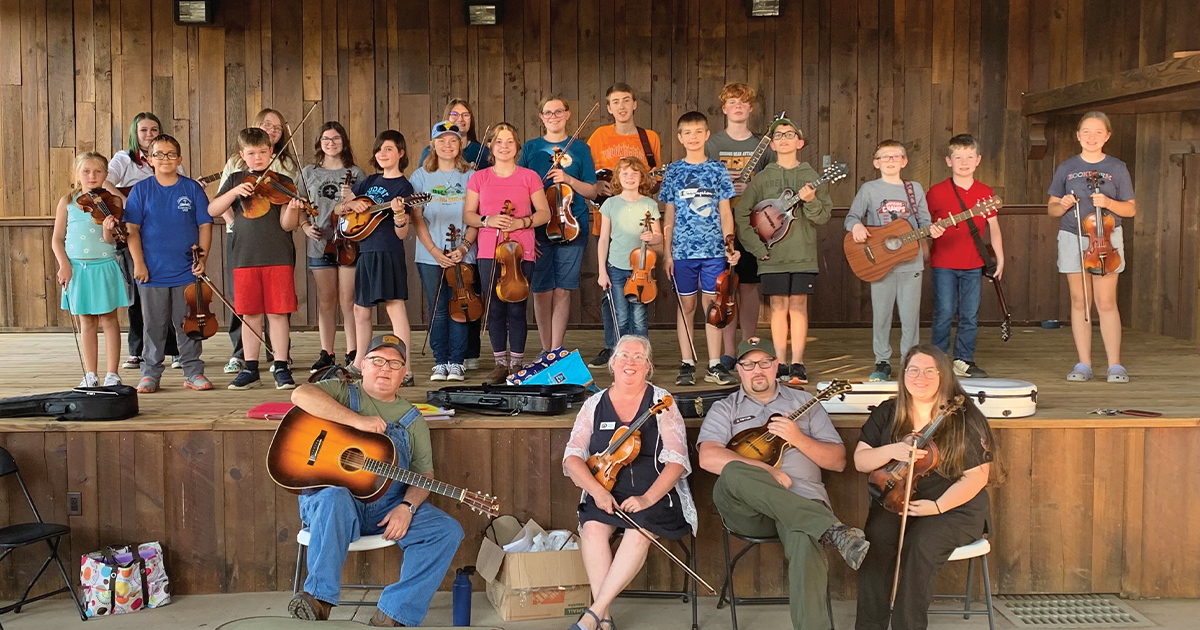
Jam Pak, now a 501(c)(3) nonprofit charitable organization, has evolved into a community, a multi-generational musical family. Dozens of children gather twice a week at Anni’s house to practice and teach each other with the goal of sharing their musical happiness with others, and the group hosts an annual summer bluegrass camp. They perform at events across the Southwest, attend IBMA’s World of Bluegrass events, and several students have gone on to perform in their own professional bands.
Flash back to 2025: The challenge, of course, was that Jam Pak’s instruments were in Arizona, and JAM headquarters was in Independence, Virginia. Cardwell and Blumenthal thought about asking bluegrass bands traveling cross-country to pick up some instruments and carry them east, but even a tour bus wouldn’t have room for 43 extra instruments.
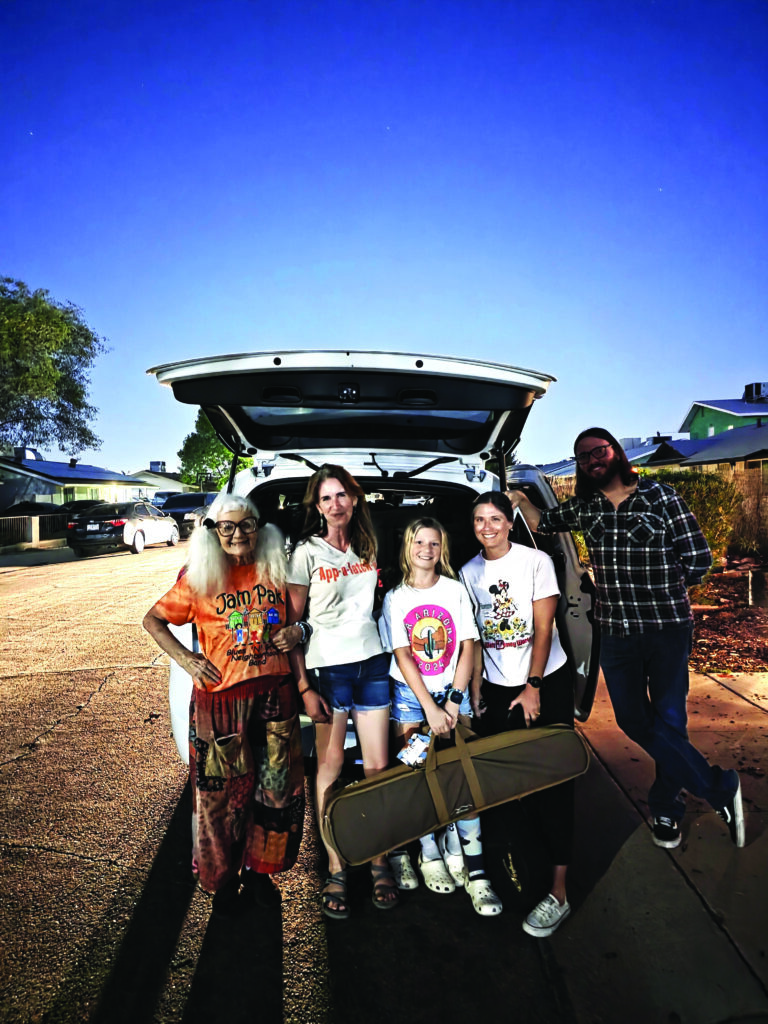
Photo by Blanche Fletcher, J.A.M.
The cost of shipping so many instruments was unrealistic. Why not just drive out there and bring them back? The “not so crazy after all” cross-country trip happened in mid-October, 2025, with Brett Morris at the steering wheel, accompanied by her two best friends, Blanche Fletcher and Paula Rosenbaum. Amazingly, all the instruments (plus the three women and their luggage) fit into the rented van, and the instruments are now being adopted by JAM affiliate students across Appalachia.
“When I first heard about the idea,” Brett Morris said, “I thought how delightful to know there’s a program similar to JAM happening in a place like Arizona and about the many collaborations we could have, but I also thought about cost effectiveness. It wasn’t something I thought my board would go for! The idea got tossed around for a few months, but it was also during my busy event season. Then it all came to fruition after World of Bluegrass week in Chattanooga, and someone offered to be our anonymous sponsor. Counting our gas and lodging, it came out to $56 in trip expenses for each instrument.”
The Jam Pak kids were excited about the upcoming visit. “They thought it was very cool,” Anni said. “I have all ages, from three years old on up, and I kept reinforcing what they were doing—the inspiration they gave and what they were sharing. They knew I had to share the instruments,” she said. “They already had what they needed. They really liked the idea of fixing up the extra instruments, but first they had to figure out where Virginia was!” she laughed. They looked at a map. “After the visit we had a big re-cap and I read Brett’s entire report letter to her board of directors, to them,” Annie said. “We talked about how what they do affects people. I’m always on that subject! That’s why people like Jam Pak so much. It’s not so much the music; it’s their persona and the way they are with people. And they love to teach. Even the small ones will teach a small, small one.”
“If I had driven straight, it would have taken three days,” Brett said, “but we stopped in St. Louis and we spent a few days in New Mexico until Anni and the kids got back from a festival they were playing. It was a little over 2,000 miles, one way.”
As they were zipping past the Arch in St. Louis toward the deserts of Arizona, did Brett ever stop and ask herself, “What am I doing?”
“A few times in the middle of the night we would stop and I’d think, ‘How did we get here?’” she laughed. “But it was a much-needed trip, and it felt very God-sent.”
She wasn’t sure what to expect. “It was very similar to JAM, but it was more home feeling. You could feel the many years of tradition that has been created in Anni’s home in the way the kids walked in and out and meandered around, and the parents who were hanging out. It was such a cool vibe to walk into. I kind of expected that in a way because she had told me, ‘If you get there before we do, just go on in.’ I like those sort of places! It was definitely very special, and she made us feel very welcome.”
Bluegrass musicians and fans are often different in every possible way except for their passion for the music. It’s astounding how people from around the world—with different vocations, cultural backgrounds, races, regions, political beliefs, and languages—often develop lifelong friendships because of a shared love for playing and enjoying bluegrass music.
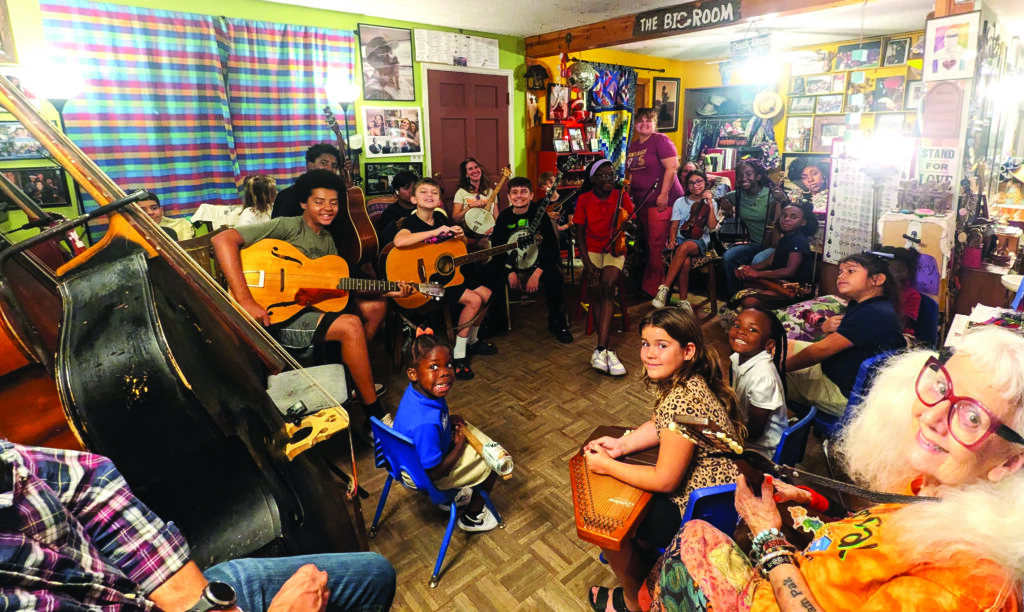
The children of Jam Pak and JAM were different in some ways, and exactly the same in others. “I think we all are cut from the same cloth,” Brett said, “but we were really taken aback at how respectful Anni’s kids are. They were so sweet. They kept saying, ‘What else can I do to help you?’ It was wonderful to sit in the middle of a whole room of kids who all wanted to be there.”
“The children themselves are the volunteers at Jam Pak,” Anni explained. It’s not something that is run by their parents. “They don’t come from bluegrass families who want them to play this music. They are here because of social reasons—they get food, they get instruments, and they get to go places and hang out. Everything is open. The place is theirs, and they know they have to help take care of it or it won’t be nice. The refrigerator is always open.”
“My two best friends and I found ourselves exactly where we were supposed to be,” Brett wrote in a report to the JAM board of directors—”sitting in Anni Beach’s living room in Chandler, Arizona, surrounded by smiling faces and clanging instruments played by children of all ages and personalities. Anni handed me a banjo, and we all crowded around each other. Everyone was excited to experience my clawhammer playing, but I enjoyed listening to the hot licks of a teenage three-finger picker in front of me. The kids took turns calling songs. When a fiddle player shouted, ‘New River Train,’ I shouted back, ‘Hey! Listen up! Y’all! Did you know that the New River train was a real thing? I live four miles from the New River, where the train once ran. And…the New River is the only river in the world besides the Nile that flows north.’
“Their minds were blown,” Brett continued. “They didn’t know it was a real place. If I’d been more prepared, I could have told them how Henry Whitter recorded ‘New River Train’ in 1923 as one of the first country music recordings in the world. Whitter was from Fries, Virginia (pronounced ‘Freeze’ in the winter and ‘Fries’ in the summer), where I used to teach school and where we just opened the first ever Grayson County JAM program this fall.
“I loved the way the Jam Pak version of ‘New River Train’ was beautifully accented by the bass player blowing a train whistle,” Brett said. “Going forward, we intend on bestowing one of these donated instruments to the new JAM program in Fries, where we can follow its journey and have ‘New River Train’ played on it a hundred more times, at least.
“I sat beside a young man who had completed much of the repair work on the instruments set aside for Junior Appalachian Musicians. Across the way was a four-year-old canjo player, working on her rhythm. There was a dulcimer, an autoharp, and banjos, fiddles, guitars, and mandolins respectfully following their leader, Mrs. Beach, as they all sang and played with gusto. We learned about their escapades traveling around the Southwest to perform and their meetings every week in Mrs. Beach’s living room that have been going on since the 1990s. Everyone there felt the vibrant community and family spirit that can’t be faked, can’t be made by AI, and can’t be destroyed.”
The group decided to write letters and stay in touch with each other. “We’ll get started with six pen pals,” Anni said. “The letters will go out from my address so I can make sure they have a stamp. Then I’ll send them to Brett’s address. I thought it was a great idea because nobody writes letters anymore.”
“We talked about pairing them up by age and instrument,” Brett said, “and I’ll likely start with people in programs that are close to our headquarters. I’m going to take the first two instruments to a program that is re-starting in Gate City, Virginia, the Scott county JAM program. A couple of them will go here in Grayson County to a new JAM program. I want to follow a few of the instruments and their journeys.”
The experience, Anni Beach said, is “something that I will reinforce over and over. ‘Why are we fixing these instruments? Where are they going?’ We have to talk about it, and then talk about it again. I’ll tell them we had this meeting today and how important it is – what they’ve done and what we do.”
“There are music education programs all around the world,” Brett wrote in her report. “We all have common ground, and we shared missions of showing others our love for music and how it can change lives in so many different ways. What Jam Pak is doing is beyond that. While our JAM programs build community one tune at a time, we are still based mostly in public centers, arts councils, schools, and other existing entities part of the often-struggling infrastructures of Appalachian communities. The family feeling in Mrs. Beach’s home is something that will stay with every single person who experiences it forever. That energy is connection, it is love, and it is exactly how music binds people together. I know [this memory] will stay with all of us, and it has re-invigorated my energy for the work I do. My mission will continue to extend this love as far as I can throughout the mountains of Appalachia.”
Morris said she is looking forward to hearing about the friends made from Appalachia to Arizona (and back), as the children from opposite ends of the country learn to “write real letters and put them in the mail.”
It is indeed more blessed to give than to receive, and one doesn’t need to be wealthy to give something away. This is a lessons the kids at Jam Pak and JAM will never forget, and one that many of us could stand to remember.
“At the end of the day if there was no other way to do it, we just would have paid to have the instruments shipped,” Sam Blumenthal said. “What’s really cool is that Brett made it into an adventure. The title, ‘Appalachia to Arizona (and Back)’ could be a great song title!
“The thing that is the most compelling to me, and to all of us,” Sam continued, “is that Anni and her kids first thought of this. They had all these instruments and they had the desire to give them away, and then we all put it together to make it happen. Music facilitates the connection between us. This has turned out to be a great story, but it’s not really about music,” he said. “It’s not even about bluegrass. It’s about the connection that is deeper. There’s something very special and powerful about music that I think comes from the essence of God. There’s no other explanation for how powerful it is.”
One of the many dreams of the IBMA Foundation is the creation of a network of resources for sharing used bluegrass instruments across the country for students and families in need of a good starter guitar, banjo, mandolin, fiddle, Dobro, or bass. There are programs like Hungry for Music based in Washington, D.C.; Can’d Music in Colorado; the California Bluegrass Association’s Lending Library, and Alan Tompkins’ Bluegrass Heritage Foundation in Texas. There are more that we don’t know about yet.
Instruments need to be played. They shouldn’t be sitting in a closet somewhere. There are people who want to learn to play, and the lack of a good instrument keeps them from it. What a great service, to put bluegrass instruments into the hands of young people—but also older folks who have more time on their hands in retirement years and want to be a part of the bluegrass community. Please take some inspiration from the young Jam Pak and JAM musicians and write your own new chapter to this good story.
View the Slide show at youtube.com/shorts/aLb8iwhaPuc.