For Luthier Lawrence Smart, X Marks His Spot
Photo by Bud Osborne
Maybe it’s something in the Pacific Northwest’s air or water, or perhaps it’s being surrounded by the grand mountain forests of Idaho and the Pacific Coast that inspires brilliant luthiery. But whatever it is, that majestic region has spawned some of the world’s finest woodsmiths, including mandolin masters Michael Heiden, Fletcher Brock, the late Bob Givens, and Austin Clark.
One of the founding members of that great luthiers’ fraternity is Lawrence Smart of Hailey, Idaho
(www.lawrencesmart.com). Now located in a cozy, wood-scented shop not far from the famous Sun Valley ski resort, over a three-decade career Smart has produced beautifully crafted, memorable-sounding mandolin family instruments and archtop guitars for musicians including the great John Reischman, Courtney Hartman (formerly of Della Mae), Chris Thile, Ricky Simpkins, Brittany Haas, Matt Flinner, Eli West, Joe K. Walsh, Nick Forster, Mike Marshall, Ben Winship, and more. When I look at his matching mandolin quartet instruments and his somewhat non-traditional instruments with dolphin soundholes done in stunning finishes highlighting wildly figured tonewoods, I think of Smart as the Monteleone of the Wild West.
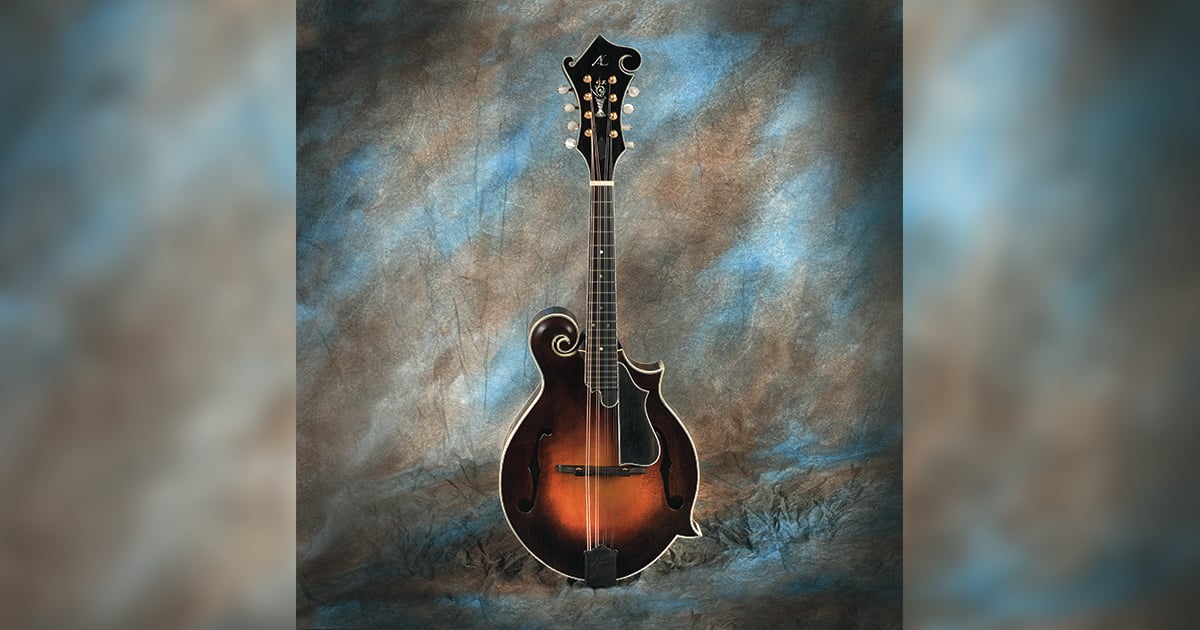
The review instrument Lawrence shared with Bluegrass Unlimited is SN #381, a premium F-5 presented in a very traditional, hand-rubbed varnish finish with a deeply figured, two-piece red maple back and sides. The fine-grained top is a piece of Englemann spruce Smart personally harvested near his old workshop in McCall, ID, and he knows its sonic palette intimately. Asked about any torrefied woods used here, Smart replies, “All woods are air-dried; nothing fancy.”
The top is X-braced with Adirondack spruce braces, an intriguing choice, using a unique bracing design. “It is X-braced, and it’s a little different than other mandolin X-bracing (where the X crosses closer to the center of the top under the bridge). My X crosses above the bridge (toward the neck) so that a brace runs under each bridge foot as is the case with tone-bar braced instruments. I’ve used this bracing forever, having borrowed it from archtop guitar makers.”
Another idiosyncratic construction element is Smart’s inclusion of distinct ridges carved into the top and back plates as they graduate away from the wide end of the scroll. Smart explains candidly that initially, he picked up that trick from fellow Idaho builder Bob Givens. “I (think of) the little ridge as a balance to the little ridge that comes off the scroll (at its curlicue end). In reality now, I don’t think it influences much tonally, and I do it really as a testament to Bob Givens, who was the first Idahoan to take mandolin building to the world,” Smart says. “He did that little ridge, and when I was just starting out I thought it was cool.”
This F-5 has a shallow compound radius neck with a 1 and 1/8th nut width. The frets are standard nickel silver with a 0.080” crown, the type most players and builders call banjo fretwire. At the far end of the mandolin, there’s a lovely flowerpot inlay done in a subtle mix of mother of pearl and abalone, set off by Waverly tuners with matching pearl buttons. Finishing the hardware off we find a dark-stained, hand-engraved James tailpiece, antiqued with material Smart sources from a local foundry to give it a distinctive darkened patina. The top, back, fingerboard, ebony pickguard and headstock are bound in a delicate white-black-white binding that’s executed cleanly with spot-on miters and joints.
The test instrument, signed October 13, 2020, has a thin spirit varnish finish that showed a bit of player wear when first removed from its case. As Lawrence explains, “Yeah, I haven’t babied the instrument and it’s hard to get that new spirit varnish finish out the door without a mark or two.” Since this instrument had been finished and played for several months before being sent for review, it’s easy to understand that the fragile finish might have picked up a few marks prior to delivery.
Priced at $10,500 with a standard hard shell case, this Smart F-5 competes directly with mandolin builders like Will Kimble, Tom Ellis and more who deliver a fine handmade F-5 at around that price point.
From my examination, this Smart F-5 clearly belongs in that company, with mostly exceptional fit and finish throughout. This mandolin is more brightly voiced than many traditional bluegrass mandolins, partly due to Lawrence Smart’s unique X-bracing and Englemann top, I suspect.
Smart isn’t trying to chase the Loar sound. The bass is potent, but it doesn’t dominate the instrument’s tone. Heavy chop chords ring out and should cut through a jam, but they don’t quite have the full body weight of other mandolins that are purpose-bred for driving a bluegrass band with their rhythmic power. That’s an aspect of this instrument that I would expect to evolve as the naturally-aged tonewoods break in over time (and it would be interesting to see if those carved ridges on the bass sides of both soundplates do, in fact, influence the bottom end sound). A set of monel or 80/20 bronze strings also might be a bass-enhancing game-changer here. The highs are pristine and filled with that lovely sizzle and crunch, revealing the signature sound of its builder. Tunes like Manzanita and other dawg music tunes, as well as fiddle tunes, lilting Celtic refrains, and other melodic pieces just begged to be played on this mandolin. As one would expect from someone who’s built an international reputation as a premium builder, there are plenty of highlights to mention. The almost perfectly book-matched two-piece back displays gorgeous 3-D figuring. All the difficult, complex angles and demanding compound curves that make F-5 mandolins so challenging to build well are professionally rendered. Looking inside, the interior of the mandolin is clean and executed crisply, although there are a few small areas of glue residue inside the kerfing that one wouldn’t find in a Dudenbostel or Gilchrist. One issue I’ve seen repeatedly from many great builders is that they create spectacular instruments, but lack similar expertise in setup and playability. On the review mandolin, all four courses of strings are slotted a little too deeply in the nut. Correcting that might free up the D and G strings to vibrate and project more. The string height is comfortably low with no buzzes along the fretboard’s full length, and the frets are properly crowned and polished. But the fret ends on both sides of the fingerboard are a bit too long and underdressed. The overall profile of the neck is a deeply rounded V, with the shoulders of the neck and fingerboard straight parallel—no rounding to give it a played-in, vintage feel. But leaving those parts more vertical also preserves valuable fretboard real estate, so it’s a trade-off. But if this were my mandolin, I’d have a setup professional change the nut, dress the fret ends and round the fingerboard edges out a bit to give it a smoother feel up and down the fingerboard.
Playing this Lawrence Smart F-5, it’s easy to understand how his environment shapes how he approaches his craft. Smart believes in the wood he harvests. He trusts his design as something right for the players in the northwest pursuing different avenues of bluegrass and acoustic music. As an artist, he’s unafraid of trying new designs and finishes. Heavy-duty traditional bluegrass mandolin players looking for a deep-throated bass response from their instrument might want to look elsewhere, as an X-braced F-5 with an Englemann top really isn’t built to deliver that “Loar” sound. But with its sweet, chimey high end and top-notch single note projection, this Smart F-5 is voiced for more contemporary mandolinists seeking an instrument that inspires their melodic creativity.