

Festival Innovation & Evolution
Written by Dale and Darcy Cahill
Over the past thirty years of attending bluegrass festivals, Dale and I have witnessed festivals evolving beyond rough camping and one-stage events. Some of the innovations grew out of attendees’ suggestions and others from promoters trying new ways to attract larger audiences and add even a small amount of extra revenue to keep their festivals alive. Some of these innovations that we now take for granted are RV camping, campsite concierge services, kids’ academies, online ticketing, dance tents, and expanded offerings on main streets from thrift stores to farmstands. The list goes on. This past season, we noticed three specific additions to bluegrass festivals that impressed us, and we expect will become standard fare moving forward: VIP tickets, well-organized sobriety support and phone apps, simple and complex.
VIP translates into Very Important Person. Thus, a VIP ticket offers above and beyond a general ticket, which typically includes entrance to the festival, camping, and access to bathrooms, sometimes showers, and all that main street has to offer. VIP tickets most often come in two or three tiers, each tier offering more amenities and costing more than the others. These tickets offer a range of perks beyond general admission, including priority entry, dedicated viewing areas, access to exclusive lounges with amenities like snacks, soft drinks, and air-conditioned restrooms, and sometimes special extras like merchandise, food and drink vouchers, or even meet-and-greets. Benefits vary widely between festivals.
Glamping
There are benefits to these VIP tickets for both the promoters, who can gain added revenue, and audience members who can afford to buy them. Another perk gaining popularity is “glamping,” which provides various levels of pre-set camping sites. These sites run the gamut of simple tent sites with cots to luxury tents, cabanas, and yurts. Those luxury tents include everything from king-sized beds with fresh linen, air conditioning, breakfasts, prime locations near the stage, and anything else that creates a comfortable camping experience. These pre-set camping communities are perfect for people coming from a distance who do not want to lug along camping equipment and who can afford upgraded packages that cost more but make attending a festival a no-hassle experience.
For instance, Grey Fox Bluegrass Festival in Oak Hill, New York, provides 4000 camp sites, a limited number of which are available in what they call their High Meadow Glamping Village. The most affordable setup includes a tent and cot with camp chairs, a wash water jug, a collapsible cooler, and other sensible camping items. This basic package can be upgraded for fees. For instance, adding a shower costs sixty-five dollars, kitchen supplies seventy-five dollars, a canopy with table one hundred and fifteen dollars, etc.
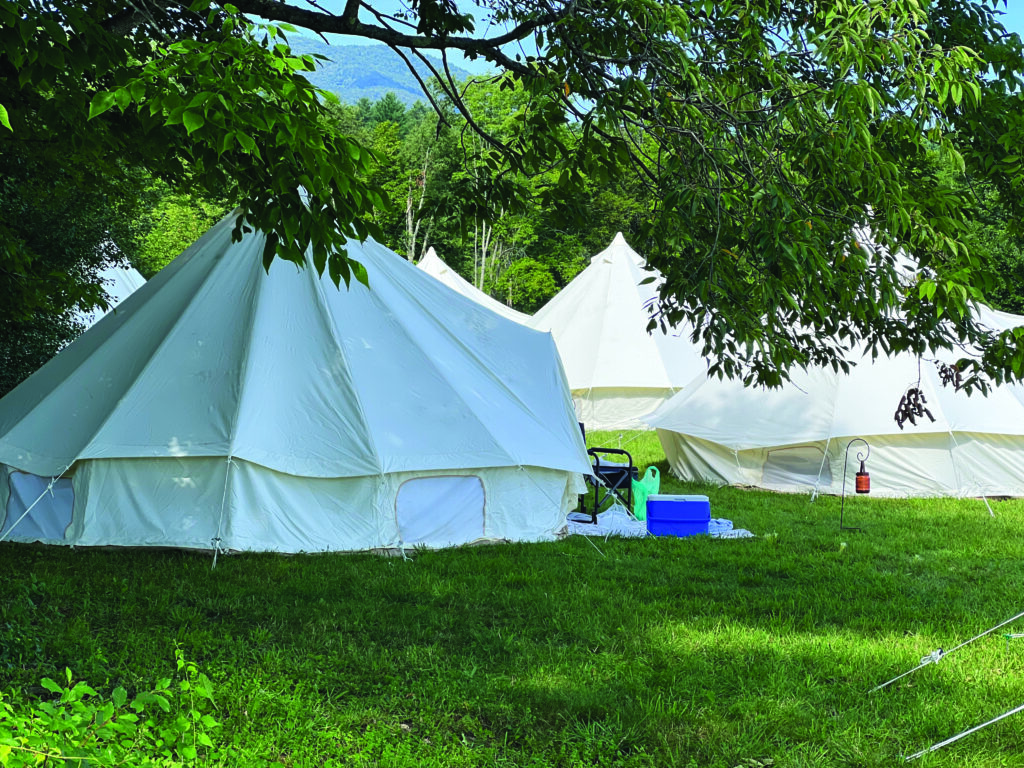
Glamping, however, is not offered at every festival, especially ones with fewer attendees, and festivals that do not have the room to set aside a site for these tents. There is also a dynamic of the haves and the have-nots, which some promoters do not like and which they believe negatively impacts their specific festival culture. Jody Barnett, general manager for Strawberry Music Festival in Grass Valley, California, says that the culture of this long-running festival promotes an equal opportunity, first-come, first-served approach. Their approximately 3000 attendees are happy with their festival just as it is, and they have had no requests to include glamping options.
The Green Mountain Bluegrass and Roots festival, now in its 7th year, has tried all kinds of camping and VIP options. Promoter Jill Turpin has hired three different glamping companies, and although they met her expectations, none of them seemed to fit her festival’s culture. She says, “They charge attendees a fortune and created an us/them feeling.” The sites took up too much room near the stage and didn’t offer a fair camping ethic, which she values. Turpin says that the decision not to include the pre-set camp sites has disappointed some attendees, but the decision not to offer them just feels right. Turpin has also scaled back VIP tickets. She does offer a small package, which allows for a close viewing area and a porta-potty. Turpin’s decision to keep this limited, low-cost VIP section is especially beneficial for people who aren’t comfortable in a large crowd.
Sobriety Support
Another innovation gaining ground is adding well-organized and visible spaces for attendees in addiction recovery. Rich James, Podunk board member, has seen sobriety support slowly gain ground since the 70’s when it happened behind the scenes. He has provided AA and NA meetings in the past and has seen the positive impact for those who need it. One of those people who has benefited from the meeting is Rich Whitman, a longtime volunteer for Podunk Bluegrass Festival in Goshen, who likes to share his sobriety story. Now in his 25th year of sobriety, Whitman knows the risks for those in recovery at a music festival.
Whitman has always loved bluegrass music and started attending festivals in the mid-70s. Despite his love of the music, he would set up his tent and then never attend any performances. Whitman says quite clearly, “I went for the party.” He did the same thing at festivals for the next twenty years and suffered all the negative consequences of alcohol and drug abuse. In 1999, with the support of family and friends, he sought support and got clean. In his second year of recovery, he took a huge risk and attended Grey Fox Bluegrass Festival. He knew that he would be surrounded with friends and strangers who would be partying, and the temptation to drink would be huge. He says, “You learn to take one day at a time to achieve recovery, but at festivals you take one minute at a time to stay sober. Not everyone makes it.”
In the 70s and 80s, there was nothing in the Grey Fox program about where to find Narcotics or Alcoholics Anonymous meetings. Determined to remain in recovery, he had to search through the message board in hopes of finding a meeting or community of sober attendees. He found them, but knows that there were plenty of recovering attendees who didn’t know where to look to find those same gatherings.
Now in his 25th year of sobriety and still attending bluegrass festivals, his first piece of advice for promoters is to learn about addiction and what it takes for someone in recovery to even step into a festival. From there, promoters need to either find people within the festival’s community who will take the lead in setting up a support system or hire an organization to come in and do it for them.
At Strawberry Music Festival, Barnett says that sobriety support comes from within the community and sprang from attendees who saw a need for it and took charge of offering the support they knew would help the most. This approach works well for smaller festivals but is lost in the chaos of thousands of campsites and throngs of attendees.
For those larger festivals, seeking out sobriety organizations like The Yellow Ballon provides a higher profile and visible sober fellowship that includes more than just an information table and NA and AA meetings. Yellow Ballon organizers, most often volunteers, rely on promoters to set aside designated sober camping, a tented area where people can gather at any time of the day to sit, take a break, and chat with other folks in recovery. These designated areas, meetings, and events are published in the program and marked on the site maps so they are easy to find. In addition, Yellow Ballon hands out our yellow stickers that people stick to their clothing, so if someone is deep in the crowd and begins to panic or feel anxious, they can look for that yellow sticker, can reach out for support, or just stay put and realize that they are not alone. Whitman emphasizes that it is possible to enjoy a festival and remain sober.
The Festival App
Finally, the innovation that took us most by surprise is a festival app. These apps are loaded onto your phone and typically feature artist line-ups, interactive maps, schedules, and real-time updates to help attendees negotiate a busy day at a festival. They can also collect analytic information from users, which helps promoters design future improvements.
Candi Sawyer, promoter of a Vermont festival, Jenny Brook Bluegrass Festival, relies on her program to communicate critical festival information. Jenny Brook takes place at an agricultural fairground and is small and well-organized enough that an app would simply be overkill. Turpin, who runs a similarly sized festival, is considering it, in part because it can take the place of a paper program, which simply adds to festival trash. However, when Turpin reached out to hear what her attendees thought about it, most asked that she not replace the program. They loved the graphics and size and took it home as a souvenir. The festivals where the app seems most helpful and even necessary are at larger festivals.
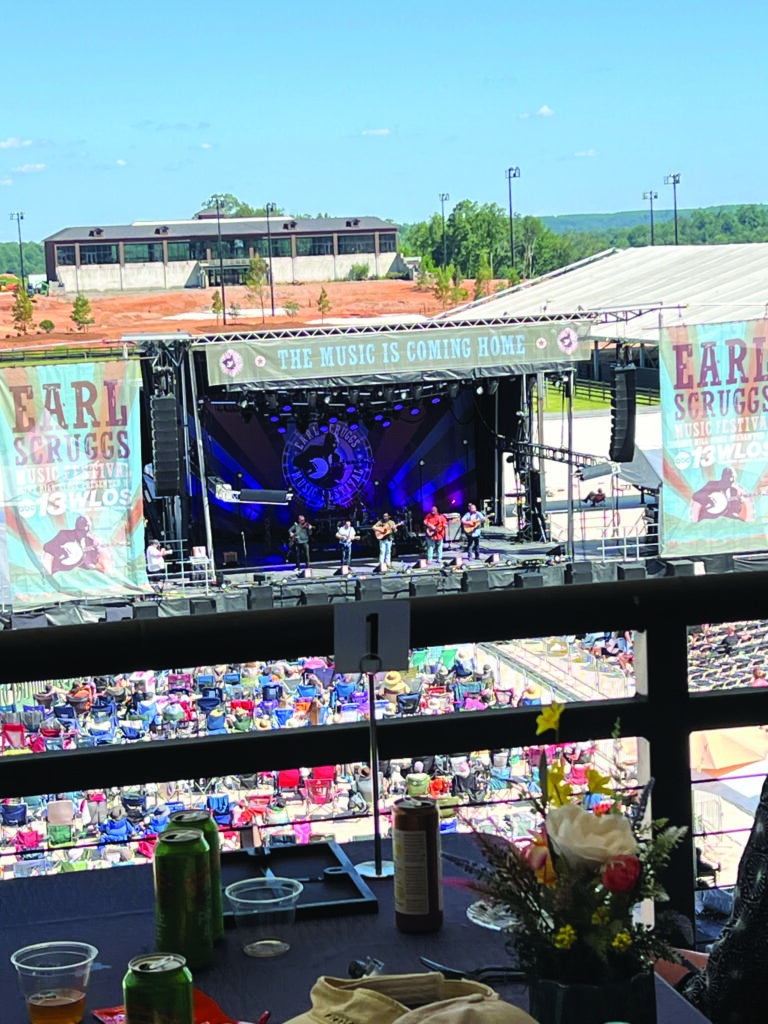
Grey Fox Bluegrass Festival is one of those festivals. In 2025, the promoters introduced a dedicated festival app designed specifically for Grey Fox. Promoter Mary Burdette says, “The app empowers fans to build personalized schedules, explore artist info, and receive real-time updates and alerts straight from the festival team—ensuring no one misses important announcements or surprise sets.” Attendees enthusiastically embraced the app, and it will become a staple at future festivals. Earl Scruggs Festival is similar in size to Grey Fox and is where we got a chance to experience the app for the first time. It did a great job of helping us to keep track of who was performing at each of their three separate stages, when the performance began, and where those stages were located. With the large number of distractions at festivals, sending reminders about upcoming shows keeps attendees from missing workshops, meet and greets, and events that can get lost in the crush.
The complexity of these apps varies, and they don’t come cheap. Promoters have to hire companies to program the apps and make sure that they work smoothly throughout the festival. The prices start in the low 100s for simply using the app to replace or duplicate the festival program. From there, the cost rises in relation to the level of customization and frequency of use. A once-a-year event like a bluegrass festival can cost upwards of three thousand dollars.
We suspect that Carlton Haney, who organized the first multi-day bluegrass festival in 1966 at Cantrell’s Farm in Berryville, Virginia, would be stunned at the state of bluegrass music festivals today. While you can still find small local one-day festivals all over the country, bluegrass festivals and what they offer attendees never remain stagnant. Promoters who are aware of innovations, listen to their attendees, and know the culture they want to promote each year will be better able to make the changes that enhance the experience for their audiences, and they might decide that no change is just fine.
