Ever Higher
Alan Munde Rises Above Convention with New Record “Excelsior”
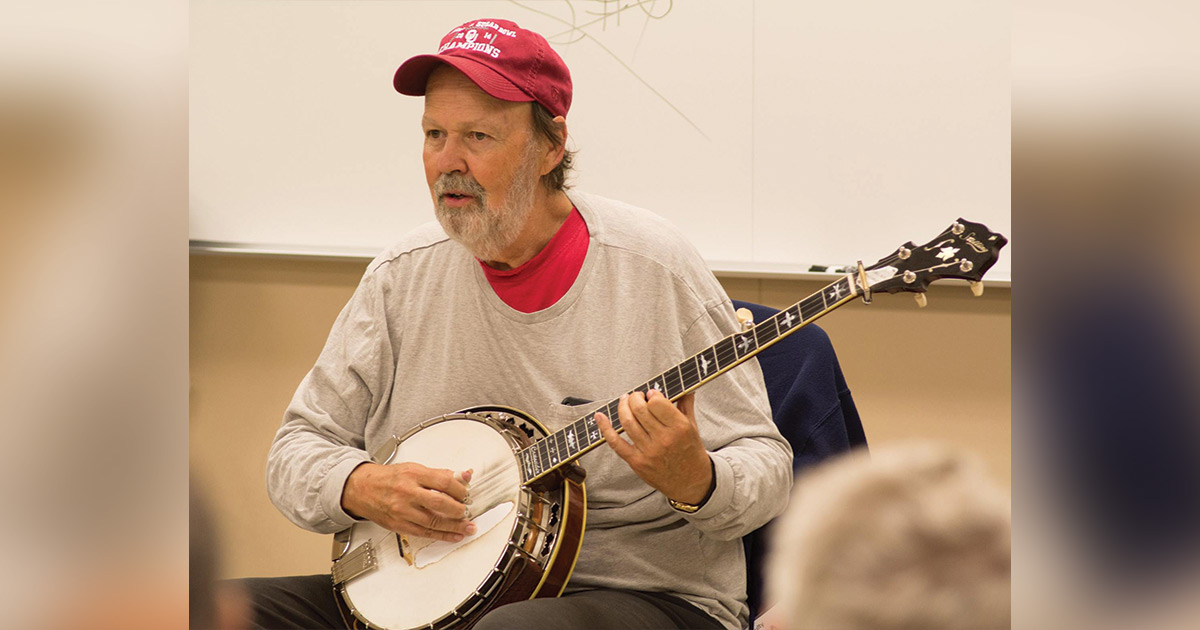
When Alan Munde was thinking of a name for his new collection of fifteen tunes building on his long-standing penchant for harmonic adventurousness and embrace of the melodic banjo style, he lit on one word: Excelsior.
It’s a direct nod to a short Henry Wadsworth Longfellow poem of the sort Munde and his school fellows might have been expected to learn by heart when they were growing up. Longfellow’s verses tell the story of a man who persists in ascending an icy peak despite being warned by local villagers of the dangers that lay ahead. Munde said he doubts “Excelsior” the poem merits a revisit for most people these days. But he likes its basic message of carrying on in the face of great difficulty.
The word “Excelsior” itself is meant as a loose translation into Latin of the phrase “ever higher.” “It’s just a feeling about the whole record,” Munde said. “For me, anyway, it’s a little different. It has a lot of different formats on there — all the way from solo banjo to duos with mandolins, and then smaller ensembles featuring a lot of mandolin up to a full band. It just seemed like an appropriate title for a sort of adventuresome project.”
Not that a willingness to experiment is something new for this album. Munde has displayed that tendency all the way dating to early recordings like his classic solo projects Banjo Sandwich and The Banjo Kid Picks Again, as well as many albums with the supergroup Country Gazette. “Peaches and Cream,” a composition that’s found its way into many a five-string picker’s repertoire, was showing bluegrassers as far back as 1975 that they could move away from the standard three-chord format of their genre without sacrificing drive or tunefulness.

Munde said at least one of the songs on the new recording dates back even further. “Ten Cent Breakfast,” he said, is “sort of my 16 year old imitation of what I thought steel guitar players played.” When he was growing up in Norman, Oklahoma, Munde spent a good deal of time listening to recordings of Western swing bands.
“There wasn’t a lot of bluegrass there, but there was a lot of country music,” Munde said. “And certainly on Saturdays, I would sit and watch anything and listen to anything at that time that had a guitar in it, because that was sort of the closest I could get there. And so I’d watch all the country music shows on Saturday, and they always featured steel guitars.”
“Ten Cent Breakfast” features Lloyd Maines—a honoree in the Texas Steel Guitar Hall of Fame, multi-instrumentalist and fixture of the Austin, Texas, music scene—on pedal steel guitar. It’s also one of the tracks to present a full band; this particular ensemble’s filled out with drums, bass, accordion and mandolin. Munde said the accordion was added in part because it was the first instrument he ever picked up. “So we got the hottest sort of young Hispanic accordion player we could find, named Josh Baca, which I thought added a real nice touch to it,” he said. “So it’s sort of a southwestern or a Texas country music-esque tribute to the steel guitar.”
Also dating back quite a few years is Munde’s “Birthday Waltz,” one of three solo-banjo compositions on the records. It’s yet more evidence that his willingness to go outside of the harmonic conventions of bluegrass has been a lifelong characteristic. Equally adventurous is another of the record’s solo-banjo tracks: “Hymn for Slim.” Munde said one reviewer of the album has heard the influence of jazz harmonies on his composition. But for Munde, the inspiration came as much from the classical world. “It’s just, once again, listening and seeing what other people have done and what you can do on your instrument—what kinds of interesting things you can do,” he said.
Munde said one of the biggest hurdles to overcome with the banjo in any setting is the instrument’s lack of sustain. That’s even more true on tracks on which the banjo is featured by itself. One technique Munde employs to produce the impression of long-held banjo tones is to take notes that might be played as full chords on other instruments and instead play them in quick succession. Especially if the notes are plucked on separate strings, they can bleed together in a way that helps camouflage the usually quick decay of the banjo’s sound.

“I’m talking about just minuscule amounts here, but you get a little more sustain,” Munde said. “And to me, it feels a little more expressive doing it that way. So that’s one of the things I was looking for—a more slow and graceful sort of hymn-like approach.”
The tune “Hymn for Slim” was named for Michael “Slim” Richey, a Texas guitarist who for years ran the well-known bluegrass and acoustic music label Ridge Runner Records. Munde said he met Richey at the age of 14, when his search for musical instruments led him to the door of Mike Richey’s Guitar Center. They remained friends until Richey’s death in 2015. In 1977, Munde and Richey played together on Richey’s landmark “Jazz Grass” album. One of the first recordings to feature bluegrass musicians playing jazz, the record had Munde and his musical brethren wending their way through the harmonic twists and turns of standards like “Back Home Again in Indiana” and “Stompin’ at the Savoy.”
Playing fiddle alongside Munde on some of the album’s tracks was the renowned Sam Bush. Bush, who became even better known as the mandolinist in bands like New Bluegrass Revival, was one of the first musicians to help Munde pursue his love of mandolin-banjo pairings. Their album featuring their duo playing, Sam and Alan: Together Again for the First Time, was released on Ridge Runner Records in 1977.
Bush returns for “Excelsior” to play with Munde on a track entitled “Byron’s Buddies.” It’s a tribute to their friend and musical collaborator, the late fiddle great Byron Berline, and just one of several banjo-and-mandolin duos to appear on the new record. Munde said the banjo-mando combination is likely his favorite among all the different possibilities for bluegrass instruments. He has paired himself with many a mandolin star over the years, perhaps most notably Roland White in Country Gazette. But his taste for mandolin-banjo duets really goes back to the days when he was trying to glean as much as he could from recordings of bands like The Dillards. That family-centered ensemble featured the hot lead playing of Doug Dillard on banjo and Dean Webb on mandolin.
Notably absent from many of The Dillards’ classic recordings was the sound of the fiddle. Munde said he didn’t necessarily miss it. As often as the banjo is paired with the fiddle, Munde said, he thinks the mandolin makes a better partner. The goal of having two picked instruments play in sync, he said, forces players to be especially painstaking with their articulation and phrasing. “The fiddle, you know, is bowed and can do long notes, that sort of thing where you have just this riot of strings,” Munde said. “But on the banjo and the mandolin, when they’re going together there, it’s almost like one instrument with two sounds.”
Bush is in fact just one of nearly ten mandolin players to appear on what Munde deemed a “mandolin-heavy” record. Besides Bush, the mandolinists Emory Lester, Ron Pennington and Jeremy Chapman all take duo turns with Munde. And Don Stiernberg shows up to play with Munde on “Untitled Waltz” with the accompaniment of a bass.
One of the tracks, “Stay with Me Waltz,” goes so far as to feature three mandolists. Billy Bright and Kym Warner were joined on their acoustic mandolins by the electric mandolin of Paul Glasse. (Bright also contributed mandola to the track.) Bright, who produced the album, said the idea for the triple mandolins was his. But once he had proposed it, Munde wasted no time coming up with an arrangement. “He was taking my idea and making it his own and solidifying it, very much so it was in line with his original intentions, especially compositionally,” Bright said.

Bright, who has worked with Munde on previous projects, said his main task as producer is to understand exactly what Munde wants out of his tunes and his playing and then to try to capture that on a recording. “I definitely didn’t tell Alan what notes to play,” he said. Bright said one aspect of Munde’s playing that he’s renowned for among musicians is his backup. On the new record, Bright said he found himself marveling at the way Munde was able to surround soloists with supportive but not overbearing accompaniments, even at times when the instruments weren’t recorded at the same time or in the same place. Tracks for “Excelsior” were laid down in studios in Wimberly, Dripping Springs and Austin, Texas; Las Cruces, New Mexico; Springfield, Missouri; Evanston, Illinois; Everett, Ontario; and Nashville.
“When you listen to it, it’s crazy,” Bright said. “He knows what to play even when the person isn’t sitting there to listen to. He’s able to play backup, and it sounds like he’s responding to the person who’s playing.” Bright said some of Munde’s backup ability no doubt stems back to the Texas-contest fiddle-style playing he was exposed to in his youth. Bright said Munde’s penchant for harmonic exploration owes quite a bit to the guitar accompaniment typically played behind fiddlers on tunes like “Leather Britches” and “Gray Eagle.”
Bright said Munde was one of the first musicians to bring those sorts of progressions to the banjo. The influence of the Texas-fiddle style shows up, he said, on the new record on tunes like “Byron’s Buddies.” Bright said Munde has certainly touched in the past on the many different styles that are present on Excelsior. But never before has he presented such diversity in one place.
“This is also the most non-bluegrass compilation of songs he’s ever done, the most solo banjo pieces and the stuff with drums and pedal steel, and furthest step from the bluegrass box,” Bright said.
The album’s longest track, “Rabbits in a Watermelon Patch,” is perhaps also its most ambitious. It starts with a more than a minute long solo banjo passage that Munde said was partly ad libbed. It’s all played bare-thumbed—Munde removed his picks for this part—in a series of downstrokes. The harmonically rich changes he wrings out of his fretboard bring to mind nothing so much as the wayward musings of a jazz pianist.
Bill Evans, a renowned banjoist himself who will be performing tunes from his own recent recording Things Are Simple while on tour this winter with Munde on the East Coast, said he has witnessed Munde on many occasions in one of these contemplative, exploratory moods. At music camps or before shows, Munde can often be found sitting to the side and testing out harmonic possibilities on one of the Stelling banjos that he’s been associated with for most of his career. “While I savor every opportunity to hear Alan play in any setting, it is in these times, when he is playing by himself for himself, that I’ve experienced Alan playing pure music that is unfettered by stylistic boundaries,” Evans said.
“Rabbits in a Watermelon Patch” doesn’t have the full band coming until well after the minute mark.. The tune then proceeds through a sequence of major and minor chords outside the standard I-IV-V framework. Before the tune’s more than five minutes are up, listeners have various instruments solo and in duo and trio configurations. Munde said his approach to composition was in part inspired by his fellow banjoists Jens Kruger and Bill Emerson. At separate times and on separate occasions, he said, he has heard the two banjo greats offer basically the same advice. “You play one note, and then you ask yourself: What comes next?” Munde said. “And you come up with some little something that sounds interesting or intriguing. And then you now ask the question again: What comes next? So rather than having a tune in mind, all the time, you sort of see what’s there, and then you start building on that.”
The practicalities of playing the banjo can provide a stimulating limitation. Munde said he’ll from time to time come up with a musical idea that proves technically cumbersome for his right or left hand. His challenge then is to choose notes that approximate the same idea but that are better suited to the instrument.
“You’re always up against some limitations—a boundary that you’re working inside of—and trying to find a way to kind of stretch it out this way and that way and take what it has to offer,” Munde said.