Edgar Loudermilk
Two Decades of Roads Traveled
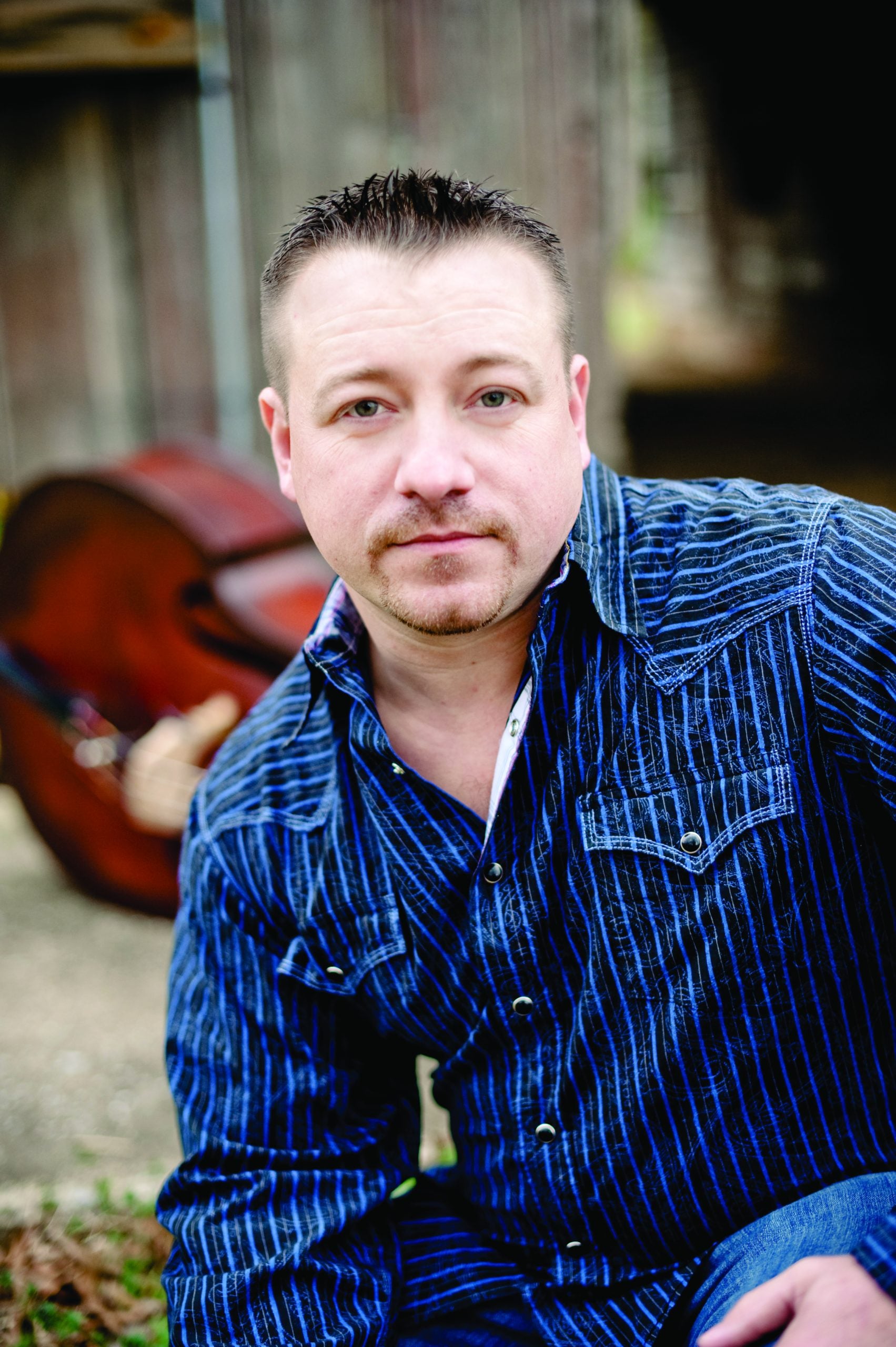
Edgar Loudermilk…Edgar Loudermilk…you might be thinking to yourself—I know I’ve heard that name but can’t quite place him. (The Louvin Brothers’ real surname was Loudermilk, so perhaps that’s what you’re thinking.) Often the case for band leaders is to start as sidemen in prominent bands. Loudermilk stepped out in 2013 from being a bass player and vocalist with Russell Moore & IIIrd Tyme Out to start the Edgar Loudermilk Band. He is now enjoying the benefits of his hard and steady work to get long overdue recognition.
Edgar was born in the hills of north Georgia in Habersham County. He lives today in Eastanollee, Georgia. Edgar grew up in a musical family known as the Kelly Mountain Boys. Bobby Loudermilk, Edgar’s dad, played the banjo; Marvin, the grandfather, played fiddle; and his Uncle Frank Pless handled the guitar. Another guitarist, Lonnie Wiley, and uncles David and Ronnie played the mandolin with the band at times.
Edgar remembers going to a Louvin Brothers Memorial Festival in northeast Alabama at age six in the early 1980s. His grandfather was a distant cousin of the Louvins and his dad, a strong tenor singer, was asked to sing on stage with Charlie Louvin at that festival where they performed “When I Stop Dreaming.” That struck Edgar as a big moment. “I left that day wanting to play this music.”
At age eleven, Edgar joined the family band, although he did not sing initially. He has fond memories of his grandpa teaching him to play bass. At that age, he had difficulty reaching all the neck on the doghouse bass, so he sat on the freezer with his grandpa in the corner by the kitchen table. Edgar reports, “Grandpa would play a record and said if I learned all the Bluegrass Album Band Volume 1, I’d know how to play the bass. He took the record and tried to teach me to play “Blue Ridge Cabin Home.”
At age thirteen he started to learn to sing tenor. The tenor singer/mandolin player had quit the family band, so his dad would help Edgar with tenor parts. At his Primitive Baptist Church they also sang the old songs, but in a shape-note fashion. He memorized many songs and learned the melodies and found himself drawn to the “really neat old hymns.”
Loudermilk entered college at age eighteen and worked third shift as a weaver in a cotton mill. He was earning his way through college and wanted to be a CNC programmer/machinist. Working in tool and die, he never dreamed he’d get “to sing and play music for a living.”
This was a tough schedule for Loudermilk. His professor would allow Edgar to come in a little late from the night shift. After class he would get to sleep some and keep that schedule during the week. On weekends he would play with the Carolina Crossfire Band, mostly in the Asheville, NC area, earning mostly just tips. During this creative period, he did a lot of songwriting. Many of those songs were included on his first recording, Roads Travelled.
Loudermilk recalls hearing that Rhonda Vincent was looking for a bass player. “I didn’t know how to get in touch with her but found a number on the back of one of her Rebel CDs. Rhonda’s husband, Herb Sanker, took the call and he liked Edgar’s family band history. Rhonda called Edgar two weeks later to ask him to attend the auditions in Nashville at the Ernest Tubb Record Shop.
Edgar remembers “there was a long line of players auditioning for the position and I was near the end. I saw them go in and come out with time for about one song. When my turn came, it lasted for a while. I had rehearsed all the parts and knew the songs she wanted to focus on. When I put my bass up, she asked if I had ever been to the Opry. I’d never even been to Nashville! “
Rhonda led Loudermilk across Broadway to the Ryman Auditorium and got him in for a look at the dressing rooms. He was in awe! He watched Rhonda perform her two songs (with her brother Darrin on bass that night even though he was with Ricky Skaggs), and then she offered him the job as he was standing in the wings. So, “I was hired on stage at the Opry,” he recalled. A week later they were back at the Opry after one other show, and it was live on CMT, and Vince Gill introduced us. I was nervous as a cat…here I am that green, having never been anywhere. It was great year with her.”
I replaced Randy Barnes (now with Joe Mullins and the Radio Ramblers) and Rob Baker as Rhonda’s bass player. We shot a video in Toronto that went to number one – ‘I’m Not Over You,’ which is still available on You Tube.”
Rhonda recalls this as well, “We had fun for the short time he was here. I was looking for someone who played and sang. Not only did he play bass, but he knew the vocal parts and could play several instruments. My brother Darrin agreed that Loudermilk would be a good fit.”
Rhonda said the video included Audie Blaylock and was shot in an alley where she was wearing a $1,000 borrowed dress that accidently skimmed some water on location. She said, “I have recorded that song twice, but the video with Edgar also includes Sonya and Ben Isaacs on vocals for the video.”
At the end of 2002 while still with Rhonda, Edgar recalls “hearing the news of Marty Raybon forming a band. Two mutual friends, Ashby Frank and Clay Jones, were helpful in telling Marty about me. I decided to go for a part since I loved Shenandoah.”
Marty responded, “I think Ed is one of the most loyal employees I ever had when he was a part of the Full Circle Band. Of course, he was very talented. I don’t think there’s a part he can’t sing. I told Edgar one day ‘if I knew you could sing bass like that (with Russell Moore and IIIrd Tyme Out) I would have had Shane (Blackwell) sing the tenor and we could have sung one of those old Monroe quartets.” Moreover, Marty added, “One night after driving the bus, we’d talk about tunes to write, and I could tell he was really blossoming into a songwriter. When I was putting Full Circle together, Ed was one of the original members, along with Glen Harrell, Shane Blackwell, Ashby Frank, and Patton Wages. I remember “Angels Rock Me to Sleep,” we had a good blend with Wages on baritone, Edgar on tenor, and Glen singing bass. Our timing and breathing were spot on. Edgar is a good friend and I’m tickled he’s pushed on.” Edgar recalled Scott Vestal being the original banjo player with Full Circle, but Vestal and Clay Jones moved in a different direction early in the life of the band.
My first project with Raybon was The Gospel in Black & White. It contained the song “Beulah Land,” which later won the IBMA Gospel Recorded Performance of the Year in 2013 with Loudermilk singing the tenor part. He was on two more albums with Raybon, including The Grass I Grew Up On and part of When the Sand Runs Out. Loudermilk also can be seen in the video “Shenandoah Saturday Night.” Loudermilk says Raybon is a monster singer, and he learned a lot by singing with Marty and participated in cruises, jams and enjoyed it all.
He also performed a lot of IIIrd Tyme Out material during his time with Carolina Crossfire. When Ray Deaton was leaving that band, some close friends passed that word to Edgar. He contacted Russell Moore while Moore was on a cruise. Loudermilk’s name had been tossed about as a possible replacement for Deaton. After a few weeks Loudermilk visited Moore as they both live in Georgia, a short distance away. There was lot of IIIrd Tyme Out material to master, as they had around fifteen recordings by that time and were performing four sets of music. Deaton was not leaving until July, and Moore began auditions in February. Edgar was prepared while still playing with Raybon, having studied all the parts, and the audition lasted almost a full day since the chemistry was very strong. At the end of the day, Moore said he was going to cancel the other auditions since he had found what they wanted.
Russell’s memory of the audition with Loudermilk is consistent with Edgar’s remarks. “Edgar understood what IIIrd Tyme Out was all about and he used his bass playing and singing to compliment the band’s sound. He has a wide range vocally and he’s a great team player. He always put himself in a position to do what he needed to make it all work in a band situation. On “The Eastern Gate” Edgar did a great job on that. He also sang “I’m Leaving Town” and he did it so well. For the band it was a cool progression and worked out to be something to showcase his vocals. I loved singing tenor to him on that. He was always on time and always on point. Couldn’t ask for anything more. He’s constantly writing, and I loved that aspect of what he’s doing. He’s all into the music business: writing, performing, social media, and trying to be all entities.”
Bandmate, and founder of the band Sideline, Steve Dilling reports Loudermilk to be one of a kind. They traveled about seven years together in IIIrd Tyme Out and left about the same time. “I didn’t know he was a bass singer until he came to the band.” Steve says Edgar started branching out with his songwriting and had a notebook on the bus. “If something was said or if he saw a sign that was clever, Edgar jotted it down for future reference,” says Dilling. Dilling also remembers Edgar as a team player; he was always there and creative. Being creative is the mark of a good band, according to Steve.
Loudermilk stayed with IIIrd Tyme Out for seven years and was part of some fine albums. That band was with Rural Rhythm Records for their first recording on that label simply titled Russell Moore & IIIrd Tyme Out. Edgar sang the lead on “I’m Leaving Town,” which has become one of his most requested songs.
He was also on “Prime Tyme.” These two albums produced five number one songs including: “Pretty Little Girl from Galax,” “Carolina’s Arms,” and “Hard Rock Mountain Prison.” This was a period in which Russell won IBMA Male Vocalist of the Year three times in a row.
Loudermilk also did some teaching on guitar, mandolin, and bass. That impressed upon him how much artists pick up things listening to other artists, especially if one is around another artist for extended periods. He says that can be good or bad – it’s a melting pot of good and bad habits. He’s been influenced as well by Merle Haggard, Marty Robbins, and Don Williams. “All of this make you the artist you are” says Loudermilk.
Another interesting fact is that while Edgar was beginning his tour with IIIrd Tyme Out , Doyle Lawson was also interested in him. “I auditioned for him,” Edgar remembers, a week between the audition with Moore. He was not offered the position right away with Lawson and he felt like that was going to be better fit with IIIrd Tyme Out. “So, I called Doyle and said I had something else I was going to do. I wish I’d had some band experience with Lawson. The audition itself was a good experience.”
Departing IIIrd Tyme Out after the Cracker Barrel recording with a lot of classic songs, and produced by Barry Bales, was a difficult decision. Moore was so supportive and said I needed to expand.
In 2013 he recorded My Big Chance Tomorrow on Mountain Fever Records. Mark Hodges, President & CEO of Mountain Fever offered these remarks: “Edgar was here on Mountain Fever for several years. We did two solo projects together, the first Roads Traveled and the second was My Big Chance Tomorrow, which marked the beginning of leading his own band. Then Dave (Adkins) came around and they teamed up for the Adkins and Loudermilk project that to this day gets lots of airplay. Edgar is a good bass player and songwriter.”
The Adkins/Loudermilk team was nominated for the IBMA Emerging Artist of the Year in 2015. Edgar also produced Adkins’ Nothing to Lose with four of Loudermilk’s songs. These efforts helped launch Loudermilk’s solo career. In 2015 Adkins and Loudermilk decided to part ways.
Edgar’s next move was to the Pinecastle label, resulting in the album Georgia Maple, with eight original songs. The title track, “Georgia Maple,” is about a tree on a farm, which performed well. “My Kentucky Home” also produced good results. Jeff Autry was a part of that band, playing guitar, and his son Zack is currently with Loudermilk’s band.
Loudermilk then moved back to Rural Rhythm Records and released Lonesome River Boat Blues. Zack and Edgar wrote the title track about a river boat. They started the song during the IBMA World of Bluegrass, and it was released a year later after they finished writing it in Reno.
Sam Passamano II of Rural Rhythm Records offered: “I have been extremely fortunate to know Edgar Loudermilk for many years dating back to 2009 with the first studio album of Russell Moore & III Tyme Out on Rural Rhythm and continuing with his band, The Edgar Loudermilk Band. Through the years I have had the pleasure to develop a strong friendship with him along with the working relationship garnered in the usual artist/record label scenario.”
Passamano continued, “Over the years I have discovered that Edgar is a Renaissance type of man…not only is he a hit songwriter and veteran bluegrass artist, but he is an accomplished carpenter, farmer, gardener, hunter and fisherman. I wonder what he does in his spare time? He has shown us over the years his unique ability to write songs that create a variety of emotions and has found a lot of success recently with bluegrass hits like ‘Lonesome River Blues’ and ‘Dark Side of Lonesome.’ Edgar’s songwriting always shines on gospel songs, which pull from his strong faith that is the centerpiece which he draws from, to be the talented, kind, helpful, sharing gentlemen who I get to call him my friend and brother.”
Loudermilk tries to meet all the promoters he can. As a result, he has a heavy tour schedule. This year the band will perform in New York, California, and Canada, with other dates across the country. With ninety dates per year and lots of miles to travel, he will have lots to write about.

The Edgar Loudermilk Band has a new project with Rural Rhythm Records that kicked off with three singles before the entire project was released. The pandemic created some release delays as well as some reorganization of the label. One single release, “I’m Going Home” from The Dark Side of Lonesome album was noted in Bluegrass Today.com: “This is a song I wrote along with Zack Autry. We were trying to write a song that felt like a classic old bluegrass song, something that would fit early day Flatt & Scruggs. As we moved along, the storyline opened into a funny story of a guy always getting stood up by a girl who he could never tame. He gets mad, and like a little boy says, ‘I’m Going Home.’” The entire album was released in March 2022.
Edgar enjoys the booking end of things and that helps with the communication with promoters. This aspect of managing a band is demanding and he recalls Russell Moore talking about that a lot. In some bands the sidemen do not see that part of the work. Edgar feels a responsibility for the guys in the band and is mindful of their employment. He looks at this as a part of longevity and wants to keeping moving to build a great career. “You can’t let the down times discourage you and don’t let the high times get out of control” he said. It’s somewhat like plowing the field – just keep going steady. This results in some repeat bookings where one can build on that and pack the house after a few cycles.
Edgar tries to be mindful that the business is also about the passion of a song itself. When he writes, he observes “if it’s good enough it will speak for itself and have its own life.” He wants the band to still be about the music, not the business per se. Edgar notes that the passion for the music can get lost if one is not watching.
He thinks about the times he had to have a day job to support his music career. When he was with Raybon, they were getting started and did not have a lot of shows. To make ends meet Edgar sold life insurance, cell phones, and even had a bait and tackle shop. Since 2013 music has sustained him.
In his spare time, he’s been building a house, which is almost finished. He tries to live on funds from shows and use royalties for savings. Edgar says life is good, living on twenty acres on one side of a lake in the country with his wife Sonya, and two daughters, Kaitlyn and Kylee. His mother lives on the other side. “I’m surrounded by girls!” he beams. The girls want horses of course, but they require a lot of work.”
As with many traveling artists, he tries to be home by the end of the weekend. Traveling can be grueling, and he tries not to overdo it. As Edgar has gotten older, he says he’s more concerned about health and sharing duties. He tries to work smarter and make time for his creative writing.
Loudermilk feels songwriting is his biggest calling. With three projects on Mountain Fever, one with Pinecastle, and two with Rural Rhythm Records, his accomplishments are admirable. He would like to do more co-writing and will continue to write even if a time comes where he has to come off the road. Edgar says that he is very much aware of the catalog of songs the Louvin Brothers left us. He’d like to have a deep catalog of material as well.
The current lineup of the band includes Zack Autry on mandolin and tenor vocals, Jamie Pittman on guitar, Anthony Howell on banjo, and of course Edgar on doghouse bass and vocals.
Edgar Loudermilk has been and is working very hard at his craft for twenty plus years and the evidence of his abilities and achievements is there for examination and enjoyment. Well done, Edgar!