
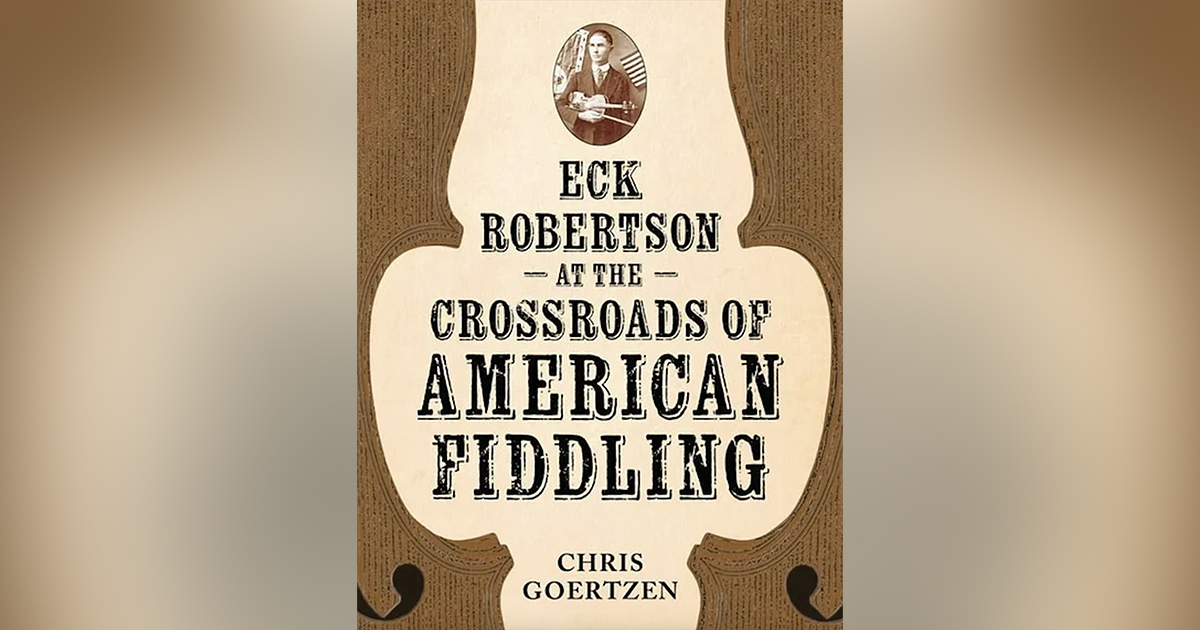
Eck Robertson—At the Crossroads of American Fiddling
“Cowboy Fiddler” Eck Robertson (1887-1975) was a Texas-style fiddle player who is known to most fiddlers and many country and bluegrass music fans, partly because he was the first country artist to make a commercial recording. On June 30th, 1922, Robertson and Henry Gilliland played two tunes for the Victor Talking Machine Company in New York City, “Arkansas Traveler” and “Turkey in the Straw.” The next day, Eck returned and recorded “Sally Goodin” and “Ragtime Annie.” Victor released “Sally Goodin” and “Arkansas Traveler” on the first disc. A second disc was released featuring “Turkey in the Straw” and “Ragtime Annie.” A third disc was also released that featured both “Sally Johnson” and “Billy In The Lowground” on one side and “Done Gone” on the other. These recordings led the way for other “hillbilly” artists to begin to record music.
Robertson, born in Arkansas, grew up in a family of fiddlers. Most online biographies of Robertson talk about his having lived in West Texas from a young age. However, for this book, Goertzen (a professor emeritus of music history and world music at the University of Southern Mississippi, who passed in late July 2025) conducted extensive research into the Robertson family’s residences and way of life and reported that information expertly in this book.
The book not only explores Robertson’s various fiddle activities—contests, appearances, various performances, and recordings—but does so in a way that helps the reader understand the nature of the contests, performances, and recording sessions of the era. Goertzen digs deep into census data, newspaper articles, and interviews conducted with Robertson by other musicians to help tell the Eck Robertson story.
While telling the story of Eck Robertson’s life in the detail that one would expect from a professor of music history is a wonderful addition to the memory and legacy of Eck Robertson, a much more important aspect of this book—from the viewpoint of a fiddler—is presented in the second half of the book’s 247 pages. This section of the book highlights Robertson’s place in the history of fiddling by giving a detailed analysis of the tunes that he played and how he played them (including 80 pages of transcriptions of Robertson’s recordings, and others who played the same tunes, presented in standard music notation).
Shortly after I received this book for review, I came across a video on fiddler Megan Lynch Chowning’s YouTube channel and she was talking about this book. Megan said, “Eck Robertson…super important…first recorded country music ever…his ‘Sally Goodin’ is the template for what we do and, in fact, we fiddle players who play Texas-style and related genres, play it pretty much the way Eck did. I’m so stoked about this book. It has bio information and a bunch of transcriptions.”
Since I am not a fiddle player, I called Megan to ask about the information that is presented in this book regarding the tunes and the transcriptions. Megan told me, “What I think is really important to note about the arrangements is the insight with which the author connects Eck’s arrangements with the modern versions that you are hearing people play within the same genre during the last twenty years or so. He shows the thread of continuity. To me, Eck made huge leaps in the improvisational things that he was adding to the tunes. The way that Dr. Goertzen lays this out in the book highlights those leaps. The things that he has chosen to transcribe really show that Eck made massive contributions to the style. It is really well done. Sometimes he shows the way it was played prior to Eck, then Eck, then the way it might have been played by a modern player at a contest in 2019. You see the things that have changed and the things that have not changed, and he highlights sections to make it very clear. I think it is hard to find anyone else who did what Eck did for the style. It is a stunning book.”