
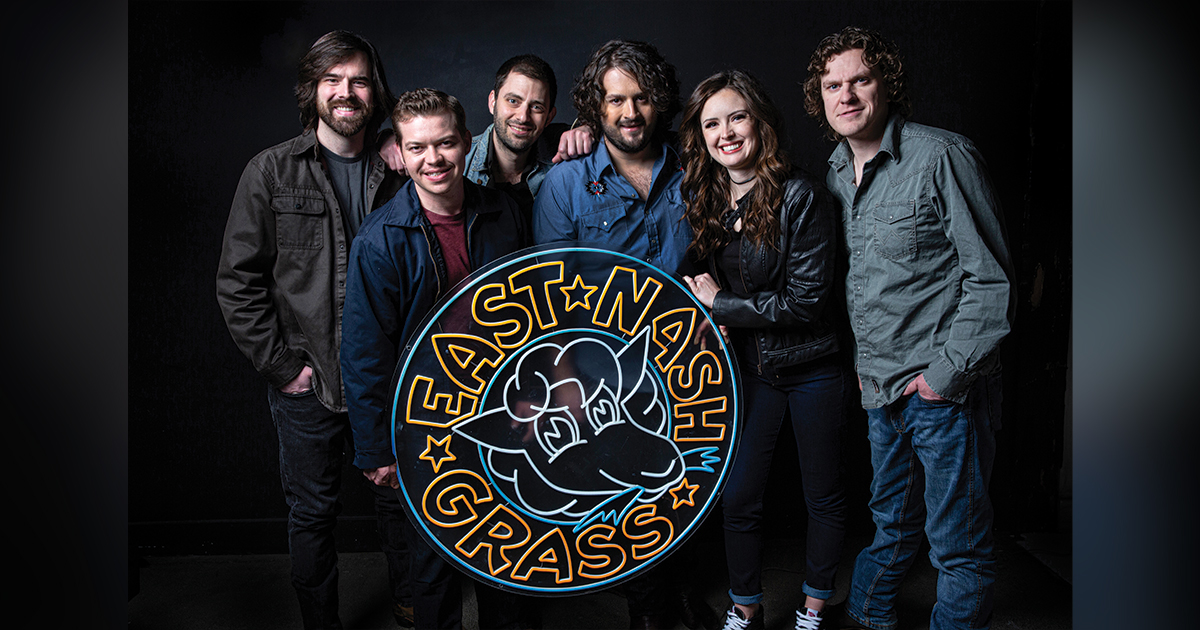
East Nash Grass
When it comes to bluegrass venues, Nashville has long been a barren desert. For years, the only full-time bluegrass venue was the revered Station Inn. But in the past few years that has been slowly changing, due in part to a relatively new Nashville-based bluegrass band called, appropriately, East Nash Grass, as well as a relatively new club in the Nashville suburb of Madison called Dee’s Country Cocktail Lounge.
Dee’s opened in 2016, and not long after several local bluegrassers, including East Nash Grass’s former banjo player, Luke Monday, persuaded the proprietors to start a weekly bluegrass Monday night. Within a year or so, as many musicians came and went, East Nash Grass gradually coalesced out of these impromptu weekly jams.
By 2017, East Nash Grass had co-opted those bluegrass Mondays and is sometimes joined by special guests, such as Sierra Hull, of whose band East Nash Grass banjo player Cory Walker, is a former member.
The band released its first album, the self-titled East Nash Grass, in 2021. “Our first album was kind of home-made,” said singer-guitarist James Kee, “but I think it’s pretty good.”
Although the debut album drew offers from several labels, the band decided to release it themselves. East Nash Grass garnered a handful of positive reviews and considerable buzz. Since then, mandolin player-singer Harry Clark and fiddle player Maddie Denton have earned individual IBMA awards for their prowess on their respective instruments.
Meanwhile, there was a little bit more shuffling in the band’s lineup as several more members joined, then left. This included Clark, who dropped out for a year or so, but rejoined in time to play on the first album. “We kind of sensed that there was something special when we started to settle into our present lineup,” said Kee. “And we sensed it even more when we started the first album, which was a little over three years ago. Everyone seemed to give a damn a little bit more.”
Even so, the Monday nights at Dee’s, in the Nashville suburb of Madison, were pretty dead at first. “When we started out at Dee’s those Monday nights were as lonesome as could be, man,” Kee recalled. “There were some nights in the beginning, before I moved to Nashville and was still commuting from Murfreesboro, where I was teaching high school at the time, I would go home with like 14 dollars in my pocket from tip money,” Denton added. “I was losing money, but it was worth it. I just loved playing with these guys.”
“Yeah,” Clark quips. “Now sometimes we go home with as much as 22 or 23 dollars.”
Then along came COVID, which in a strange way, gave East Nash Grass a boost. It was during the shutdown that they finished their first album. And they continued playing weekly at Dee’s, though admittedly to smaller, masked and safely distanced crowds.
Dee’s also began streaming the band’s shows on the club’s Facebook page and You Tube. That also helped raise the band’s profile. “We still hear from people everywhere we go who tell us they discovered us through those streams,” said Kee. Toward the end of the lockdown, East Nash Grass began work on its second album. The first album showcased some fine singing, first-rate songs and seamless musicianship. The sophomore album, Last Chance to Win (tentative title) is even more impressive.
This time the band recorded in a studio called the Tractor Shed, which once was indeed a tractor shed owned by Grand Ole Opry favorite Grandpa Jones. “It’s Mark Howard’s studio and it’s in a house that used to belong to Grandpa Jones,” Kee said. “Of course, he lived next to (Opry star) Stringbean Akeman, (whose 1973 murder is a dark Nashville legend). So that was quite an experience. Sean Sullivan did the engineering, and we pretty much produced it ourselves.”
Once again, various bandmembers wrote or cowrote quite a few of the songs. There are two old-timey covers: Uncle Dave Macon’s “Railroadin’ and Gamblin’” (the first single) and “Papa’s on The House Top,” an old bluesy number written and first recorded by Nashville-born bluesman Leroy Car in 1931. On the more contemporary side are East Nash Grass’s take on Hugh Moffatt’s “How Could I Love Her So Much” and Bill Anderson’s “Slippin’ Away.”
“This new record kind of surprised me, and I think everybody would agree, that it almost has an old-time sound to it,” said Kee. “It has a lot of really simple melodies, a lot of what I would call ear worms. The kind of stuff that ends up getting stuck in your head.”
Dobro player Gaven Largent agrees. “I also think you can hear the maturity of the band, as far as the dynamic and the harmonies and playing,” he added. “To me, it feels tighter than the first record.”
Added bass player Jeff Picker: “I think this new record will be exciting for people who like our kind of music. It’s original and it’s traditional-sounding and energetic in a way that’s also fresh and new.” Once again, Kee’s baritone voice provides a honky-tonk patina to some of the material. “I think that’s what my voice brings, a sort of natural country flavor to the band,” Kee agreed.
The band is also blessed with the versatility of having four lead singers; Kee, Denton, Clark and Largent. This time around in the studio, Clark and Kee switched instruments. “That really changed the dynamic of the band,” Clark said. “On the first record, James played mandolin and I played guitar. Then there was some time in 2021 when I couldn’t make our shows, and he had to play guitar. Then James, Cory and I went out to Idaho with a couple fellows and played a gig outside of East Nash Grass. I was booked on mandolin and he was booked on guitar. That ended up jiving pretty well, and James said ‘Why don’t we kind of keep it like this?’ It worked out well because James is a great multi-instrumentalist, and I was able to get back to my home instrument.”
“It was a hell of a lot better for me, because I don’t have to take as many solos now,” Kee said with a laugh. “It’s also easier for me to lead the band playing guitar, and Harry is back to his strong suit.”
In July of last year, East Nash Grass got a big boost when the band performed at Nashville’s venerable Ryman Auditorium. “That was the biggest shot in the arm we’ve ever had,” Kee recalled. “It almost gives you instant credibility. It was a great experience as well. And this summer we’ll be playing there again, opening for Sierra Hull.
Even though the band is relatively new, its members have been around on the circuit for quite a long time. Most of them crossed paths one time or another before East Nash Grass. Individually or collectively, they have performed with Blue Highway, Dan Tyminski, Dailey and Vincent and quite a few other big names.
“I had known Maddie for many years,” Kee explains. “I didn’t know her well, but we were kind of going around the same circuits. The same with Cory. We’d met, going back sometime in Nashville when we were young. So yeah, most all of us already knew each other when we got started.”
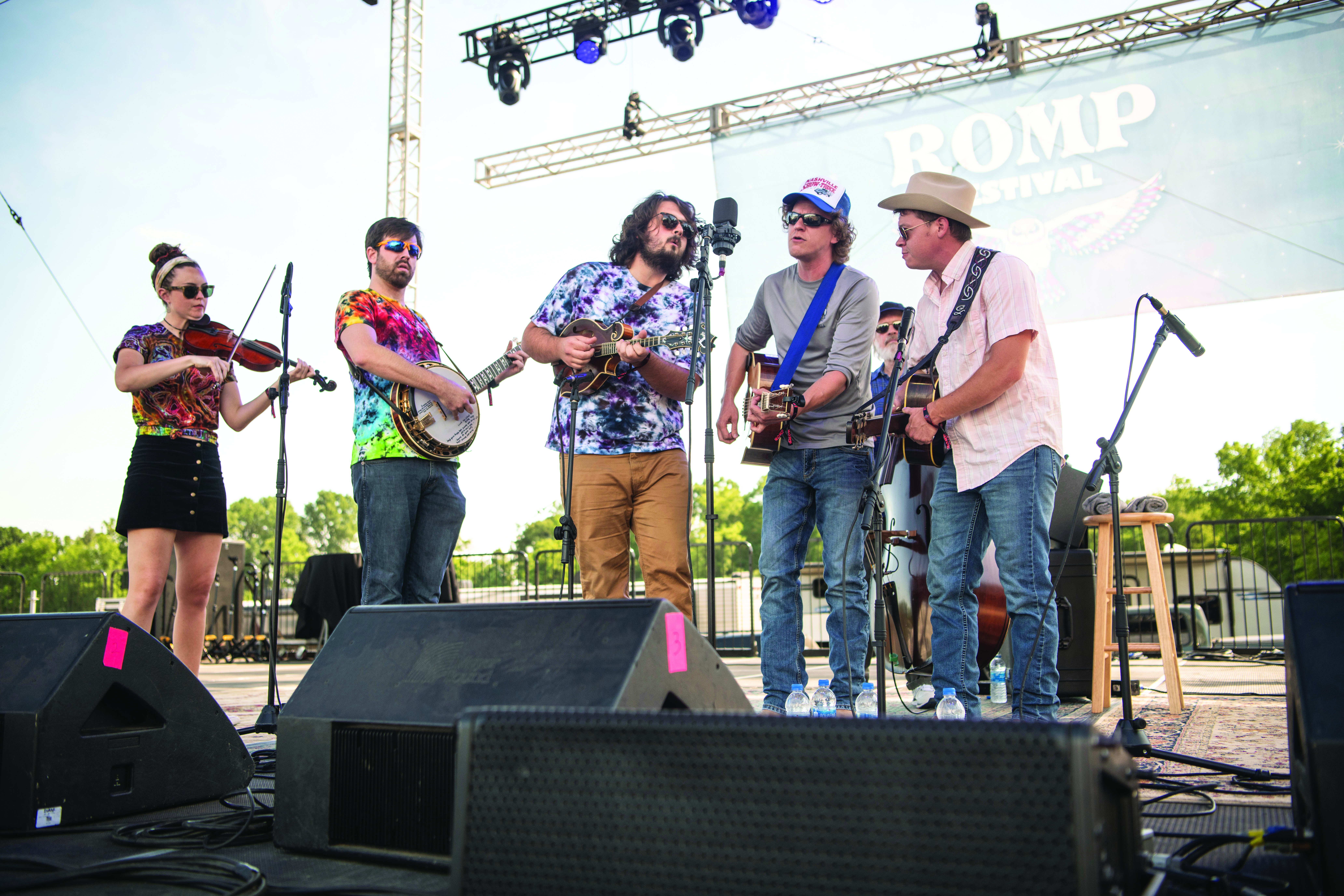
Maddie Denton was born and raised in Murfreesboro, Tennessee, just down the road from Nashville. Her mother and grandfather were also fiddlers in their own times. As a high schooler, Denton’s parents drove her to fiddle contests across the country and she won a bunch of them. She attended Tennessee Middle State University in Murfreesboro on a golf scholarship and majored in biology.
After graduation she spent five years as a high school biology teacher. But her fiddle never stayed in its case for very long, and she eventually found her way to Dee’s. Just last year she left teaching to put her full-time energy into the music.
Harry Clark, from Central Arkansas, picked up the mandolin at age 10. “That’s when we moved to a new town that had a college in it,” he recalled. “A fellow at the college taught multiple instruments, and he decided that I should play mandolin. After one 30-minute lesson, I was hooked. What really got me into bluegrass was when my dad took my brother and me to see Ricky Skaggs and Kentucky Thunder. It was when he had Andy Leftwich in the band. That just kind of blew my mind.”
Clark first came to Nashville in 2012, at age 18. He did a year-long stint playing guitar in a band called The Roys, a brother-sister duet. Then he joined up with an outfit called Volume Five. “Then I quit them, moved around a little bit, then moved back to Nashville in 2017,” he added. “I’ve been here ever since.” Kee recalls that Clark ran into him at the Station Inn one night and asked him to join the band.
Cory Walker grew up just east of Tampa, Florida. His father was a picker and a big fan of Flatt & Scruggs. When he was 7 years old, he was already playing and taking lessons at a place called the Bluegrass Parlor in Tampa. His two brothers are also pickers. By age 16, Walker was playing banjo behind Sierra Hull. “By the time I was getting ready to graduate high school I decided it made sense to go to a college near Nashville,” he said. “So, I also went to MTSU. In 2013 I moved to Nashville and I’ve also been here since then.”
Along the way, Walker has also performed with Tim O’Brien, The Dillards, Mountain Heart, Peter Rowan, along with Sierra Hull and other headliners. His brother Jarrod plays mandolin for Billy Strings.
James Kee is a Chattanooga native. His grandfather, a Nashville resident, played guitar and banjo. “Back in 1997, when I was a kid, he took me to a place on Signal Mountain, called The Mountain Opry,” he remembered “That was my first exposure to bluegrass. I think he thought I was gonna fall asleep, but I was really interested in it. I started playing about a year or so later.”
Kee spent his growing-up years in Chattanooga, Tennessee “I was in a lot of bands along the way,” he said. “I was in a band in Kentucky called NewTown for five years. Then I had a group in Chattanooga called The Hamilton County Ramblers for a couple of years.”
When Kee’s parents left Chattanooga, he decided there was no good reason for him to hang around either. He went west, back to his Nashville roots, in 2016. “I didn’t have any other family there,” he said. “All my family was here in Nashville, where my mother was born. So, it was an easy move for me. I’d visited here many times, so I already knew the lay of the land.”
Dobro player Gaven Largent, from Winchester, Virginia, grew up surrounded by bluegrass. His grandfather had a bluegrass band. Largent picked up his chosen instrument when he was eight, and not long after was playing alongside his granddad. “I just loved the sound of the Dobro,” he recalled.
After high school, he went on the road with Michael Cleveland for about a year, then joined Blue Highway for three years. He next spent several years with Daily & Vincent, up until COVID hit. When he started dropping by Dees on Mondays, East Nash Grass, “was still just a bar gig and more or less a revolving door of road musicians who were in town on a Monday.”
He’d previously crossed paths and jammed with Walker and Clark in various settings. He met Kee one of the first times he dropped by Dee’s. Not long after, he got a standing invitation to sit in with them whenever he was in town. “In the beginning I was playing with another band, and almost everybody else was,” Largent said. “It was more or less just a fun thing to do during the week when we were off the road. And you never knew who was going to show up.”
Bass player Jeff Picker, originally from Portland, Oregon, also took a circuitous route to Dee’s and East Nash Grass. As a teenager, back when he started taking bass lessons, he was seriously into “hardcore modern jazz.”
Early on, he won various awards and grants as well as a scholarship to the Manhattan School of Music. He moved to New York City in his late teens.
“That’s where all the music I was interested in at the time was happening,” he recalled.
After 11 years, he felt the need for a change and relocated to Nashville. He spent five years as the bass player for Ricky Skaggs and Kentucky Thunder. He also began playing with Nickel Creek. Additionally, he’s a session player for the Grand Ole Opry. He’s recorded a pair of solo albums along the way: With the Bass in Mind and Liquid Architecture.
All the while, Picker also continued meeting and playing sessions and gigs with many different musicians. In 2018, he met Kee. “At the time I lived just up the street from Dee’s and I started dropping by on Monday nights,” he said. “The band was very different back then, with almost entirely different people, but I got a kick out of them.
“The band was pretty serious by then, and when their bass player left, I joined,” Picker added. “Then we (East Nash Grass) started the first album and it sounded really good. Next thing, we had a manager and agent and 600 people showed up at our show at IBMA’s Pinecone Council of Traditional Music Showcase.
“The reason I finally decided to make the band a serious thing in my life is that they’re really great musicians,” he added. “I like the singing and the diversity of material. Also, they’re fun. They make me laugh. Our music is serious, but the vibe is kind of goofy and fun. And everyone I’ve played with, it’s because I love their music and I love them,” he said.
East Nash Grass is slowly building its presence on the touring circuit. The band recently signed with Crossover Touring, and they’re settling in for the long haul. Last year they played about 20 shows outside Nashville, and they expect to play a few more this year.
“I think 2024 is when we’ll be doing a whole lot more touring,” said Kee. “Things are snowballing for us, but we’re still rolling the ball at the pace that is naturally happening.”
“We’re really kind of just getting started,” Picker offered. Of course, live shows are really at the core of the the band’s appeal. In the course of all those Monday nights at Dee’s, the members have not only honed their musicianship and their cohesion as a band; they’ve continued to expand their repertoire and sharpen their stagecraft. All the while, drawing bigger and bigger crowds.
“Each member can play any style of bluegrass there is, so sometimes we’ll groove on a jam or play something just for the fun of it,” Kee pointed out. “Also, everybody in the band can sing, so you have a much deeper well of songs to draw from. I don’t want anyone to come to our shows and sit cross-legged, trying to pick up every nuance of our music,” he added. “Mostly we want people to have a great time. Bluegrassers, at least some of them, tend to take it too damned seriously. We want people to have fun, even if they don’t know anything about bluegrass.”
East Nash Grass’s members naturally take a lot of pride in playing a part in the heightened presence of bluegrass in Music City. “Back when I came to town, a lot of my friends playing bluegrass had left in the years before that,” Kee recalled. “At the time, there was nearly no bluegrass going on locally at all and they were having to face rising real estate prices.
“About a year after we started our thing at Dee’s, we noticed that there was a whole lot more grassers than there was before, and that there’s much more of a bluegrass scene here now than there was,” he added.
“I’m not saying we started that, but we certainly helped.”