
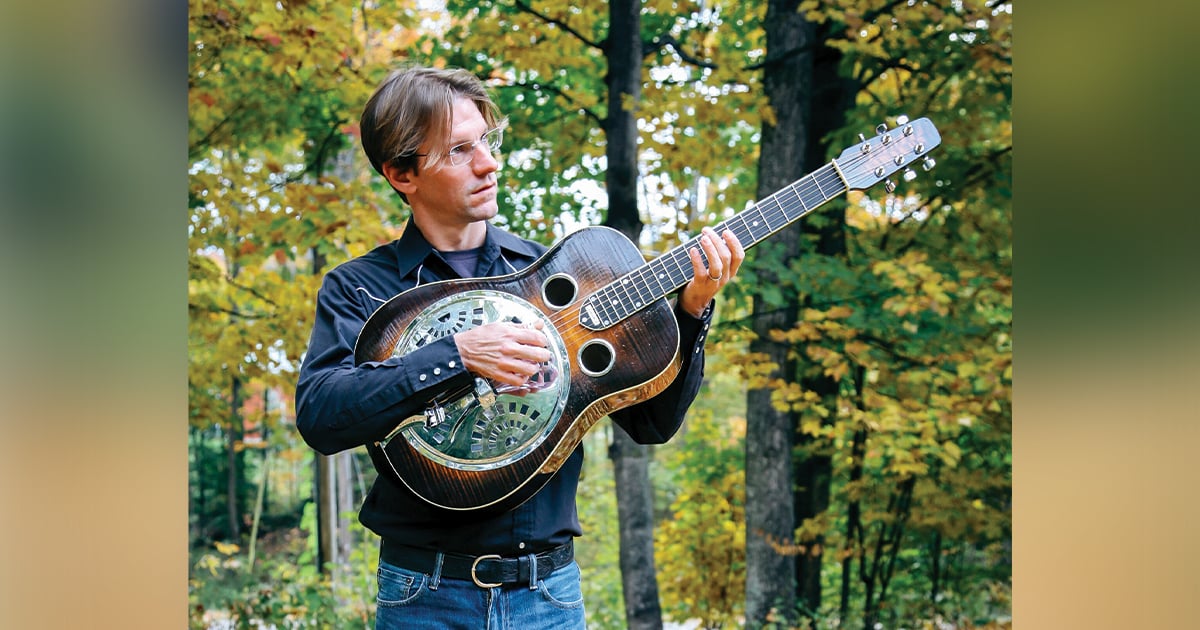
Dobro Joe’s Dobro School
If you’ve ever searched “Dobro Lessons” on YouTube, you’ve probably come across the lessons posted by “Dobro Joe” Wilson. You can also find a couple of lessons from Joe on the lessons page of the Bluegrass Unlimited website. While it is generally harder to find Dobro lessons than lessons for guitar, mandolin, banjo, or fiddle, they can be found online, in books, and in instructional videos. The wonderful thing about Joe’s lessons are they are “donation driven,” which means that if you don’t have the money to pay for a book, video, streaming, private, or subscription-based lessons, Joe is your man! Of course, if you appreciate what Joe is doing you can send a donation his way—or if you like what Joe is teaching for free and you want more, he is always available for Zoom lessons.
There are several great features to Joe’s video lessons that I really like. First, he places a black pad under his strings on top of his Dobro so it makes it easier to see what his right hand is doing. On many Dobro videos, the right hand fingers can get lost in the background of the resonator cover. The second likeable feature on Joe’s videos is that the tab, with chords, is shown on the screen and a visual cue (vertical line) flows through the tab in time with Joe’s playing of the tune. Additionally, on his website lessons (dobrojoe.com), Joe provides a play-along track, full tablature that is arranged in a landscape orientation (making it easier to view on a computer screen or tablet), and a feature that allows you to click or swipe the tab page to easily bring up the next page. Lastly, Joe provides a separate “discussion” video where he talks about various techniques and skills that pertain to a particular tune.
One of the reasons that Joe presents his lessons as “donation driven” is simply because Joe feels like he is not as well-known as other Dobro players who are charging for their lessons. I thought that we’d help solve that problem by letting Bluegrass Unlimited readers know a little bit about him.
Background
Joe Wilson grew up in the southern part of Michigan, near Toledo, Ohio. He was raised in a musical family and started piano lessons in second grade. By middle school he was also studying the trombone and in high school he spent time studying jazz piano and trombone, which introduced him to improvisation. While a senior in high school, he started learning how to play the guitar.
While in college, at Michigan Tech, Joe played guitar in rock bands at venues in Michigan’s upper peninsula. Then, in 1999, Joe moved to Lansing, Michigan. Joe explains, “When I move to Lansing, I got a job working at Elderly Instruments and I started sitting in with my twin brother in his band playing guitar. Between joining a band that had a bluegrass interest and being at Elderly, that opened up the world of acoustic music.”
Regarding his motivation to learn the Dobro, Joe said, “When the band started listening to bluegrass, I loved the sound of the Dobro and I didn’t know anyone who could play it. Between that and also finding out that I wasn’t as good at guitar as I thought I was…moving to a bigger city I found out that everyone could play the guitar. But, I didn’t know anyone who could play Dobro and I loved that sound and it fit with the stuff that my brother’s band was doing.”
In 2000, Joe joined his brother’s band, Steppin’ In It, as a regular member. Joe describes it as a “funky” band. He said, “The drummer learned how to play banjo, so we would take a bluegrass mini-set in the middle of the show. The drummer would grab a banjo and everyone would switch to bluegrass instruments.”
Joe worked at Elderly from 1999 to 2002. He said, “The band ended up evolving over time and we started touring, so we quit our jobs in 2002 and played the festival circuit until about 2010.” When the band first started they would play a mixture of rock, Cajun, bluegrass, honky tonk, and western swing. Later, they changed from playing covers to original material and the songwriter of the group incorporated “all of those influences into one sound.” Steppin’ In It recorded six albums, with one being produced by Sally Van Meter. Joe said, “I looked at that experience as an expensive private Dobro lesson.”
As the various members of the band got older, married and started having children, they started to drift their separate ways. Joe said, “The bass player is now with Jack White and the lead singer, Joshua Davis, placed third on The Voice in 2015. Joe added, “We still get together and do a couple of shows a year.” When the band started performing less, Joe—who had gotten married and started having kids in 2009—moved to the Traverse City area of Michigan, became a stay-at-home dad and started performing with Don Julin.
Joe said, “Don got me into teaching. When my son started school I was able to have the time to teach guitar lessons. I wanted to also teach Dobro, but there were not a lot of local people who wanted to learn, so I had to take it online. I keep the website open-source because not a lot of people know who I am.”
Those readers who are familiar with the career of Billy Strings will know that the young flatpicker’s career was launched while he was playing with Don Julin in Traverse City, Michigan. During Strings’ early days, Joe Wilson had the opportunity to play with both he and Julin on many occasions. When asked about performing with Billy Strings, Joe said, “I have never seen anyone else with the combination of his playing, singing, and on-stage charisma.”
In 2016, Joe released an album by The Joe Wilson Trio titled Green Street that featured Don Julin on mandolin and Kevin Gills on bass. In 2018, Julin released the album, Don Julin Quartet—Live 2018, that features Joe on Dobro, Kevin Gills on bass and Dave Collini on cajon. Currently Joe and Don continue to perform together with Joe playing Dobro, lap steel, and double-neck eight-string table steel.
Teaching the Dobro
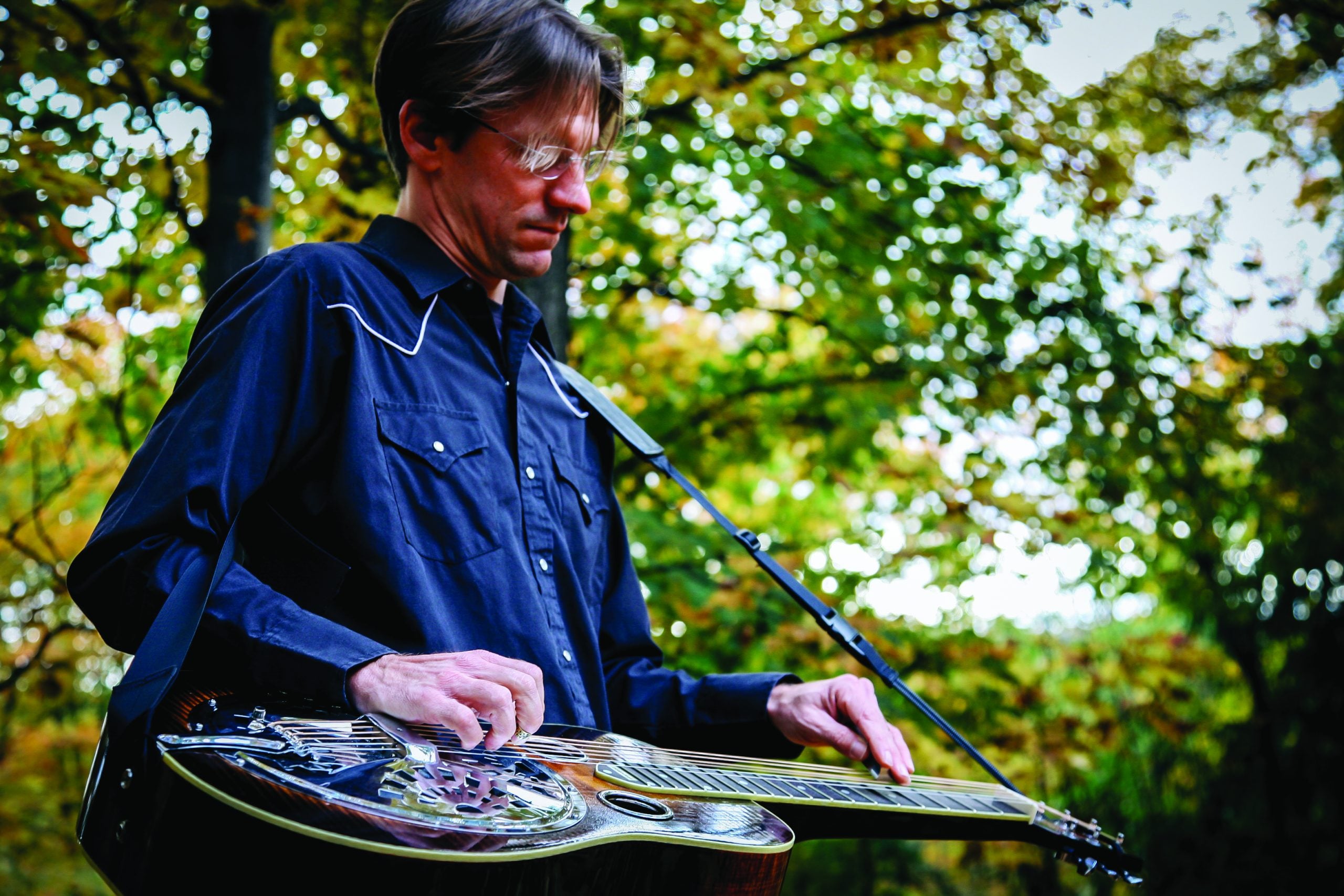
After spending time posting lessons online and teaching private students via Zoom, Joe started to modify his teaching method to some degree. He said, “I realize that tab has a place, but it can also be a big crutch for some people. I wanted students to start using their ears.” As a result, Joe started posting a series of “real world” lessons. These lessons don’t have tablature. He encourages the student to play along with the video as if they were in a real jam session. Joe provides the chord changes and lends advice on which scale will be applicable to the song. He said, “I think this encourages the student to connect the scale to the melody and us it in context. Given the scale and the first note, they can then use their ear to find the melody. With this approach, I find that students are listening to their instruments more. I like to use Christmas songs because they are almost all just using the major scale. I like people to use their ears with their scales. I want to try to promote that.”
Another lesson Joe learned was that he needed to slow things down in relation to his presentation of material. He said, “The thing that became obvious to me when I started teaching is that what I was thinking of as beginner material is probably really intermediate material. I’ve been playing music for so long that stuff that seemed obvious to me is probably not going to be obvious to most of my students. So, I learned that I really have to keep things simple.”
Joe also feels that the Dobro is not an instrument that necessarily needs to be played fast. He said, “I just don’t see it as a fast instrument. It is not particularly good at playing fast.” For students that are frustrated trying to keep up with fast fiddles, mandolins, or banjos Joe said, “I tell them, OK, tell your buddy to pick up his fretless banjo and play it with one finger and see what he can do.”
The tunes that tend to be played fast in the bluegrass context are fiddle tunes. Regarding playing fiddle tunes on the Dobro, Joe said, “There are a few tunes that layout right, like ‘Red Haired Boy,’ but for most of the fiddle tunes you have to ‘Dobrophy’ those melodies. You are not going to play it in unison with the fiddler. If you can find a way to capture the melody in a way that makes sense on the Dobro, that is really the right thing to do.”
Joe continues, “Jerry Douglas played ‘Saint Anne’s Reel’ on one of his records. You listen to it and realize that he is not playing the fiddle melody. He is playing a melody that doesn’t have the bar flying all over the place. I tell my students, ‘If you are a mandolin player, fiddle tunes are beginner material. If you are a Dobro player, fiddle tunes are the most advanced thing that you are going to do. But, there are things that the Dobro does with ease better than other instruments. You take what the instrument gives you.”
Regarding any “pearls of wisdom” that he likes to pass along to his students, Joe said, “When I first started working at Elderly, I didn’t know anything about folk music. John Hartford came in to do an in-store performance and I had no idea who he was. He was sitting in the high-end guitar room and I thought that he was a customer. I went up and started talking with him about jazz guitar. I would never have had this conversation with him had I known who he was. I was struggling to play jazz guitar and telling him about it. He said, ‘Well…can you sing it? Can you hum it? Because if you can sing it, playing it is easy.’ Later I figured out who he was and that has always stuck with me. When I have students work with a melody and their rhythm is off I will say, ‘Wait a second…sing it for me.’ If you have it in your head and can sing it, you are going to be OK.”
Regarding Dobro back-up, Joe said, “One of the things I do is have students listen to what the Dobro is doing when it is not taking a solo. I also make them listen to Flatt & Scruggs Live At Carnegie Hall. I’ll then ask, ‘What did you hear Josh Graves doing when he was not taking a solo?’ They say, ‘Not much.’ I guess what I’m trying to get people to do is stop trying to strum chords on the Dobro. That is not your job. You do fills and you do melodic things.”
Joe continued with this insightful observation, “With a lot of your favorite songs there is a magic moment when the Dobro comes in and that can’t happen if the Dobro is already there. The Dobro has to not be there for it to come in. If I’m at a gig, I feel weird not doing anything, so I try to turn that into an active thought process. I think, ‘I’m going to find the coolest part of this song to do nothing.’ And it works because it feels like an active thought process when I decide to do nothing. I make it an active musical decision.”
If you’d like to benefit from more of Joe Wilson’s musical expertise and advice, check out dobrojoe.com to find out what he has to offer aspiring Dobro players. You will be glad you did!