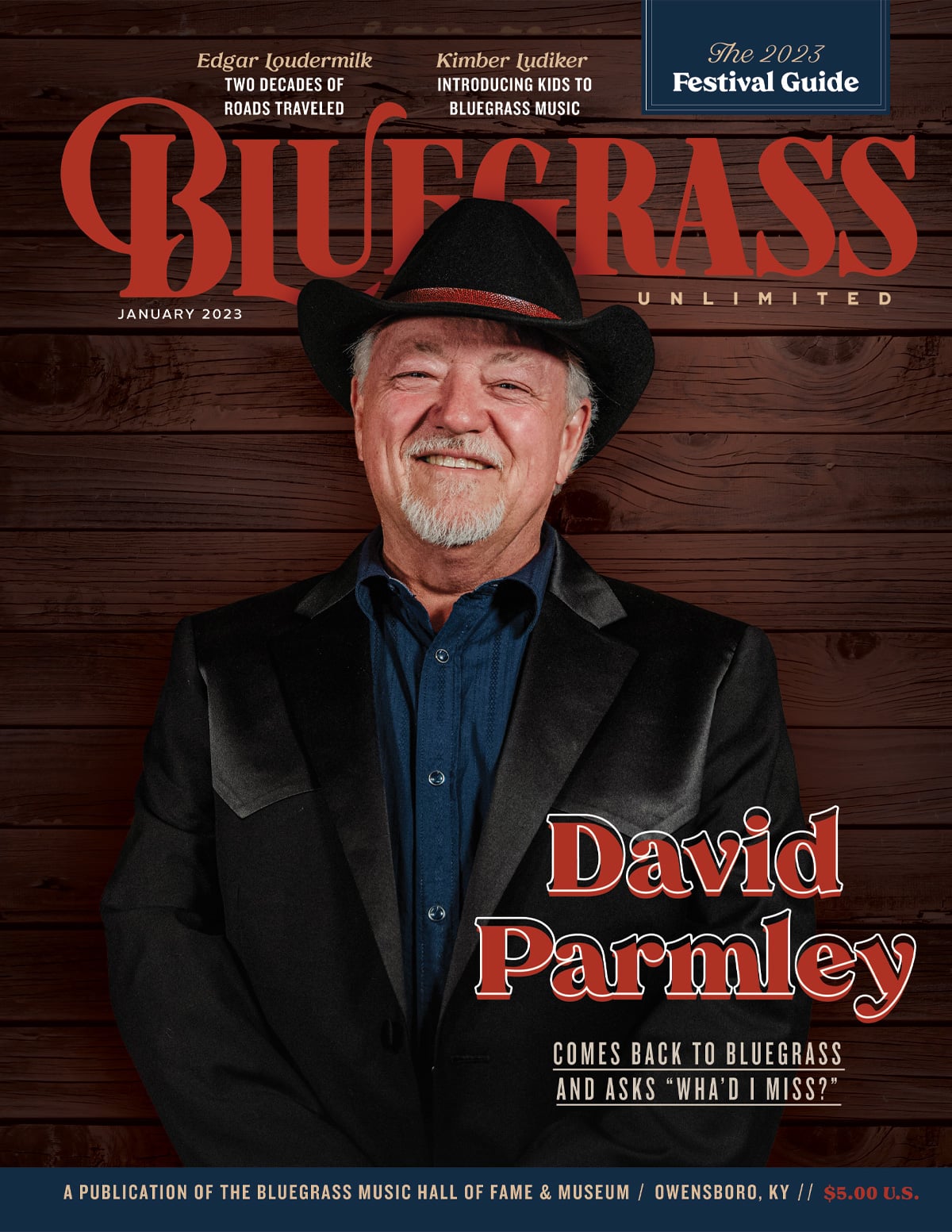
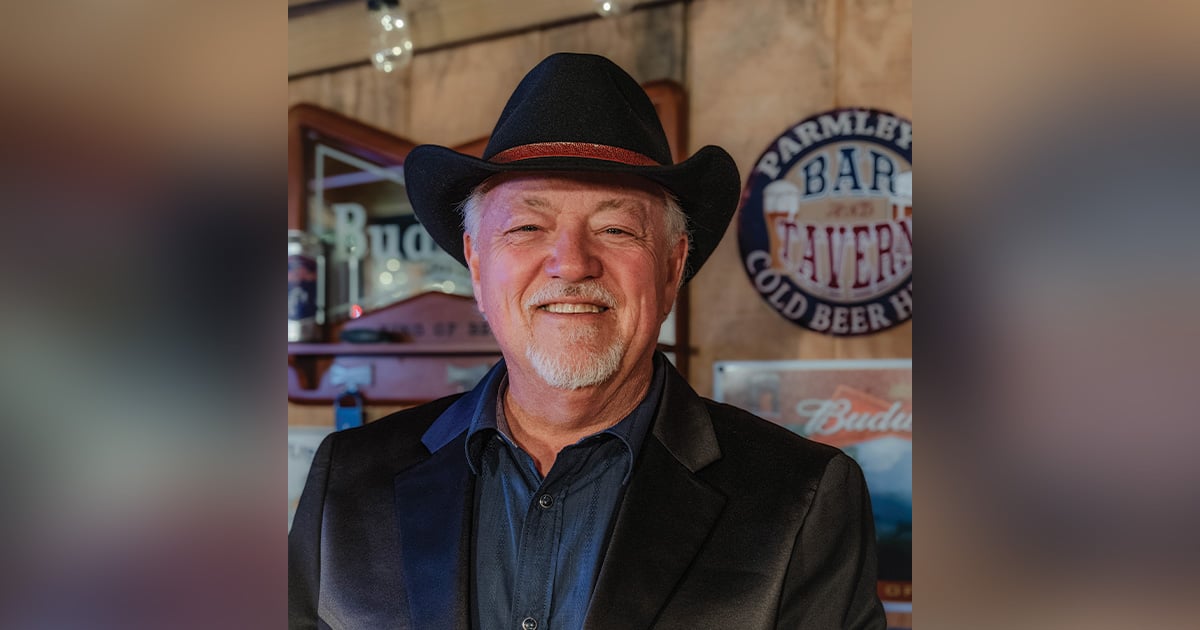
David Parmley
“Wha’d I Miss?”
Photo by Lance Velarde Photography
David Parmley gained a reputation as one of the strongest lead vocalists in bluegrass music while working with his father, Don Parmley, for many years in The Bluegrass Cardinals—and then later continuing with his own bands Continental Divide, followed by Cardinal Tradition. Due to a health issue in 2008, David took some time off the road, but came back in about 2010. Having quit high school to play music full-time at the age of sixteen, David was ready to retire from the life of a touring musician in 2019. But when 615 Hideaway Records owner Sammy Passamano III approached David about recording for the label, David agreed to come back.
Regarding his decision to approach the retired Parmley, Passamano said, “Signing David Parmley to 615 Hideaway Records just fell together so naturally. Ronnie Reno, who is my business partner with Bluegrass Music TV, is also good friends with David Parmley. Well, Ronnie, my dad and I talk all the time and one thing led to another and before we knew it, we were developing a strategy for the first album in a multi-album deal with David on 615 Hideaway Records. It has been a real pleasure and fun working with David. We are looking forward to bringing some great David Parmley music to his fans for many years to come.”
When asked why he decided to return to music, David Parmley said, “Ronnie Reno, a long-time friend, called me up one day and said, ‘Let’s meet for breakfast.’ We met and he started telling me about Sammy and his ideas with the new label. I then had a meeting with Sammy and he brought me back into the music business again because in all of my adult life recording music, I’ve never been around anyone who is excited, and wanting to do more, than Sammy. He has great ideas and he wants to do things that are going to promote me, which is really cool.”
The result of those meetings with Reno and Passamano is an album of great music featuring one of the most talented lead voices in bluegrass performing with an all-star cast of musicians. For several cuts, David is backed by The Traveling McCourys, with Del singing harmony. Other tracks include a core band of Scott Vestal on banjo, Tim Crouch on fiddle, Jim Hurst on guitar, Seth Taylor on mandolin, Jeff Partin on Dobro, and Dave Roe on bass—all recorded in Scott Vestal’s studio with Vestal engineering the project. The result is an album worthy of David’s return to bluegrass.
David Parmley—The Early Years
With banjo legend Don Parmley (originally from Monticello, Kentucky) as his father, David was born into bluegrass. He said, “Dad and Mom told me a story about when they brought me back from the hospital, the first thing my Dad did was put me in my crib and turned on a Flatt & Scruggs record. So, I’ve been around it my whole life.”
By the time David was four or five years old, he was singing at the jam sessions that Don had at their home in Los Angeles. David recalls, “Dad had a pretty hard-core way of teaching. They’d be having the jam session and I’d come in and say, ‘I want to sing one.’ If I started singing and didn’t do it right, he would just stop and say, ‘No, you don’t know it yet. You need to go back in the room and learn.’ He wouldn’t tell me what I was doing wrong, he sent me back into my room to put the record on the stereo and listen to it. I’d discover that either the words weren’t right, or I wasn’t singing the melody of the song, or my phrasing was off. The vocals were always the most important part of the music for my dad and with The Bluegrass Cardinals as we got started. Looking back, I see that it made me learn vocals and harmonies really good. I learned from the pioneers of this music because I would go back in my room and listen to Flatt & Scruggs and The Osborne Brothers…that is how I learned to sing harmony is listening to The Osborne Brothers and singing the parts with them. Me and my dad and Randy [Graham] used to drive down the road in the car and sing harmonies. My whole life was based around that.”
The “nucleus” of the jam sessions at the Parmley home was formed by David and Don Parmley, Randy Graham, and Steve Stephenson. But David explains that Byron Berline, John Hickman, and Scott Hambley would often get together to pick with the Parmley’s group and trade live tapes back and forth. Additionally, David recalls, “Anyone who was traveling to California from back east would come by and jam with us…I remember this one time when Keith Whitley and Jimmy Gaudreau were trying to start this band The Country Store and when they came out they pretty much lived at our place. When J.D. Crowe and the New South were on their way to Japan, they all came by our place and we had a big jam session before they played at McCabe’s. My dad had a full-time job driving for Continental Trailways, but anytime that he was off, there was going to be a jam session.”
David was also able to see a lot of live bluegrass music when he was young at venues like McCabe’s and the Ash Grove. He said, “I would always get up there right in the front row. I remember one time, I was maybe five or six years old, and Bill Monroe came to the Ash Grove. I was sitting in the front row, right at the edge of the stage. When Monroe started asking for requests, I started hollering out all kinds of Flatt & Scruggs songs. I was young and didn’t know that you shouldn’t request those songs from different bands. I just wanted to hear them.”
David was also exposed to many of the active California bluegrass musicians during his youth. He said, “I remember one time me and my dad and Randy, Berline, Hickman, Alan Munde, and Roger Bush all went up to Clarence White’s house and had a jam session. I was real young and Clarence gave me a reel-to-reel tape of him playing the guitar. It had about thirty or forty songs on it. When Clarence passed, Roland came to me and said that he heard I had that tape and he asked if he could borrow it to make a copy.”
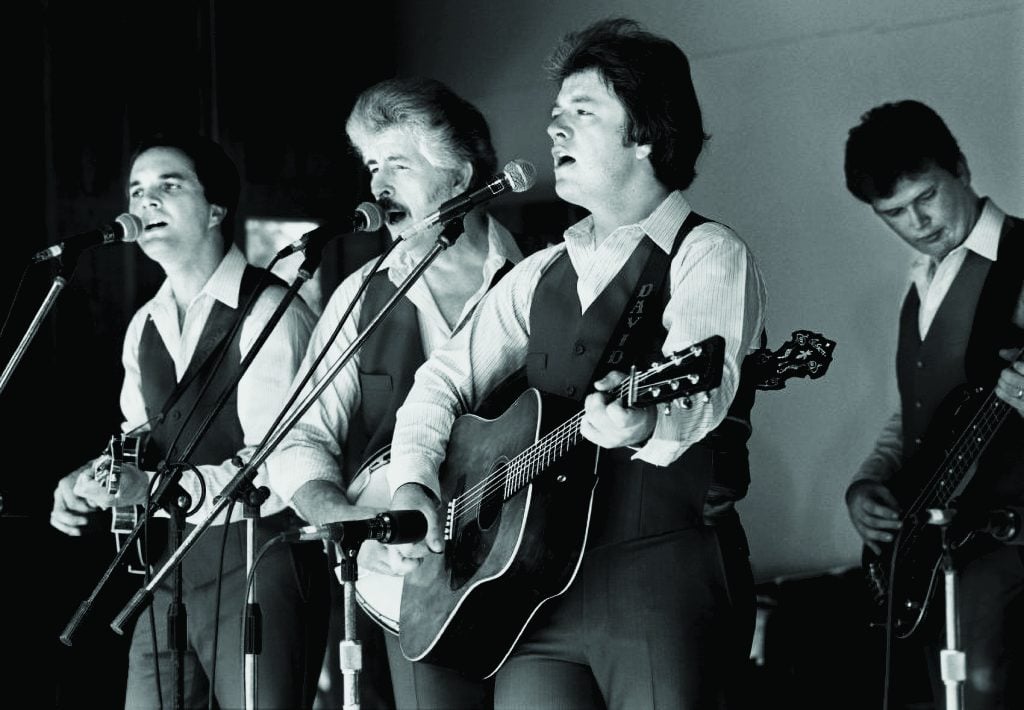
In the early years of jamming, David would sing with the group without playing an instrument. His first instrument was the bass because there usually wasn’t a bass player at the jam. His dad played banjo, Randy Graham played mandolin and Steve Stephenson played the guitar. Although the four musicians played music together frequently, David explains that they didn’t start calling themselves a “band” until about 1974. David said, “Before that, it was always just ‘That bunch that got together to play.’ One or two nights a week we would just pick and sing and have fun.”
Regarding the events that led to forming The Bluegrass Cardinals, David said, “There was an audition for a band to play at Bush Gardens in California and it was going to be for the whole summer. At that point, Steve bowed out because he didn’t want to play music full-time and he took a full-time position with Nissan and moved to Virginia Beach. So, I started playing the guitar and Bill Bryson came in on bass. We auditioned for the Bush Gardens job and got it. I was sixteen at the time. That is when we all started playing full-time and calling the band The Bluegrass Cardinals.”
When asked where the band name came from, David said, “It came from my mom. My mom has always been a fan of cardinals. She just loves the red birds. We were sitting around one night trying to think of a band name and she said, ‘How about The Bluegrass Cardinals?’ We started thinking about it and since the cardinal is the state bird for a lot of states that are the stronghold for bluegrass music, we decided to go with that.”
During the summer of 1976, the Bluegrass Cardinals toured the east coast with Don Parmley on banjo, David on guitar, Randy Graham on mandolin, Bill Bryson on bass, and Dennis Fetchet on fiddle. The tour was a huge success and it motivated the band to decide to move east where opportunities to play bluegrass music for a living were better than they were in California. As soon as they returned to California from the tour, they packed up their belongings and David, his mom and dad, and Randy Graham headed back east. Bill Bryson and Dennis Fetchet had deep roots in California and decided not to make the move. When they arrived in the Washington, D.C. area, they picked up John Davis on bass and Warren Blair on the fiddle.
Recalling the early days after the move, David said, “During the tour we wound up meeting Walt Broderick, who owned the Red Fox. He told us that if we wanted to have it, Wednesday nights would be ours. So, we came back and started playing Wednesdays at the Red Fox and in no time we got to playing Tuesday nights at a place called Charlie’s West Side. Back in them days with all of the venues that were within a two-hour drive of northern Virginia, we could keep real busy. Plus, we were doing shows for the government, like the Library of Congress, during lunch hour breaks. There were times when we were doing two shows a day. We got to where we were working 25-26 days a month playing music.”
The band arrived in the Washington, D.C. area in November of 1976, started working right away and by February 1977 they cut their Welcome to Virginia album for Rounder. The rest is bluegrass history. A number of Bluegrass Cardinal musicians who later went on to become band leaders and sidemen of note include Larry Stephenson, Mike Hartgrove, Don Rigsby, Jeff Autry, Ernie Sykes, Norman Wright and others. David continued to perform with The Bluegrass Cardinals until the spring of 1992. The Bluegrass Cardinals continued performing for another three years after David left the band.
Moving On
Regarding his decision to leave the Cardinals, David said, “I’d always had dreams and aspirations of being a country singer, so a buddy of mine got me a development deal with Harold Shedd at Mercury Records. I thought that if I was ever going to do it, I had to at least try. At the time Harold Shedd was the vice president at Mercury in Nashville. But, he ended up leaving the label and when he did, my deal went into the toilet. Harold moved on to another company and offered me a deal there, but I turned it down. At that point I was in my mid-thirties and everything that was going on in Nashville was with younger aritsts. At that point, I decided to go back to bluegrass. That is when Scott Vestal and I started Continental Divide.” In 1994, David and Scott brought in Mike England on the bass, Jimmy Bowen on the mandolin, and Aubrey Haynie on the fiddle. In 1995, Continental Divide won the IBMA award for “Emerging Artist of the Year.”
Continental Divide, with Scott Vestal in the band, stayed together a few years (until 1998). When Scott left, David kept the band active until 2008 when health issues, and road weariness, caused him to take a break from the music. David said, “I had a heart attack and then at that point I was just kind of tired of it and needed a break. I drove a truck for a while and then I took a job driving a bus for Rascal Flatts. I did that for about four years. Then I started missing playing music. That is when I started David Parmley and Cardinal Tradition (2015).” David Parmley and Cardinal Tradition performed together for roughly three years and released one album. After the Cardinal Tradition broke up, about a year before the pandemic, David went back to driving buses.
Del’s Bus
When David Parmley and Cardinal Tradition quit performing, David sold his bus to Del McCoury. David tells the story—“When I quit Cardinal Tradition, I had that bus and put it up for sale. Del called and asked about it and I said, ‘Come on up and look at it.’ He come up and looked at it and then later brought the boys up and they decided to buy it and Del asked if I wanted to drive for him. I said, ‘Yeah, I’ll drive for you.’ So, I still do that and I will continue to do that because it is just limited dates. I schedule my time around it and go.”
David started driving The Bluegrass Cardinals bus when he was sixteen years old and learned how to maintain and repair buses. For a time he even had a garage in Nashville where he worked on engines and bus interiors. He has driven buses for everyone from various music acts to the pro golf tour.
Additional Projects
In addition to the projects that David recorded with the various bands that he played in over the years, a couple other projects of note include an album by Parmley and McCoury titled Families of Tradition and another titled White House. Regarding the Parmley and McCoury recording, David said, “We were out at the bluegrass festival in Grass Valley, California and, of course, my dad and Del had been friends for many years and when we moved back east, I got to know them all. Both bands were staying over after the festival ended. We all went to the promoter’s camp and had a jam session. Somebody said, ‘Ya’ll ought to record this!’ We looked at each other and said, ‘That would be fun.’ So, we got together, went in and did a record.” The album included David and his dad, Del and his sons and Warren Blair playing fiddle.
The White House project was released in 2003 by a group of bluegrass musicians who all lived in White House, Tennessee—David Parmley, Larry Stephenson, Jason Carter, Missy Raines, and Charlie Cushman. David said, “I had a studio in my house at the time. Larry and I were doing a lot of work for Pinecastle Records. We had all gotten together for a jam session one night and Larry and I mentioned the possibility of the group cutting a record. We talked to Tom Riggs [head of Pinecastle] and he said, ‘That sounds like a great project. Go into the studio and cut it.’ So, we did that record together.”
So Wha’d I Miss?
Remembering his decision to come back and record the new album for 615 Hideaway Records, David said, “All those years that I was driving buses or doing these other things that I do, I’m sitting there listening to XM radio and singing because I just love music. So, I decided to cut this record and I’m putting a band together now and I’m going to get out and work some dates. But it won’t get to the situation where I’m out playing 150-200 dates a year like I did with The Bluegrass Cardinals. I’ll work when it makes sense, and I’ll drive buses when that makes sense and live out my time.”
With The Traveling McCourys and Del on some cuts, and the aforementioned all-star band forming the core group, there is no question that the instrumental and vocal talent on this recording is of the highest caliber. Regarding the selection of material, David said, “It all came about real quick because I hadn’t planned on doing anything else. When this happened I did have some songs set back that I’d always wanted to do and I grabbed them up. Then I just started looking…I did a song that Don Williams did on one of his more recent albums. Linda Buell—a friend of mine who is a songwriter—I cut some of her stuff back on my second solo album, so I’ve been knowing her and liking her music for years. We cut two of her songs on the first Continental Divide album. I had some of her songs set back. One of the songs that I re-recorded with The Traveling McCoury’s was ‘Smoke Along The Track’, which was the number one single that came off of the Parmley and McCoury project.
Back On The Road
In addition to putting a band together to go out and tour in support of his new record in 2023, David has also been performing with Larry Stephenson, Randy Graham, and Mike Hartgrove (all former members of The Bluegrass Cardinals) as a Bluegrass Cardinals tribute band. David said, “We did six dates in 2022 and we got some more dates booked in 2023. We love playing and singing together and doing all the classic Cardinal songs.” The tribute band originated when Darrel Adkins, a bluegrass promoter in Ohio, made the request. David said, “It hit me at just the right time, I was itching to do something. We wound up doing that at his festival and that got the ball rolling.”
David said that the new band that he is putting together will be performing the songs that he has recorded for his new album, but they will also be performing songs that he has recorded throughout his career. He said, “Any time I go on stage I get requests for certain songs that I have done through the years and I’m always going to do them. For me, that is one of the best things in the world is when an audience requests your stuff. The new band will have to be able to play that stuff also…and it is hard to find musicians that can play that many different styles. When you mention anything about Continental Divide it scares a lot of banjo players to death because they say, ‘Oh God, I can’t play it like Scott Vestal.’ I say, ‘Man, you don’t have to play it note-for-note like him. Just get up there and do the song.’”
Looking ahead to 2023, David said, “I’m very excited to get back into it. Sometimes taking time off from something will clear your head and make you realize what you missed about it. I’ve been doing music since I was a teenager…lots of traveling, lots of shows, and sometimes you can get burned out and don’t appreciate what you love about it.” As of November 2022, David has about six dates lined up for the new band in 2023.
For more information, check davidparmleymusic.com.