David Harvey
Gibson Master Luthier
Photos By Jake’s Visuals
The Father of Bluegrass, Bill Monroe, is legendarily linked to a Gibson F-5 mandolin. Its label was signed on July 9, 1923 by Acoustic Engineer Lloyd Loar. Loar implemented violin F-holes and raised fingerboards, and he introduced long maple necks to the fretted-instrument world. He took the existing, very successful Orville Gibson carved oval-hole design and created what is arguably one of the greatest mandolins ever devised.
Since 2007, David Harvey has led the creative team at Gibson’s Original Acoustic Instrument Division. David’s official title is Master Luthier, the modern-day position we associate with Loar. David is the creative, hands-on luthier, responsible for quality, research and development, and the final product bears his signature. His outreach includes working directly with dealers, customers and the music community as a whole.
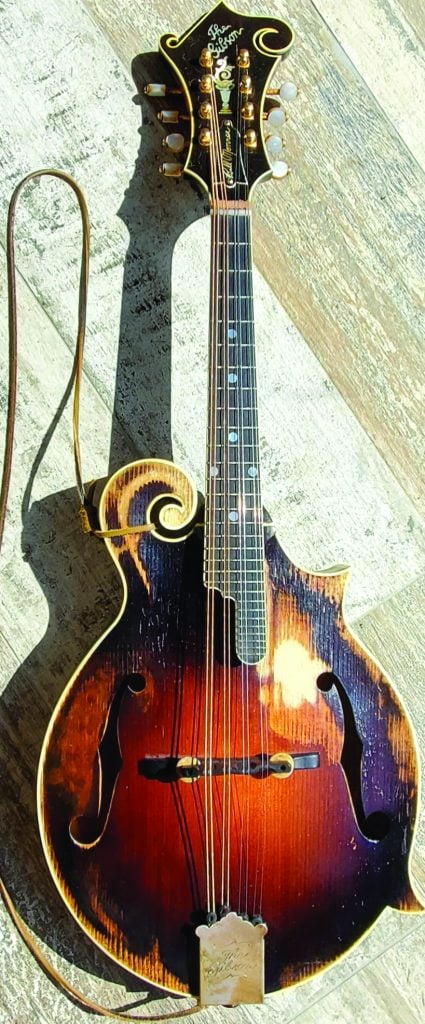
David is an accomplished musician and producer, and that is where his journey began. He has toured and recorded with a “who’s who” list of artists and is featured on Grammy and IBMA winning projects. He was mostly influenced by his Dad, Dorsey Harvey, a fantastic mandolin picker in Dayton, Ohio. “Dad was always tinkering and trying to get the best sound he could out of a mandolin. The first mandolin he owned, he tried to tune it for two weeks and took it outside and stepped on it!” His dissatisfaction and desire led his mother to eventually purchase a 1953 Gibson F-5. In search of perfection, Dorsey scraped the finish off the instrument to achieve what he was looking for in sound quality. David remembers from a young age being fascinated with mandolins and dreamed of designing and building them one day. He assumed that all humans felt the same and was shocked when he asked a schoolmate, “What kind of mandolin does your Dad play?” The boy had no idea what a mandolin was.
David began developing his lutherie skills as a young man by buying beat up guitars and mandolins he could afford. “The idea was to repair and put them back together, but in reality I mostly just took them apart! I was a 12-year-old with a room full of instrument parts! In the big picture, this is where I began to understand how they were built and why.” David took things to a higher level when he met friend and builder John Ramsey, owner of “The Folklore Center” in Colorado Springs, Colorado, whom he considers a mentor. David’s journey led to an apprenticeship studying violin building and repair. He later honed his skills while managing “About Music” in Indianapolis, In. When a move brought him to Nashville in 1996, he worked with Charlie Derrington at Bellevue Guitars. The Nashville community of musicians became increasingly acquainted with David during his time at the Violin Shop, where he repaired both violins and fretted instruments before joining Gibson in 2004.
Prior to becoming Master Luthier, David was with Gibson Warranty, Repair, and Restoration. During these years he would see a few reoccurring problems and began to think about ways to alter designs to rectify the problems. This served him well when he became responsible for design, research, and development.
That responsibility began in 2007 when he signed his first Master Model label. I asked David what his goals were when he took on that role and he told me, “I wanted to achieve greater consistency in the builds and minimize warranty returns. I wanted to bring violin repair and building ideas into the process and make sure we implemented what, in my opinion, were Loar’s intentions about what he wanted the F-5 to be: perfecting violin technology in fretted instruments. Loar was, after all, a great violin and viola player. When folks ask about copying Loar-signed instruments specifically, I remind them that they are consistently great, but each one is different, so we aim to create an amalgam of all the best aspects of his instruments in our Master Model line.”
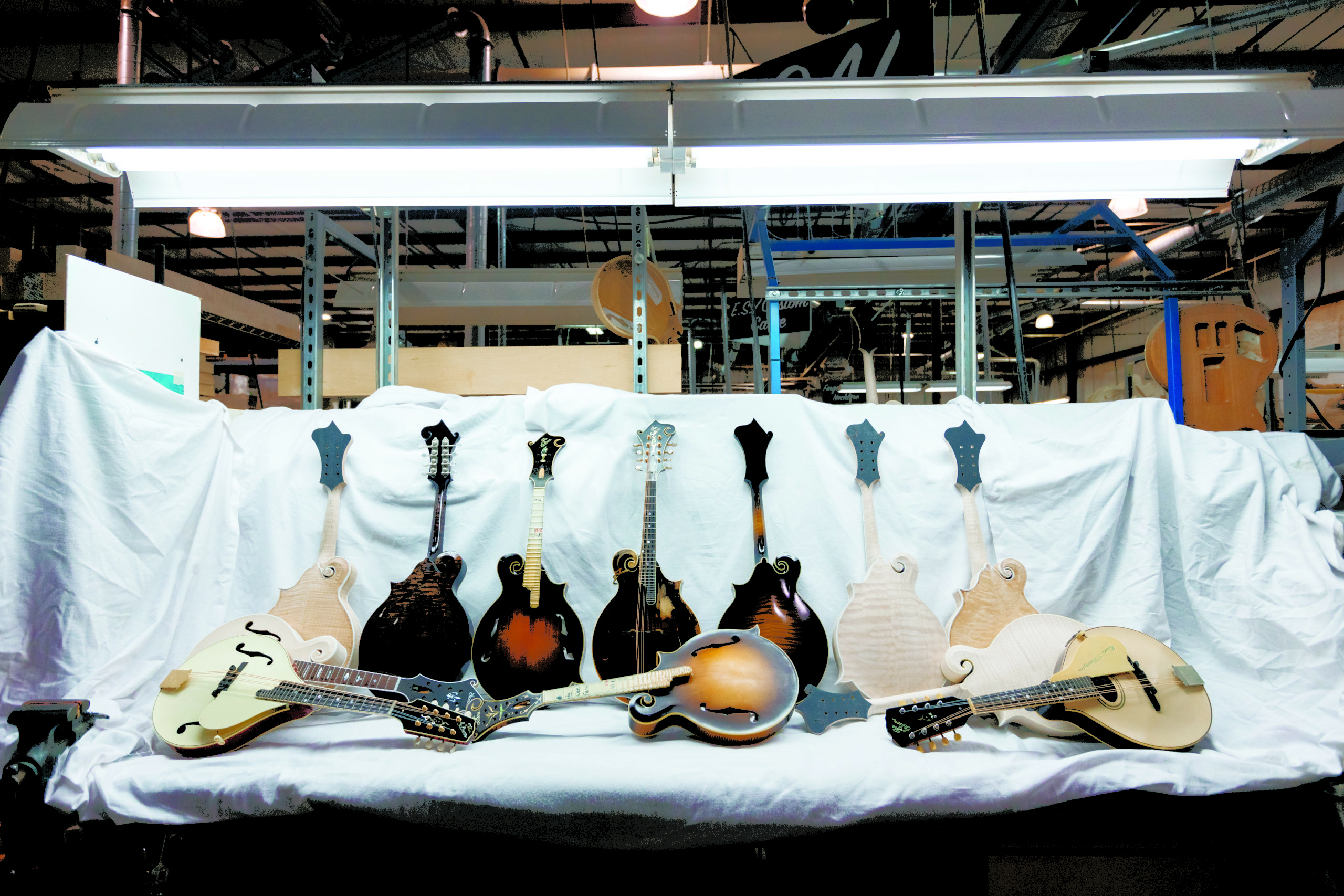
David has been very successful in introducing new models to the mandolin line (we’ll get to those shortly), no small feat in the acoustic stringed instruments world where tradition is king, and dealers and players alike tend to look askance at departure from the norm. Convincing management to take on a new model involves more than just getting everyone on the Gibson team excited about the instrument itself: David has to get commitment from dealers and players. His knowledge of the history of Gibson and how and why it might be good to re-introduce a model that sold well in another era or modify an existing one helps his case.
“New mandolin models like the Orville Tribute, Victorian F-5, and the 120th Anniversary started with an engineering meeting. After discussing the vision and features I had in mind, such as inlays, hardware, wood types and so on, the computer mock-up is created. A few meetings follow to fine tune the mock-ups and implement engineering contributions. Examples are the intricate inlay patterns on the Orville and the 120th Anniversary. A spec sheet is written and a prototype is built. Since many models are built on existing frames, the prototypes start with inlay drawings, a spec sheet, and good old fashioned lutherie skills.”
The first new model David introduced when he became Gibson’s Master Luthier was the Victorian F-5, in 2007. It was built on an F-5 frame with F-4 appointments, double flower pot inlay on the peghead, bound f-holes and aged varnish finish. Many early twentieth century Gibson oval-hole instruments had black tops with wine/burgundy colored back and sides, and the Victorian was a tip-of-the-hat to those models. Many early Gibson instruments had radiused fingerboards (the idea is that the radius follows the curve of the player’s finger), but the Loar era mandolins didn’t, so the fact that the Victorian model was radiused would be unique to a Loar purist. Its name a tribute to the usually overly ornate but somehow beautiful era in which Gibson carved instruments were born, the Victorian is a striking and very successful instrument offering.
The first A-model Harvey introduced was the A-35, built on an A-5 frame. David took many elements from the A-3, a model that sold well in the early twentieth century. The ivory colored top with ivoroid pick guard and the traditional A-3 peghead inlay are features of that mandolin. It also sports a ‘snakehead’ peghead (the top of the peghead actually has the shape of the furrowed brow of a viper), a distinctive addition to some instruments of the Loar era for which he was responsible but did not sign. The F-holes are bound and the varnish is aged.
The Victorian and the A-35 are great examples of how David and his team were able to introduce elements of many models from Gibson’s vast history and create something new that players and dealers were interested in.
Bill Monroe, Lloyd Loar and Gibson fans should be excited about a plan that has begun and is in place for the next few years. It is a tribute to the Father of Bluegrass and Gibson, a series of three models that will capture different eras of Bill Monroe’s Loar-signed F-5. Looking forward to the one-hundredth birthday of Bill’s mandolin on July 9, 2023, the series will include: The Hall of Fame Mon, The Mad Mon, and the Barbershop Mon.
The Hall of Fame Mon is based on Monroe’s mandolin in its current state in the Country Music Hall of Fame. Every effort was made to match wood grain, wear patterns and sound, and to copy all original appointments. So far, three have been built in addition to the prototype.
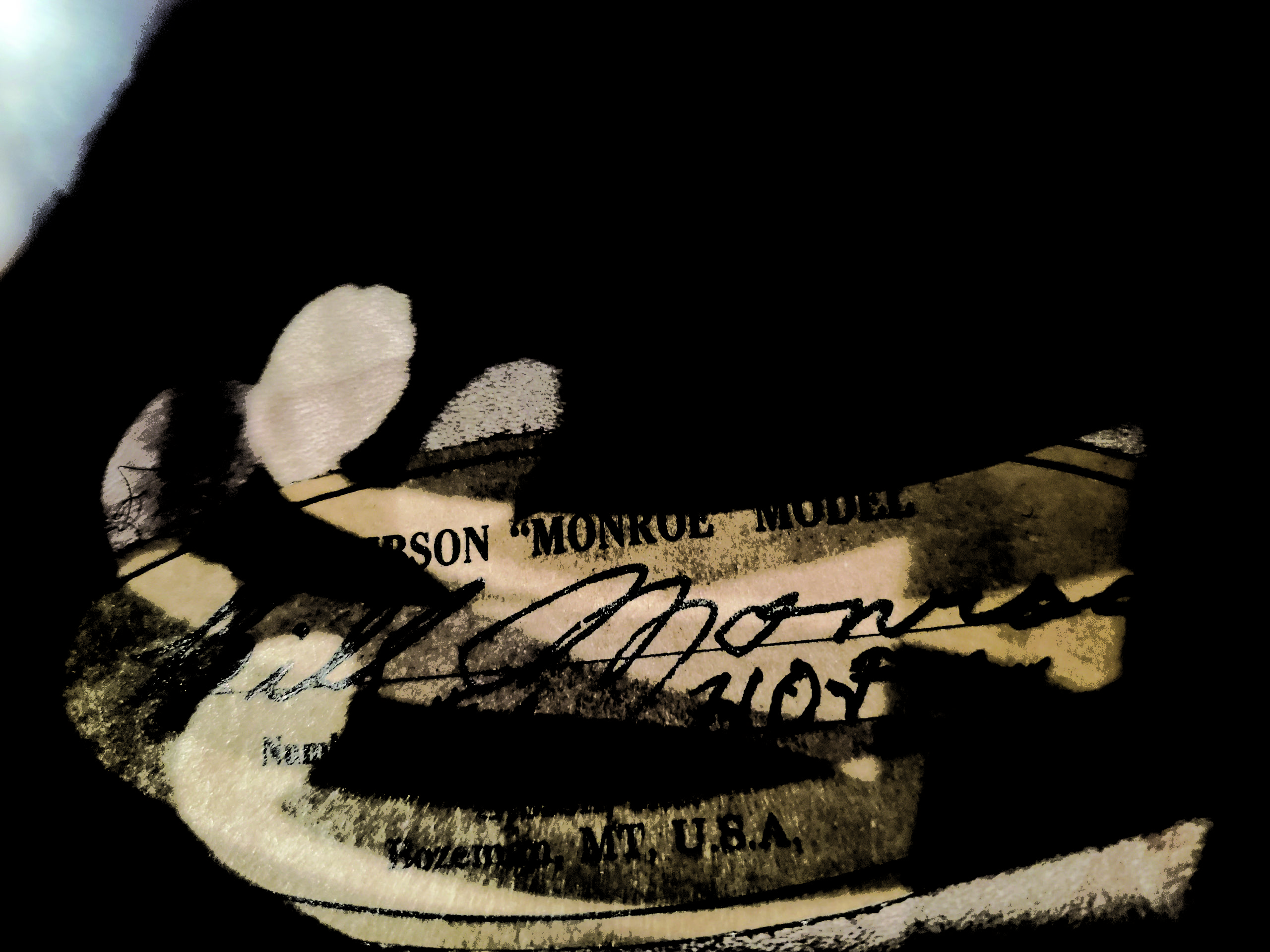
The Mad Mon is styled after the early 1950’s status of the instrument. According to Harvey: “In the early 1950’s, Bill sent his beloved mandolin back to its birthplace in Kalamazoo, Michigan, for some much needed repairs, including replacing a broken peghead scroll. When Mr. Monroe received his mandolin back, he was not pleased or satisfied with the work that had been done. They had had the mandolin for four months and didn’t repair the peghead scroll. In anger he took his pocket knife and gouged out the Gibson name from the peghead. His attention then turned to the body and he took the same knife to the instrument and began to remove the finish they had sprayed in Kalamazoo.” There are many pictures of Bill and his mandolin with this iconic look with gouged-out brand and broken scroll, and the Mad Mon model will include them as well as all other appointments of the instrument at that time. It will be available in the near future and market interest is already high.
The Barbershop Mon is based on the mandolin’s condition when Bill purchased it. David: “In 1945 Bill Monroe spotted a Gibson F-5 mandolin, serial number 73987, signed July 9, 1923, by Acoustic Engineer, Lloyd Loar, in a barber shop in Miami, Florida. When Bill found it in the shop it was already 22 years old and nearly pristine! The price of the mandolin when in was new was $250, and Bill paid $150.” (His mandolin today has been given a value of over 1.25 million dollars.) This instrument will represent the mandolin at its cleanest, best shape and closest of the three tribute models to what it would have looked like when new.
We look forward to the 100th birthday of Bill’s mandolin in 2023, the continued launch of this three-phased series, and David wants you to know about the final kicker: all will include a label with Bill Monroe’s ACTUAL signature, not a copy of his signature.
And, of course, one of the big questions on the minds of Bluegrass Unlimited readers: will Gibson build banjos again? David: “We’re closer than we’ve been in a long time.”
So, what else does the future hold and what can we look for? David said, “I’ve got lots of ideas and plans, but at this point in time, they will have to remain a mystery, but I know they are exciting! Gibson has a long rich legacy, but it has a bright thriving future as well.”
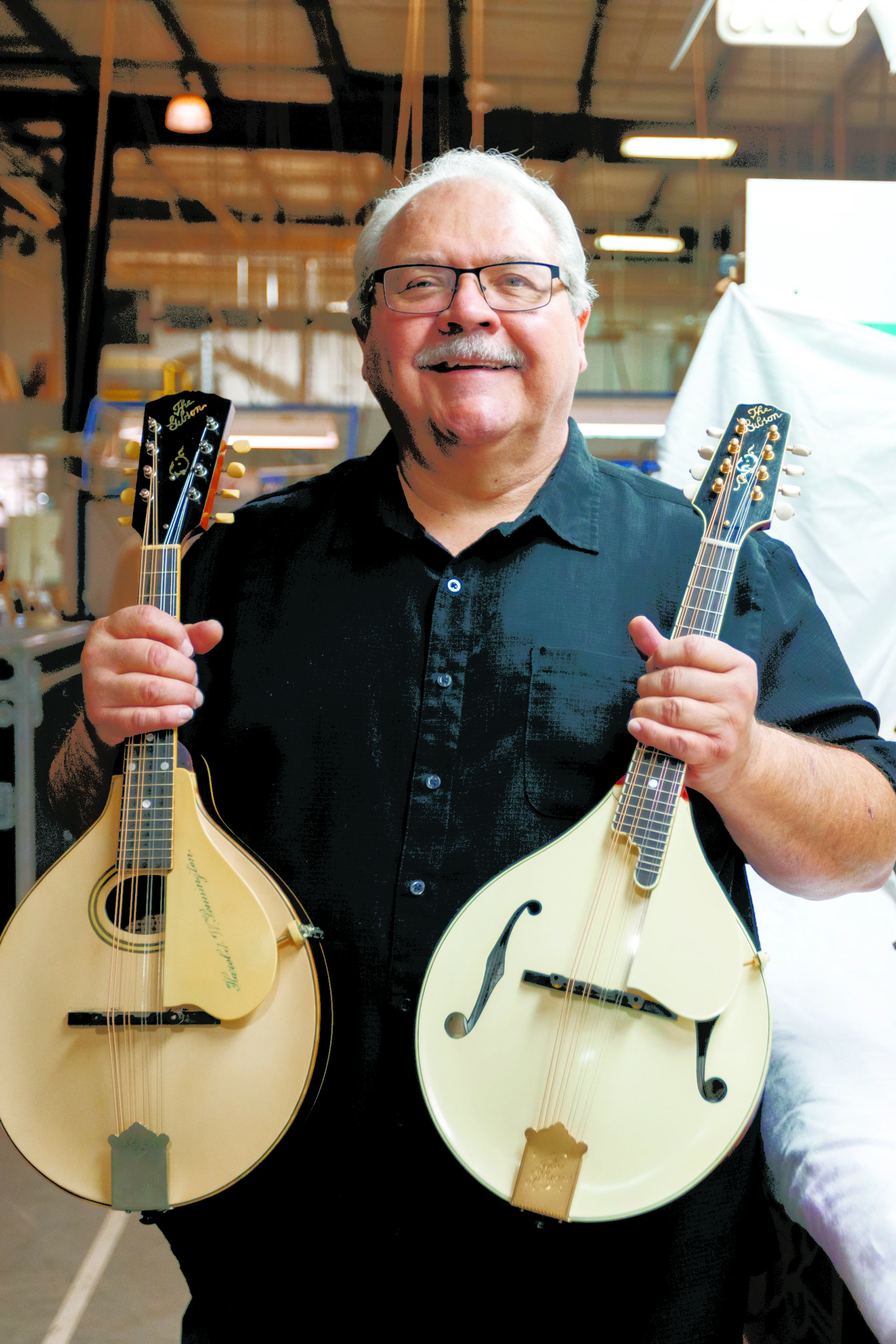
He added, “I don’t want to diminish God’s role in everything in my life. I feel very blessed to be here at Gibson and don’t take it for granted. I look back on my life and see how each step and position held was a precursor to the next.”
A fully developed story about Harvey as a player, producer and writer will have to wait until another time, but here’s a teaser:
David toured as a young man with Red Allen, was a member of Larry Sparks ‘Lonesome Ramblers’, was a member of Larry Cordle and Lonesome Standard Time, played with Claire Lynch, with his own band ‘Wild and Blue’ with wife Jan and her sister, Jill Snider-Crabtree, and with Nashville based ‘Radiola’. He produced and played on ‘Moody Bluegrass: A Nashville Tribute to the Moody Blues’ and ‘Moody Bluegrass Two…Much Love’, projects that included John Cowan, Alison Krauss, Ricky Skaggs, Vince Gill, among many others, and the Moody Blues guys themselves.
David added a final note to our conversation, “I want to recognize my great Gibson Original Acoustic Instruments Team, and especially my beautiful and incredibly talented wife of 32 years, Jan Harvey! I definitely would not be where I am today without her help, and support and I thank God for her every day!”
Gibson sends out all its mandolins with D’Addario EJ74 Mandolin Strings and in Gibson brand TKL cases.