

Dave Nichols
A Master Luthier and Inlay Artist Who Keeps No Secrets
Photos By Dale Cahill
fter returning from an extended tour in Vietnam and receiving his Doctorate in Psychiatry, Dave Nichols started working at St. Lawrence Psychiatric Center. Shortly thereafter, Nichols set up his first inlay/ luthier shop, Custom Pearl Inlay. Since then, Nichols has perfected his craft as a luthier and inlay master and likes to say that he can inlay anything into anything. But while Nichols takes pride in his own accomplishments as an instrument maker and inlay artist— evidenced by guitars with elaborate and over-the-top pearl inlay—of equal importance to him is the work he has done as a teacher and mentor. He knows that the mark of his success will be in sharing the knowledge he has gleaned from over 60 years on the job with others.
In the late 60’s Dave set up his shop in his hometown of Waddington, NY. While inlaying has always fascinated Nichols, up till then pearl inlay was more of a hobby than a full-time job. Then he met Mike Longworth, Martin Guitar’s inlay guru. Longworth convinced Martin Guitar to send Nichols fingerboards, pickguards, bridges, headstocks, and other essential components to a guitar for him to inlay with pearl. Nichols then hand delivered the worked pieces back to Martin. The rest is inlay history. For the next 40 years all custom pearl inlay for a Martin guitar went through Nichols’ shop. It was during this time working for Martin that Nichols began to develop his own unique and personalized inlay designs.
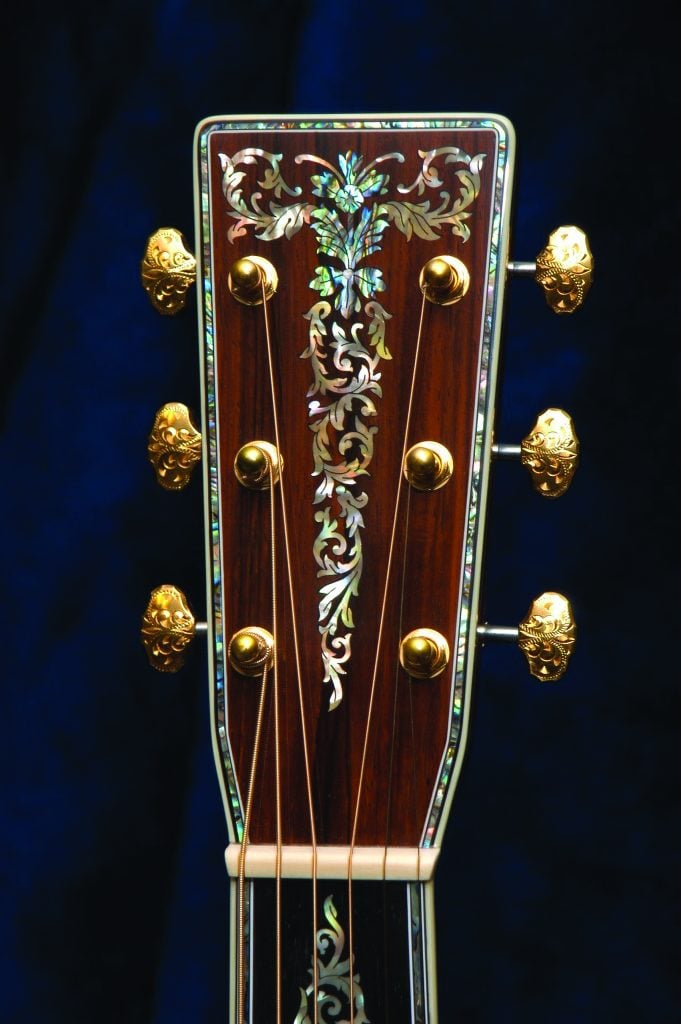
Over the years, Nichols has inlayed thousands of instruments. Nichols’ list of bluegrass, country and rock star customers includes B.B. King, Del McCoury, David Grisman, Aerosmith, ZZ Top, Merl Haggard and Johnny Cash, who’s guitar was painted black with a tree of life inlaid on the fingerboard and his signature in the peg-head. He even got a call from Gibson when they needed to repair and inlay Bill Monroe’s damaged mandolin. Nichols is also a talented instrument repairman and builder of beautiful guitars, and mandolins.
Early in his career, Nichols started teaching classes on building and inlaying guitars. Over the years, Nichols has taught hundreds of students in his Malone shop and at ASIA symposiums (Association of Stringed Instrument Artisans), bluegrass festivals, the American Woodworking Society and for the North Eastern Woodworkers Association. Some of those students were guitar making and inlay hobbyists and others have gone on to create their own luthier and inlay businesses with the knowledge Nichols has imparted to them.
Dick Boak, who has held many titles at Martin Guitar over the years, worked closely with Dave. “As the unofficial artist in residence, I was the one that created much of the custom inlay artwork that David would use to do the inlays. I was his primary contact at Martin.” Boak considers Nichols one of the finest pearl inlay experts in the world. “Nichols is generous,” describes Boak. That innate generosity extends to his students and colleagues. Boak says, “For Nichols it is not about business but about what is right and about his personal relationships with people. That personal approach is what his students and mentees appreciated the most about Dave as a mentor and teacher.”
Luthier, inlay artist, and tool designer/machinist John Hall of Blues Creek Guitars echoes Boak’s assessment of Dave as both a person and instructor. Hall called Nichols for the first time about eighteen years ago when he needed help with an inlay project. Dave taught him the long and intricate process of designing patterns and cutting pearls over the phone, sent him the necessary materials and thus began a friendship that to both now feels a lot like family.
It is when Hall attended one of Nichols’ weeklong classes for guitar building and inlay that he saw first-hand Nichols’ role as a teacher. During that week, Hall learned the basic mechanics of cutting pearl, including specific inlay hand skills and how to relax and position his body when cutting delicate designs. Hall would not call Nichols a cheerleader. “Dave is blunt, direct and honest. He tells you what you need to know, whether you like it or not.” It is because of that honesty that Hall trusts Nichols and eventually turned to Dave not only for building and inlay advice but how to start his own luthier business. As a machinist Hall also worked with Nichols to design a pneumatic inlay tool which has almost doubled his productivity. Understandably, Hall’s loyalty to Dave runs deep. He says with great conviction, “Nichols has taken my inlay skills to levels I can’t believe. If the man needs a kidney, he’s got mine.”
Mike Franks who owns his own luthier shop in Rochester Hills, Michigan shares Hall’s respect for Nichols as a mentor and as a person. Franks met Nichols about sixteen years ago. Franks says, “as talented, experienced and busy as Dave is, he still takes time to mentor people like me.” These days, Franks talks to Nichols about once a week to trouble shoot building problems, discuss orders, and just catch up. When building a style 45 Dreadnought a few years ago, Franks ran into some challenging pearl junctions that required specialty mitering. “Dave talked me through it on the phone, sent photos and took the time needed to teach me how to do this joinery.” Not long after that, Franks showed up at Nichols shop to build an F-style mandolin. Nichols put down what he was doing and built one alongside of Franks so that he could better demonstrate how to carve the back and top of the instrument. “He is a selfless man who, unlike others with his talent, will share his secrets with you so that you become a better luthier,” says Franks. Mentoring clearly comes naturally to Nichols.
Kate Greenland, one of Dave’s more recent students, attended a weeklong inlay class with Dave in 2019. She was making a banjo and wanted to add inlay to the neck. Kate contacted Dave in part because she knew his reputation as an inlay artist. What she did not know about Dave when she signed up for the class was how much time he would make for her and the patience he showed as she acquired what seemed to her a near impossible task. She also did not know that she would be the only student in the class. During that first class, Dave taught her not only about the process of cutting and joining pearl but the importance of approaching the work with a relaxed mind and body. She says, “Everything I learned I used.”
The second class she attended included four other students. She explains that Nichols would pull the five of them together to teach them something new or make a point. When they returned to their work, Nichols then took time to guide every student, no matter what their level of experience. He would then go back to work on his own inlay projects and allow them time to work at their own pace. Greenland says that the full day of instruction never dragged and that when she finished a project, like the portrait of her dog, or completing nine tiny letters in cursive, Dave was just enthusiastic about the outcome as she was. She explains, “He still has a real joy for what he is doing.” That joy is contagious.
Greenland left that second workshop and returned to her home in Quebec shortly before covid hit. During the covid lockdown, Greenland frustratingly had no access to a fully equipped workshop. Greenland did what so many of us did during covid isolation, she adjusted to her new world and decided to apply her inlay work to jewelry making. She now sells her carefully and beautifully inlayed bolos and bandana clips through her Instagram site. Nichols, who has seen Greenland’s jewelry and admires her work, describes Greenland as an inlay artist who is both skillful but more importantly works from her heart.
Tracy Cox is another student who went on to make a name for himself in the world of guitar making and inlay. After his time as a student in Nichols’s Malone studio, Cox went to work at Martin Guitars from 2007–2010 and has since started his own luthier and inlay business in Parishville, NY. On his website, tracycoxguitars.com, he makes a point of mentioning his apprenticeship with Nichols and how it led him to the C.F. Martin & Co. Custom shop. Nichols says Cox takes his inlay over the edge and beyond., That means something coming from a man known for his own otherworldly inlay.
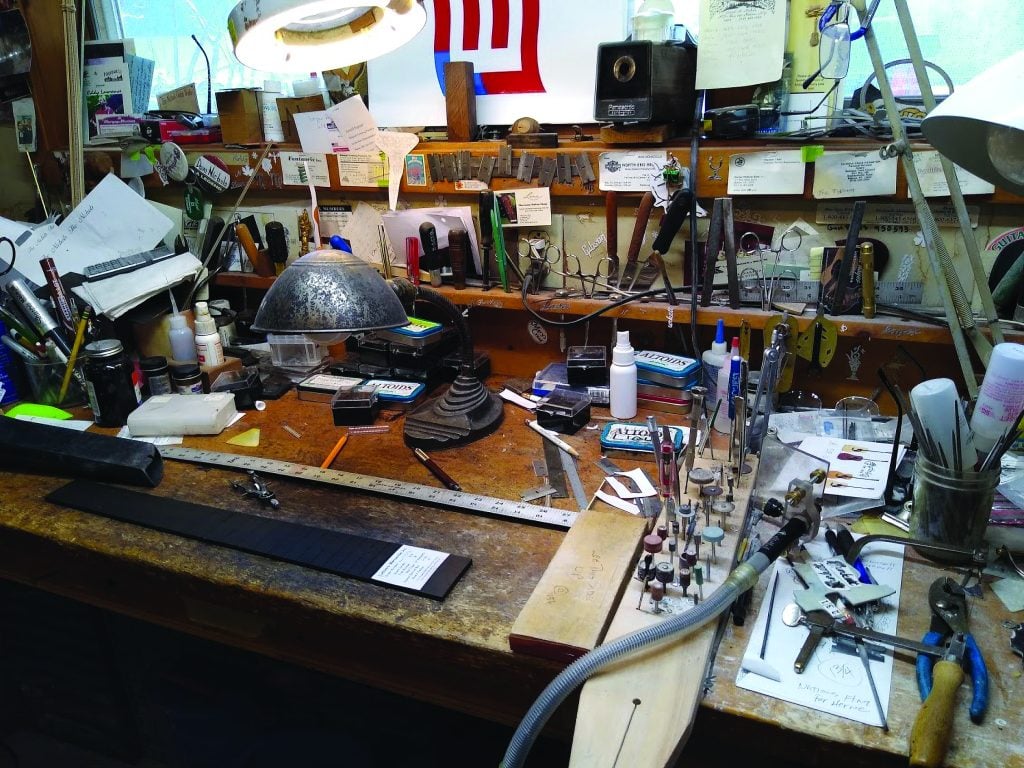
While Nichols might be slowing down a bit, when you walk into his Malone shop out of which he runs his business Custom Pearl Inlay, a buzz of excitement and possibility fills the air. Nichols positive outlook and intense focus creates an ideal setting for learning. Nichols says “My philosophy is that we’re on the earth for a short time, and when we’re gone, the only thing left is what we’ve managed to teach others or the skills that we’ve passed on. When I am gone, there’s going to be an awful lot of people that have learned from me and can continue doing what I have done. It is something, kind of a legacy. I don’t just want to leave some guitars or that kind of thing, but knowledge of ‘how to.’” To the benefit of other luthiers and inlay artists, Nichols has happily shared his secrets.

Dave is the best. I toll his class and. Built a guitar. Fantastic detail. Taught me how to inla and work carefully. Thanks Dave you are the best. !!!