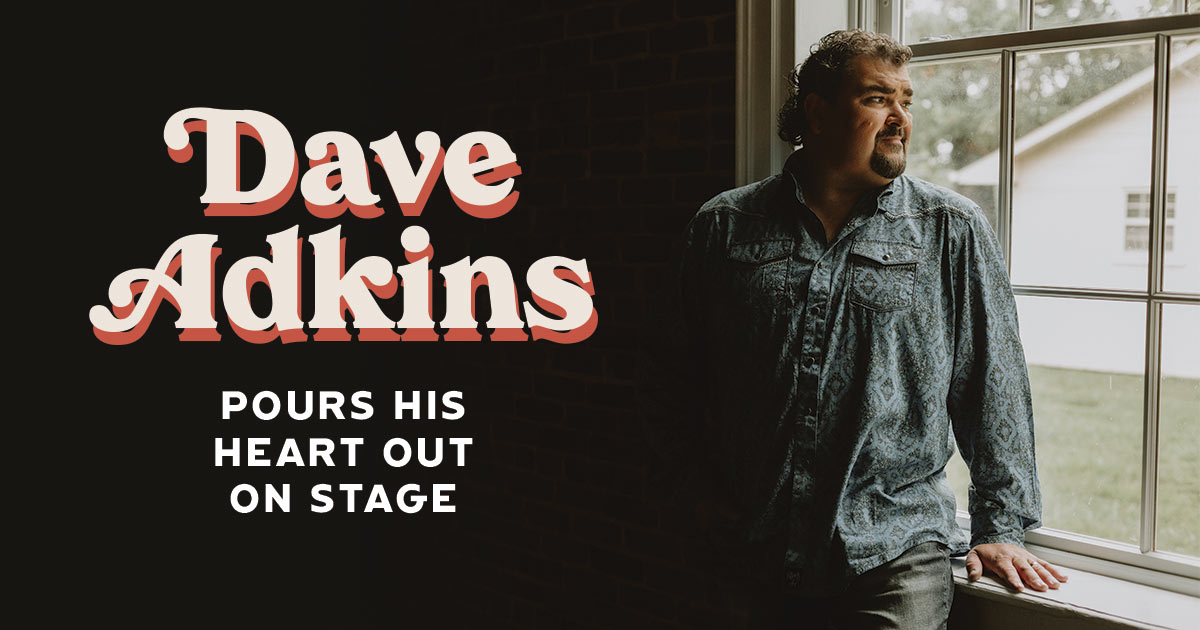
Dave Adkins
Pours his Heart Out on Stage
“This is the boss of the family; she’s 17,” Dave Adkins explains as he introduces Lila Jean, one of his many canine friends. The Pikeville, Kentucky, singer/songwriter is definitely a huge animal lover. He can’t turn away those adorable pooch and cat faces and often fosters and adopts four-legged friends.
“Everybody knows that around here, so we’ve had two dogs dumped off in the last month. Of course they’re living in my basement now. My wife is just throwing a fit! I ain’t got much money, but I make up for it in animals,” he explains, letting out a hearty laugh.
Adkins is as jovial as he is big-hearted. He has the extroverted personality that draws people into his presence, which is a huge asset when he performs. Each time he steps out on that stage, Adkins lives by a piece of advice that Jimmy Martin gave him as a 13-year-old kid who was fortuitous to share the stage with the bluegrass legend.
“He said when you’re on stage the thrill ain’t for them people to get to see you. It’s for you to get to perform for them. He said, ‘Don’t perform at them, perform with them. Make them feel like they’re part of your show because the honor is you’re getting to play for them not that they get to see you.’ I’ve lived by that every time we go out (on stage). No matter if it’s five or five thousand they get the same show. We give a hundred and ten percent, and if it is the last time I get to walk on stage, they can truly say we left it all up there.”
That creed was underscored for Dave last year when he faced a health scare with kidney cancer. “Anytime they tell you that you have cancer the first thing it’ll do is scare the poop out of you. You never think you’re going to hear that. Then, your mind goes a thousand places. God, what’s going to happen? Am I going to need this? Am I going to have to do this? How much treatment? It’s a wake-up call. I hope nobody that reads this has to go through it. But if they do, don’t give up because there’s always hope.”
Fortunately, doctors caught it early thanks to Adkins’s conscientious wife, Katrina, who is an RN. “She’s like, ‘You have to be healthy so you can sing until you’re 90.’ I had regular doctor appointments. Catching it early is the main thing. When they took three quarters of my left kidney out, I didn’t have to have chemo. I didn’t have to have radiation. They felt good about it. Thank God! It could have gone so wrong. The earlier you catch it the better chance you have.”
The experience gave Adkins a renewed sense of how precious life is. “It can be gone in a blink of an eye or change drastically. At the last appointment, the cancer specialist said, “We got it all. As of right now, you’re cancer free. Everything’s good.’ Me and my wife both teared up and I thought, Oh, My God, I’m gonna dance out of this place. I’m the happiest dude in the world! But then, next door you hear somebody squalling because their life is never going to be the same. It’s the most elated and the most helpless feeling in the whole world. I guess that’s how I can explain it. But it gives you such a new lease. I try to be such a better guy. I try to make the best music I can. It gave me a real sense of if this is my last album would I be happy with it.”
The answer is a resounding, “Yes!” After signing with Billy Blue Records in August, he recorded What I’m For, his latest and, to him, best album so far. The 11-track album features Aaron McDaris (banjo), Justin Moses (resonator guitar and mandolin), Jason Roller (fiddle and guitar), and Jeff Partin (bass) with background vocals from Jerry and Magnolia Salley, as well as two of Adkins’s band mates, Zack Vickers and Ari Silver.
“I’m so proud of this record. My wife had her second brain surgery in August. She’s a tough cookie; she don’t get very emotional. And we were laying in bed the first time that Jerry Salley sent it over. When I listen to music, especially new music, even if it’s mine, I don’t want anything on. I don’t want anybody talking to me. I just want to listen. I want to focus. We had it on our speaker and all of a sudden she gets these big tears in her eyes, and she says, ‘If this record don’t move you up the ladder a little bit, I don’t know what else you can do.’ I looked at her with tears in my eyes, and I said ‘I don’t either.’ It’s just that kind of record man.”
The first single, “Bad Moon Rising,” is a grassed-up version of Creedence Clearwater Revival’s rock classic. “CCR was just always one of my favorite groups,” Adkins explains. “Their lyrics moved me and their melodies and the way they did their songs. About 30 years ago I heard Timmy Ray Cline, son of Curly Ray Cline who played fiddle for Ralph (Stanley) for 24 years, sing and put that out on a little CD here locally. I loved that version. They did it really peppy. I’ve always wanted to do it, but I just never did really have the courage to put it out. When I got to do this first record with Billy Blue and Jerry Salley, which that was a dream come true, I said can I send you something and see if we can do this?”
They recorded the song’s tempo at a lightning pace, which has proved to be a bit of a challenge for Dave’s rhythm guitar skills. “I kick myself in the butt every time we play it live. I do the best I can. Live, they (my band) kill it. I just try to keep up.”
The second single and title cut, “What I’m For,” comes from the writing pens of songwriting veterans Marc Beeson and Allen Shamblin. Admittedly, Adkins was on the fence about recording the statement song because he had never done anything like it, but now, he’s certainly glad he did. “It’s just about being a decent person. It starts out I’m for wild flowers in a window and mechanics you can trust. I’m for crackers in my chili and leaving grudges in the dust. Every decent person should feel this way. You know what I mean? I get chill bumps just reciting the words. It was a very emotional song to sing. Everyone I’ve played it for is like, ‘Man, I’m eat up with chills.’ And that’s what I’m looking for, music to move people.”
Adkins moves people again with his soulful voice on his version of “I Can Only Imagine,” a #1 award-winning, multi-million-dollar song recorded by Contemporary Christian band Mercy Me. “I started doing it with just a guitar, and then I have Zack Vickers that plays banjo for me and sings tenor come up and sing the first chorus with me. Then, I have Ari Silver who plays mandolin, another amazing musician. Us three put it on this new record as a bonus track, stripped down with just a guitar and a little dobro on it with us three singing it. Man, it really turned out special.”
Adkins’s Beginnings
Adkins was only eight years old when he started singing and playing with classmates in a band at schools and other venues. His musical tastes were influenced by his mother, a diehard fan of the country group The Statler Brothers, and his dad, who was hardcore bluegrass and old-school country.
“We were really poor growing up,” Adkins says, “which things haven’t changed a whole lot,” he adds with a big laugh. “My grandfather was my biggest influence. He was a coal miner 48 years underground, and we would sit in papaw’s LTD, he’d light up a cigar, and listen to the blues or Bob Seger or the Opry and I loved that.”
At 17, he moved to Nashville and performed bluegrass music at Dollywood the next two years. Dave switched gears and tried his hand as a solo country performer, teamed with a rock band in Chicago and climbed behind the microphone as Brave Dave Adkins, the Original Midnight Cowboy at WDHR in his hometown. By 2010, though, he had returned to his first love—bluegrass, forming the group Dave Adkins and Republik Steele. His killer pipes earned him a Male Vocalist of the Year nomination in the Contemporary category at the 2013 SPBGMA Awards. The following year Adkins released his first solo album, Nothing To Lose. It included three songs he penned including “Pike County Jail” that appeared on Bluegrass Unlimited’s National Bluegrass Survey Top 30 Song Chart for ten months.
“‘Pike County Jail,’ still to this day, I love it because we’ll do that song either the first set or the second set. I’ll tell the audience, “I feel like we’ve got to be pretty personable. I know you all. You all know me. So, who here besides me has been to jail? Raise your hand? And you can see their faces. They just laugh and giggle. We were somewhere way up North and there’s a huge crowd. There wasn’t but one person in the whole place to raise their hand up, and it’s one little woman down front in a wheelchair. I said, ‘You’re the one that’s been to jail like me? She goes, ‘I used to be ornery.’ The whole place just erupted.”
Two of the tracks, “Don’t Pray That Way,” and “I Can’t Even Walk” appeared in the Top 5 on the gospel music charts. The latter song especially tugs at Dave’s emotions. “That is a song that my grandmother asked me to learn, and the day before she died she asked me if I would remember her and play that song. Every time we play, I play it at least once, and I dedicate it to my grandmother. You can see grown men with tears rolling down their face every time we do it, and people raise their hands and they’ll go to church with us.”
Adkins was nominated along with Edgar Loudermilk at the 2015 IBMA Awards for Emerging Artist of the Year. A year later Adkins saw his self-titled album debut at #1 on Billboard’s Top 10 Bluegrass Album Chart. Then, he got a huge feather in his cap in 2020 with a Grammy nomination for Best Roots Gospel Album. Adkins contributed lead vocals on two tracks for Gonna Sing, Gonna Shout by Rick Lang and Various Artists.
The Soulful Singer
Adkins began developing those incredible pipes growing up in church, but even more he credits those fond days in the car with his papaw belting out Bob Seger tunes. “When I got older, his range kind of left me,” he said, recalling the typical puberty vocal change. “I’ve just been blessed that there’s some folks out there that like to hear me do what I do. I tell folks when I practice I’ll put on some of my favorite stuff like Keith Whitley, J.D. Crowe, Ralph Stanley. The first time around when the chorus comes, I’ll sing the lead during the song and then the second chorus, I’ll do the tenor and third chorus, I’ll do a baritone. It teaches you each part and if you sing each part, you’ll be a better singer. It’ll teach you where to go and where not to go. It really shows you your range. So you’re not guessing all the time what you can do.”
Besides the technical aspects to his voice, Dave takes a song and internalizes it. “If I want people to believe that I can do this, then I have to believe it myself, and that takes practice and confidence. I try hard to deliver a song. You have to believe what I’m singing to you. The songs that we do touch me. I think to get across your message as a singer you have to be an actor. You have to put yourself in that mood of that song. “Bad Moon Rising” takes me back to when I was a kid just coming up in this music and watching so many of my heroes. There’s a lot of times tears roll down my face when I tell the story about my grandmother and her asking me to sing “I Can’t Even Walk” at church for her and then asking me, the day before she passed if I would sing it. I still get choked up but if you want to play a hurting song, you got to think about something that hurt you in the past and put it into that song, or if you’re playing a happy song, think about something happy as you start going into the lyrics because you want to convey what that song is.
“But I’m still scared every time I go out on stage. I still get butterflies and I love that part of it. About three songs in you finally settle down. It gets the excitement going, and it gets those butterflies to settle down and then you can go into your show.”
Dave Adkins and Mountain Soul
Though he’s the talented lead singer of his group, Dave is quick to acknowledge the instrumental forces behind him that make Dave Adkins and Mountain Soul thrive. Bobby Davis has laid down the groove on bass the past seven years. He’s joined by fiddler Layla Contafio, Ari Silver on mandolin/guitar, and multi-instrumentalist Zackary Vickers, who hones in on banjo with this band.
“This year we went on the road almost three complete weeks traveling in that little van playing from Kentucky to Virginia to Wyoming up to Washington and then played our way back. Most of the times that you do trips like that when you get to where you’re going, you split up. You don’t see each other until it’s time to go to the stage. Even on the last night of that trip, we still had dinner together. We always spend time together. We stayed in rooms together. I’ve never had nothing like it with five different people that just enjoy playing music and getting to spend time with each other. I know bands change, and sooner or later this will too, but man, I’m loving it right now.”
Dave ended the interview on a humorous note, telling a story that he shares with audiences about a tour that included a fun stop to Niagara Falls. On the nine-hour drive from Kentucky, his fiddle player, who hails from New Brunswick, Canada, warned him that the border guards will stop them.
“All the way up there Layla keeps telling me, ‘Dave, they’re probably going to want to talk to me. I’ve got dual citizenship. I’ve got papers. I got a passport, but they’re probably going to talk to me. They usually do. I said, “Okay, Lulu. We’re fine.’ About every 30 minutes she tells me ‘Dave, don’t forget. They’re gonna probably want to get me out of the van.’ I said, ‘Lulu, it’s okay. We’re good.’ So we spend the night in Niagara Falls, and the next morning we get up and we get to the van.”
After waiting two hours to get to the passport crossing, a serious border crossing guard approaches the van. “He goes, ‘Passport! Here you go.’ I roll the window down. What I heard him say next was ‘Who has the Canada card?’ Adkins who also worked around heavy equipment a long time, is a little hard of hearing.
“I said that’s hers. I said, ‘Do you need me to pull over? She’s going ‘No, Dave! No! No sir. He’s not right.’ I’m like, ‘Yeah, she’s talked about it for two days. Get her out. We gotta go. Do whatever you need to do.’ This crossing guard gets this huge smile on his face, and he starts giggling. Excuse me, sir, what did you say to me? He said, ‘Usually most people don’t give each other up that quick.’ He said, ‘I asked you who had the Cannabis in the car?’ She liked to die. They rolled me for that. I tell this story every time I introduce her, and the crowd just goes nuts. I was throwing her under the bus and didn’t have a clue. That was the easiest I’ve ever crossed the border.”
Stories Behind Dave Adkins’s Songs
Although Adkins didn’t write any of the songs on his new What I’m For album, he has penned many memorable bluegrass songs throughout his career. The talented tunesmith crafted “Pike County Jail,” “Change Her Mind,” “Turn and Burn,” “Nothing to Lose,” “Back Side of Losing” (co-written with Mark Brinkman), “Blood Feud” (co-written with Larry Cordle), and “Better Days A Coming” (co-written with his wife), to name a few. He does most of his writing when he drives because he says that’s when his mind opens up.
“One of my favorite songs I’ve ever written was a gospel song called “A Whole Lot More to Tell.” It’s a true story. I was in a Dollar Store, and I was talking to an older guy in line, and all the power went off, the register shut down, and we’re standing there. We get to talking, and he’s showing me his grandbabies and I’m showing him—I’ve got two now—but I was showing him the one I had then. He’s telling me where he lives, and I’m telling him I live right up the road here. Then, out of the blue, he looks at me and goes, ‘Son all this is great, but do you know the Lord?’ His little face lights up, and he’s telling me about the Lord. As soon as we finally get out of the store, I get to the truck and I’m kind of laughing. You’re not going to believe what just happened. I told her (my wife) I want to write a song about it. She said, it sounds like it’s writing itself.”
As a Valentine’s Day present for his wife, Adkins wrote another song called “Heartstrings” that he believes will be on his next record. “We were broke, and I asked her, what can I do that you’re gonna be happy and old Dave’s gonna be happy. She said in all the years we’ve been together you’ve never written me a song and I said, ‘You just tugged on my heartstrings.’ So, I wrote the song. Let me tell you what I did. I tried it again at Christmas time that same year. We don’t talk about that anymore,” he adds, cracking up.
Mrs. Adkins also had a much different opinion about one of his songs, the chart-topper, “Change Her Mind.”
He was telling his friend about a spat with his wife: “She was so mad about something. I can’t remember what she’s mad about. He said, ‘What would you do if she came in here and told you she’s leaving.’ I said, ‘Why I’d change her mind.’ He said, ‘What if she wouldn’t have it?’ I said, ‘I would have to change her mind.’ She was leaving; I was grieving. She didn’t even start crying, Adkins sang. “When they don’t cry, that means it’s dead serious. Something is wrong.
“That song turned out to be the fourth most played song in our music for that year, and it was number one six different times. When I played it to her— because it’s got two different times signatures in it—-she hated it. She’s like, ‘Do not record that song.’ I said, ‘This is going to be the first song on the record. This is the hit.’ Even the label I was recording for then is like ‘Man, we don’t like that song.’ I said, ‘It don’t matter; we’re doing this song.’ And it was the biggest thing that we’ve ever had to date so far. She didn’t like “Pike County Jail” either. So if she loves the song I usually scrap it!”