Daryl Mosely Flies Solo
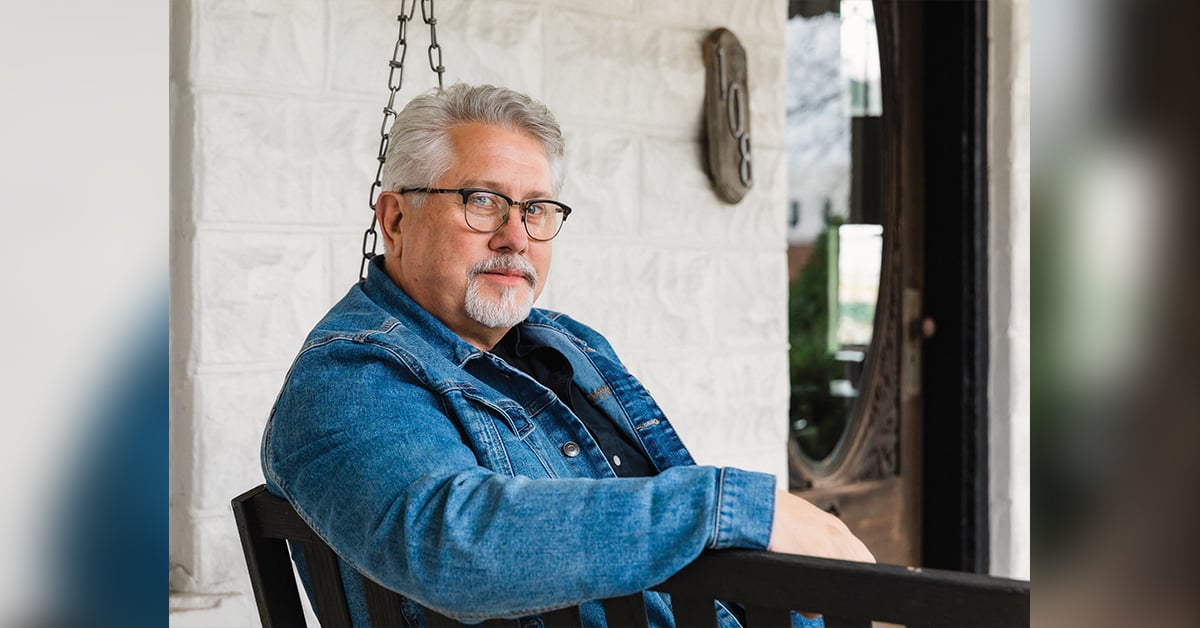
Photos by Shelley Swanger
Despite his lengthy career in music, veteran bluegrass artist Daryl Mosley had his doubts that people would recognize his individual talents.
“Even though I’ve been in bluegrass music professionally for 30 years, you never really know who knows who you are,” Mosley said. “I’ve always been part of a band. I was concerned that when I put something out under my own name would people even know who I was.”
The talented tenor’s apprehension was put to ease with the release of his solo debut, The Secret of Life on Pinecastle Records.
“It’s already exceeded my expectations,” Mosley said. “The support that I’ve had from within the industry and from my peers and the feedback I’ve gotten from people since the album was put out has just been overwhelming.”
The sideman departed from the Farm Hands, a group he co-founded with Tim Graves, in September of 2019.
“I spent a lot of time building up what we had going with the Farm Hands. The older I get the more songwriting and songs mean so much to me. Tim was my partner in the Farm Hands. Playing is his life. Tim is one of these guys who would work 365 dates a year if he could string them close enough together. He loves the road. That’s great! I enjoy touring too, but I also wanted to write and co-write, and I wanted to do some songwriting events. There were other things I wanted to do in addition to that. It didn’t make sense to slow everybody else down so I could expand in some other areas.”
Still, the decision wasn’t easy. After all those years standing beside other musicians, stepping out on stage without that safety net was tough.
“Walking away from that and basically creating something new at this stage in my life was a little scary,” the 56-year-old musician admits. “But it just felt like the time was right. It’s a little more comfortable now than it was in the beginning. When you spend that many years sharing the space with somebody, there’s comfort in that.”
From a fan perspective, Mosley has experienced the solo shows of other artists.
“Some of my greatest concert experiences have been sitting and listening to songwriters tell their stories and sing their songs.”
He also has discovered some advantages to the one-man-show approach.
“There are some songs that work great in a band that don’t work as well when you’re just by yourself and vice versa. There are songs that are really effective when it’s just me and the guitar. The song is too intimate to have a whole band play it. There’s been some trial and error in learning what songs to bring and which songs not to. I guess that will always be a work in progress.”
However, Mosley won’t be doing only shows where he’s the sole musician in the spotlight. He put together his own band that will tour in support of the music. The pandemic prevented him and other musicians from playing safely at the usual places, but in October he was able to showcase his music and three of his former Farm Hands bandmates performed alongside him. Bennie Boling plays bass, Keith Tew is on guitar, and Don Hill picks banjo. Jaelee Roberts plays fiddle in the Daryl Mosley Band, and her father, Danny Roberts chops on the mandolin when his commitments with The Grascals allow.
The Songwriter
One of Mosley’s true passions is songwriting, and that love clearly bleeds through on the lyrical page. His vivid storytelling abilities have been honored with two Society for the Preservation of Bluegrass Music Association (SPBGMA) “Songwriter of the Year” awards. Besides the Farm Hands and New Tradition, a few of the artists who have recorded his songs are: Bobby Osborne, Appalachian Trail, Lynn Anderson, Josh Williams, the Booth Brothers and Marty Raybon. Seven of his songs have gone to number one. In 2006, Mosley’s song “(Ask the Blind Man) He Saw It All” won “Song of the Year” at the Singing News Fan awards and later the magazine named it one of the top Southern Gospel songs of all time.
“It was on a demo with two other songs I wrote, and I didn’t think that song was the best one of the three,” Mosley recalls about the Southern Gospel standard. “I still have people tell me how that song impacted their life. I had no idea it was going to have the impact it did. I just write what seems to work for me and hope that it will strike a chord.”
The idea for the song hit him as he was driving the bus back home for The Osborne Brothers after they had performed at a bluegrass festival in North Carolina, “They were all asleep, and it was my turn to drive. The idea just came. I remember singing it onto the voicemail on my phone so that I didn’t forget the melody. The funny thing about the song is from a songwriter’s standpoint the song doesn’t work. The second chorus doesn’t match the second verse. It doesn’t balance out like a typical song is supposed to. It breaks songwriter rules, but yet it somehow struck a chord. I’ve found that songs do that. Some of my favorite stuff that Tom T. Hall ever wrote breaks all the songwriter rules, but the song somehow still works. I’ve come to learn to trust the process and try to write the best possible songs I can. Then, at that point whatever happens happens.”
Two of Mosley’s songs earned top honors at SPBGMA. “Rural Route” gave the Farm Hands their first chart-topper and a “Song of the Year” trophy. The next year Mosley brought home another “Song of the Year” award for “Hillbilly Graham.”
“I’ve got a buddy here in town who is actually a former pastor of mine,” Mosley explains of the song’s origin. “That’s a nickname that he has. The first time I heard it I thought, ‘Man, I’ve got to write a song about that.’ I’ll never forget. One of the first times I saw Jerry Salley after I wrote it Jerry came up and said, ‘Man, I don’t know how I missed that. I should have written that song. What a great idea!’”
Salley, a two time IBMA “Songwriter of the Year,” obviously is impressed with Mosley’s skills as a tunesmith. “A master at marrying a strong melody with just the right lyric, Daryl is easily one of the finest songwriters in our business.”
Gospel music legend Bill Gaither also sings Mosley’s praises. “Daryl is a poet, and we don’t have many poets left.”
Mosley first started writing songs 40 years ago while he was singing at his summer job on country legend Loretta Lynn’s ranch.
“I’ll never forget the conversation I had with her,” Mosley remembers. “She said, ‘Darling, do you write songs? I said, ‘No, ma’am.’ She said, ‘Honey, you need to learn to write. Lots of people can sing, but the good ones can write them too’.”

Daryl took the conversation to heart and bought Tom T. Hall’s book How I Write Songs, Why You Can, and he began turning to mentors like songwriters Wayne Perry and Larry Shell for feedback on his work.
“At the same time I was listening to great writers trying to learn what makes a song work for me. What is it about certain lyrical patterns or meters or melodies that work for me? All of that over the years has found its way into the way I write. Beyond that it’s kind of hard to explain. To me, writing songs is almost like you’re trying to remember the words of a song that you used to know. The words and the melody are just beyond your grasp, and you’re coaxing it in. That’s kind of how the song develops.”
Mosley, who writes frequently by himself, has his radar up listening for new ways of expressing previous ideas, but co-writing is a different animal.
“It’s a little more structured. Most of us now keep a list of ideas that we’ll toss around with whoever we’re co-writing with and see if that strikes a chord with them so we can write that. Writing alone is a different experience because you don’t get that instant feedback and wondering does this work for you, do you understand what I’m trying to say.”
“I try to make a habit of playing guitar every day. It’s humming through melodies and trying to come up with ideas. Sometimes you finish one and you think, ‘That didn’t turn out very well.’ I think that keeps you thinking like a songwriter. The good ones will keep coming.”
Mosley’s Roots
Mosley was born, raised, and still lives in Waverly, TN, a tiny town with a Mayberry feel. He digs deep into his roots with his writing. He paints, “I still live in an area that hasn’t changed that much over the years. We’re far enough removed from the big cities that it’s not a bedroom community. People typically live here on purpose, and because of that you’ll still see kids on bicycles going down the sidewalk and it’s a very old-timey small town kind of place. I love that about it. Because of that, I’m able to write songs that I hope resonate in the same way that some of the older songs have. But I’m actually pulling from fairly recent experiences.”
A big Don Williams fan, he grew up listening to country music that his dad played in the truck, and the gospel music his mom loved to sing and played in church.
“I grew up listening to the Opry, so I had heard The Osborne Brothers, Monroe, and Jim and Jesse, but that was really about all. I did not realize there was a bluegrass world, that there were people making a living just playing bluegrass and playing festivals”
In 1987, Mosley met banjo player Richie Dotson who turned him on to Doyle Lawson and Quick Silver.
“He loaned me a copy of their Rock My Soul album. I had never heard anything like it. It was like Southern Gospel harmony on steroids. The first time I heard “On the Sea of Life,” I called him and said, ‘Man, we’ve got to do some of this’.”
Dotson introduced Mosley to mandolin player Danny Roberts and guitarist Fred Duggin, and the four guys formed New Tradition, playing fiddle contests and other events around middle Tennessee.
“We ended up at the SPBGMA contest. We were rehearsing in the hall, and a record company saw us and offered us a record deal. Promoters heard us at SPBGMA and hired us for their festivals. It snowballed.”
In 2001, when the Osborne Brothers were looking for a bass player and singer to replace Terry Smith, Mosley was hired. He worked with the famous bluegrass siblings until 2003, and continued on with Bobby Osborne and the Rocky Top X-press until 2011.
“One of the best things about those guys was they had so much history and had so many experiences in the business, good and bad. Some of my favorite times were when we would be on the way back or forward to a festival and everybody’s asleep, but Sonny’s driving. I would sit and ride shotgun, and he would tell stories. We would talk about the business.”
Mosley continues, “I performed at the first bluegrass festival I went to [Strange Family Bluegrass Festival in Texarkana, Texas]. So, I was playing catch up on how the industry works and who does what. Sonny was so wonderful to sit and tell me those stories. It was just like going to college. Even now when I’ve got a question, I’ll text Sonny. He and Bobby both are still really good about giving me advice and giving help. They are truly two of the best guys I’ve ever known.”
Ten years after starting with the Osborne Brothers, Mosley organized his own group, the Farm Hands with Tim Graves on resophonic guitar, Bennie Boling on banjo and Kevin Williamson on guitar.
“It was a good run. We worked a lot, 150 or more concerts a year. Radio was good to us, and we won a lot of awards, and I enjoyed that a lot. It was just one of those things where the time had come for me to do something else.”
Only a decade away from the typical retirement age of 65, Mosley decided to reassess his future.
“You reach a place in life where you want to be a really good steward of what time you’ve got and invest your time and your energies on things that you’re really passionate about.Writing songs and singing them is something that drives me.”
His Own Story
That drive prompted him to write his new album, The Secret of Life, a collection of 11 tunes he wrote/co-wrote that encapsulate the journey he’s taken from teenager to present day.
“It’s kind of an anthology of all that I’ve done,” Mosley says. “You could almost separate [my music life] into ten-year increments. Each of those eras has totally different experiences in lots of ways. I don’t write necessarily autobiographical, but I try to write from experiences and from people that I have met or that I have known along the way and stuff that represents who I am as an individual.”
Although Mosley loves creating new music, the storyteller has a difficult time going into the studio.
“I never did like to record,” he admits. “I felt I couldn’t get comfortable in the studio. It was hard work for me.”
That’s why he turned to his friend Danny Roberts of the Grascals to produce the album. He remembered their experiences together recording back in the New Tradition days. “Danny was like a duck in water. He just loved the studio and was really good at it. In addition to being a world-class mandolin player, he’s got great producer ears. When I was stepping into this solo thing by myself, he was the first call I made. There’s no question the album would not have been anything close to what it turned out to be without Danny Roberts’ finger on it. When we were working arrangements, he would say, ‘What if we tried this?’ He would have really interesting ideas. There were a few songs that went in a direction that I wouldn’t have taken them, but when I’d hear it back, he was right. He really did bring out the best in me, which is what you want out of a producer. I will be eternally grateful for his friendship, as well as his expertise.”
The first single, “A Few Years Ago,” from this new chapter in Mosley’s life is a reflection of his inexperienced ways when he first started in bluegrass music with New Tradition.
“None of us had ever been a sideman. We were learning as we went. We didn’t know what the rules were, but some really cool things happened. I look back at it now, and I realize we kind of stumbled into some of that stuff. Some things that I would have loved to have done differently had we known better. I think that certainly applies to my personal life and most people’s personal lives. You reach a place where you look back and think some of that stuff turned out really good. Some things I would love to redo. You don’t get that opportunity, of course. Hopefully, what you get is wisdom along the way, and you own your past the good and the bad and use all of that to help you be a better person and make better decisions as you move forward. That’s the song in a nutshell.”
Told from a veteran barber’s wise vantage point, the album’s title cut is based on a real life story with Mosley’s own barber.
“Toad Smith has been cutting hair in our town for 67 years. He’s this really great guy, wonderful storyteller, and historian. He loves to talk. I’ve learned if I can catch him later in the afternoon when it slows down a little bit, I get a little more time with him and we can talk about stuff. That song actually came from a conversation I had with Toad.”
On the cut, “The Deal,” Mosley retooled the exchange between bluesman Robert Johnson and the devil where legend has it that the bluesman traded his soul for fame and fortune.
“I was thinking what that conversation would have been like if it were to happen to any of us now, if the devil was going to come and present his case. Here’s the contract; this is what you get. This is what it costs. Danny was really instrumental in putting that arrangement together. It’s a real haunting song. It’s a little unusual. I’m really proud of how that turned out.”
Mosley resurrected the upbeat number “In A Country Town” that he wrote years ago for the Farm Hands. The third single off the project features harmonies from IBMA award-winning vocalist Jeanette Williams.
“This is one of my very favorite songs from the album,” Mosley says. “I love that it brings my small town roots front and center, but it’s more than just a tribute to where I grew up. “In A Country Town” is an anthem for anyone who has country and rural living in their heart. It’s a celebration of the simple things in life that made us who we are.”
He enlisted his friend Irene Kelly to sing harmony on “It Never Gets Old” and his producer’s daughter added her talents on “A Piece At a Time,” about a farmer watching his land be auctioned off.
“I wrote and recorded that years ago when I was with New Tradition. Jaylee Roberts —Danny’s daughter—sang harmony on some of the songs on the album, and Jaylee was singing harmony on that one. I stopped her and said, ‘You realize that the last time this song was recorded your dad and I were in the studio recording it, and you weren’t born yet,” he recalls, laughing. “It was like one of those full circle moments.”
For all that the positive support Mosley has heard about his new baby, the response he most wants to see is that people feel better because they’ve listened to his music.
“For the most part, it’s a real positive work. It’s pretty upbeat. It talks about small town, faith, and family and love and positive emotions. These are songs I’m really proud of that I was able to write and get recorded.”