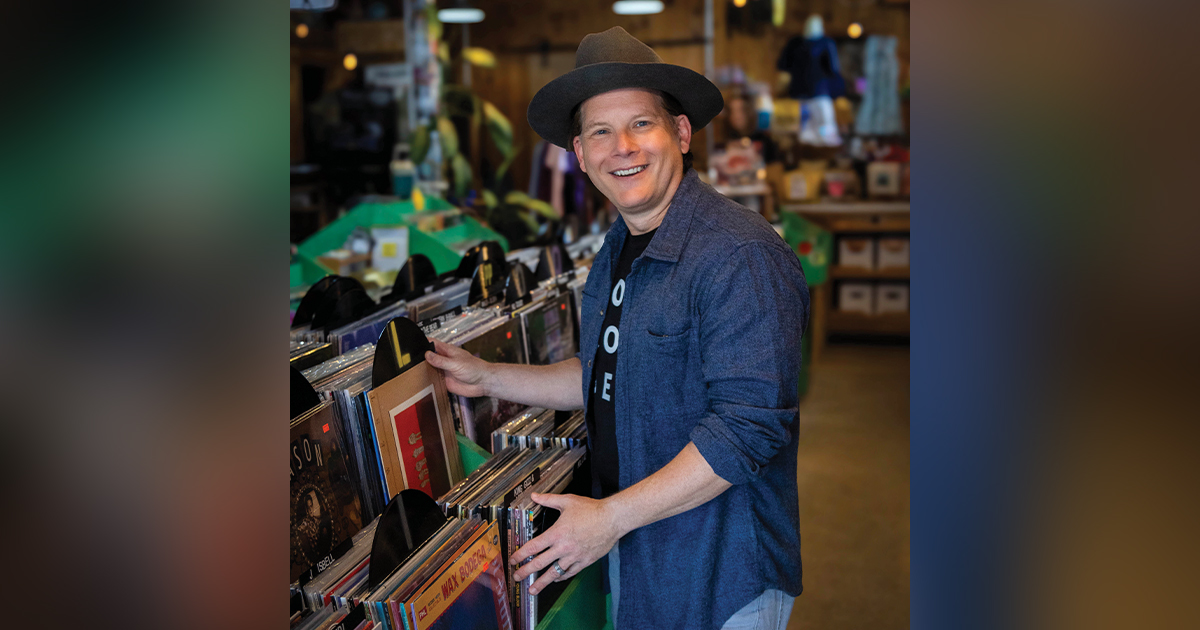
Daniel Patrick
Much More Than “Mandolins and Beer”
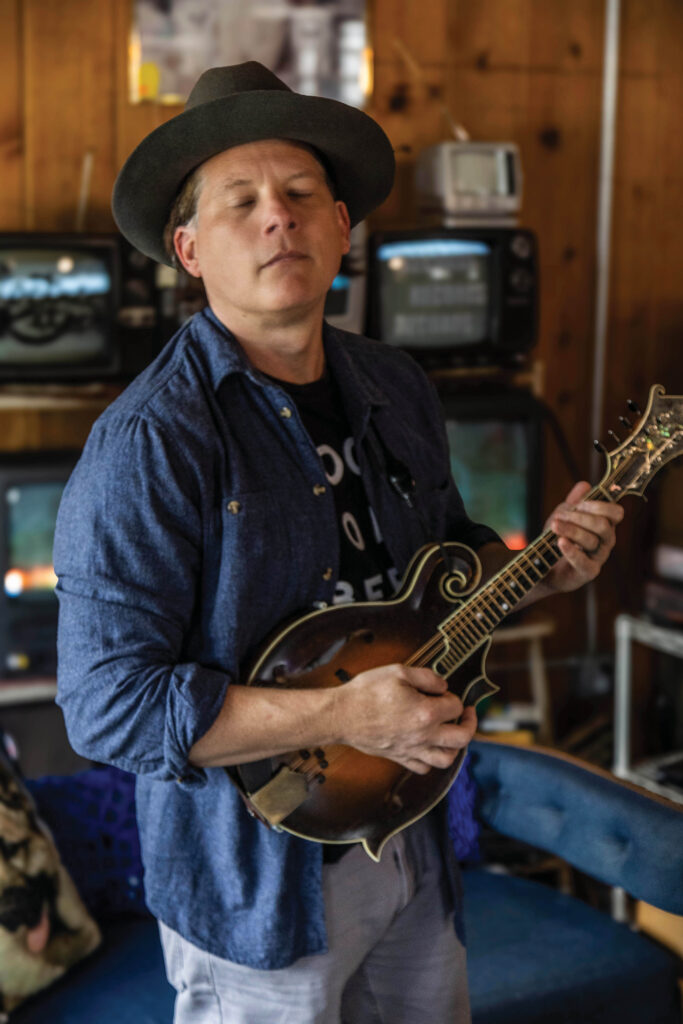
Photos by Doug Julian
Over the course of the last five years, Daniel Patrick has made a name for himself in the mandolin world by hosting the very popular “Mandolins and Beer” podcast. Having produced and published over 250 podcast episodes, he has interviewed most all of the top mandolin players in bluegrass music, some of them having now been a guest on his show several times.
In addition to having made a name for himself as an interviewer, he has also helped countless numbers of mandolin players learn how to improve their skills through the instructional material available on his Patreon page, by producing over 190 “Mandolin Lick of the Day” videos and by publishing his new book The 365 Project—Book 1.
Having helped mandolin players learn about their heroes through his podcast and continuing to help them learn how to play through his web offerings, Daniel is now showing the world that he is also a top-notch mandolin player himself through the release of his new CD on Adhyaropa Records Around the Clock (also available on vinyl). On this CD Daniel plays and sings duos with an impressive list of mandolin greats, including Sam Bush, Ronnie McCoury, Jacob Jolliff, Mary Meyer, Sharon Gilchrist, Jarrod Walker, Tim O’Brien, Joe K. Walsh, Harry Clark, Mike Guggino, and Matt Flinner. Although each of these mandolinists are highly skilled, Daniel is able to stay right with them playing harmony parts and exchanging mandolin solos and vocals—not an easy task.
What makes this album a fun listen is not just the awesome duo picking and singing, but the song selection of classic tunes—but they are not bluegrass classics. These tunes are covers of songs from the Allman Brothers, Jerry Garcia, Tom Petty, Willie Nelson, The Cars, The Beatles, Jimi Hendrix, Jim Croce, Pink Floyd, Credence Clearwater Revival and John Prine.
When asked about the tune selection, Daniel said that one of the questions he always asks his guest on the podcast is, “What kind of music do you listen to outside of bluegrass or mandolin music?” He used those answers to inspire his song selection. For instance, he knew that Sam Bush was a big Allman Brothers fan and so it made sense for them to record the great Allman Brothers classic “Blue Sky.” He also knew that Ronnie McCoury was a Grateful Dead fan, so Garcia’s “Deal” was selected for the duo with Ronnie. He had heard Mary Meyer play a Jim Croce song on Instagram and so selected Croce’s “I Got a Name” to play with Mary. He also knew that Sharon Gilchrist was a Willie Nelson fan and so they recorded Nelson’s “Seven Spanish Angels.” The list goes on…A Pink Floyd tune with Mike Guggino, a Cars song with Tim O’Brien, a Jimi Hendrix song with Joe K. Walsh, a John Prine song with Matt Flinner, a Beatles song with Jarrod Walker, a Tom Petty song with Harry Clark and a Credence Clearwater Revival tune with Jacob Jolliff.
If you like music by the above-mentioned artists, and you like mandolins, you will love this record.
Daniel Patrick’s Background
Looking over the song list on Daniel’s new album, it is not surprising to learn that when he was young his father spent time as a rock and roll DJ in Daniel’s hometown of Bay City, Michigan. The 52-year-old musician said, “I grew up surrounded by music my entire life.” At the age of eight, he started playing the drums. While a lot of parents would be less than enthusiastic about an eight-year-old banging on the drums all day at the house, Daniel said, “My mother was very supportive. I spent hours and hours every day playing the drums and she encouraged it.”
Throughout his high schools years, Daniel spent time performing with garage bands playing rock and roll covers. He said, “I was kind of in one band during most of my high school years and we continued a couple years after graduation. We played rock and roll covers. Every local band that I looked up to as a young guy were just cover bands and ‘hair metal’ was the music of the day.” Later, when some friends of his started writing their own tunes, he thought that it would be better to try writing original material. A few years after high school he also picked up the guitar. He said, “I discovered Stevie Ray Vaughn and bought a Stratocaster, an amplifier and a Stevie Ray Vaughn book. I thought that it would be easy because he made it look so easy. I was terribly mistaken.”
While he was learning how to play the guitar, he was performing as drummer in the band Acoustic Fields. He described this band—which was comprised of acoustic guitar, acoustic bass guitar, drums and a singer—as a band that took songs that may have typically been written as electric rock music and played them on acoustic instruments. The band mostly wrote and performed their own music. Daniel said that as much as he loves electric rock music, acoustic music was something that he always gravitated towards.
Acoustic Fields was the first band that he was in that toured throughout the state and recorded an album. He describes the band as “Pearl Jam-ish, but without electric guitars.” He started performing with Acoustic Fields in around 1997 when he was about 25 years old.
After spending four or five years with Acoustic Fields, Daniel joined an electric blues band called Gone Daddy Gone. In this band he played the Stratocaster and sang lead. After spending time in that band, he also joined a “power pop” band in the vein of Cheap Trick with two of his cousins. He said, “It was a high energy band playing three-minute songs with a lot of vocal harmonies. It was a fun band. We traveled all over the mid-west.” After playing guitar with that band for while, he then moved to the drums after the original drummer left the band. The four-piece band became a trio (guitar, bass and drums). That band was called The Haskels.
Daniel also started performing as a solo artist playing original singer/songwriter style songs, and some cover tunes, every Thursday at a local bar. The show became popular with the locals and someone who saw him perform mentioned that a new TV show called Nashville Star was looking for talent. He sent the show a demo and got a call back for an audition. After the audition he got accepted for the show. He said, “I was working at a marina and campground that my family owned and they sent a camera crew up to follow me around all day.” At the time, most of the contestants were singing modern pop country tunes. Daniel was singing songs by older country artists like Johnny Cash, Willie Nelson and Merle Haggard. Although he did make it to the first episode of the first season of the show, that was the end of the line for Daniel with Nashville Star. However, participation in the show did change his life in a big way.
Daniel explains that while he was preparing for the show, and realizing that most of the contestants were singing modern pop country, he thought that he would check out what some of the pop country artists were singing. He was unfamiliar with modern country music and he thought that if he was going to have a chance to go do well in the competition, he might have to learn some modern country. He went to Target and looked through the country music section. One album cover stood out to him and he bought that CD. The album that he bought was not modern country at all…it was Nickel Creek’s 2002 album This Side. Daniel said, “Listening to that first song, ‘Smoothie Song,’ changed my life.”
Daniel immediately called his cousin, who worked at a music store to see about purchasing a mandolin. He said, “I asked my cousin if they had any mandolins for sale at the store. He said, ‘We might have one, let me put you on hold.’ The hold music was ‘Can’t Stop Now’ by the New Grass Revival. That rocked my world as much as that Nickel Creek song did!” When his cousin got back to the phone, he told Daniel that they did not have a mandolin for sale at the store. Daniel asked, “What was that hold music?” Daniel said, “He told me what the music was and I left work that day, got a New Grass record and ordered a mandolin for $99 from Musician’s Friend that same day.”
About that time (2003), Daniel’s father put the family’s marina and campground up for sale and so he moved on to a job with Barnes and Noble while he continued to perform as a solo act and learn how to play the mandolin. Although he continued to play music, for several years he looked at it as just a hobby that he would do for the rest of his life, but did not think it would be something he could do for a living.
By 2009 Daniel had gone through a divorce and moved to Charleston, South Carolina to work as the General Manager at a Barnes and Noble in Charleston. By about 2013, he also started playing solo acoustic shows in Charleston. He said, “I started going to see a guy play every Tuesday night. He was doing some bluegrass and I asked him if I could come up and play a few songs with him on my mandolin. He invited me to come up for the last song of the set. The guy’s name was Hank Futch. Little did I know that he was kind of a local legend in Charleston. I played the last song of that set and ended up playing with him for a few years after that.
“I spent time playing with Hank and through that I met another guy, Eddie White, who was also a locally known musician. He runs a showcase called Awendaw Green. He introduced himself to me when I was playing with Hank and said that this bluegrass musician named Donna Hughes was coming to town and he wanted to know if I could do an opening set and then perform with her playing mandolin. So, I got to do a couple of shows with her. Local opportunities like that started coming my way and I had to turn a lot of them down because of my full-time retail job. I had to turn down more jobs than I could take. After you have to turn down jobs so many times, the phone stops ringing.”
In 2016, Daniel decided that he would rather be playing music than working retail, so he quit his job and has been a full-time musician ever since. He started performing solo, playing as many pick up gigs as he could get and started working with a band called The Blues Green with the interesting configuration of mandolin, upright bass, saxophone and drums. He also started a bluegrass trio called Ol’ 55s (mandolin, bass and guitar). He said that between 2017 and 2019 he was playing over 300 gigs per year thanks to working four local residency gigs per week. The residencies added up to about 200 shows a year and he also took any other gigs that came his way. He worked as a solo act, as a duo with a guitar player and with his trio.
Daniel worked with Ol’ 55s until 2020. By that time he had met a guitar player named Brad Edwardson who flatpicked in the style of Doc Watson and Norman Blake. They started a trio with bass player Whitt Algar called New Ghost Town. The band was scheduled to record a demo at Alan Bibey’s studio in 202o. Daniel said, “On the way to the studio, I was looking at an article about this doctor who had died from this sickness called COVID.” The world would soon shut down and they did not get a chance to finish their recording. However, once venues started to open up again, the band continued to perform local and corporate gigs. Daniel explained that they mostly perform as a trio, but for bigger shows they will add a banjo or fiddle. Recently Brad moved, so Whit started to play guitar and they added Fuller Condon on bass.
Mandolins and Beer
Although Daniel’s musical talents have been known by the locals, both in Michigan and South Carolina, he did not gain a national and international following until he started producing the Mandolins and Beer podcast in 2019. He explained that in June of 2019 he went to Ireland for a month and saw online that David Benedict was also there. He said, “I had never met him, but we had been Facebook buddies and so I messaged him and asked if he was playing any gigs.
Daniel met David and said that he was very impressed with how nice David was. He said, “I had also met Jacob Jolliff and taken some lessons. I thought, ‘All of these people are so nice!’ I had listened to a podcast with Billy Strings and thought, ‘There is no one doing a mandolin podcast.’ I was wondering to myself how these mandolin players practiced, how they got better, how do they structure their day…and I thought that maybe other people would be interested. I put my first episode together with David Benedict as the guest.” After Daniel put the first episode out, Scott Tichner of Mandolin Café reached out to say that he wanted to help Daniel promote the podcast. Shortly after that Peghead Nation reached out as well offering to help sponsor the show. Daniel said, “It really took off during COVID.” Daniel said that the podcast has now been produced for about 250 weeks and he gets between 5000 and 10,ooo listeners every week “pretty consistently.”
While the majority of the guests on Daniel’s podcast are mandolin players, he also talks with musicians who are mandolin-adjacent, such as guitar player Grant Gordy who worked with David Grisman.
Around The Clock
When asked about the concept behind his album, Daniel said, “I wanted to do a mandolin duet recording but because a big part of my performance gigs include singing, I wanted to do vocal songs. Plus, Casey Campbell put out the best mandolin duo album and I knew that I couldn’t top that. I wanted to do songs and the first song that I thought of was ‘Drive’ by The Cars. I thought, ‘I would love to record this with Tim O’Brien,’ because one of my all-time favorite albums is Real Time with Tim O’Brien and Darrell Scott. That album was kind of like my road map because when I listen to that album, it is like listening to two people sitting on a couch and playing songs.
“Through the podcast I had also had the opportunity to see these intimate moments in person, or to be a part of them. Like, sitting down with Andrew Marlin after a gig backstage and just playing mandolin for an hour, or watching people do it at festivals. It is such an intimate thing. It is so cool to see two people play a song together. It is magical. I wanted to try and capture that on this recording. Tim O’Brien was the first person that I reached out to. I thought that if I could get Tim O’Brien to say ‘yes,’ it would be easier to get everybody else. Oddly enough, he wasn’t familiar with The Cars music.
“When we recorded there was just one isolation wall between us with a window. We were looking right at each other. I remember recording this solo and hearing my mandola and his mandolin and it gave me flashbacks to that Real Time album and I’m thinking, ‘At this moment a musical dream of mine is a reality. Something that I dreamt about happening just became real. I still can’t believe it. It was the same with Sam Bush.
“Oddly enough, I didn’t ask Sam’s manager about Sam being on the recording because Sam Bush to me is on another level. Hearing ‘Can’t Stop Now,’ which led me to mandolin, which led me to all of these classic Sam recordings, to watching his documentary, to getting to interview him. I just thought it was beyond possibility to have him on this album. I started to record this album in 2023 and then I got a concussion in May of that year and I was out of work for 30 days. So, it threw off the recording schedule. Fortunately, that happened because later I was MCing a festival that Sam was playing at and I hear someone say, ‘Mandolins and Beer!’ Sam comes up and gives me a huge hug on stage and then gives me a high five after the band finished playing. The venue wanted me to get Sam to sign a shirt because they were going to auction it off for charity. So, I end up talking with Sam for an hour and a half by the bus. It was just him, my wife and myself.
“A couple weeks later I reached out to Ronnie McCoury’s manager saying that I was starting to reschedule the sessions. He wrote back and said, ‘It is funny that you would email right now because I was just telling Sam about this project. Would you be interested in having Sam on the project?’ I’m like, ‘What!! One hundred percent!’ We set the date to record with Sam for the Tuesday after Thanksgiving. On the Saturday after Thanksgiving my wife got very sick. It was so bad, I thought we would have to go to the hospital. So, I had to cancel the Sam Bush session in Nashville. I emailed Sam and Ronnie’s manager and told him that I couldn’t make the sessions. I told him that I understand that Sam takes all of December off and if I’ve blown the opportunity to have both these guys, I get it. An hour later my phone rings and it is Sam Bush. The first thing that he says after I answer the phone is ‘How is your wife?’ It was crazy. He said, ‘Hey, buddy, we will make this happen.’ He was super cool. The fact that he calls me on a Sunday an hour after I email his manager to ask me how my wife is doing is incredible to me. What a great person.”
Without going through the details of the recordings with all of the great mandolin players who are on this album, I will just say that each has its own interesting story and the album did come out in the way Daniel envisioned. The listener has the chance to hear these intimate moments with two high caliber musicians sitting down to play and sing these classic tunes. It is a wonderful recording and a very gratifying listening experience.
Mandolin Lick of the Day
I originally contacted Daniel with the intention of primarily featuring his “Mandolin Lick of the Day” and his new book The 365 Project—Book 1. That is why this article is under the “Learning to Play” article series. So, let’s get to it!
When asked about his concept of posting the “Mandolin Lick of the Day” instructional series online, Daniel said, “One of the first questions that I ask my guests during the podcast is ‘If you had ten minutes a day to work on something, what would you work on?’ I ask everyone that question the first time that they are on the podcast because what I realized is that a lot of people have full time jobs and families and other commitments, but they still want to get better. I’m a firm believer that if you just pick up the mandolin for ten minutes a day and really work on something, you will focus and learn something, which will motivate you. I also think that you will play more than ten minutes after you pick it up. But, even if it is only ten minutes, you have set aside a portion of your day to get better on mandolin. If you work on that one lick, you can get it down.”
So the theory behind putting out the Lick of the Day is to give students of the mandolin small manageable chunks that they can get under their fingers in a short amount of time. In learning a new lick every day, the student will then have a catalog of licks in their mandolin playing bag that will pop out when they are jamming or working to arrange solos for tunes.
Daniel’s book, The 365 Project—Book 1 is arranged in a similar manner, but each lick builds a solo to a popular tune. The tunes that are included in this book are “Live and Let Live,” “Love Please Come Home,” “Panhandle Country,” “Blue Ridge Cabin Home,” and “Head Over Heels.” Each one or two bar phrase of each tune is designated as a separate “lick.” The idea is similar to his “Lick of the Day” concept. You build your solo to these tunes day-by-day and lick-by-lick. On the first day, you spend your ten-minute practice session by learning Lick 1 from “Live and Let Live.” The next day you learn Lick 2, etc. The tune is divided up into 14 different lick sections. So, if you only have ten minutes a day and can learn one lick per day. You will have this tune under your fingers in two weeks. Go ahead and give it a try!
Through his efforts to interview top mandolin players on his podcast and present learning material on his website, Daniel Patrick is one of those mandolin players who is helping to make the instrument more accessible to those who are interested in learning how to play and learning how to improve. To explore Daniel’s “Mandolin Lick of the Day” videos and tabs, find out more about his The 365 Project—Book 1, listen to his podcast, or learn about his offerings through Patreon, check out his website mandolinsandbeer.com.