
Continuing the Flow of First Generation Bluegrass DNA
Like a lot of folks that grew up in the last century, the Graves family moved north from the Appalachian region looking for work. While Tellico Plains, Tennessee, was the home base for future bluegrass musician Tim Graves, his Dad decided to move the family to Michigan when he was a very young kid. During that whole period of migration, Tim was too young to grasp the reality that he was the nephew of one of the most famous bluegrass musicians in the U.S.
For about two decades, Uncle Josh Graves played the resonator guitar for Flatt & Scruggs. It was a group that, through the clever marketing and management of Louise Scruggs, rose to heights that would even eclipse the popularity of the Father of Bluegrass Bill Monroe as the 1950s and 60s unfolded.
Lester Flatt and Earl Scruggs, of course, were in that original bluegrass band that Monroe put together in 1945. But, after leaving to form their own group, Flatt & Scruggs hit paydirt with the distribution of their own television program in the 1950s, a high-profile concert at New York City’s Carnegie Hall in 1962, and recording the theme songs for the hit 1960s TV show The Beverly Hillbillies and the popular 1967 movie Bonnie and Clyde. During that amazing period, Uncle Josh Graves not only played the Dobro for Flatt & Scruggs, he also was a part of the comedy side of the act. Tim
Uncle Josh Is Your Uncle
Graves’ father was proud of his brother’s accomplishments and tried to get through to his son who his uncle really was, playing the music of Flatt & Scruggs in the house on a constant basis. But, it took Tim a while before it all clicked that a famous person with the stage name “Uncle” was his uncle in real life. When that reality did become clear, however, it changed his life forever.
“We moved up to Detroit when my Dad got a job up there and we lived there from 1962 to 1969,” said Tim Graves. “Josh and Flatt & Scruggs were on the Martha White Show every morning and my Dad would turn it on the TV when we were in Detroit. Every time Josh would come on the show he’d say, ‘That’s your uncle.’ But, I didn’t know what that meant because I was six or seven years old and had never been around him. I’d just look at him on the TV screen and think, ‘I don’t know what that is.’
“Until we moved back to Tellico Plains in 1969, I had never met Uncle Josh, because we were in Detroit and he had moved to Nashville long before then,” continues Graves. “But, after we moved to Tellico, he started coming up to visit us when I was nine years old. Back in Tennessee, when Josh came around and played that Dobro in front of me, I got set on fire. I thought, ‘That is what I’ve been hearing all of this time.’”
When Uncle Josh saw the look in his nephew’s eye when he played the resonator guitar in front of him, he eventually took the next step a good uncle would take, and that set the young Tim Graves on a new trajectory.
“I eventually played a regular guitar a little bit as a kid and I knew all of the chords and stuff, but I really took off on the Dobro when Uncle Josh brought me one when I was fourteen-and-a-half years old,” said Graves. “Uncle Josh brought me a Dobro on June 25,1975 along with a stack of vinyl records and said, ‘Here you go, kid.’ It was a Dobro-brand 1973 D-60 with Josh’s name on the side of it. I played that guitar until I started playing Beard resonator guitars, which I still play now. He said, ‘If you can learn how to play this, it will take care of you and it will take you all over the world.’ And, it has done exactly that for me.”
With all of the swirling sounds of his youth now solidified and understood, Graves had a new skill to master and he was doing it with a quality instrument, “Uncle Josh also gave me all of the Flatt & Scruggs records to listen to and my favorite one was their Live At Carnegie Hall album,” said Graves. “It was a killer record and I thought it was the best music in the world. Yes, I had grown up hearing all of that stuff because my Dad was always playing it. But, when I got that Dobro, I’d sit in front of my little record player for eight hours a day trying to learn that music. I worked it out and learned how to play those songs by myself.”
While he was still in his teen years, Graves began hanging out with his Uncle Josh, riding in the bus and playing music and having the time of his life.
“I’d go to bluegrass festivals with him, and that is what got me started in bluegrass,” said Graves. “I was driving him around at 17. I thought the world of him and I was with him all of the time. He was a special guy, and there was more to him than just being my uncle. When we would go backstage, there would be Bill Monroe, Jim and Jesse, Wilma Lee Cooper and the Osborne Brothers. Uncle Josh could tell some of funniest stories in the world and make you bust a gut. One time, years later, I took him to Thunder Bay, Canada, on my bus and it was a week-long trip and from the minute we left his house to the minute we got back, there was something going on that was crazy. He was really approachable. He would talk to anybody about anything. Once I got to know him, I just loved Uncle Josh. He was one of the best guys that you could ever be around.”
Going Pro
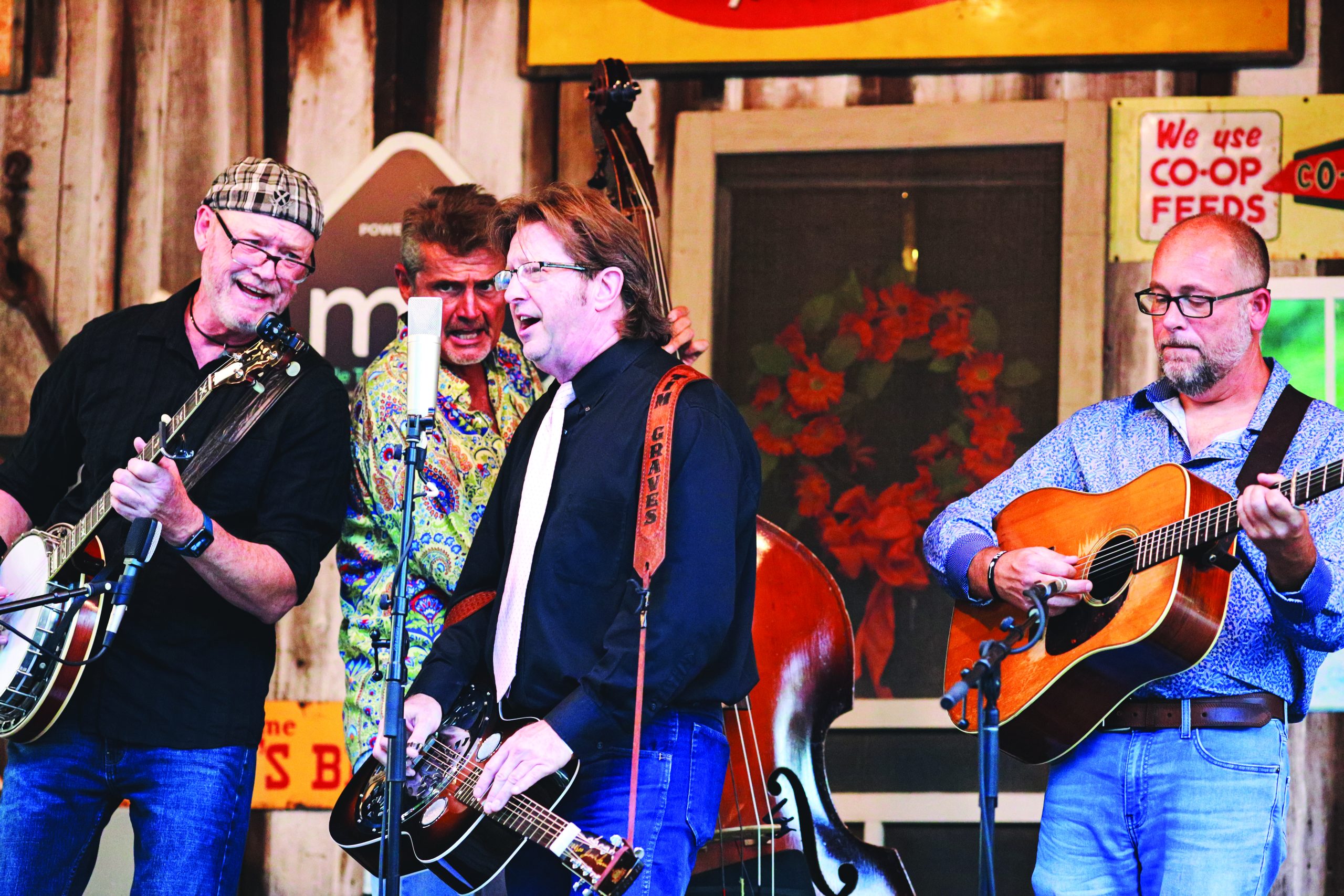
While in his late teens, Graves entered the bluegrass world as a professional musician. He played with a local band Cedar Run and Bobby Smith and the Boys From Shiloh as a teenager and then created his own group called Cherokee. He was hired to do a busy run at the World’s Fair in Knoxville (1982) before joining James Monroe’s band in the early 1980s. After a decade or so with Wilma Lee Cooper’s band and two years with the Osbourne Brothers, Graves eventually formed his own group with Tim Graves and the Farm Hands.
Graves’ time with the legendary Wilma Lee Cooper, however, got off to a bad start and he had to learn a hard lesson on being a sideman for a legend. “Wilma Lee saw me play at the World’s Fair in Knoxville,” said Graves. “We were the Official World’s Fair Bluegrass Band and we worked six days a week for six months. When she came there, her Dobro player was the great Gene Wooten, and Gene would work on my Dobro because the neck of my instrument was getting loose because of the heat. We were standing on a crate in the sun playing bluegrass music. Anyway, I wanted to go and see Wilma Lee at the fair because Uncle Josh had played with her and Stoney Cooper back in the 1940s. I went up to her and stood there and talked and she said, ‘Play me some songs,’ and I did. Then she said, ‘Gene Wooten is leaving me in December of 1983, would you like to come and work for me in 1984?’ I gave her phone number and because that was a year and a half away, I thought, ‘She’s never going to call me.’”
Wilma Lee did call Graves and the job offer was still on the table. After Graves joined Cooper’s band, however, Graves soon realized he was not playing up to her standards. “The very first time I played with Wilma Lee, I was covering her all up with my Dobro,” said Graves. “We came off stage and we got back to the dressing room and she grabbed me and pointed her finger at me and said, ‘We don’t play like that,’” said Graves. “I said, ‘Ma’am, how do you want me to play?’ She said, ‘If I don’t sing it, you don’t play it.’ I said, ‘So, you want melody only?’ She said, ‘Yes, and whenever I’m singing, you do not play over top of me.’ So, it was that strict. After about six months, she was about to fire me. I was just about to lose my job and Uncle Josh called me and said, ‘Get over here, kid, I got to talk to you.’
“I went over to his house and he said, ‘You’re getting ready to get fired. You’re not doing the job. You have to learn her stuff and learn when to play and what to play,’” continues Graves. “He said it that quick. He said, ‘You have two weeks before she is going to fire you.’ She had told Josh that but had yet to tell me that. So, I sat down at his house and I got to turning her records on a Wednesday night and then I went back in on a Friday night and played and Wilma Lee said, ‘Well, I can see that somebody has been rehearsing.’ I said, ‘Yes, ma’am, and you will never have any problem with me not knowing your music or knowing when to play.’ And, I never heard another word from her for the next twelve years.”
Wilma Lee Cooper was known for wanting things her way, and yet Graves experienced some magical moments while in her band. “Before I joined her band, I was working in a knitting mill at the time, making t-shirt material as a knitter and working on the machines as a mechanic,” said Graves. “She called me and I just thought,’ You know what, I’m done with this day job.’ Right away, on January 7, 1984, it was my first time playing on the Grand Ole Opry. I was excited and scared to death. I saw Minnie Pearl standing in the wings and I was standing there shaking and she said, ‘Sonny, is this your first time on the Grand Ole Opry?’ I said, ‘Yes ma’am.’ She said, ‘Well, you just go out there and love them and they’ll love you back.’ That was her big saying, you know, but on that night, she told it to me in person. That was back when it was still the Grand Ole Opry of old, when Minnie Pearl and Roy Acuff were still there.”
When Wilma Lee Cooper’s schedule naturally slowed down after she had been in the music business for over half a century, Graves joined forces with the equally-legendary Osborne Brothers. “It was a big deal for me when Sonny and Bobby Osborne called me because I had restarted my own group at the time and I was tired of doing everything myself with driving the bus, working on the bus, booking the dates and running the band,” said Graves. “With Bobby and Sonny, I could just play the Dobro. Bobby was singing good and Sonny was still playing good and singing good when I went with them and it was something special. We worked a lot of big shows and Grand Ole Opry dates and TV stuff and it was wonderful. I loved working with Bobby and Sonny and I wish they were still together so I could work with them some more. All things change, but it was the highlight of my career.”
The Osborne Brothers were not only amazing IBMA Hall of Fame musicians, they were also two distinct personalities that had to be dealt with, as often happens in the music business. “Sonny Osborne knew more about the music business then anybody else that I’ve been around in bluegrass,” said Graves. “I would sit and pick his brain for hours at a time while riding on the bus. He told me many things that I still use today with my band. Sonny was straight as an arrow. If he told you he was going to do something, he did it. Now, Sonny would get mad several times a day, but he would forget about it. Bobby would get mad one time a year, but would never forget about it. That was the difference between them. Sonny would be fine in 20 minutes, but Bobby never forgot. And yet I loved the both of them tremendously and I loved working for them. I hated to see Sonny retire.
“I had been with them for six years when Sonny retired,” continues Graves. “I was there the day he announced it. He came into the Grand Ole Opry and took me and Daryl Mosley and David Crow into one room and said, ‘Guys, I’m going to retire. My shoulder is messed up, it hurts, and I can’t play like I want to and I’m going to go out on top instead of sticking around too long and let everybody say that I can’t play anymore.’”
The Farm Hands
After leaving Sonny and Bobby Osborne, Graves formed his band The Farm Hands. The group would go on to strike a chord with the folks who attend the annual Society for the Preservation of Bluegrass Music of America (SPBGMA) convention and awards show, which happens every February in Nashville. The group has won over 30 SPBGMA awards and in 2015 Graves was inducted into the SPBGMA Preservation Hall of Greats.
Graves is also an important leader of the Uncle Josh Graves Memorial Music Festival, which is a part of the overall Cherohala Skyway Festival that takes place every October in Tellico Plains, Tennessee. The live music portion of the event features live roots bands all day long as well as an official Josh Graves Memorial Dobro Pick-off Competition in the afternoon.
Like with every band in the country, the COVID pandemic took its toll on Graves and his Farm Hands group. After the lockdowns were over and live entertainment began to come back, Graves formed a new version of the Farm Hands that includes Don Wayne Reno on the banjo—a former long-time member of Hayseed Dixie who is the son of the legendary bluegrass musician Don Reno—Jimmy Haynes on the guitar, who played and recorded with the late and great James King, and Terry Eldredge on bass, a bluegrass veteran who has worked with Lonzo and Oscar, the Osborne Brothers, Larry Cordle and Lonesome Standard Time and The Grascals.
With this new and tight band of experienced players in the Farm Hands, Graves is motivated again. This time, it comes in the form of a brand-new album called Bluegrass DNA released on the Pinecastle Records label. “This is the best band I’ve ever worked with in my whole career of playing music,” said Graves. “We called our new album Bluegrass DNA because Don Wayne is Don Reno’s son and I am the nephew of Uncle Josh. There are only four people working in bluegrass now that has the direct bloodline of the music’s first generation pioneers. Those names include Don Wayne Reno, me, Ralph Stanley II and Bobby Osborne Jr., and two of them are in my band. There are some others around, of course, but they are not playing bluegrass music full-time. As for the new project, my brother Tedd Graves, his wife Nita Graves and I wrote the title track. I called Tedd up and said, ‘I need a song about the bluegrass DNA bloodline.’ He said, ‘How long do we have to write it?’ I said, ’24 hours.’ And yet, it’s a great song. It turned out to be really good.”
For more information, please go to farmhandsmusic.com and pinecastlemusic.com.