Clyde Mattocks
Hugging The Hound
Clyde Mattocks has a lifetime of stories. He remembers seeing Bill Monroe and His Bluegrass Boys play 20-minute shows between cowboy films at his hometown theater. He’s shared the stage with Ervin Rouse, composer of iconic “Orange Blossom Special.” Barely out of high school, Mattocks played the TV-and-schoolhouse circuit in both Carolinas. He slept under his truck at Carlton Haney’s bluegrass festival at Camp Springs, and he’s earned a well-deserved reputation as one of the finest musicians, producers, and performers in North Carolina.
Mattocks is a musical polyglot, whose languages include rock, country, country rock, beach music, and his favorite, bluegrass. North Carolina musicians old and young regard him as a “legend,” a sobriquet honoring more than 70 years of contributions to his home state as musician, recording artist, producer, and mentor.
“Clyde is super dedicated to the music,” says Lorraine Jordan, Carolina Road frontperson and lifelong Mattocks friend. “Of all the music he plays, bluegrass is his favorite. He was a legend where I grew up. He stays young, and keeps it fresh.”
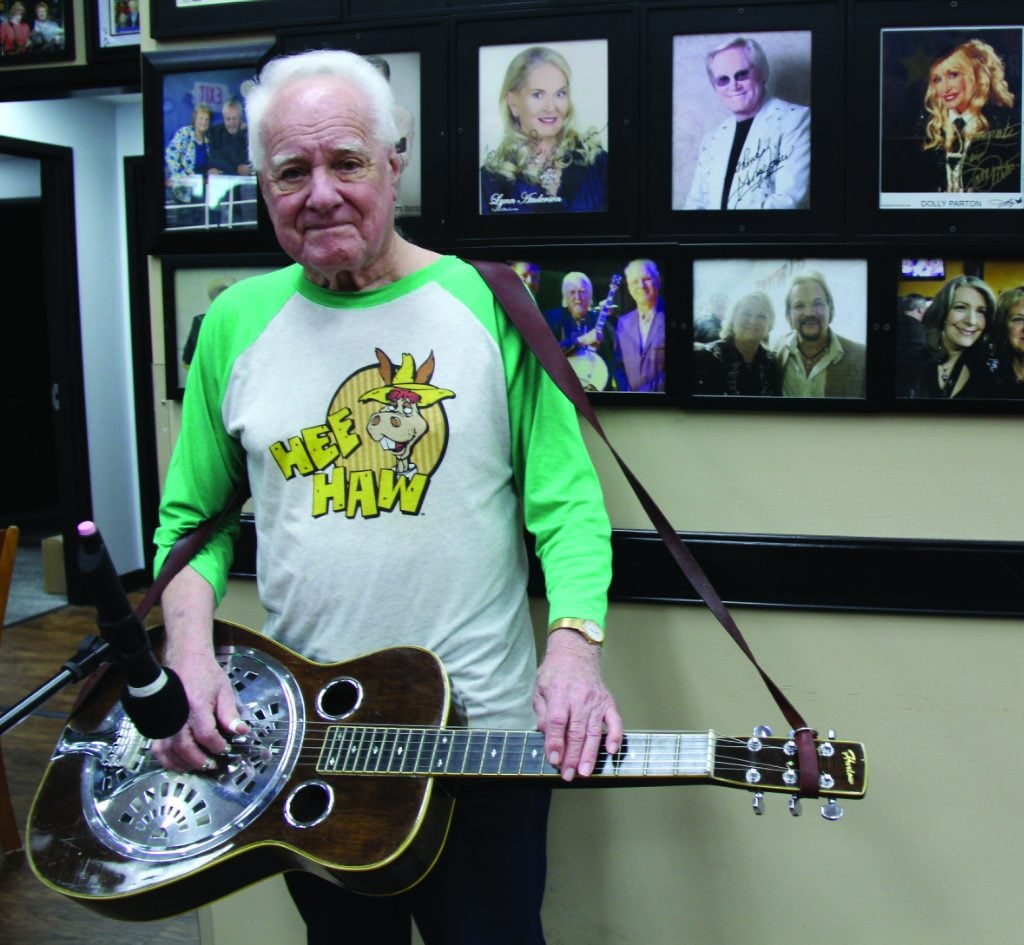
In a career which began in the 1950s, Mattocks is a musician’s musician adept at guitar, banjo, and upright bass, although his principal instruments are resonator guitar and pedal steel. Known as the “Man of Steel,” Mattocks’ talents are on display on his resonator guitar masterpiece, Hugging the Hound, Highway 58 Bluegrass, and Over My Shoulder: The Steel Guitar Album.
Mattocks, 84, is a life-long resident of Kinston, Lenoir County, NC, some 80 miles east of Raleigh. Its rural landscape arrayed in remnant tobacco fields, Lenoir sits next to Craven County, home of “Orange Blossom Special” composer, Ervin Rouse. Mattocks remembers Rouse stopping by in the late 1950s while traveling to and from gigs in Florida. “I was playing with a country band, Elm Street, in Rocky Mount,” Mattocks recalls. “Ervin and his brother were following the tobacco market up from Florida. They were driving an old Chevrolet they painted blue with a paint brush. Everything but the windshield was painted because they were living in that car.
“Ervin showed up a few other times at gigs I was playing and wanted to sit in. I think he was looking for tips. He was a genius, man! It didn’t matter if his fiddle was in tune or not, he would play it in tune. He’d move his fingers to intonate it. He would loosen the bow hair and play 4-part harmony on all four strings. On ‘Orange Blossom Special’ he didn’t sing, ‘lose these New York Blues.’ He sang, ‘lose these Craven County Blues.’”
In his youth, Eastern North Carolina was not a bluegrass heartland, yet there was bluegrass in the air and it captured young Clyde’s imagination. He attended shows by Reno and Smiley, Jim and Jesse, and Flatt and Scruggs. One of his earliest memories was hearing the Father of Bluegrass on the family’s radio. “My mom and dad played cards on Saturday nights,” he says. “They’d have the radio on. I was 8 or 9 years old. Bill Monroe would come on the Opry. I’d get up close to the radio, and he was singing ‘Footprints in the Snow’ and ‘Christmas Time’s a’Comin’’ – stuff that appealed to a little kid.
“Then, I’d go to the Oasis Theater downtown to see the cowboy movies. They announced who was coming—Bill Monroe and His Blue Grass Boys. I was about 11 or 12. I’d get down there about one o’clock and stay until the last show at 9. I saw all the 20-minute shows—Bill Monroe, Jimmy Martin, Gordon Terry, Charlie Cline, and Bessie [Mauldin]. This was 1949.”
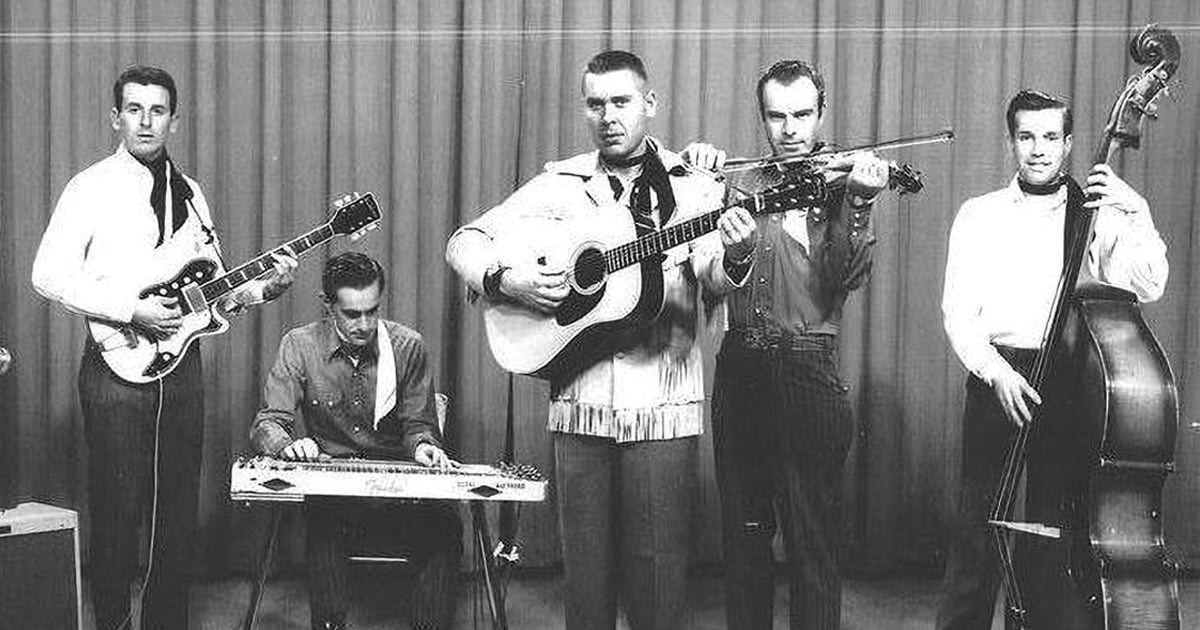
Mattocks graduated high school in 1955, and was hired to play pedal steel with Slim Mims and His Dream Ranch Boys in Florence, South Carolina. “Bluegrass was my favorite music,” he says. “But in the 1950s and ‘60s, there was more country music than bluegrass. I got more work in country.Work started blossoming in bluegrass after the festivals got big.”
With Mattocks on steel guitar, the Dream Ranch Boys enjoyed a regular gig on WBTW in Florence, and played the theater and schoolhouse circuit. When Mims was looking for a guitarist, Mattocks recommended his friend and fellow Tarheel Jimmy Capps.
Mattocks first heard Capps play guitar on local television. He was impressed by the talented picker. “I had the TV on and there was a band playing. The band wasn’t that good. But all of a sudden, I heard this guitar come in. It sounded like Chet Atkins. It was a kid about my age, 16 or 17. I found out who he was and where he was from. I called him up and we’d get together on Sunday afternoons and play.”
After a year-and-a-half with the Dream Ranch Boys, the friends returned home and joined Slim Short, who performed over WNCT in Greenville, NC. From there, Capps was hired by the Louvin Brothers before joining the Grand Ole Opry house band, where he remained for more than 50 years.
Over the years, Mattocks made frequent trips to Nashville to visit and play music with his friend, who died in June 2020, at age 81. Capps had tried to convince Mattocks to move to Music City, but Clyde’s loyalty to family kept him at home. “I would go out to Nashville and sometimes spend a week with him,” he says. “I’d run around with him on sessions and he’d introduce me to players. He kept wanting me to move out there, but I had small children, so I didn’t feel I could leave.”
Other Nashville cats took an interest in Mattocks, as well. Bill Anderson tried to recruit him to his band. So did Johnny Paycheck, who recorded Mattocks’ “Tell Me Your Troubles” on his Wherever You Are LP. Other offers came from Loretta Lynn, Mel Street, Jim Ed Brown, and Vern Gosdin. But again, family came first and Clyde remained in Kinston.
Mattocks continued with country and bluegrass, and in 1974, he co-founded country-rock powerhouse, Super Grit Cowboy Band. Super Grit caught the wave of popularity swirling around Poco, the Eagles, and other bands blending the two genres into a chart-topping hybrid. Super Grit gained superstar status on the East Coast, as five singles from four albums landed on the Billboard chart.
While Super Grit continues to perform occasionally, Mattocks is engaged in so many projects a man half his age would have difficulty keeping pace. He’s in demand as a session player and producer. He’s produced bluegrass for North Carolina’s all-woman Sweet Potato Pie and Eric Strickland’s sterling Black and White and Blue. He produced the first three albums for the retro-country Malpass Brothers, and performed with them for several years.
Today, Clyde performs bluegrass with Highway 58, country in Without Further Ado, and Legends at Lorraine Jordan’s Coffee House. And he mentors young musicians, a commitment he’s held throughout his career. “When I was 16 or 17, I was just starting out playing mandolin,” Jordan recalls. “I went to one of his shows and he asked if I had my mandolin. I said, ‘I sure do.’ He let me come on stage with his band. He helped me out and showed me who I needed to listen to. He’s very good about keeping young people involved and looking out for them.”
Chris Malpass of the Malpass Brothers acknowledges Mattocks’ early influence in the studio and on the road. “[Clyde] showed us how to pick the right songs. He taught us to go out and do what we do and be proud of our music. He taught us to take the songs to the people as if to say, ‘Do you remember this one?’ and give it our all.” As for the notion of legend, Clyde’s humility does not allow him to take such characterization to heart. “Clyde doesn’t know he’s Clyde,” Malpass says.
Musicians and fans of hardcore bluegrass, honky tonk, and country rock are not so circumspect. They regard Mattocks as among the most talented, devoted and accomplished musicians in the Old North State. A lifetime of music, honest and heartfelt, has given Mattocks a lifetime of memories, stories, and friends.
It’s the stuff legends are made of, and “legend” fits the “Man of Steel” as comfortably as a steel bar and fingerpicks fit the hands of the man who’s made steel strings sigh and whine for more than 70 tuneful years.